


If you’re a self-employed contractor in the UK, you have almost certainly heard of IR35. It is one of those pieces of tax law that can feel complicated and a little daunting, but understanding it is absolutely essential for your business.
Think of it as HMRC’s way of figuring out if you are a genuine independent business or, for tax purposes, a 'disguised employee'. This guide will walk you through exactly what that means for your contracts, your finances, and how you run your contracting career.
What IR35 Means for Your Self-Employed Career
For most self-employed professionals, IR35 is a source of confusion and maybe a little anxiety. In a nutshell, it is tax legislation designed to spot contractors who, despite working through their own limited company, have a day-to-day relationship with their client that looks a lot like traditional employment.
The official name for these rules is the off-payroll working rules.
Their whole point is to make sure that people who work like employees also pay roughly the same Income Tax and National Insurance Contributions (NICs) as employees. If your contract and the reality of how you work suggest you are basically an employee, HMRC considers you 'inside IR35'. If you are genuinely running an independent business, you are 'outside IR35'.
This distinction is massive because it directly controls how you get paid and how much tax you owe. Being inside IR35 means your client or agency will deduct tax and NICs through PAYE, just like a regular salary, before your company even sees the money.
IR35 Status At a Glance
To make it clearer, here is a quick summary of the core differences between being inside and outside IR35.
| Aspect | Inside IR35 (Deemed Employee) | Outside IR35 (Genuinely Self-Employed) |
|---|---|---|
| Tax Treatment | PAYE applies. Income Tax and NICs are deducted at source. | You are responsible for your own taxes via Self Assessment and Corporation Tax. |
| Payment Structure | You receive a 'deemed salary' after tax deductions. | Your limited company invoices the client and receives the gross payment. |
| Take-Home Pay | Generally lower due to employee-level tax and NICs. | Typically higher, as you can pay yourself a mix of salary and dividends. |
| Financial Risk | Minimal. Tax is handled by the fee-payer. | You carry all the business risk, including managing tax liabilities. |
| Business Control | Client has significant control over how, when, and where you work. | You have full autonomy and control over your work. |
Understanding these differences is the first step in correctly assessing where you stand with any new contract.
The History and Impact of IR35
IR35 is not some new-fangled rule; it has actually been around since 2000. It was originally brought in to tackle what the government saw as tax avoidance by contractors using personal service companies (PSCs) to pay less tax than equivalent employees.
The real shake-up happened in 2021 when the rules were extended to the private sector. This shifted the responsibility for deciding a contractor's IR35 status from the contractor themselves to the end-client. According to government analysis, this reform had a massive impact, directly affecting around 120,000 workers and causing a big drop in new PSCs being set up.
Why This Matters to You
Getting your IR35 status right is not just about ticking a compliance box, it is fundamental to running your business properly. A wrong determination can lead to a hefty tax bill and penalties from HMRC down the line.
So, for every contract, you need to:
- Assess each one carefully to figure out its IR35 status.
- Know the difference between what it means to work inside versus outside the rules.
- Understand the financial hit it could have on your take-home pay.
Navigating these rules helps you make smart decisions about the jobs you take and how you structure your business. If you are just starting out, our article on when to register as self-employed is a great place to build your foundational knowledge. At UmbrellaCompany.com, we aim to give you the clarity you need to operate with confidence.
The Three Pillars of IR35 Status
When HMRC looks at a contract, they are not just ticking boxes on a form. They are trying to build a picture of your real-life working relationship. What matters is what actually happens day-to-day, not just the words written in a document. The whole assessment really boils down to three core principles, often called the key tests of employment.
Getting your head around these "three pillars" is essential for any contractor. They are the framework used to decide if your client relationship looks more like genuine self-employment or if it is closer to a traditional employer-employee setup. Let's dig into each one.
This diagram shows how IR35 acts as a filter, separating genuine independent businesses from 'disguised employees'.
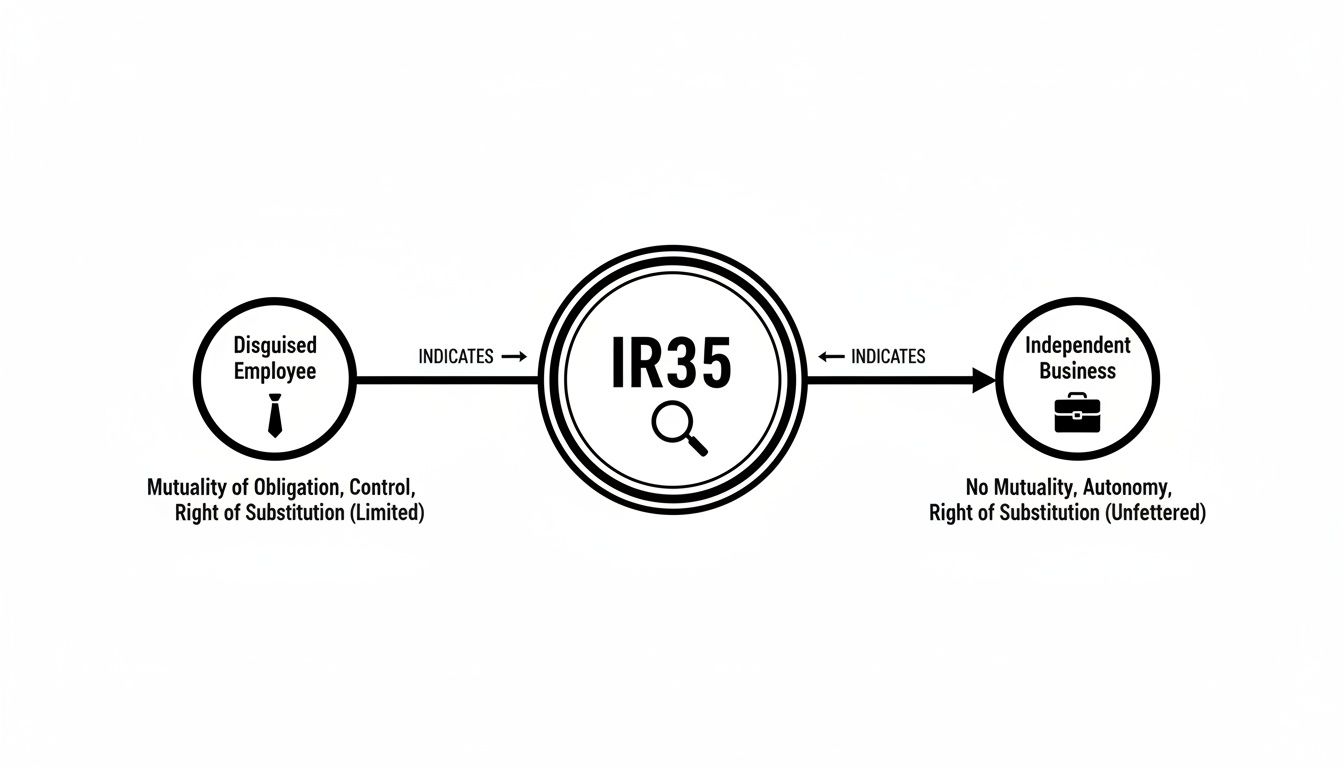
As you can see, the whole point of the legislation is to spot arrangements where someone is working like an employee but using a limited company structure to handle their tax.
Pillar 1: Control
The first and arguably most important test is Control. This is all about who is calling the shots. Who decides how, when, and where you do the work? If your client has a heavy hand in managing your daily activities, it is a big clue you might be seen as an employee.
Think about a self-employed electrician. You tell them which circuit is faulty, but they decide how to fix it, which tools to use, and when they will do the work. They are in control.
On the other hand, if a client insists you are at your desk from 9 am to 5 pm, makes you follow a rigid internal process, and expects you to join mandatory team meetings, that points to a high degree of control. This is a classic sign that you could be inside IR35.
Pillar 2: Substitution
Next up is the Right of Substitution. The question here is simple: could you send someone else with the right skills to do the job for you? A genuine business provides a service, not a specific person. So, they should be able to substitute one expert for another.
For a contractor to be truly self-employed under IR35, this right has to be real and without unreasonable restrictions. Your client cannot just refuse a replacement out of personal preference; they would need a valid reason, like the person not having the necessary qualifications or security clearance.
If your contract names you personally and explicitly states no one else can do the work, that is a massive red flag for HMRC. Even if you never actually send a substitute, simply having the genuine, unrestricted right to do so is a powerful argument for being outside IR35.
Pillar 3: Mutuality of Obligation (MOO)
The final pillar is Mutuality of Obligation, or MOO for short. This is about expectation. Is the client obliged to keep offering you work after the current project is done, and are you obliged to take it?
In a true business-to-business arrangement, the relationship ends when the project is finished. There is no ongoing promise of more work from the client, and you are free to walk away.
If your contract just rolls on indefinitely, or you have been with the same client for years on end without signing new agreements for each specific piece of work, it starts to look like an ongoing employment relationship. This continuous expectation of work is a strong pointer towards being inside IR35. To get a deeper understanding, check out our guide on the key differences between being inside or outside IR35.
Key Takeaway: MOO is about the obligation for future work, not just the obligation to finish the current job. For a true contractor, once the agreed work is done, that is it, until a brand new contract is negotiated and signed.
Other Important Factors to Consider
While Control, Substitution, and MOO are the big three, HMRC will look at other factors to get the full story:
- Financial Risk: Are you shouldering any real financial risk? This could mean buying your own expensive equipment, paying for professional indemnity insurance, or having to fix mistakes in your own time and at your own cost. Employees do not carry this kind of risk.
- Provision of Equipment: Are you using your own laptop, software, and tools? If the client provides everything you need, it looks more like employment.
- Part and Parcel: How integrated are you in the client’s company? Things like having a company email address, appearing on their organisation chart, or having a line manager can make it seem like you are 'part and parcel' of their business, not an external supplier.
How IR35 Status Hits Your Take-Home Pay
Your IR35 status is much more than just a box-ticking exercise; it directly and significantly impacts your earnings. For any contractor, getting to grips with the financial difference between being inside or outside the rules is absolutely essential. It is what decides how you are taxed and, ultimately, what lands in your bank account.
The fundamental difference is pretty straightforward. If your contract is deemed 'inside IR35', your income gets treated almost exactly like an employee's salary. On the flip side, an 'outside IR35' status means you can operate your limited company in a much more tax-efficient way. Let's dig into what this really means for your wallet.

The Financials of an Inside IR35 Role
When you take on a contract that falls inside IR35, the organisation paying you, be it the end client or your recruitment agency, is legally required to deduct tax and National Insurance Contributions (NICs) at source. This is the familiar PAYE (Pay As You Earn) system that employees are on.
This means the payment that arrives in your limited company's bank account has already had a few chunks taken out:
- Income Tax: Calculated using the standard employee tax bands.
- Employee's National Insurance: Deducted from your earnings just like a regular employee.
- Employer's National Insurance: This is also taken from the contract funds, which in practice reduces the day rate that is left for you.
- Apprenticeship Levy: This may also be deducted if the fee-payer is large enough to be liable for it.
The upshot is a take-home pay that is noticeably lower than what you would get for the same gross contract value outside IR35. You are effectively taxed like a permanent staff member but without the tax-planning flexibility that a genuine business enjoys.
For many freelancers caught by inside IR35 determinations, this financial reality forces a major rethink of their business structure. A common move is to switch to a compliant umbrella company to handle the payroll for these specific contracts.
When the IR35 rules were extended to the private sector in 2021, it triggered a huge shift. Official data shows a staggering 14.6% fall in people 'working for themselves', dropping from 3.5 million in early 2020 to just 2.9 million by early 2022. It is a clear sign that contractors are moving away from their PSCs for inside-IR35 work.
The Financials of an Outside IR35 Role
Operating outside IR35 is a different world. It means HMRC sees you as a legitimate, independent business providing services to a client, not as a 'disguised employee'. This recognition gives you far more control over your company’s finances and how you manage your tax.
With an outside-IR35 contract, your limited company invoices the client for the full gross amount. From there, it is your responsibility to manage the company's tax liabilities and decide how to pay yourself. The most popular method is a tax-efficient blend of:
- A low base salary, often set just below the National Insurance threshold to be efficient.
- Dividends, which are distributed from the company's profits after Corporation Tax has been paid.
This salary-and-dividend model is generally much more tax-efficient than taking everything as a straight salary, simply because dividend tax rates are lower than income tax rates. It is the key benefit of genuine self-employment and allows you to keep more of what you earn. Of course, with this freedom comes the responsibility of managing Corporation Tax, VAT, and your personal tax return.
A Direct Comparison
The best way to appreciate the difference is to see it in black and white. While everyone's situation is different, a contractor on an outside IR35 contract can often expect to take home 15-25% more of their contract value than if they were inside IR35.
That is a substantial gap and it really underlines why getting the IR35 determination right is so crucial. To see how these scenarios might play out for you, it is worth using a specialised tool. You can play around with the numbers on our IR35 take-home pay calculator to get a personalised estimate.
Proactively Managing Your IR35 Risk
Knowing the IR35 rules is one thing, but actually taking control is what separates the seasoned contractor from the rest. A proactive approach is not about crossing your fingers and hoping for the best; it is about building a rock-solid case for your genuine business status long before your client even thinks about making a determination.
This means you need to look at every contract not just for the work you will be doing, but for how you will be doing it. By getting ahead of the game and assessing your contract wording and working practices, you can spot potential trouble spots and gather the evidence you need to prove you are operating outside IR35.

Assessing Your Working Practices
Let’s be clear: the day-to-day reality of your work matters far more to HMRC than the paper your contract is written on. You have to be able to demonstrate that you operate like a proper, independent business.
Run through this checklist and be brutally honest with yourself about your relationship with the client:
- Control: Do you have real autonomy over how you deliver the project? Can you decide your own hours and where you work, or is the client telling you when and where to be?
- Substitution: Does your contract give you a genuine, unrestricted right to send a qualified substitute in your place? More importantly, could you actually do it if you needed to?
- Mutuality of Obligation (MOO): Is this a contract for a specific project with a defined end? Or does it feel more like a rolling, open-ended arrangement where there is an expectation you will just keep getting more work?
- Financial Risk: Are you shouldering any real financial risk? This could mean anything from having to fix mistakes at your own cost, paying for professional indemnity insurance, or buying your own expensive software and tools.
A "no" to any of these is a potential red flag that needs attention. Being able to confidently say "yes" to most of them is a huge step toward proving you are genuinely self-employed.
Spotting Red Flags in Your Contract Wording
While your working practices are king, the written agreement has to back them up. A contract that says one thing while you do another is a gift to an HMRC investigator.
You need to be on high alert for clauses that smell like employment. Watch out for wording that mentions things like:
- Specific hours of work (e.g., “you will work from 9 am to 5 pm”).
- Supervision, direction, or control from a line manager.
- Being included in company processes, like performance appraisals or disciplinary procedures.
- Restrictions on working for other clients at the same time.
- Benefits normally reserved for employees, like holiday pay or sick pay.
If you see these terms, do not just sign. It is vital you raise them with your client or agency and push to have them amended to reflect a true business-to-business partnership.
Building a Strong Portfolio of Evidence
To properly manage your ir35 self employed status, you have to think and act like a business owner all the time. That means actively building a portfolio of evidence that screams independence and commercial savvy.
Think of it this way: an employee would not need to do these things, but a genuine business would. Your goal is to create a clear and undeniable distinction between you and your client's permanent staff.
Here are some practical things you can do to build your case:
- Maintain a Business Presence: Have a professional website, a LinkedIn profile for your company (not just yourself), and proper business cards. This shows you are in the market for work, not just tied to one client.
- Work with Multiple Clients: This is one of the most powerful indicators you are in business for yourself. Try to avoid having all your income come from a single client for a long time.
- Invest in Your Own Assets: Use your own laptop, your own software licences, and any specialist kit the job requires. Do not get comfortable using client-provided gear.
- Hold Business Insurances: Maintain policies like professional indemnity and public liability insurance. This is not just a box-ticking exercise; it is what legitimate businesses do.
By consistently taking these steps, you are doing more than just complying with the rules. You are building a resilient, defensible contracting business that can confidently prove its self-employed status on any project you take on.
Your Practical Options for an Inside IR35 Role
Getting an 'inside IR35' determination is not the end of the road for your contract. It simply means your pay needs to be processed differently to make sure the right tax and National Insurance are paid. Think of it less as a problem and more as a fork in the road where you need to decide which path to take.
For any contractor working on a project that falls inside IR35, there are really three main routes you can go down. Each one has its own pros and cons, and the best fit for you will probably depend on your personal situation, how long the contract is, and what your career goals are.
Option 1: Using an Umbrella Company
By far the most popular choice for contractors working inside IR35 is to use a compliant umbrella company. When you do this, the umbrella company effectively becomes your employer for the duration of the contract. You send them your timesheets, and they handle the invoicing with the agency or client.
They then process your pay, deducting all the necessary PAYE tax and National Insurance Contributions, before paying you a net salary. It is a straightforward model that keeps you fully compliant with HMRC's off-payroll working rules.
The ir35 self employed landscape shifted dramatically after the 2021 private sector reforms. We saw a real 'flight to safety' among contractors, with official figures showing self-employment dropping from 5 million to 4.2 million by 2021. Government reports also confirmed that up to 45,000 fewer new Personal Service Companies were set up as contractors looked for compliant solutions like umbrella companies.
Option 2: Agency PAYE
Another common route is to get paid via agency PAYE. If you found your contract through a recruitment agency, they can often just add you to their own payroll system for the job. It works in a very similar way to an umbrella company.
The agency simply deducts Income Tax and NICs from your earnings before paying you. It is a simple, no-fuss option for a specific inside-IR35 contract.
The main drawback? Every time you change contracts with a different agency, you get a new employer. This can make it tricky to build a continuous employment record, which is often a big deal when you are applying for a mortgage or a loan.
Option 3: Joining the Client's Payroll
In some situations, the end client might offer you the chance to join their permanent payroll on a fixed-term contract. From a tax point of view, this is the simplest option because you become a direct employee of the client for the length of the project.
You would get the same benefits as other employees, like statutory sick pay, holiday pay, and maybe even a workplace pension. While this offers maximum security, it usually means giving up the higher day rates and flexibility that make contracting so appealing in the first place.
For a lot of contractors, this feels a bit too much like giving up their self-employed career, even if it is just for a short time. You can see a detailed breakdown in our guide on the differences between umbrella companies and agency PAYE.
Comparing Your Options Inside IR35
When you are faced with an inside IR35 contract, choosing the right payment structure is crucial. Each of the three main options (Umbrella Company, Agency PAYE, and Client Payroll) offers a different balance of flexibility, administrative ease, and employment continuity.
The table below breaks down the key features of each route to help you see, at a glance, which one aligns best with your professional and financial goals.
| Feature | Umbrella Company | Agency PAYE | Client Payroll |
|---|---|---|---|
| Employment Status | Employee of the umbrella company | Employee of the agency for the contract duration | Employee of the end client on a fixed-term contract |
| Continuity of Employment | Yes, across multiple contracts and clients | No, employment ends with each contract | Only for the duration of the fixed-term contract |
| Administrative Burden | Low – submit timesheets, umbrella handles the rest | Low – agency manages all payroll deductions | None – fully managed by the client's HR/payroll |
| Flexibility | High – easily switch between different clients | Moderate – tied to that specific agency's contracts | Low – committed to one client as a direct employee |
| Statutory Benefits | Yes (holiday pay, sick pay, pension) | Yes (holiday pay, sick pay, pension) | Yes, often includes wider company benefits |
| Ideal For | Career contractors needing flexibility & continuity | Contractors on a single, short-term inside IR35 role | Those seeking stability and benefits over a higher rate |
Ultimately, the choice comes down to what you value most. If maintaining a continuous employment record for things like mortgages is important, while still having the freedom to move between projects, an umbrella company is often the standout choice.
The Umbrella Advantage: Many contractors lean towards the umbrella route because it gives them a single, continuous source of employment. This is incredibly useful for maintaining financial stability and proving a consistent income, all while you keep the flexibility to work on different projects for various clients.
At UmbrellaCompany.com, we specialise in making this decision easier. Our comparison service helps you find a fully compliant and accredited umbrella company that is a perfect fit for your profession and pay rate. We will make sure you can move forward with your inside-IR35 contract with total confidence, knowing you are being paid correctly and on time.
Common IR35 Questions from Contractors
Even when you have got your head around the basics of IR35, the reality of contracting throws up some tricky questions. How do the rules apply in this specific situation? What happens if I get two different contracts at once?
Let's cut through the confusion. Here are the answers to the most common queries we hear from contractors on the ground. Think of it as a practical cheat sheet to back up what you have already learned.
Can I Have Both Inside and Outside IR35 Contracts at the Same Time?
Yes, absolutely. This is a day-to-day reality for many career contractors. Your IR35 status is not a label that sticks to you personally; it is assessed on a contract-by-contract basis. It is perfectly normal to have a mix of work with different statuses running through your limited company.
For instance, you might have a long-term project with a big corporate client that has been flagged as 'inside IR35'. At the same time, you could be working on a short, sharp gig for a start-up that is clearly 'outside IR35'.
- For inside IR35 work: You need to make sure the income is paid through a compliant payroll. This usually means using an umbrella company or the agency’s PAYE system to handle all the tax and National Insurance deductions.
- For outside IR35 work: Business as usual. You invoice for this work through your own limited company and manage your own tax affairs.
The golden rule is to treat each contract on its own merits and manage the income accordingly.
Who Decides My IR35 Status?
This is a big one, as the goalposts shifted dramatically with the off-payroll reforms. Since April 2021, the legal responsibility for determining your IR35 status sits with the end-client.
This rule applies if your client is a medium or large-sized private sector business, or any public sector organisation. The client has to assess your status with 'reasonable care' and give you a formal document explaining their decision.
There is a crucial exception: small businesses. If your client officially qualifies as a 'small business' under the Companies Act definition, the responsibility for figuring out IR35 status flips back to you and your limited company.
It is vital to clarify the size of your end-client before you sign anything. It tells you straight away who is legally on the hook for making the call.
What Is a Status Determination Statement (SDS)?
A Status Determination Statement (SDS) is the official document the end-client must give you. It formally states whether your contract is inside or outside IR35 and, most importantly, sets out the reasoning behind their decision.
This is not just a courtesy; it is a legal requirement for medium and large clients. It is their proof that they have taken 'reasonable care' to get the status right.
If you get an SDS and you do not agree with the outcome, you have the right to challenge it. You should use the client’s official dispute process to appeal, providing evidence about your working practices (think control, substitution, financial risk) to back up your case. The client then has 45 days to review your appeal and respond. If they stick to their guns, you have a choice to make: accept the contract on their terms or walk away.
Does an Umbrella Company Solve All My IR35 Problems?
Using a compliant umbrella company is a great, hassle-free way to work on contracts that have been deemed 'inside IR35'. For those specific jobs, it takes the compliance headache right off your plate.
When you join an umbrella, they become your employer for tax purposes. They handle all the PAYE tax and National Insurance contributions correctly, making sure you are fully compliant with HMRC. You can relax, knowing you will not face an investigation over an incorrect IR35 status for that particular engagement.
But it is important to be clear on what an umbrella does and does not do. It is simply a compliant payment channel for inside-IR35 work; it does not change the IR35 status of the role itself. If you want to keep taking on 'outside IR35' contracts, you will still run those through your own limited company. An umbrella is just the cleanest tool for the 'inside' part of your job portfolio.
Figuring out your options when a contract falls inside IR35 can feel like a minefield, but you do not have to navigate it alone. At UmbrellaCompany.com, we help you find and compare trusted, accredited umbrella companies that are a perfect fit for your profession and pay rate. It is the simplest way to stay compliant and get paid on time.
Find the perfect umbrella company for your next contract at https://umbrellacompany.com.


