


Let's be honest, the term 'IR35' can make even the most seasoned contractor's blood run cold. But when you strip away the jargon, the core idea is actually quite straightforward.
Think of IR35 (you will also hear it called the 'off-payroll working rules') as HMRC’s way of levelling the playing field. It is designed to spot contractors who, for all intents and purposes, work just like permanent employees but end up paying less tax by operating through their own company.
This guide will demystify these rules, breaking them down into clear, practical steps. We will walk you through how to figure out your status, what that means for your bottom line, and how a service like UmbrellaCompany.com can offer a simple, compliant way forward, taking the guesswork out of the equation.
To help you get up to speed with the terminology, here is a quick rundown of the key phrases you will encounter.
What Is IR35 and Why Does It Matter?
Picture this: two software developers are working side-by-side on the same project for a big bank. One is on the company payroll, paying tax and National Insurance like any other employee. The other works through their own limited company, but they have the same manager, work the same hours, and have the same responsibilities.
IR35 was created to close that tax loophole and make sure everyone contributes their fair share.
Key IR35 Terms at a Glance
| Concept | Simple Explanation |
|---|---|
| Inside IR35 | HMRC sees your contract as one of 'employment'. You're taxed at source, just like a regular employee. |
| Outside IR35 | Your contract is a genuine business-to-business service. You are responsible for your own taxes. |
| Disguised Employment | The situation IR35 was designed to prevent: a contractor working like an employee to gain a tax advantage. |
| Personal Service Company (PSC) | Another name for a contractor's limited company, the 'intermediary' between them and the client. |
| Status Determination Statement (SDS) | The official document from the end client stating whether they believe your contract is inside or outside IR35. |
| Off-Payroll Working Rules | The official name for the IR35 legislation, especially the reforms introduced in 2017 and 2021. |
Understanding these terms is the first step, but it is just as important to know where these rules came from.
The Origins of IR35
To really get to grips with IR35, it helps to know why it was created in the first place. Officially known as the Intermediaries Legislation, it became UK law way back in April 2000.
The government was getting worried about a growing trend called ‘disguised employment’. This is where individuals would provide their services through an intermediary, usually their own personal service company (PSC), to sidestep the taxes that come with being an employee, even when their day-to-day working relationship was identical.
Essentially, IR35 was brought in to stop a person from leaving their permanent job on a Friday, only to walk back into the very same office on Monday as a limited company director doing the exact same work for a much lower tax bill.
Why It Is Crucial for Contractors
Getting your head around IR35 isn't just a box-ticking exercise; it is fundamental to protecting your finances and your professional reputation. If HMRC decides to investigate and finds you have incorrectly classified a contract as 'outside' the rules, the consequences can be severe. We are talking demands for back-dated tax and National Insurance, plus interest on top.
At its heart, IR35 is all about looking at the real nature of a working relationship. It ignores the labels on the contract and digs into the day-to-day reality of how you actually deliver your work for a client.
The critical thing for contractors to remember is that your IR35 status is determined on a contract-by-contract basis. You cannot just decide you are an 'outside IR35 contractor' and apply that to everything. Each and every engagement needs to be assessed on its own merits.
Recent reforms have also changed who is responsible for making that call. Our guide explains in detail what has changed with the IR35 reforms and how they affect you.
For many, trying to stay on top of all this can feel like a job in itself. That is why building a solid understanding of the fundamentals is the best possible first step you can take towards achieving compliance and, ultimately, peace of mind.
Are You Inside or Outside IR35?
Your IR35 status has nothing to do with the job title on your contract. It all boils down to the reality of how you work, day in and day out. Every single contract you take on will be classed in one of two ways: either inside IR35 or outside IR35. This single determination is the cornerstone of the entire system.
Landing outside IR35 means HMRC sees you as a genuine, independent business providing services to a client. Simple as that.
On the other hand, being inside IR35 means your working relationship is considered much closer to that of a traditional employee, at least for tax purposes.
To figure out where a contract falls, HMRC and the courts look past the paperwork and focus on what's actually happening on the ground. They use a few key tests, sharpened over years of employment law cases, to build a clear picture of the relationship.
The Three Key Tests of Employment
While many different factors can come into play, three core principles carry the most weight in any IR35 assessment. Think of them as the main pillars holding up the decision. If your working arrangement looks like employment under these tests, it is almost certainly going to be inside IR35.
- Control: This test is all about who is in charge. Who has the final say over how, when, and where you do the work? A real business owner calls the shots. An employee is usually directed by a manager.
- Substitution: Can you send someone else to do the job? If you have a genuine, unrestricted right to send a qualified replacement in your place (and you pay them yourself), it is a powerful sign that you are outside IR35.
- Mutuality of Obligation (MOO): This one is a bit more subtle. Is the client obliged to keep offering you paid work, and are you obliged to accept it? In a proper business-to-business relationship, there is no such obligation beyond the specific project you have both agreed to.
This flowchart gives you a quick visual summary of how it works.
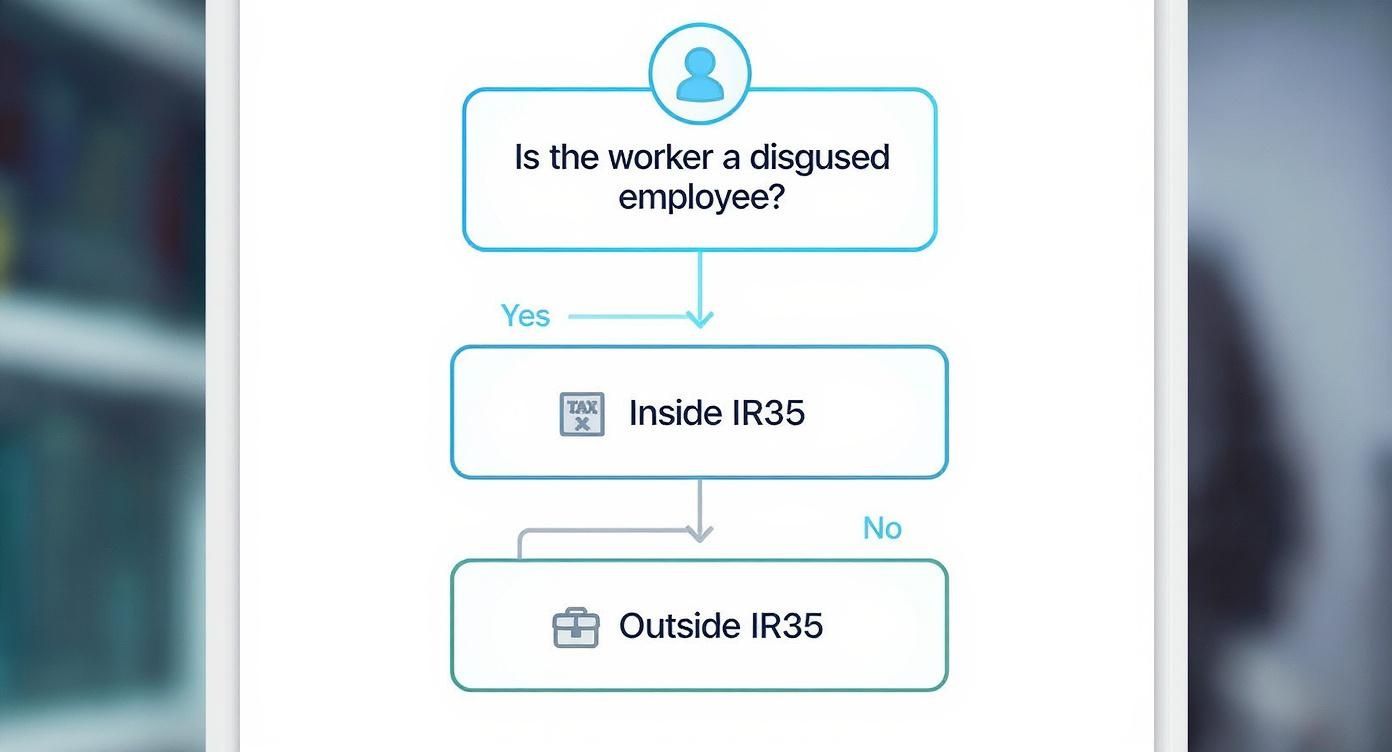
It really just boils down to one question: are you a 'disguised employee'? If the answer looks like a 'yes', then the contract is inside IR35. If it is a clear 'no', you are outside.
Control in Practice
Let's make the Control test more concrete. Imagine you are a freelance graphic designer hired to create a new logo.
If you are outside IR35, the client gives you a brief and a deadline. But you decide which software to use, when you work, and whether you do it from your home office or a local café. The client is paying for the final logo, not for your time under their constant supervision.
Now, flip that around. If you were inside IR35, the client might insist you work from their office from 9-to-5, use their company laptop, and join the daily team stand-ups. This level of hands-on direction points straight towards an employer-employee dynamic.
The Reality of Substitution
Next up, the Right of Substitution. This has to be a genuine right, not just a token clause you have dropped into your contract to try and game the system.
A genuine right of substitution is a huge indicator of being outside IR35. But if the client can reject your substitute for any flimsy reason, then the clause is worthless in HMRC's eyes.
For example, an IT contractor on an outside IR35 project should be able to send another qualified engineer to finish the job if they fall ill. Crucially, the original contractor would be responsible for finding, vetting, and paying that substitute.
An inside IR35 scenario is where the client hired you specifically for your skills. If the contract implies the work can only be done by you personally, then no real right of substitution exists.
Understanding Mutuality of Obligation
Finally, we have Mutuality of Obligation (MOO), which can be the trickiest to pin down. It is all about the expectation of future work.
In a true outside IR35 arrangement, once the project is done, it is done. The client isn't obliged to offer you another gig, and you are not obliged to take it if they do. The professional relationship ends when the deliverables are handed over.
An inside IR35 relationship, however, often looks very different. A contractor might finish one project and just get rolled onto the next one without a new contract. There is an unspoken understanding that the work will keep coming and you will keep doing it, much like a permanent employee.
Getting these assessments right is absolutely vital, and every contract has to be judged on its own merits. For a deeper look into the details, you can find out more about what it means to be inside or outside IR35 in our detailed guide.
Understanding the Off-Payroll Working Rules
The world of IR35 got a whole lot trickier with the arrival of the 'off-payroll working' reforms. The single biggest shake-up was a massive shift in who is responsible for deciding a contractor's IR35 status, a change that has completely reshaped how contractors and clients work together.

These rule changes did not happen overnight. They were rolled out in stages, first hitting the public sector in 2017 and then the private sector from 6 April 2021. For any public sector project after April 2017, the client suddenly had to decide if IR35 applied. Similar rules then followed for medium and large private businesses a few years later. If you want to see the full play-by-play, you can discover the full IR35 timeline.
Who Decides Your IR35 Status Now
So, who makes the call? It all depends on the type of client you are working for.
If your client is in the public sector or is a medium-to-large private business, the responsibility now sits squarely with them. This is a huge departure from the old days when you, the contractor, made the decision yourself.
However, if your client is a small private sector company, the original rules still stand. In that case, the responsibility to assess your IR35 status and pay the right tax remains firmly with you and your limited company.
Here is a quick table to show who is responsible for what.
Who Decides Your IR35 Status
| Factor | Small Private Sector Client | Public Sector / Medium-Large Private Client |
|---|---|---|
| Who assesses IR35 status? | You (the contractor's PSC) | The end client |
| Who is liable for tax? | You (the contractor's PSC) | The fee-payer (client or agency) |
| What document is issued? | No official document required | Status Determination Statement (SDS) |
It is crucial to know your client’s size to figure out where the buck stops. HMRC uses the Companies Act 2006 to define a 'small' company. A business is considered small if it meets at least two of these conditions:
- Annual turnover of no more than £10.2 million
- A balance sheet total of no more than £5.1 million
- No more than 50 employees
The Status Determination Statement Explained
When a medium or large client makes their assessment, they must give you a Status Determination Statement (SDS). This is not just a simple thumbs-up or thumbs-down; it is a formal document that has to state their conclusion and, importantly, the reasons behind it.
The client must also show they have taken 'reasonable care' in their decision. This means they cannot just make lazy, blanket decisions (like declaring all their contractors inside IR35) or blindly plug details into HMRC's CEST tool without thinking. They have to genuinely evaluate your specific contract and working reality.
The SDS is a critical document. It passes the IR35 status decision down the supply chain to you and the agency paying you (the 'fee-payer'). It is the official record of the client's decision.
Receiving an SDS is a non-negotiable part of the process. The client has to give it directly to you and to whoever pays your invoices. If they fail to provide a valid SDS, the tax liability could bounce right back to them, which is a pretty powerful incentive for them to get it right.
How to Dispute an Incorrect SDS
What happens if you get an SDS and you are convinced it is wrong? Thankfully, you do not just have to accept it. The rules include a formal client-led disagreement process you can use to challenge the decision.
Here is how to tackle it, step-by-step:
- Present Your Case: Write to your client and formally state your disagreement. Clearly explain why you think their assessment is incorrect, backing it up with evidence related to the key IR35 tests like control, substitution, and mutuality of obligation.
- Client Review: Once they have your dispute, the clock starts ticking. The client has 45 days to respond. In that time, they have to review your arguments and take another look at their original decision.
- Final Decision: The client must then either stand by their original determination (explaining why in more detail) or issue a brand new SDS with a revised status.
This process gives you a clear path to fight your corner if you feel a determination does not reflect your true working relationship. It is a vital safeguard for every contractor.
Navigating an Inside IR35 Determination
Getting a Status Determination Statement (SDS) that lands your contract ‘inside IR35’ can feel like a bit of a blow. It is a moment that often causes some initial worry, but it is crucial to understand what it actually means. In short, your contract will simply be treated like regular employment for tax purposes.
This is not a reflection on your skills, your expertise, or your professionalism. It is purely an assessment of the working practices for that specific project. When a contract is deemed inside IR35, it changes the mechanics of how you get paid, but it also opens up a couple of very clear, compliant routes forward.
What Happens Immediately After an Inside IR35 Decision
The biggest immediate change is how your invoices are handled. The responsibility for deducting tax and National Insurance shifts away from your limited company and onto the party that pays you, the fee-payer. This is usually your recruitment agency or, if you are contracting directly, the end client themselves.
Before the payment ever hits your limited company's bank account, the fee-payer will deduct all the necessary contributions at source.
This process breaks down into a few key deductions:
- Income Tax: This is calculated and taken off based on your earnings, exactly as it would be for a permanent employee on payroll.
- Employee’s National Insurance Contributions (NICs): This is also deducted directly from your gross pay.
- Employer’s National Insurance Contributions (NICs): The fee-payer is also liable for this chunk. It is worth noting this can sometimes affect the day rate offered for inside IR35 roles, as it is an extra cost for them.
What you receive is a net payment. The fee-payer handles sending all the tax deductions straight to HMRC on your behalf. It is a system designed to ensure full compliance and, for that contract at least, it takes the tax liability off your shoulders.
Your Options: What to Do Next
Facing an inside IR35 determination presents you with a few distinct paths. The right choice will depend on your personal circumstances, your relationship with the client, and how much admin you are willing to manage.
It really pays to take a moment and weigh up each option.
An inside IR35 determination isn't the end of the road for a contract. Think of it as a signpost, pointing you towards a different, more structured way of managing your earnings for that particular engagement.
You could start by looking closely at the SDS itself. If you genuinely believe the client has got it wrong, you have the right to challenge the decision through their formal dispute process. But if the determination seems fair, or you would rather not get into a dispute, you have other straightforward options.
The Most Common Solutions for Contractors
For the vast majority of contractors, an inside IR35 role leads to one of two main solutions. Both offer a completely compliant way to carry on with your contract while making sure all tax obligations are met properly.
Agency PAYE: You can opt to be paid directly through the recruitment agency’s payroll system. This is a very simple route where the agency essentially treats you as a temporary worker, handling all your tax and NI deductions. It is straightforward, but it does mean you will not have a continuous record of employment if you move between different agencies for contracts.
Using an Umbrella Company: This is often the go-to choice for career contractors. You become an employee of the umbrella company, and they sign a contract with your agency or end client. You submit your timesheets to the umbrella, and they pay you as their employee, taking care of all the necessary tax deductions.
Working through an umbrella company is a simple and highly effective solution. It completely takes the IR35 headache away for that contract because you are, genuinely, an employee. This structure also provides a continuous employment record, a huge plus for things like mortgage applications, and gives you full statutory employment rights, including holiday pay and sick pay. To get a better feel for the process, check out our detailed guide on what happens if you’re inside IR35.
How an Umbrella Company Simplifies IR35
When a contract is deemed 'inside IR35', the thought of managing the tax fallout can be a real headache. This is exactly where a compliant umbrella company steps in, offering the most straightforward and secure path forward for contractors.

Here at UmbrellaCompany.com, we make it simple by becoming your legal employer. For any inside IR35 contract you take on, you no longer have to worry about IR35 compliance. Why? Because you are a genuine employee, so the legislation no longer applies to that particular engagement.
The whole process is designed for simplicity and peace of mind. First, we sign a contract with your recruitment agency or the end client. Then, you sign a contract of employment with us, officially making you part of our team.
Your Simple Payroll Journey
Once you are all set up, the day-to-day admin on your end is minimal. We have designed it so you can get on with your actual work, not paperwork.
All you need to do is send us your approved timesheets. That is it. From there, we handle everything else.
We will invoice your agency for the work you have done. As soon as the funds land, we process your payment as our employee through the PAYE (Pay As You Earn) system, making all the correct deductions for Income Tax and National Insurance Contributions.
The rise of compliant umbrella solutions is a direct response to the challenges IR35 created. Before the 2017 reforms, HMRC estimated that nearly 50% of contractors who should have been inside IR35 were not paying the right amount of tax. After the rules changed, compliance in the public sector jumped significantly.
Key Benefits of Using an Umbrella Company
Choosing a compliant umbrella company is about more than just sorting out your tax. It provides a stable, professional framework that brings some pretty significant perks for career contractors.
- Guaranteed IR35 Compliance: By becoming our employee for the contract, the off-payroll working rules are no longer your problem. Your tax is handled correctly from day one.
- Access to Statutory Employment Rights: You get all the legal rights and protections that come with employment, like statutory holiday pay, sick pay, and access to a workplace pension scheme.
- Continuous Employment Record: Jumping between short-term contracts can make it tricky to prove a steady income for things like mortgages or loans. An umbrella provides a single, unbroken employment record, which lenders much prefer to see.
Using an umbrella company effectively removes the IR35 variable from the equation for that specific contract. You are employed, paid correctly, and fully compliant, allowing you to focus on delivering for your client.
Understanding how IR35 applies when working through an umbrella company is crucial to making an informed decision about your contracting career. It is a structure built for security and simplicity.
Choosing a Trustworthy Provider
Not all umbrella companies are created equal, and picking the right one is essential to protect yourself. The market has its share of non-compliant providers who push risky tax avoidance schemes, which can land you in serious trouble with HMRC.
To stay safe, always look for providers who are accredited by reputable, independent bodies.
The two main accreditations to look for in the UK are:
- The FCSA (The Freelancer & Contractor Services Association)
- Professional Passport
These organisations run rigorous annual audits to make sure their members operate to the highest standards of compliance. Seeing their logo is a strong sign you are dealing with a trustworthy, legitimate company. Checking for these credentials should be your very first step before signing anything.
Your Top IR35 Questions Answered
To finish up, let's tackle some of the most common questions contractors have about IR35. Think of this as a quick-fire round to clear up any lingering confusion and reinforce what we have covered so far.
Can I Have Inside and Outside IR35 Contracts at the Same Time?
Yes, absolutely. This is a classic contractor scenario and perfectly normal. Your IR35 status is not about you as a professional; it is assessed on a contract-by-contract basis.
It is very common to juggle multiple projects with different statuses. You might have one long-term gig that is clearly inside IR35 because the client has a lot of say over how you work. At the same time, you could be working on another project for a different client that is genuinely outside IR35, where you are operating as a true independent business. The only thing that matters is that each contract is judged on its own unique terms and working practices.
What Is HMRC’s CEST Tool and Is It Reliable?
CEST stands for Check Employment Status for Tax. It is HMRC’s free online tool designed to give a verdict on whether a contract falls inside or outside IR35. You answer a series of questions, and it provides a determination.
HMRC says it will stand by the tool's result, but only if the information you put in is 100% accurate and truly reflects the real-world working arrangement. Here is the catch: the tool has been heavily criticised by tax experts for being too simplistic. Many argue it glosses over crucial aspects of employment law, especially the complex concept of Mutuality of Obligation.
While the CEST tool can be a decent starting point, it is best to handle it with care. Most specialists see it as just one piece of the puzzle, not the final word.
A far safer bet is to get a professional contract review from an IR35 expert. They will give you a much more detailed and reliable assessment, which offers far greater peace of mind.
Does a Substitution Clause Automatically Make Me Outside IR35?
Not by itself, no. A genuine, unrestricted right to send a substitute in your place is a massive pointer towards an outside IR35 status. But the keyword there is 'genuine'. It has to be a real, practical option, not just a handy clause you have dropped into the contract to look good.
HMRC will always look beyond the paperwork to see if that clause could actually be used. If your client can reject a substitute for any old reason, or if your work is so specialised that only you could possibly do it, the clause is worthless. For a right of substitution to hold any weight during an IR35 investigation, it must be a real, unfettered choice you can make.
What Are the Financial Risks of an Incorrect IR35 Status?
Getting an IR35 determination wrong can be financially crippling. If HMRC investigates a contract you have been treating as outside IR35 and decides it should have been inside, the bill can be eye-watering.
You could be on the hook for all the tax that should have been paid from the start.
This includes:
- The entire amount of Income Tax for the contract's duration.
- Both the employee’s and employer’s National Insurance Contributions.
- Significant interest charged on the late tax.
- Potentially massive penalties, which can be as high as 100% of the tax owed if HMRC thinks you were deliberately non-compliant.
While the off-payroll working rules now shift the liability to the client in most cases, an investigation is still a hugely stressful, lengthy, and expensive ordeal. It is exactly why getting it right from day one is so critical for every single contract you take on.
Navigating IR35 is a crucial part of modern contracting, but you do not have to do it alone. At UmbrellaCompany.com, we provide the tools and guidance to help you find a compliant and reliable umbrella solution, ensuring you can focus on your work with complete confidence. Visit UmbrellaCompany.com to compare trusted providers and secure your contracting future today.


