


Welcome to our straightforward guide for UK contractors. If you're running your own business, you have probably heard of IR35. It might sound like just another piece of tax jargon, but getting it wrong can be costly. We are here to cut through the noise and explain what it really means for you, your contracts, and your bank balance.
Your Guide to Navigating the IR35 Landscape
So, what exactly is IR35? Put simply, it’s HMRC's method of tackling what they call 'disguised employment'. This occurs when a contractor works through their own limited company but, for all intents and purposes, the relationship with their client closely resembles a standard employer-employee one.
The entire point of the legislation is to ensure that people working like employees pay roughly the same Income Tax and National Insurance contributions (NICs) as actual employees. This has a direct knock-on effect on how much you get paid and who is responsible for organising the tax.
The Impact of Recent Reforms
The rules are not new, but they have been shaken up quite a bit. The big change came in 2021 when the off-payroll working rules were rolled out to the private sector, and it completely changed the game for the UK’s contractor community. In fact, an HMRC update estimated that around 120,000 workers were directly affected by this shift.
We saw many contractors reclassified as employees by their clients and shifted onto payroll. Others started using compliant umbrella companies to keep working on contracts that were now deemed 'inside IR35'. The financial impact was huge, reportedly leading to a £4.2 billion boost in tax revenue for HMRC.
This is precisely why every contractor needs to understand their IR35 status. It affects:
- Your Take-Home Pay: Being ‘inside IR35’ means PAYE tax and NICs are deducted before you get paid, which will reduce your net income compared to an ‘outside IR35’ contract.
- Who Does the Paperwork: The rules dictate whether you are in charge of your own business taxes or if your client (or an umbrella company) handles them.
- Legal & Financial Risk: Get it wrong, and you could be liable for significant back-taxes and penalties if a contract is incorrectly deemed ‘outside IR35’.
Here at UmbrellaCompany.com, we want to give you the clarity you need. This guide will break down the crucial differences between being ‘inside’ and ‘outside’ IR35 with practical examples. By the time you finish reading, you will have a clear roadmap for staying compliant and making the best decisions for your contracting career.
Understanding Inside vs Outside IR35
As a contractor, getting to grips with your IR35 status is probably the single most important thing you will do. Every contract you take on will fall into one of two camps: you are either ‘inside IR35’ or ‘outside IR35’. Getting this right is crucial, as it dictates how you are taxed and who is responsible for paying it.
Think of an ‘inside IR35’ determination as HMRC viewing your working relationship with a client as being very similar to that of a regular employee. When this happens, your earnings are subject to standard income tax and National Insurance Contributions (NICs), all deducted at source before the money even reaches your account.
On the other hand, an ‘outside IR35’ status is the confirmation you are looking for. It means you are recognised as a genuine, independent business. This gives you the freedom to manage your own tax affairs, usually through your Personal Service Company (PSC), and offers far more financial efficiency. The trade-off is that meticulous record-keeping and compliance are your responsibility.
The Impact on Your Take-Home Pay
The most immediate difference you will feel is in your pocket. When a contract is inside IR35, deductions for PAYE tax and both employee’s and employer’s NICs are taken from the top. This nearly always means a lower take-home amount compared to an outside IR35 contract of the exact same value.
For an outside IR35 assignment, you receive the gross payment straight into your business account. From there, it is your job to handle Corporation Tax on your profits and figure out your own mix of salary and dividends. It is a structure that offers much more flexibility for tax planning, but remember, the buck stops with you when it comes to compliance.
A simple way to think about it is comparing a hired taxi to a full-time chauffeur. The taxi driver is an independent business providing a one-off service (outside IR35), while the chauffeur is effectively an employee providing an ongoing service (inside IR35).
This distinction is absolutely fundamental. We dig into more detailed scenarios in our complete guide to working inside or outside IR35. Understanding this difference properly helps you price your services correctly and manage your financial expectations from one project to the next.
Administrative Duties and Client Relationships
Your IR35 status also shapes your administrative workload and your day-to-day relationship with your client. An outside IR35 status cements your position as a separate business, not just another team member.
Key characteristics of a genuine outside IR35 relationship include:
- Project-Based Work: You are brought in to deliver a specific outcome, not just fill a seat for an indefinite period.
- Autonomy: You have control over how, when, and where you complete the work. You are the expert, after all.
- Financial Risk: You cover your own business expenses, carry your own insurance, and if you make a mistake, you have to fix it on your own time and at your own cost.
Conversely, an inside IR35 determination tends to blur those lines. The client, or whoever pays you in the chain, becomes responsible for deducting all the necessary taxes. For you, this might simplify the payroll side of things, but it also pulls you much closer to being treated like an employee within the client’s organisation.
Ultimately, the determination shapes your professional identity for that contract. Being outside IR35 confirms your independence and entrepreneurial spirit. Being inside IR35 means you are treated as an employee for tax purposes on that specific job, even if you are still running your limited company for other work. That is why getting a clear, accurate determination from the very start is absolutely vital for every contractor.
How Your IR35 Status Is Determined
Working out whether a contract is inside or outside IR35 can feel like trying to solve a puzzle. As an IR35 contractor, this decision is a big deal, as it directly affects how much tax you pay and what ends up in your bank account. It is not a choice made on a whim; HMRC uses a set of principles, often called the 'tests of employment', to get a real sense of your working relationship with a client.
These tests are not just a simple checklist. They are designed to look past the ink on the contract and see what is actually happening day-to-day. The whole point is to figure out if you are operating like a genuine, independent business or if your role looks more like a traditional employee in disguise.
The Three Key Tests of Employment
While HMRC looks at the whole picture, three factors have always been the cornerstones of any IR35 assessment: Control, Substitution, and Mutuality of Obligation (MOO). If you want to get a handle on your own status, you need to understand these three inside and out.
Getting just one of these wrong can be enough to tip the scales towards an 'inside IR35' determination, so it pays to look closely at how each one applies to your contracts.
1. Control
This one is all about who is calling the shots. The big question is: how much say does your client have over how, when, and where you do your work? If a client tells you exactly what hours to work, insists you are in their office every day, and gives you a step-by-step guide on how to do your job, that is a high degree of control. It looks a lot like employment.
A genuine contractor, on the other hand, works with a lot more freedom. You are the expert they have brought in to deliver a result. The client gives you the brief, but you decide the best way to get it done. That is the hallmark of a proper business-to-business relationship.
2. Right of Substitution
This is often seen as one of the most powerful indicators of self-employment. The substitution test asks a very simple question: could you send someone else with the right skills to do the job for you? If you can, it proves your client is paying for a service, not for you personally.
But be warned, this cannot just be a clause you have copied and pasted into your contract for show. It has to be a genuine, unrestricted right. That means you must be able to send a replacement without your client being able to unreasonably say no, and you would be the one paying your substitute. A token clause will not fool HMRC.
3. Mutuality of Obligation (MOO)
Mutuality of Obligation, or MOO, is all about the expectation of future work. In a normal job, an employer is obliged to provide paid work, and the employee is obliged to do it. For an IR35 contractor, that kind of mutual obligation should not exist beyond the project you are currently working on.
Once you have delivered what you promised, the client is under no obligation to offer you another project, and you are under no obligation to take one if they do. Each contract should be a separate, standalone piece of work. If there is an unspoken expectation that your contract will just keep rolling on indefinitely, it starts to look very much like permanent employment to the taxman.
This handy decision tree shows how your working practices point towards one status or the other.
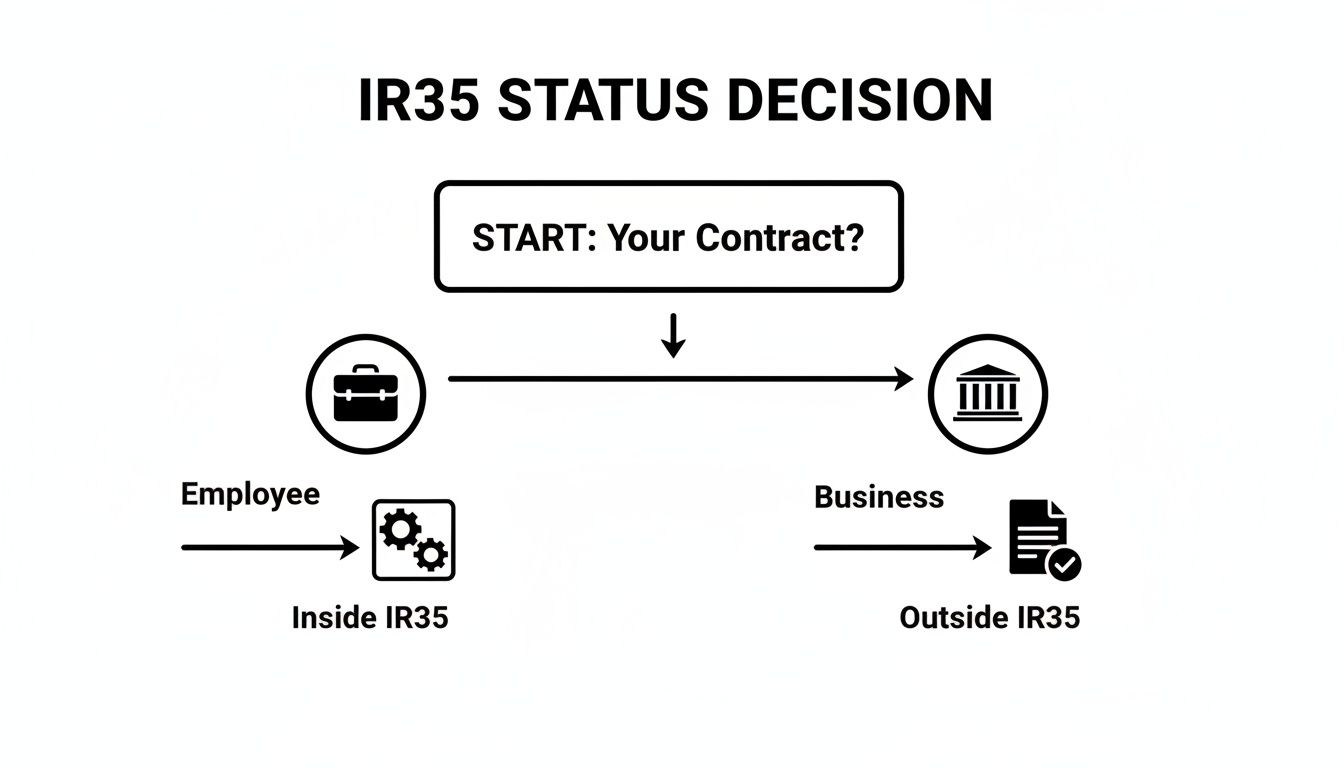
As the flowchart makes clear, it is a fork in the road. Practices that mirror employment lead you down the 'inside IR35' path, while those that reflect a true business-to-business setup put you 'outside IR35'.
Other Important Factors
While the big three are crucial, HMRC will always look at the complete picture of your working arrangement. A few other factors can either help or hinder your case for being outside IR35.
- Financial Risk: Are you putting your own money on the line? Things like having to fix your own mistakes at your own expense, buying your own equipment and software, or paying for your own insurance and training all demonstrate genuine financial risk.
- Part and Parcel: How integrated are you in the client’s company? If you have a company email address, your own desk, and a spot on the organisational chart, you start to look like 'part and parcel' of the business, which points towards an inside IR35 status.
- Provision of Equipment: Do you use your own laptop, tools, and software, or does the client supply everything? Supplying your own gear is a classic sign of a self-employed professional running their own show.
These concepts can seem a bit dense at first, but they really are the building blocks of every single IR35 decision. For a simpler take on these rules, have a look at our introductory guide on IR35 for dummies.
At the end of the day, no single factor is a silver bullet. HMRC weighs everything up to get a balanced view. The best way to secure the right determination is to make sure both your contract and your day-to-day working practices are completely aligned and tell the same story.
Managing Your Compliance as an IR35 Contractor
Knowing your IR35 status is just the first step. Actively managing it is how you truly take control of your contracting career. For any IR35 contractor, being on the front foot with compliance is not just about ticking boxes; it is fundamental to protecting your finances and your professional reputation.
It all boils down to making sure your contracts and your actual working practices are perfectly aligned. This is not about creating paperwork for the sake of it. It is about building a solid defence against any potential challenges from HMRC, giving you the confidence that you are operating on firm ground.

Proactive Steps for Outside IR35 Contracts
If your contract looks to be outside IR35, your main job is to make sure reality matches the paperwork. Having a perfectly worded contract is great, but it will not mean much if your day-to-day actions tell a completely different story.
Here is how to strengthen your position:
- Get a Professional Contract Review: Before you even think about signing, get an IR35 specialist to look over the contract. They are trained to spot risky clauses and can suggest changes that clearly define a genuine business-to-business engagement.
- Align Your Working Practices: Make sure what you do reflects what the contract says. This means things like controlling how and when you work, being able to send a substitute, and making sure you do not become just another part of the client's internal team.
- Maintain Meticulous Records: Keep everything that backs up your outside IR35 status. We are talking invoices, emails that show your autonomy, and receipts for business expenses you have paid for out of your own pocket.
It is worth noting that HMRC's track record on IR35 enforcement has been a mixed bag. For example, investigations between 2004 and 2012 only brought in an average of £866,000 a year. This just goes to show that being proactive with your compliance is a much safer bet than just hoping you will fly under the radar.
Navigating an Inside IR35 Determination
Getting an 'inside IR35' determination is not the disaster it might sound like. All it means is that for this particular contract, you need to be taxed in the same way as an employee. When this happens, you have a couple of straightforward routes to take to make sure you are fully compliant.
The best choice really comes down to your personal situation and how you want to handle your finances. Both options get you to the same compliant outcome.
Option 1: Pay a Deemed Salary Through Your PSC
You can absolutely continue to use your Personal Service Company (PSC). The catch is that you have to treat the income from that inside IR35 contract differently by calculating and paying a 'deemed salary'.
This involves taking off PAYE Income Tax, plus both employee's and employer's National Insurance Contributions, from your fees before you take the money. It can get complicated, and many contractors find the administration a bit of a nightmare, often needing an accountant to handle it.
Option 2: Join a Compliant Umbrella Company
The second route, and often the simplest, is to work through a compliant umbrella company for the duration of the contract. This is a very popular choice because it pretty much removes all the administrative stress from your shoulders.
An umbrella company effectively becomes your employer for tax purposes. They invoice the client, deduct all the required taxes and National Insurance, and pay you a salary via PAYE.
For an IR35 contractor, this path comes with some clear benefits:
- Simplified Compliance: The umbrella company handles all tax and NI calculations and payments to HMRC, so you know you are always compliant.
- Statutory Employment Rights: As their employee, you get access to rights like holiday pay, sick pay, and a workplace pension.
- Continuous Employment Record: Working this way gives you a consistent employment history, which can be a huge help when applying for a mortgage or loan.
Let's break down the key differences in a bit more detail.
Comparing a PSC vs an Umbrella Company for Inside IR35 Work
| Feature | Personal Service Company (PSC) | Umbrella Company |
|---|---|---|
| Admin Responsibility | High. You or your accountant must calculate and pay deemed salary, NI, and taxes. | Very Low. The umbrella company handles all payroll, tax, and NI deductions. |
| Take-Home Pay | Potentially slightly higher after all deductions, but complex to manage. | Clear and predictable, but includes the umbrella's margin. |
| Employment Rights | None. You are a director of your own company. | Full statutory rights (holiday pay, sick pay, pension). |
| Setup & Costs | Ongoing accountancy fees and company running costs. | Simple to join. A weekly or monthly margin is deducted from your income. |
| Simplicity | Low. Requires careful financial management and accounting support. | High. You submit timesheets and get paid. That is it. |
| Best For | Contractors who also have outside IR35 work and a good accountant. | Contractors seeking a simple, compliant solution for inside IR35 contracts. |
Ultimately, whether you stick with your PSC or use an umbrella company depends on what you value most: control and potentially higher returns, or simplicity and peace of mind.
At UmbrellaCompany.com, we specialise in helping contractors find the payroll solution that fits them best. For a more detailed look at your obligations, take a look at our guide on compliance for contractors and IR35. Making the right choice means you can get back to focusing on what you do best: delivering fantastic work for your client.
Choosing a Compliant Umbrella Company
If you have landed a contract that has been determined to be inside IR35, using an umbrella company is often the simplest and most secure way forward. It takes the headache out of calculating deemed payments and ensures all the right tax is paid. But, and it is a big but, not all umbrella companies are created equal. Choosing the right one is absolutely vital.
The UK market is flooded with hundreds of providers, so your number one priority has to be compliance. A trustworthy, legitimate umbrella company operates a standard Pay As You Earn (PAYE) payroll system, exactly like any other UK employer. Getting this wrong and accidentally signing up with a non-compliant provider can lead to serious financial trouble and unwanted attention from HMRC down the line.
The Importance of Accreditation
So, how do you sort the good from the bad? A great place to start is by looking for providers accredited by independent professional bodies. In the UK, the two names you need to know are the FCSA (The Freelancer & Contractor Services Association) and Professional Passport.
These organisations do not just hand out badges. They conduct rigorous, independent audits to make sure their members meet the highest standards of compliance. Seeing their seal of approval is a clear signal that an umbrella company operates ethically and will correctly process your pay, tax, and National Insurance contributions.
Put simply, choosing an accredited provider gives you peace of mind. It is your confirmation that they have been thoroughly vetted against UK tax law and supply chain standards, protecting you from any dubious practices.
Red Flags of Non-Compliant Schemes
Unfortunately, there are schemes out there that specifically target contractors with tempting but incredibly dangerous promises. You need to be able to spot the warning signs of a tax avoidance arrangement from a mile off.
Be extremely wary if a provider:
- Promises unusually high take-home pay. If it sounds too good to be true, it almost certainly is. All legitimate providers work from very similar calculations based on PAYE.
- Mentions payments via loans, grants, or other odd, non-taxable methods. This is a classic "disguised remuneration" tactic that HMRC is actively cracking down on.
- Has an offshore or non-UK address. This is a huge red flag. It is often a way to obscure payment structures that do not comply with UK tax law.
- Is not accredited by the FCSA or Professional Passport. While not every unaccredited company is bad, accreditation is the gold standard for assurance. Why take the risk?
Engaging with a non-compliant scheme can leave you liable for unpaid taxes, interest, and steep penalties years down the line. Remember, the responsibility for your tax affairs ultimately rests with you, so doing your homework is crucial.
At UmbrellaCompany.com, we are committed to helping contractors make safe, informed decisions. That is why we only list accredited and compliant providers, taking the guesswork and risk out of your search. Our comparison tool is designed to help you find the best umbrella company in the UK for your specific needs, letting you filter by margin and even by industry.

This way, you can transparently compare trustworthy options. By focusing only on compliant, accredited providers, you can be confident your finances are being managed correctly. It lets you get on with what you do best (delivering excellent work for your client) without any compliance worries hanging over you.
A Quick History of IR35 for Contractors
To really get to grips with IR35 today, it helps to know where it came from. The rules, officially called the Intermediaries Legislation, landed way back in April 2000. HMRC’s goal was simple: to crack down on what it called ‘disguised employment’.
So, what is that? It is when a contractor works through their own limited company (a Personal Service Company, or PSC), but in reality, their day-to-day relationship with the client looks just like a regular employee's. HMRC was not happy, seeing this as a loophole for individuals to sidestep standard employee Income Tax and National Insurance Contributions (NICs).
The Early Days: The Ball Was in Your Court
For the first 17 years, figuring out your IR35 status was entirely your responsibility as a contractor. You had to look at each contract, assess the working reality, and decide if you were inside or outside the rules. If you were inside, you had to make sure the right tax was paid through your company.
In practice, though, HMRC found it difficult to enforce. Compliance was not exactly high. While around 29,000 contractors declared themselves inside IR35 in the 2007/08 tax year, that figure plummeted to just 12,000 by 2011/12. HMRC’s own investigations between 2004 and 2012 only clawed back about £12.1 million in total, a tiny drop in the ocean. You can find more insights about IR35's early years if you want to dig deeper.
The Game-Changer: Off-Payroll Working Reforms
Realising the original system was not working, HMRC decided to flip the script. The big change came in April 2017, when new 'off-payroll working' rules hit the public sector. This was a seismic shift. For the first time, the responsibility for deciding IR35 status was taken away from the contractor and handed to the public sector client doing the hiring.
The impact was immediate. Seeing a jump in tax revenue, the government rolled out the same rules to the private sector in April 2021. Now, for almost all contracts with medium or large-sized businesses, your client is legally responsible for assessing your IR35 status and giving you a formal Status Determination Statement (SDS).
This transfer of responsibility from contractor to client is the single biggest change in the history of IR35. It completely redrew the landscape, making compliant payroll solutions like umbrella companies more important than ever.
This journey explains why there is so much heat around status determinations now. With the client carrying the risk, many have become far more cautious. Understanding this history makes it clear why every modern IR35 contractor needs watertight contracts, aligned working practices, and a fully compliant way of getting paid.
Common Questions from IR35 Contractors
Working as a contractor means you will inevitably run into some tricky IR35 situations. It is totally normal to have questions. Knowing where you stand, especially when it comes to status determinations or juggling different contracts, is absolutely vital. We have tackled some of the most frequent queries we hear from contractors just like you.
What Should I Do If My Client Gets My IR35 Status Wrong?
First off, do not panic. If your client hands you a Status Determination Statement (SDS) that just feels wrong, you have a legal right to challenge it.
The first step is to formally dispute their decision, and you need to do it directly with them. Your best bet is to go back with clear evidence supporting your "outside IR35" position. Point to specific clauses in your contract or highlight real-world examples from your working practices that prove you are a genuine independent business, not a disguised employee.
Your client is then on the clock. They have 45 days to respond. In that time, they must either issue a new SDS with a different outcome or stick to their original decision and clearly explain why. A word of warning: if they fail to show they have taken 'reasonable care' during this process, the liability for any unpaid tax and National Insurance can bounce right back to them.
Can I Have Inside and Outside IR35 Contracts Simultaneously?
Yes, absolutely. This is a very common scenario for career contractors. You can easily manage a mix of contracts at the same time.
Many contractors run their 'outside IR35' projects through their Personal Service Company (PSC), just as they always have. For any 'inside IR35' roles, however, the most straightforward and compliant option is usually to work through an umbrella company.
This approach keeps a clean separation between your different income streams. It ensures that all the money from your inside IR35 work has the correct PAYE tax and National Insurance dealt with right from the start. It is a dual approach that lets you keep the flexibility of your PSC for the right projects while staying fully compliant on the others.
This method keeps your administration clean and straightforward. It avoids the complexities of running deemed salary calculations through your own limited company, which can be a significant administrative burden.
Does Using an Umbrella Company Make My Contract Inside IR35?
This is a huge misconception, but the answer is a firm no. An umbrella company is simply a payroll service; it has zero influence on your IR35 status.
The decision about whether a role is inside or outside IR35 is made by your end client, based entirely on your working practices and contract terms. That happens long before you even think about how you will get paid.
You only need an umbrella company after a contract has already been deemed to be inside IR35. The umbrella's job is to act as your employer for that specific contract, process your pay, and make sure all the right taxes are paid to HMRC on your behalf. Think of it as a tool for compliance, not a cause of your IR35 status.
At UmbrellaCompany.com, we specialise in helping contractors find accredited, compliant payroll solutions that fit their needs perfectly. Our comparison tool makes it easy to choose a trusted provider with confidence. Find your ideal umbrella company with UmbrellaCompany.com.


