


When you are a contractor, understanding the real-world impact of IR35 on your take-home pay is critical. An IR35 calculator take home tool is your first port of call, giving you a clear estimate of your net earnings and highlighting the often-dramatic difference between working inside and outside the off-payroll rules. Getting this right is fundamental to planning your finances and negotiating your contracts effectively.
In this guide, we will break down how these calculators work, what information you need to get an accurate result, and how your payment structure impacts the final amount that lands in your bank account.
Decoding Your Contractor Pay with an IR35 Calculator
Figuring out your true earnings as a contractor in the UK can feel like navigating a maze, especially with IR35 throwing curveballs. An IR35 calculator is more than just a handy tool; it is an essential part of your financial toolkit. We find it cuts through the jargon and complexity to give you much-needed clarity.

At its core, the calculator is designed to show you one thing: the stark contrast in your net pay depending on whether you are deemed inside or outside IR35. This single determination dictates how your income is taxed, and the difference in what lands in your bank account each month can be substantial.
Understanding the Financial Impact
Your IR35 status tells HMRC how to tax you. If you are classified as 'inside IR35', you are essentially treated as an employee for tax purposes. This means your gross earnings will be subject to PAYE Income Tax and National Insurance Contributions (NICs) before you receive payment.
On the flip side, operating 'outside IR35' means you can run your finances through your own limited company. Most contractors in this position pay themselves a small, tax-efficient salary and take the rest as dividends. This structure generally leads to much higher net retention.
The core difference comes down to tax treatment. Inside IR35 subjects your full earnings to employment taxes, while outside IR35 offers the flexibility of a corporate tax structure, which can maximise your take-home pay.
How Your Pay Changes
HMRC brought in IR35 to tackle what it calls 'disguised employment', and its effect on a contractor's bottom line is huge. Let's take a real-world example: a contractor on a £500 daily rate operating outside IR35 might keep around 75% of their income.
If that same contract is deemed inside IR35, their take-home pay could fall to 60% or even less once all the tax and NICs are deducted. This gap can easily add up to thousands of pounds over the course of a year. That is why using an online calculator to compare scenarios is so important.
Here is a quick overview of what that looks like.
IR35 Status At a Glance: How It Affects Your Pay
| Factor | Inside IR35 (Taxed as Employee) | Outside IR35 (Limited Company) |
|---|---|---|
| Payment Method | Paid via PAYE, usually through an umbrella company or agency | Invoice via your own Personal Service Company (PSC) |
| Taxes Deducted | Income Tax and full Employee's & Employer's NI deducted at source | Corporation Tax on profits, plus personal tax on salary/dividends |
| Take-Home Pay % | Typically 60-65% of the contract value | Typically 75-80% of the contract value |
| Financial Control | Limited control; net pay is fixed after deductions | Full control over company finances, salary, and dividend payments |
This table provides a high-level summary, but it clearly shows why knowing your status is non-negotiable for financial planning.
Using an IR35 calculator take home tool arms you with the information you need. It helps you:
- Forecast your earnings with genuine accuracy for any new contract.
- Negotiate your day rate from a position of strength, knowing exactly what you need to earn.
- Decide on the best payment structure, whether that is using an umbrella company or running things through your own limited company.
By plugging in your contract details, you get a realistic projection that empowers you to make smarter financial moves. For a broader look at payroll deductions, you can also use our helpful UK payroll calculator. This guide, however, will walk you through the specifics of an IR35 calculation.
Getting an Accurate Result from Your IR35 Calculator
An IR35 calculator is a brilliant tool, but its output is only as good as the information you provide. To get beyond a rough estimate and arrive at a forecast you can rely on, you need to understand what each field means and why it is important.
Think of it as a financial health check for your contract. It all starts with the basics: your day rate and how many days a week you will be working. These two numbers are the foundation of your gross contract value, so getting them right from the outset is crucial.
Your Contract Details
The most obvious inputs are your contract rate and working days. If you are on a standard five-day week, that part is easy. However, many contractors work variable schedules or part-time, so it is vital to input a realistic average.
This is where many people make a mistake: they forget to account for the time they will not be billing. It is a classic error to base your annual income on a full 52 working weeks. You must subtract:
- Bank holidays (there are typically eight in England and Wales).
- Personal holidays you are planning to take.
- Potential sick days or any other unplanned time off.
If you do not factor in this non-billable time, you will end up with an inflated earnings projection. That can lead to a shock when the money hitting your bank does not match what you were expecting.
A good rule of thumb is to plan for around 44 to 46 working weeks a year. This builds a sensible buffer into your financial planning and gives you a much more grounded annual income figure.
Personal Financial Information
Once the contract basics are in, the calculator needs your personal details to work out the correct tax deductions. This is where you can fine-tune the numbers to reflect your unique situation.
Your tax code, for example, is a significant factor. Most calculators will default to the standard tax code (currently 1257L), which assumes you have the full personal allowance. If you have other income streams or owe tax from a previous year, your code will be different, and that will directly change your take-home pay.
You also need to tell the calculator about any other deductions for which you are liable. Do not forget to input details for:
- Pension Contributions: Are you paying into a personal or workplace pension? These contributions are usually tax-deductible, which lowers your taxable income and, therefore, your tax bill.
- Student Loan Repayments: If you have an outstanding student loan, you will need to select the right plan (e.g., Plan 1, Plan 2). Repayments are taken as a percentage of your earnings over a set threshold.
These details are just as important as your day rate. Forgetting them will give you an overly optimistic figure that does not reflect reality. The more accurate your inputs, the more valuable the calculator becomes. For more context on how your IR35 status affects all of this, have a look at our guide on working inside IR35 or outside.
How Different Inside IR35 Payment Routes Affect Your Pay
When a contract falls inside IR35, you have a few decisions to make about how you get paid. This choice is significant, as it directly shapes your net income. Understanding the differences is crucial for protecting your earnings.
The three main paths are using your limited company, joining the agency's payroll, or working through a compliant umbrella company. Each comes with its own set of deductions and paperwork, leading to a noticeable difference in what you take home at the end of the month.
Using Your Limited Company via Deemed Payment
It is still possible to run an inside IR35 contract through your Personal Service Company (PSC), but it is often the most complicated route. In this setup, your client or agency must calculate a deemed payment.
This means they will deduct PAYE tax and both Employee’s and Employer’s National Insurance Contributions (NICs) directly from your invoice value. The purpose is to ensure the tax paid is almost the same as what a permanent employee would pay. While you get to keep your company active, the administrative burden can be a real drawback.
Agency PAYE: The Direct Employment Route
A much simpler alternative is to get paid directly through the recruitment agency's payroll. For the duration of the contract, you are effectively their temporary employee. They take care of all the tax and NIC deductions at source, just as any regular employer would.
This is a straightforward option that removes the hassle of running a limited company for an inside-IR35 engagement. The downside is that you may miss out on having a continuous record of employment or access to the statutory benefits that other options provide. If you want to dig deeper into the specifics, check out our guide on the difference between umbrella and PAYE.
The Umbrella Company Option: A Popular Choice
Using an umbrella company has become the most popular payment method for contractors on inside IR35 assignments. It is a simple model: you become a full employee of the umbrella company, and they contract with your agency or end client on your behalf.
This route strikes a great balance between simplicity and security. The umbrella handles all your payroll, tax, and insurance, giving you a single, continuous employment record. Better still, you also get access to statutory employment rights like holiday pay, sick pay, and a workplace pension. This structure offers peace of mind and keeps you fully compliant with HMRC.
The infographic below shows the key financial inputs that an ir35 calculator take home tool needs to give you an accurate forecast.
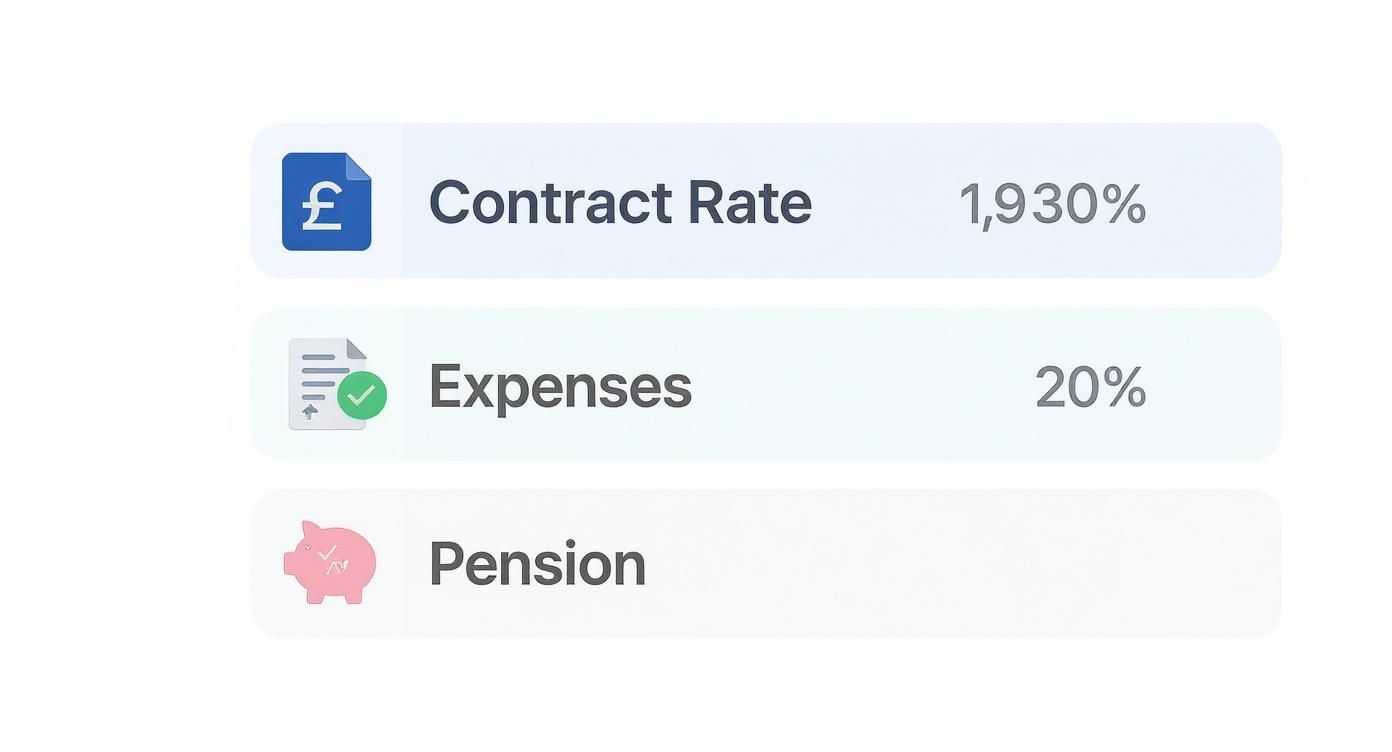
As you can see, it all starts with your contract rate, expenses, and pension contributions. These are the building blocks for working out your final net pay.
Side-by-Side Pay Comparison
Let's apply some real numbers to this to see how it all works. We will use a common scenario: a contractor on a day rate of £500, working five days a week.
Here is a rough breakdown of what their monthly take-home pay might look like across the different payment structures when they are inside IR35.
Inside IR35 Pay Comparison Based on a £500 Day Rate
| Payment Method | Gross Monthly Income | Key Deductions | Estimated Net Monthly Pay |
|---|---|---|---|
| Limited Company (Deemed) | £10,833 | Employer’s NICs, Apprenticeship Levy, PAYE Tax, Employee’s NICs | £6,300 – £6,600 |
| Agency PAYE | £9,500* | PAYE Tax, Employee’s NICs | £6,200 – £6,500 |
| Umbrella Company | £10,833 | Umbrella Margin, Employer’s NICs, Apprenticeship Levy, PAYE Tax, Employee’s NICs | £6,400 – £6,700 |
*A quick note on Agency PAYE: the gross income often looks lower because the rate the agency offers has already factored in their employment costs, like Employer’s NICs.
What the table shows is that while the gross figures vary, the final net pay between these compliant options is quite similar. The real difference comes down to the amount of administration you have to do, the employment rights you get, and the overall support you receive.
Ultimately, choosing the right payment route for an inside IR35 contract is about your personal priorities. Whether you are after simplicity, employment benefits, or want to keep your limited company active, using an ir35 calculator take home tool is the best way to model each scenario. It will give you the clarity you need to pick the path that best fits your financial goals.
Maximising Your Take-Home Pay Outside IR35
For most contractors, operating outside IR35 through your own limited company, often called a Personal Service Company or PSC, is the ideal scenario. It is widely seen as the route to the highest earning potential, and for good reason. This setup puts you firmly in control of your finances, giving you the flexibility to pay yourself in the most tax-efficient way possible.

Unlike an inside IR35 engagement where your entire income is subject to PAYE, this method lets you create a clear separation between company profits and your personal income. The primary strategy involves blending a small, tax-efficient salary with dividend payments drawn from your company’s post-tax profits. This approach is powerful because it significantly reduces your National Insurance liabilities.
To get a realistic picture of your take-home pay, you will need to factor in three key tax deductions: Corporation Tax on your company’s profits, PAYE tax and NICs on your salary, and finally, Dividend Tax on your shareholder payments. A good ir35 calculator take home tool built for outside IR35 scenarios will do the heavy lifting for you.
Calculating Your Limited Company Profit
Before you can pay yourself dividends, you first have to determine your company's actual profit. This is not just the total value of your invoices; it is what remains after you have paid all your business running costs.
You start with your gross annual turnover. From there, you subtract any allowable business expenses, which are costs incurred "wholly and exclusively" for your business. Common examples include:
- Accountancy fees
- Business insurance (like Professional Indemnity)
- Software subscriptions
- Travel and subsistence (where applicable)
- Equipment purchases
Once you have deducted these expenses, you have your gross profit. The next step is to subtract your director's salary. What remains is your company's net profit, and that is the figure HMRC uses for Corporation Tax.
The main rate of Corporation Tax currently stands at 25% for companies with profits over £250,000. A smaller profits rate of 19% applies if your profits are £50,000 or less, with marginal relief for profits between those two thresholds.
After Corporation Tax is paid, the money left over is your retained profit. This is what is available to be paid out to shareholders as dividends, and it is the key to unlocking your maximum earnings.
Structuring Your Salary and Dividends
The classic tax-efficient structure for limited company contractors involves paying yourself a small salary, typically set at or just below the National Insurance Secondary Threshold.
The reason for this is that your salary is an allowable business expense, which directly reduces your Corporation Tax bill. By keeping it low, you also minimise, or even completely avoid, paying both Employee's and Employer's National Insurance Contributions. That is a huge saving.
Let’s walk through a real-world example to see how this works.
Worked Example Outside IR35
Imagine a contractor turning over £100,000 a year. They have legitimate business expenses totalling £5,000.
- Gross Turnover: £100,000
- Business Expenses: £5,000
- Director's Salary: £12,570 (set at the Personal Allowance threshold)
- Gross Profit: £100,000 – £5,000 – £12,570 = £82,430
Now we apply Corporation Tax. Since the profit is over the £50,000 small profits threshold, we will use the 19% rate for simplicity here, but in reality, marginal relief might apply.
£82,430 x 19% = £15,661.70 in Corporation Tax.
- Net Profit Available for Dividends: £82,430 – £15,661.70 (Corporation Tax) = £66,768.30
This remaining £66,768.30 can now be drawn as dividends. These are taxed through your personal Self-Assessment, but at much lower rates than standard income tax. This two-step process of managing company and personal tax is exactly how you achieve a higher take-home figure when operating outside IR35.
Getting the Numbers Right: Common Pitfalls to Avoid
An IR35 calculator take home tool is a brilliant resource for a quick forecast, but it is only as accurate as the numbers you feed it. A few simple oversights can give you a wildly optimistic figure, setting you up for a shock when that first payslip arrives. If you know what to watch out for, you can use these calculators with a more critical eye and avoid financial missteps.
One of the most common traps, especially for contractors new to umbrella working, is forgetting about the employment costs. The day rate an agency pays your umbrella company is not your gross salary. It is the gross contract value, and it has to cover all the costs of employing you before your pay is calculated.
Understanding the Assignment Rate
That headline figure your agency agrees for the contract is called the assignment rate. This single payment has to cover several significant deductions before your personal, taxable salary can be worked out.
These deductions always include:
- Employer’s National Insurance Contributions (NICs): This is a large deduction, currently 13.8%, that the umbrella company is legally required to pay to HMRC on your earnings above the secondary threshold.
- The Apprenticeship Levy: Another 0.5% tax on the payrolls of larger employers, which also comes out of the assignment rate.
- The Umbrella Company Margin: This is the fee the umbrella company charges for their service, usually a flat weekly or monthly amount.
Only once these employment costs have been taken care of is your gross, taxable pay calculated. Forgetting to factor them in is the primary reason a calculator's estimate looks so much better than reality.
Forgetting Non-Billable Time
Another classic error is plugging in a full 52-week working year. This rosy outlook ignores the simple reality of contracting life. You have to build in time off, whether for a well-earned holiday or an unexpected sick day.
Any realistic forecast must account for these non-billable periods. Without this buffer, your annual income projection will be artificially high, making it nearly impossible to budget properly for the year ahead.
It is a simple but crucial step. When using an IR35 calculator take home tool, always base your working year on something more realistic, like 45 or 46 weeks. This accounts for holidays, bank holidays, and a couple of sick days, giving you a far more reliable financial forecast.
Ignoring Your Personal Financial Picture
Most online calculators start with a default scenario, assuming you have no other financial commitments. However, your personal circumstances will impact your final net pay, so it is vital to include any other deductions that apply to you.
Make sure you input the right figures for:
- Pension Contributions: These are usually tax-deductible, so adding them will give you a more accurate tax calculation and a clearer picture of your net position.
- Student Loan Repayments: If you have an outstanding student loan, those repayments are taken directly from your pay and need to be factored in.
- Your Correct Tax Code: Calculators nearly always assume a standard tax code (1257L). If yours is different, perhaps due to other income or a previous tax issue, your take-home pay will change.
By avoiding these common mistakes, you can turn a rough IR35 calculator into a genuinely powerful financial planning tool. Taking a few extra minutes to input accurate, real-world information ensures the final figure reflects what you can expect to hit your bank account. That is the clarity that empowers you to make smarter decisions about your contracts and your money.
Finding a Compliant Umbrella Company You Can Trust
So, you have run the numbers through an IR35 take-home pay calculator and decided that working through an umbrella company makes the most sense for your inside IR35 contract. Now for the most important part: choosing the right one.
This is not a decision to take lightly. It is about much more than just finding the lowest weekly margin; it is about protecting yourself and ensuring you are fully compliant with HMRC. The simple truth is that not all umbrella companies are created equal.
The single best way to gauge if a provider is trustworthy is to check for accreditations from independent, professional bodies. You should look for names like the FCSA (The Freelancer & Contractor Services Association) or Professional Passport.
Why Accreditation Matters
Think of these accreditations as your quality guarantee. They prove an umbrella company has passed rigorous audits and meets the highest industry standards for compliance. It is your assurance that they operate ethically, handle your tax deductions correctly, and provide payslips that make sense.
By choosing an accredited provider, you steer clear of non-compliant schemes that could cause problems with the tax authority. As an FCSA accredited organisation ourselves, we at UmbrellaCompany.com will only partner with providers who meet these same stringent standards.
Be on the lookout for red flags. If a company promises unusually high take-home pay, often around 80-90%, or mentions strange payment structures involving loans or credit, walk away. A compliant umbrella will always give you a clear, honest pay illustration that details every single statutory deduction.
To help you navigate this, we have put together a practical guide on how to spot a good umbrella company.
When you get a sample payslip or pay illustration, review it properly. It must clearly show:
- The umbrella company’s margin
- Employer’s National Insurance
- Employee’s National Insurance
- PAYE Income Tax
- The Apprenticeship Levy
- Any pension contributions
If these deductions are not transparent or the document seems unnecessarily complicated, treat it as a serious warning sign. A good umbrella company has nothing to hide. Using our comparison tool helps you find a fully vetted, accredited, and transparent partner you can trust to manage your pay and keep you compliant.
Your IR35 Pay Questions Answered
Working out your IR35 pay can raise many questions. Whether you are using an IR35 calculator take home tool for the first time or just trying to make sense of your payslip, getting clear answers is crucial.
Let's run through some of the most common queries we receive from UK contractors. The goal here is to give you straightforward advice so you can plan your finances and deal with umbrella companies and agencies with confidence.
Why Is My Umbrella Company Pay Lower Than the Calculator's Estimate?
This is probably the most common question we hear, and the difference almost always comes down to the details. Online calculators are a fantastic starting point, but they work from a simplified set of assumptions.
When your actual payslip comes through, a few things can create a gap between the estimate and reality. Most of the time, it is because the initial calculation did not account for things like:
- Pension contributions you have decided to make.
- Student loan repayments that are deducted automatically.
- A non-standard tax code (anything other than 1257L) that HMRC has issued for you.
Remember, the umbrella company’s margin, the legally required Employer’s NICs, and the Apprenticeship Levy are all deducted from the assignment rate before your own gross pay is calculated. To avoid any surprises, always ask a potential umbrella company for a full, tailored pay illustration before you sign anything.
Can I Claim Expenses When I'm Working Inside IR35?
For most contractors inside IR35, the short answer is no, not in the same way you used to. When you are treated as an employee for tax purposes, you lose the ability to claim tax relief on day-to-day costs like travel to your main client site or subsistence.
There are, however, some very specific exceptions. Certain business expenses that are incurred ‘wholly, exclusively, and necessarily’ in performing your job might still be claimable. This depends on your specific situation and the umbrella company’s policy, so it is vital to check with them directly and keep an eye on the latest HMRC guidance.
How Does My Tax Code Affect My Take-Home Pay?
Your tax code is one of the biggest factors determining what lands in your bank account. It is a simple string of letters and numbers that tells your employer, in this case, your umbrella company, how much income you can earn tax-free each year.
Just about every online IR35 calculator take home tool will default to the standard tax code, which for the 2024/25 tax year is 1257L. If your code is different, your take-home pay will be too. This might be because you have another job, or you are paying back underpaid tax from a previous year. An incorrect code can leave you overpaying or underpaying tax, so make sure your umbrella company has the right one from HMRC.
What Is a Deemed Payment and How Does It Work?
A ‘deemed payment’ is a calculation that only comes into play if you are working inside IR35 but still getting paid through your own limited company (PSC). It is essentially the portion of your income that HMRC considers your salary for tax and National Insurance purposes.
To work it out, you start with your fee income and first deduct a flat 5% allowance for general business running costs. From there, you also deduct any pension contributions and salary you have already paid yourself through your company's PAYE. What is left is 'deemed' to be your salary and is subject to full PAYE Income Tax and NICs. The whole process is designed to ensure the tax you pay is broadly the same as a direct employee.
Finding the right path does not have to be a headache. At UmbrellaCompany.com, our free comparison tool helps you find a fully accredited and compliant umbrella company that is the right fit for you.
Compare Top UK Umbrella Companies Today


