


If you are a contractor in the UK, understanding IR35 is non-negotiable. These are the government's off-payroll working rules, and they have a major impact on how you work. In short, IR35 determines your tax status.
This guide explains the relationship between IR35 and umbrella companies, how the process works, and what it means for your pay. You will learn how to stay compliant and find a trustworthy partner for your contracting career.
If a contract places you 'inside IR35', you are considered an employee for tax purposes. For these assignments, a compliant umbrella company is the most straightforward and secure way to manage your earnings. It ensures you pay the correct tax and National Insurance, just like a permanent member of staff.
Understanding IR35 and Its Impact on UK Contractors
For any UK contractor, knowing about IR35 is not just a "nice-to-have" – it's fundamental. The rules, officially called the Intermediaries Legislation, were introduced by HMRC to tackle 'disguised employment'.
This term describes a situation where a contractor works through their own limited company, but their day-to-day working relationship with the client strongly resembles a standard employer-employee one.
The purpose of IR35 is to ensure people in these situations pay broadly the same Income Tax and National Insurance Contributions (NICs) as regular employees. Your IR35 status is the single biggest factor that dictates how you get paid and what tax you owe. For a deeper dive, check out our full guide on what IR35 is.
The Key Shift: The 2021 Private Sector Reforms
The link between IR35 and umbrella companies became much stronger after major rule changes. These reforms first affected the public sector in 2017, but their rollout to the private sector in April 2021 completely reshaped the contracting world.
Before 2021, you, the contractor, were responsible for determining your own IR35 status. The new rules flipped this responsibility, placing it squarely on the end client, the business hiring you. This was a game-changer, and it all boiled down to one thing: risk.
Many businesses, concerned about facing hefty HMRC fines for an incorrect IR35 decision, became incredibly risk-averse. To protect themselves, a large number introduced blanket policies: they would no longer engage contractors working through limited companies for roles deemed 'inside IR35'.
This sudden policy shift created a huge demand for compliant payroll services like umbrella companies. Research shows the private sector reforms transformed the contracting market, with clients shying away from limited company contractors, which in turn fuelled significant growth in the umbrella sector.
Inside vs Outside: What It Means for You
Every contract you take is assessed against key employment tests to determine its IR35 status. The result will place you in one of two categories, each with completely different consequences for your pay and how you operate.
To make it crystal clear, here’s a quick breakdown of how the two statuses compare.
IR35 Status Quick Reference: Inside vs Outside
| Factor | Inside IR35 (Deemed Employee) | Outside IR35 (Genuine Business) |
|---|---|---|
| Tax Treatment | Treated as an employee. Subject to PAYE, including Income Tax and Employee's NICs. | Operate as a genuine business. You handle your own business taxes (e.g., Corporation Tax, VAT). |
| Payment Structure | Paid a salary via a payroll provider (like an umbrella company) after tax deductions. | Invoice the client for your services. You can draw a mix of salary and dividends from your company. |
| Financial Control | Less control over how and when you are paid. Fixed payment cycle. | Full control over your company's finances and how you extract profits. |
| Administrative Burden | Minimal. The umbrella company handles all payroll, tax, and NI calculations for you. | Higher. You're responsible for all company accounts, tax returns, and bookkeeping. |
| Ideal Setup | Use a compliant umbrella company. It's the simplest and most common route. | Operate through your own limited company (also known as a Personal Service Company or PSC). |
| Statutory Rights | As an employee of the umbrella company, you get statutory rights like holiday pay and a workplace pension. | No employment rights from the end client. You are responsible for your own benefits. |
In a nutshell:
Inside IR35: This means HMRC views your contract as 'deemed employment'. For tax purposes, you are an employee, and your pay is subject to PAYE tax and National Insurance. This is precisely where an umbrella company fits in perfectly.
Outside IR35: This confirms you are running a genuine, independent business. You have control over how you deliver the work, you could send someone else to do the job (a substitute), and there's no ongoing obligation for more work. In this case, you can continue to use your own limited company and manage your business finances yourself.
Getting this distinction right is the first, most crucial step to staying compliant and financially secure in your contracting career.
How a Compliant Umbrella Company Works
So, you’ve discovered your contract falls inside IR35. This is where a compliant umbrella company steps in, becoming your essential partner for the duration of your assignment. Think of us as your continuous employer, handling all the complex payroll and tax administration so you can get on with your work.
The process is designed to be completely straightforward. When you join an umbrella company like us, you officially become our employee. It’s a simple but crucial step that gives you full UK employment rights, providing a layer of stability and protection often missing from traditional contracting.
The Journey of Your Payment
Once you are on board, we establish a clear contractual chain. We sign a contract directly with your recruitment agency (or, in some cases, the end client). This agreement formalises the services you will be providing and locks in the agreed assignment rate.
When it’s time to get paid for your hard work, the payment flows from the end client to your agency, and then from the agency to us. At this point, we take over all the administrative heavy lifting.
This is what that payment and contractual flow typically looks like when you are working through a compliant umbrella company.
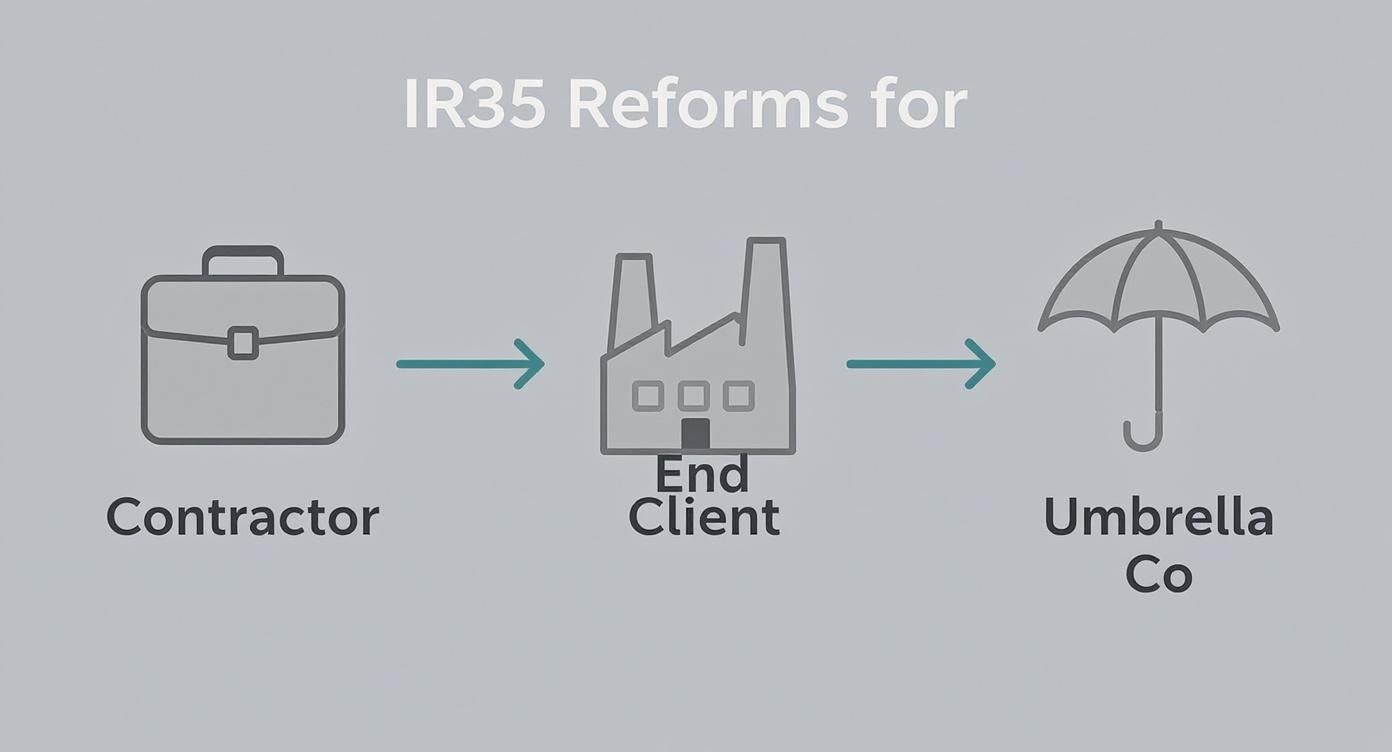
As you can see, the umbrella company acts as the central employer, connecting you to the end client and making sure the entire process is managed correctly under UK employment law.
How We Process Your Pay
As your legal employer, we have a statutory duty to manage your pay through HMRC's Pay As You Earn (PAYE) system. It is the exact same system used for millions of permanent employees across the country and is the bedrock of tax compliance.
Our role involves a few key steps:
- Receiving Funds: First, we receive the gross funds for your completed work from the agency.
- Calculating Costs: From this assignment rate, we deduct all the necessary employment costs. This includes items like Employer's National Insurance Contributions (NICs), the Apprenticeship Levy, and our agreed margin for the service.
- Deducting Your Taxes: We then calculate your gross pay. From this figure, we deduct your personal Income Tax and Employee's NICs, just as any standard employer would.
- Paying Your Salary: The remaining amount is your net salary, which we pay directly into your personal bank account. You will always receive a clear payslip detailing every single deduction.
By handling all tax and NI contributions at source, we ensure you are fully compliant with HMRC. This structure completely removes the risk of an unexpected tax bill at the end of the year, giving you total peace of mind.
This robust process means that when you work with a compliant provider, the complexities of IR35 and umbrella companies are managed entirely for you. Because you are being taxed at source through PAYE, the legislation does not apply directly to you as an umbrella employee—you are already fulfilling all of HMRC's requirements for an 'inside IR35' role.
Understanding this framework is key. You can find out more in our detailed guide on how an umbrella company works. Ultimately, our purpose is to let you focus on your contract, confident that your pay is being handled professionally, on time, and in full compliance with UK law.
The Financial Reality of an Inside IR35 Contract
When you land a contract that’s ‘inside IR35’, it is important to understand how this impacts your earnings. The way your pay is calculated is a world away from working ‘outside IR35’ through your own limited company. Let's pull back the curtain and show you exactly how the numbers work, from the top-line rate down to what lands in your bank account.
One of the biggest points of confusion for new contractors is the gap between the assignment rate and their actual take-home pay. The assignment rate is the headline figure you agree with the agency or client; it is what they pay for your services. But, and this is crucial, it is not your salary. Think of it as a total pot of money that has to cover all the costs of employing you before your own pay is calculated.

Understanding the Key Deductions
As your official employer, the umbrella company has a legal duty to handle certain deductions from that assignment rate. These are not hidden fees; they are the mandatory employment costs every single employer in the UK has to pay. These costs are deducted before your gross pay is calculated.
The main deductions are:
- Employer’s National Insurance Contributions (NICs): A non-negotiable legal requirement. This is a percentage of your earnings that goes straight to HMRC to fund state services like the NHS and state pensions.
- The Apprenticeship Levy: This is a UK tax on larger employers (those with a pay bill over £3 million a year) which is used to fund apprenticeship schemes.
- Our Umbrella Margin: This is our fee for handling all the payroll, administration, and employment responsibilities. A good, compliant umbrella will always be upfront about this simple weekly or monthly charge.
Once these employment costs are taken care of, the figure that is left is your gross pay. From here, the process looks much more like a standard payslip you would get in a permanent job. We then calculate and deduct your personal taxes through the PAYE system, which includes your Income Tax and Employee’s NICs.
Why Your Take-Home Pay Seems Lower
There is no getting around it: working inside IR35 usually means less money in your pocket compared to an identical outside IR35 contract. This is simply the direct result of being taxed like an employee. The entire system is designed to make sure contractors working in roles similar to permanent staff contribute a similar amount of tax and National Insurance.
Since the rules changed for the private sector in 2021, HMRC has reported that the reforms have brought in over £1.8 billion more in tax revenue than expected. This is because far more contractors are now correctly classified as inside IR35, leading to more tax and NI being paid. It just goes to show how vital it is to understand your payslip.
The key takeaway is that an inside IR35 determination aligns your tax status with that of a traditional employee. The reduction in net pay reflects the correct and legal application of PAYE, not an unfair charge by the umbrella company.
For a deeper dive into this, our guide on what happens if you’re inside IR35 is a great place to start.
A Practical Example of a Payslip Breakdown
To make this all crystal clear, let's walk through a practical example. The table below shows the journey from that initial assignment rate to the final net pay, so you can see where every penny goes.
Sample Payslip Breakdown for an Inside IR35 Contract
Here’s a typical breakdown of a contractor's weekly pay, illustrating how the gross assignment rate is processed into net take-home pay.
| Item | Description | Example Amount (£) |
|---|---|---|
| Assignment Rate | The total amount paid by the agency for one week's work. | £2,500.00 |
| Umbrella Margin | Our fixed weekly fee for employment and payroll services. | (£25.00) |
| Employer's NICs | The statutory contribution the employer must pay. | (£297.52) |
| Apprenticeship Levy | The levy paid by the employer. | (£12.37) |
| Gross Pay for Tax | The amount remaining after employment costs, which is your taxable income. | £2,165.11 |
| Employee's NI | Your personal National Insurance contribution. | (£107.05) |
| Income Tax (PAYE) | Your personal income tax deduction. | (£627.48) |
| Net Pay (Take-Home) | The final amount paid into your bank account. | £1,430.58 |
This example shows the full journey from the contract value to what you actually receive. By understanding each step, you can manage your finances with confidence and know that you are working with a transparent, compliant partner.
Key Benefits of Using an Umbrella Company
https://www.youtube.com/embed/Bd_11I4FY_U
While many contractors first look into umbrella companies to handle IR35, the benefits go far beyond just staying on the right side of the tax authorities. When you join a compliant provider, you step into a structure that gives you the security and stability you would expect from a permanent job.
This setup provides a consistent employment record, a huge but often overlooked benefit of the IR35 and umbrella companies relationship. It lets you get on with what you do best: delivering fantastic work for your clients.
Gaining the Stability of Continuous Employment
One of the biggest headaches for career contractors is proving a steady income. Applying for a mortgage can be an incredibly frustrating process, as lenders are often nervous about the variable nature of contract work.
This is where an umbrella company provides a solution. You get a single, overarching contract of employment that covers all your different assignments. This means you have a continuous employment history, even if you switch clients or have a short break between projects.
This continuous record is invaluable. It shows lenders a consistent and reliable income stream, making it much easier to get a mortgage, a personal loan, or other types of credit. You get regular payslips from one employer (us), which is exactly what banks want to see.
Suddenly, your financial standing is transformed. You get access to financial products that might have been out of reach when you were moving from one short-term gig to the next.
Access to Full Statutory Employment Rights
Because you are formally an employee of the umbrella company, you are legally entitled to all the same statutory rights as any other employee in the UK. This is not a small thing; it is a vital safety net that supports you throughout your contracting career.
These statutory entitlements include:
- Statutory Holiday Pay: You accumulate paid time off for every hour you work, so you can take well-deserved breaks without your income disappearing.
- Statutory Sick Pay (SSP): If you are too ill to work, you are eligible for SSP, which provides some financial support while you recover.
- Parental Leave and Pay: You have the right to statutory maternity, paternity, or adoption leave and pay, giving you the freedom to take time off to care for your family.
These rights provide a level of security you do not get as a sole trader or limited company director. They make sure you are protected when life’s big moments happen.
Comprehensive Insurance and Pension Benefits
A good umbrella company also handles essential financial protections as standard. We ensure you are covered by comprehensive business insurance, taking a significant administrative and financial weight off your shoulders. This typically includes:
- Professional Indemnity Insurance: Protects you if a client claims your work was negligent or contained mistakes.
- Public Liability Insurance: Covers you if your actions cause an injury to someone or damage their property.
- Employers’ Liability Insurance: This is a legal requirement for us as your employer.
On top of that, we handle your workplace pension automatically. Under the government's auto-enrolment rules, we will set you up in a pension scheme and make the required employer contributions. It helps you save for your future without you having to lift a finger. This combination of insurance and pension offers genuine peace of mind, knowing you're protected now and for the long haul.
How to Choose a Compliant Provider and Avoid Risks
Choosing the right umbrella company is one of the most important decisions you will make as a contractor. A fully compliant provider is more than just a payroll service; they are a partner, ensuring your finances are handled correctly. Get it wrong, however, and you could face serious financial and legal problems.
This section explains how to find a trustworthy provider and, just as importantly, how to avoid the dangerous tax avoidance schemes that plague the industry.

The scale of the problem is sobering. HMRC figures for 2022–2023 revealed that out of around 700,000 contractors using umbrella companies, an estimated 275,000 were with providers not meeting their tax obligations. Disguised remuneration schemes alone cost the Treasury an estimated £500 million. It is a stark reminder that you must be vigilant.
Spotting the Red Flags of Non-Compliance
Tax avoidance schemes are masters of marketing. They use tempting promises to lure contractors in, but knowing what to look for is your best defence. If an offer sounds too good to be true, it almost certainly is.
Keep an eye out for these classic warning signs:
- Unrealistically High Take-Home Pay: Any umbrella advertising that you will keep 80%, 90%, or even more of your contract rate is a massive red flag. A compliant PAYE payroll simply does not work that way.
- Non-Transparent Payslips: Your payslip should be crystal clear. It must show the full assignment rate, all employment costs (like Employer's NI), the umbrella's margin, and your own tax deductions. If it is confusing or information is missing, start asking questions.
- Complex Payment Structures: Be wary of any arrangement involving loans, annuities, offshore payments, or other convoluted financial products. Your pay should be straightforward employment income, taxed at source through PAYE.
- Lack of Professional Accreditation: Reputable providers are proud of their compliance and have it independently verified by established industry bodies.
Any payment structure that is not simple PAYE is a gamble you cannot afford to take. HMRC is relentless in its pursuit of these schemes, and ultimately, the liability for any unpaid tax falls squarely on you, the contractor.
The Importance of Professional Accreditation
The most reliable way to find a compliant partner is to check for professional accreditation. In the UK, the two leading independent assessors for the payroll sector are The Freelancer & Contractor Services Association (FCSA) and Professional Passport.
These bodies carry out rigorous, independent audits every year. They scrutinise everything from a provider’s financial stability and internal processes to the accuracy of their PAYE calculations. Choosing an accredited provider gives you the peace of mind that their entire operation has been thoroughly vetted by experts. You can find out more about the benefits of working with an FCSA accredited umbrella company in our dedicated guide.
Your Checklist: Essential Questions to Ask
Before signing any agreement, you need to ask some direct questions to confirm a provider's legitimacy and transparency. A compliant company will have no problem giving you straight answers.
Arm yourself with this checklist:
- Are you accredited by the FCSA or Professional Passport? This should always be your first question. Do not be afraid to ask to see their certificate of compliance.
- Can you send me a full take-home pay illustration? Make sure the calculation is based on a standard tax code and clearly breaks down every single deduction from the assignment rate.
- Is my entire income processed through UK-based PAYE? There should be zero mention of offshore elements, loans, or any other unusual arrangements.
- What is your weekly or monthly margin? This should be a simple, flat fee. Steer clear of providers who charge a percentage or have confusing fee structures.
- What insurance cover is included as standard? Any reputable provider will include Professional Indemnity, Public Liability, and Employers' Liability insurance as part of their service.
Doing these simple checks protects your money, your reputation, and your peace of mind. Taking a little extra time to choose a compliant provider is not a chore; it is an investment in a secure and successful contracting career.
Your Questions on IR35 and Umbrella Companies Answered
Understanding contracting throws up a lot of questions, especially regarding the relationship between IR35 and umbrella companies. We get it. To provide some clarity, we have answered some of the most common queries we receive from contractors just like you.
Think of this as a no-nonsense guide to help you make sense of everything from your payslip to your rights with a new client.
Can I Challenge an Inside IR35 Determination?
Yes, you can, and you have the right to do so. Any client that issues an 'inside IR35' determination must have a formal ‘status disagreement process’ in place for this reason.
To build your case, you will need to gather solid evidence showing your working practices are genuinely 'outside IR35'. The argument should centre on the key tests of employment: your level of control over the work, your right to send a substitute, and the fact there is no ongoing mutuality of obligation between you and the client.
A word of caution, though: be realistic. Clients tend to be risk-averse, so getting a decision overturned is not always easy. If your challenge does not succeed and the 'inside' status stands, working through a compliant umbrella company is still the safest and most straightforward way forward.
Why Does My Umbrella Company Deduct Employer's National Insurance?
This is probably the most common question we hear, and it is a crucial one to understand. The assignment rate you agree with your agency is not your personal take-home pay; it is an all-inclusive figure that is meant to cover all the costs of employment.
Because the umbrella company is your legal employer, we are required by UK law to pay Employer's National Insurance Contributions (NICs) on the money you earn. This cost, along with the Apprenticeship Levy and our margin, is deducted from that top-line assignment rate before your personal gross pay is calculated.
Any transparent, compliant umbrella company will show these deductions clearly on your pay reconciliation. It is a legitimate cost of employment, not a hidden fee being taken from your salary.
Does Using an Umbrella Company Affect My Ability to Claim Expenses?
Because you are an employee of the umbrella company, your ability to claim tax relief on business expenses is limited, just as it would be for any permanent employee in the UK. Under HMRC’s rules, this means you generally cannot claim for items like your daily commute to your main workplace.
Be very wary of any scheme that promises to boost your take-home pay by processing vague or inflated expenses. This is a massive red flag for a non-compliant provider and could be a disguised remuneration scheme, which will land you in trouble with HMRC. Legitimate expenses, like specific training courses or professional subscriptions, might still be claimable, but always check with a compliant provider first.
Is a Limited Company or Umbrella Company Better?
There is no single "better" option here. The right choice is dictated entirely by your IR35 status for a particular contract.
- For 'outside IR35' contracts, running your own limited company (often called a Personal Service Company or PSC) is nearly always the most tax-efficient way to operate.
- For 'inside IR35' contracts, the tax advantages of a limited company are almost entirely removed. In this situation, a compliant umbrella company is the simplest, safest, and most hassle-free solution. It takes care of all your tax and NI correctly, without the administrative burden of running a limited company for a role that HMRC views as employment.
Navigating your contracting career does not have to be a minefield. By understanding the link between IR35 and umbrella companies, you can make informed decisions that protect your finances and support your professional goals. A compliant umbrella company provides stability, security, and peace of mind, allowing you to focus on what you do best.
At UmbrellaCompany.com, we provide the tools and guidance to help you find and compare FCSA-accredited providers, ensuring you work with a partner you can trust.


