


As a contractor, maximising your take-home pay while staying on the right side of HMRC is a constant balancing act. It boils down to two things: understanding your employment status and then choosing the right payment structure.
For most UK contractors, this means deciding between a professional umbrella company or running your own Personal Service Company (PSC). Each path significantly impacts your net income and the amount of administration you will face.
Understanding IR35 and How It Affects Your Pay
For any UK contractor, understanding IR35 is non-negotiable. It is the cornerstone of your financial planning. In simple terms, this legislation examines your contract and working practices to decide if you are genuinely self-employed or, for tax purposes, more like a traditional employee. That decision dictates your tax obligations and, ultimately, how much money lands in your bank account.
The government introduced the IR35 rules in 2000 to tackle what HMRC calls ‘disguised employment’. This occurs when a contractor provides services through their own limited company, but their daily relationship with the client closely resembles a standard employer-employee arrangement. The purpose of the rules is to ensure these contractors pay roughly the same tax and National Insurance as a regular employee.
Your IR35 Status Decides Everything
The first and most critical step is establishing your contract's IR35 status. It splits your options into two very different paths:
- Inside IR35: This means your contract is considered employment for tax purposes. Your ability to structure your pay tax-efficiently is heavily restricted, and your income will almost certainly be processed through PAYE, just like a regular salary.
- Outside IR35: This is where your contract is recognised as a genuine business-to-business service. It unlocks more tax-efficient ways to pay yourself, most notably by operating through your own Personal Service Company (PSC).
Getting this right is not just a compliance exercise. It is a strategic decision that shapes your entire contracting career. An incorrect assessment could lead to a substantial tax bill and an unwelcome investigation from HMRC.
Our in-depth guide explains exactly how IR35 works in more detail, breaking down the key factors that determine your status. At UmbrellaCompany.com, we aim to provide clear, straightforward guidance. We want to help you make the best choice for your situation, ensuring you remain fully compliant while keeping as much of your hard-earned money as possible.
Determining Your Path: Inside vs. Outside IR35
Your IR35 status is the absolute cornerstone of your financial life as a contractor. It is the fork in the road that determines whether HMRC sees you as an employee or a genuine, self-employed business. This single determination dictates your tax obligations, administrative burden, and ultimately, your take-home pay.
Getting it right is not just a box-ticking exercise; it is fundamental to your compliance and financial health.
At its core, HMRC wants to understand the reality of your working relationship. Are you genuinely in business for yourself, or does your arrangement with a client look and feel like a permanent job? They will look past the wording in your contract to see how you actually work day-to-day.
The Key Tests for IR35 Status
Over the years, court cases have established key principles that HMRC and tribunals use to determine status. While many factors can be considered, it usually boils down to three main tests.
Control: Who calls the shots? If your client dictates how, when, and where you perform the work, it strongly suggests employment. Having the freedom to complete the project on your own terms is a significant indicator of being outside IR35.
Substitution: Could you send someone else to do the job? A genuine business can provide a suitably qualified replacement if the primary contact is unavailable. If you have an unrestricted right to send a substitute (and you are responsible for paying them), it is a powerful argument that you are a business, not a disguised employee.
Mutuality of Obligation (MOO): This test concerns expectation. In a typical job, the employer must provide work, and the employee must complete it. For a contractor, that obligation should not exist beyond the current project. Once the work is done, there is no expectation of more work from the client, and you are not obliged to accept it if offered.
A determination of 'inside IR35' means your earnings are subject to PAYE, so tax and National Insurance are deducted at source, just like a salaried employee. Conversely, being 'outside IR35' allows you to operate through your own limited company, paving the way for greater tax efficiency.
This image provides a quick visual of how your take-home pay can vary depending on the structure you use.
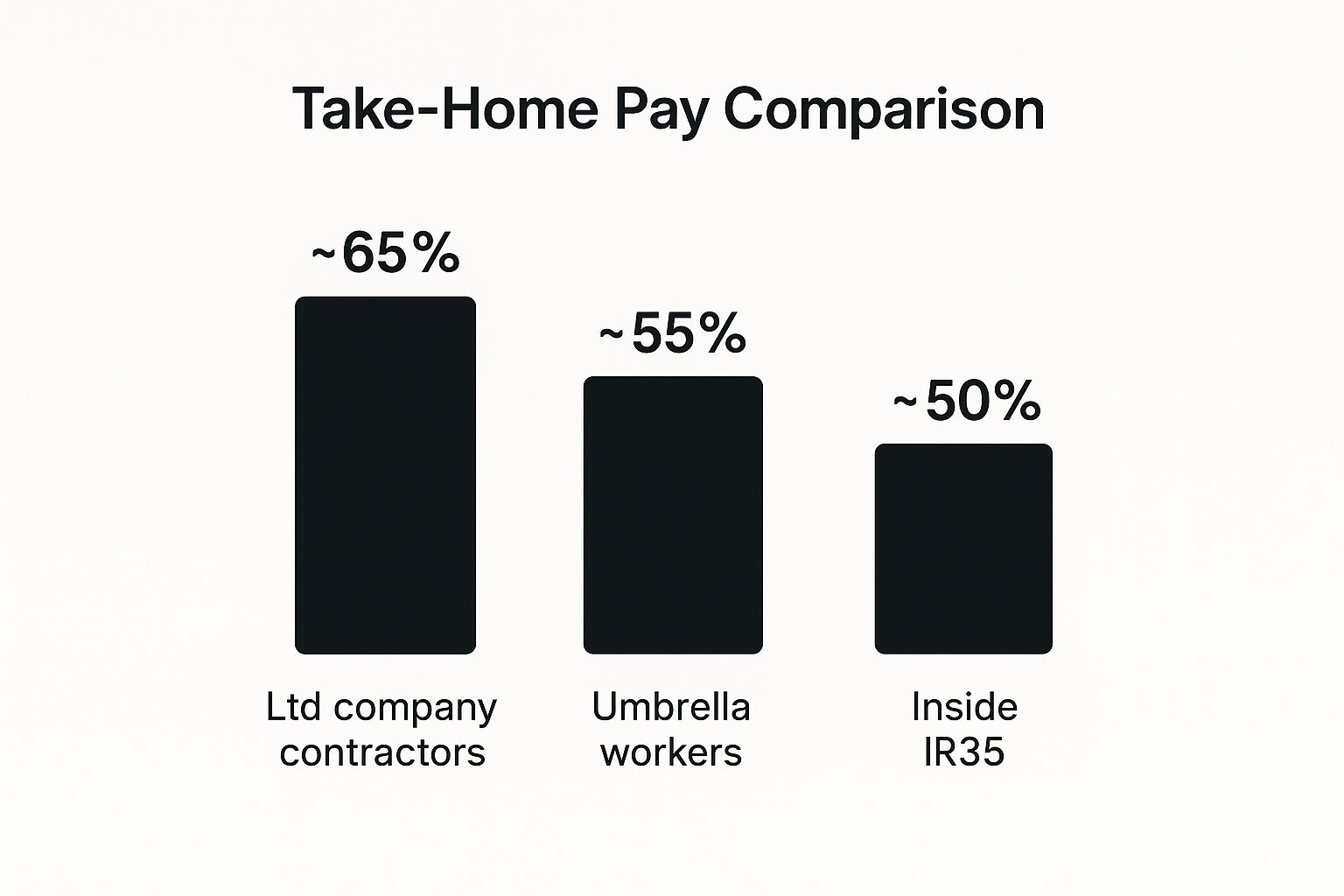
As you can see, running your own limited company while operating outside IR35 usually results in the highest net income. However, that potential reward comes with significantly more personal responsibility.
To clarify further, let's break down the practical differences between being inside and outside IR35.
Inside IR35 vs Outside IR35 Key Differences
This table shows a direct comparison of how your IR35 status impacts everything from your payment structure to your potential take-home pay.
| Feature | Inside IR35 | Outside IR35 |
|---|---|---|
| Tax Deductions | PAYE income tax and NI are deducted at source by the fee-payer. | Your company pays the gross amount; you are responsible for Corporation Tax, salary (PAYE), and dividend taxes. |
| Payment Structure | You receive a net salary, usually from an umbrella company or the agency's payroll. | Your company receives the full invoice value. You structure your own income via salary and dividends. |
| Admin Responsibility | Very little. Your umbrella company handles all payroll and tax administration for you. | Complete. As a company director, you are responsible for invoicing, accounts, tax returns, and compliance. |
| Take-Home Pay | Lower. Typically around 50-55% of your gross contract value. | Higher. Potentially 65% or more of the gross contract value, depending on your tax planning. |
The right path depends entirely on your contract's status. An 'inside' determination pushes you towards the simplicity of an umbrella company, whereas an 'outside' status allows you to reap the financial rewards of your own Personal Service Company.
The Umbrella Company Route for Simplicity and Compliance

If your contract falls inside IR35, working with an umbrella company is often the most straightforward and hassle-free way forward. Think of us as your employer for the contract's duration; we handle all the complex payroll and tax matters, leaving you free to focus on your work.
The process is simple. You submit your timesheets, we invoice your agency or client, and once we receive payment, we process it through a standard PAYE system. This means we deduct the correct amount of income tax and National Insurance contributions, just as any permanent employer would.
You receive your net salary directly into your bank account, along with a clear payslip detailing all deductions. This setup makes moving between contracts seamless and provides a continuous record of employment, which is incredibly useful when applying for a mortgage or loan.
Key Benefits Of Using An Umbrella Company
This route provides a solid safety net and several benefits you would not get as a sole trader or limited company director. The main advantages are guaranteed IR35 compliance, minimal administration for you, and full statutory employment rights.
Here is a quick summary of what you can expect:
- Statutory Rights: You gain access to essentials like statutory sick pay, holiday pay, and maternity or paternity leave.
- Pension Contributions: We automatically enrol you into a workplace pension scheme, making it easy to save for your retirement tax-efficiently.
- Continuous Employment: Your employment record remains unbroken with us, even if you move between different clients on short-term assignments.
- Minimal Administration: We manage all invoicing, tax calculations, and payments to HMRC. This means no more tedious paperwork consuming your evenings.
Choosing a compliant umbrella company removes the entire IR35 headache. It ensures you pay the correct tax and National Insurance, giving you complete peace of mind.
How To Choose A Reputable Provider
It is important to know that not all umbrella companies are the same. When you work with a provider, they will retain a small portion of the invoice value as their margin to cover their services. This margin is the only income they should generate from you; be very suspicious of anyone suggesting otherwise.
Selecting a provider that is fully compliant with UK tax law is absolutely vital. Look for accreditations from respected industry bodies like the FCSA (Freelancer & Contractor Services Association) or Professional Passport. These organisations audit their members to ensure they operate legally and ethically.
A final word of warning: avoid any scheme promising an unrealistically high take-home pay. If a deal looks too good to be true, it almost certainly is. These are often non-compliant tax avoidance arrangements that could lead to serious trouble with HMRC. To see how this model compares with agency payroll, read our detailed guide on umbrella company vs PAYE.
Using a Personal Service Company for Greater Control
For contractors whose work is confirmed as 'outside IR35', setting up a Personal Service Company (PSC) is often the best route for maximising take-home pay. Running your own limited company puts you in full control of your finances and business affairs.
A PSC offers the flexibility to structure your income much more tax-efficiently. Instead of taking all your earnings as a salary (which is subject to high rates of PAYE), you can pay yourself a small, tax-friendly salary and draw the rest of your company’s profits as dividends.
This salary and dividend model typically results in a lower overall tax bill compared to a straight salary, which can significantly increase your net pay. It stands out as one of the key ir35 and high take home pay options for contractors who are genuine business owners.
The Trade-Off Between Freedom and Responsibility
Of course, this level of financial control is not without its costs. It is balanced by a significant increase in your legal and administrative workload. When you establish a PSC, you are not just a contractor; you are a company director, a title that comes with a host of legal duties you cannot ignore.
This means you are personally responsible for everything your company does. From sending invoices and managing cash flow to ensuring every tax return and legal document is filed correctly and on time, the responsibility rests with you.
The IR35 reforms from April 2021 have made things even more complex, shifting the responsibility for status determination to the end client for most contracts. These changes have directly impacted an estimated 120,000 workers, pushing many into standard PAYE setups and reportedly increasing HMRC's tax revenue by £4.2 billion. You can learn more about the impact of these IR35 reforms and what they mean for you.
Key Director Responsibilities
When you run a PSC, you are operating a proper business, and HMRC expects you to act accordingly. You can (and probably should) hire an accountant to handle the detailed work, but remember, the ultimate legal responsibility always remains yours.
Your core duties as a director will include:
- Invoicing and Bookkeeping: Maintaining a meticulous record of all income and expenditure.
- Corporation Tax: Calculating and paying Corporation Tax on your company's annual profits.
- VAT Returns: If your turnover exceeds the VAT threshold, you must register and submit regular returns.
- Annual Accounts: Filing statutory accounts with Companies House every year.
- IR35 Diligence: Continuously ensuring that your contracts and working practices keep you safely outside IR35.
While the administrative load is certainly heavier, the reward can be substantial. For dedicated contractors with a solid business mindset, the financial benefits of a PSC often make the extra work worthwhile. It is the definitive path for anyone seeking the highest possible take-home pay from their outside IR35 contracts.
Compliant Strategies to Optimise Your Contractor Income

Securing a great contract rate is a fantastic start, but it is only half the battle. The real key to boosting your earnings comes from smart, compliant financial planning. Fortunately, there are several HMRC-approved ways to increase what you take home, regardless of your IR35 status.
One of the simplest yet most effective strategies is contributing to a pension. Why? Because these contributions are taken from your gross earnings before tax is calculated. This simple step can significantly reduce your overall taxable income.
Pension Contributions and Salary Sacrifice
For contractors paid through an umbrella company, salary sacrifice schemes are a genuine game-changer. It is a straightforward arrangement: you agree to lower your gross salary, and in return, we, as your employer, pay that exact amount directly into your pension pot.
The beauty of this is the double benefit it creates. Not only do you pay less income tax, but both you and your employer also save on National Insurance contributions. That NI saving means even more of your hard-earned money is channelled into your retirement fund, making it one of the best ir35 and high take home pay options available.
Think of it this way: with a salary sacrifice scheme, every pound you put into your pension costs you less than a pound from your net pay. It is an incredibly efficient way to save for your future while giving your current take-home pay a welcome boost.
Claiming Allowable Business Expenses
Understanding legitimate business expenses is another cornerstone of financial optimisation. But be aware, the rules are not the same for everyone. They change depending on whether you are an umbrella company employee or a PSC director working outside IR35.
If you are an umbrella employee, your claims are generally limited to expenses not subject to Supervision, Direction, or Control (SDC). This usually covers items like specific training courses or professional body memberships. On the other hand, PSC directors operating outside IR35 can typically claim a much broader range of expenses, from new office equipment to business travel.
A crucial first step is determining which payroll solution offers the highest take home pay based on your individual circumstances and likely expenses. When weighing up contract rates, make sure you conduct thorough market research using effective salary benchmarking tools.
Here is a quick checklist of common allowable expenses you should consider:
- Professional Subscriptions: Fees for memberships to relevant professional organisations.
- Business Mileage: For using your own vehicle for business travel to a temporary workplace.
- Essential Training: Courses directly related to fulfilling your current contract.
- Equipment: Items you have purchased specifically and exclusively for your work.
It is absolutely vital to only claim for genuine business costs incurred "wholly and exclusively" for your work. Adhering to the rules keeps you compliant and ensures you avoid any risky disguised remuneration schemes.
Making the Right Choice for Your Contracting Career
So, how do you decide which path is right for you? Ultimately, choosing between the main ir35 and high take home pay options depends on your personal circumstances. The single biggest factor is your contract's IR35 status, followed closely by how much administration you are willing to handle yourself.
If your role is determined to be inside IR35, a compliant umbrella company is often the most secure and straightforward route. It removes all administrative hassle, ensures you pay the correct tax, and provides continuity of employment, which is a huge help when applying for a mortgage or loan.
Weighing Your Options Carefully
On the other hand, if your contracts consistently fall outside IR35, running your own Personal Service Company (PSC) can be much more rewarding financially. This path, however, means you are not just a contractor; you are a company director. You will be responsible for everything from invoicing and managing accounts to staying on top of your ongoing IR35 compliance.
The best decision always aligns with your appetite for risk, your financial goals, and the reality of the work you do. There is no one-size-fits-all answer for every contractor.
Before making any big decisions, it is worth getting a solid grasp of the role by understanding what a contractor job truly entails. It is also wise to remember that IR35 affects various industries differently, so knowing the specific sectors most affected by IR35 can give you a real advantage.
Take the time to weigh your options carefully. If you are at all unsure, always seek professional advice. Getting your structure right from the start not only maximises your earnings but also protects you from future issues with HMRC.
At UmbrellaCompany.com, we live and breathe this work. We specialise in providing clear, compliant, and supportive solutions for contractors like you. Whether you need a reliable umbrella service for an inside IR35 contract or expert guidance on your next steps, our team is here to help make your contracting career a success.
Your Questions Answered
We receive many questions from UK contractors about IR35 and how to maximise their earnings. Let's tackle some of the most common ones with clear, practical answers to help you make the right financial decisions.
Can I Still Use My PSC for an Inside IR35 Contract?
Technically, you can, but it is rarely a good idea. Once a contract is deemed 'inside IR35', the fee-paying company must deduct tax and National Insurance at source, just as if you were a regular employee. This is known as the 'deemed payment'.
This single step effectively eliminates the main tax benefits of running a limited company, such as paying yourself in dividends. You are left with all the administration and costs of a PSC but none of the financial advantages. This is why most contractors in this situation find a compliant umbrella company to be a much more straightforward and sensible choice.
How Does a Salary Sacrifice Pension Actually Boost My Pay?
A salary sacrifice pension is a fantastic, HMRC-compliant way to enhance your overall financial package, especially if you work through an umbrella company.
The concept is simple. You agree to take a slightly lower gross salary, and in exchange, your umbrella employer pays that exact amount directly into your pension pot.
Because this happens before any tax or National Insurance is calculated, it reduces your taxable income. The brilliant part is that both you and your employer save on NI contributions. That NI saving means more of your hard-earned money goes directly into your pension, making it one of the smartest ir35 and high take home pay options for long-term saving.
The real magic of salary sacrifice is how it supercharges your pension contributions. Every pound you put away is amplified by the tax and National Insurance savings, giving your future self a much bigger pot to draw from.
What Are the Telltale Signs of a Non-Compliant Scheme?
This is a critical question. You should be extremely sceptical of any organisation promising wildly high take-home pay, especially anything reaching 85% or more. These are almost always non-compliant tax avoidance schemes that will lead to serious trouble with HMRC.
Here are the key red flags to watch for:
- Unusual Payment Structures: If you hear terms like 'loans', 'annuities', or other complex financial jargon instead of a simple salary, you should be very cautious.
- Offshore Providers: Schemes based in offshore locations are a classic method used to try and bypass UK tax law. Do not fall for it.
- No Accreditations: A trustworthy provider will be accredited by a professional body like the FCSA or Professional Passport. A lack of accreditation is a huge warning sign.
- Confusing Payslips: Your payslip should be crystal clear, showing standard PAYE tax and National Insurance deductions. If it is vague or you cannot understand it, you should ask serious questions.
At UmbrellaCompany.com, our entire focus is on providing transparent, compliant, and easy-to-understand payroll solutions. Our platform is designed to help you compare trusted, accredited umbrella companies so you can find the perfect match for your contracting career. We make sure you stay compliant while getting the most from your earnings. Find the right path for you at https://umbrellacompany.com.


