


At its core, IR35 is HMRC’s method for ensuring that contractors who work in a similar way to permanent staff pay the correct tax and National Insurance. The rules are designed to tackle what HMRC calls ‘disguised employment’, where an individual operates through a limited company to achieve tax efficiency, despite being an employee in all but name.
Understanding your IR35 status is vital for staying compliant with UK law. This guide explains what you need to know, from determining your status to choosing the right way to work for any contract.
What IR35 Means for UK Contractors
The term ‘IR35’ can seem daunting, but it’s more straightforward than it appears. The official name is the off-payroll working rules, and the goal is to create a level playing field between permanent employees and contractors performing similar roles.
If you are a contractor working through your own limited company, often called a Personal Service Company (PSC), these rules are aimed directly at you. The key question IR35 asks is: if your limited company did not exist, would your client consider you an employee?
The answer determines whether your contract falls 'inside' or 'outside' IR35. Each outcome has a significant impact on your pay and tax obligations.
Inside vs Outside: A Quick Look
The distinction between 'inside' and 'outside' is the single most important aspect of IR35 for a contractor to understand. Getting this right is essential for your financial and legal security.
Inside IR35: This means HMRC considers you a 'deemed employee' for tax purposes. Your client (or the fee-payer, such as an agency) will deduct income tax and National Insurance Contributions (NICs) at source through PAYE, just like a regular employee.
Outside IR35: This is the ideal position for a genuine business. It allows you to receive gross payments to your limited company, and you are responsible for managing your own business taxes, such as Corporation Tax and dividends.
IR35 is not designed to penalise genuine freelancers. It aims to ensure fairness in the tax system by identifying engagements that are, in practice, employment relationships disguised as business-to-business contracts.
Since its introduction in April 2000, this legislation has been a major focus for HMRC. To illustrate its impact, between 2000 and the 2013/14 tax year, investigations into just 4,576 contractors recovered over £12.1 million in additional tax for the government. With around 200,000 limited company contractors in the UK, the rules affect a huge part of the flexible workforce.
This guide is here to simplify the jargon. We will explain what the rules mean and the practical implications of being inside or outside IR35. Our goal is to provide the practical knowledge you need to stay compliant and protect your business. For a deeper look, see our detailed article on what is IR35 and why it matters to UK contractors.
Determining Your Status Inside or Outside IR35
Working out your IR35 status involves more than just your contract's wording; it depends on the reality of your day-to-day work. HMRC focuses on the genuine nature of your relationship with a client, looking beyond the paperwork to determine if it is a true business-to-business service or disguised employment.
This section covers the three key principles HMRC uses in its assessments. These are the core tests for genuine self-employment. Understanding Control, Substitution, and Mutuality of Obligation (MOO) is the first, vital step for any contractor navigating IR35.
The Test of Control
First, and arguably the most significant factor, is Control. This comes down to a simple question: who has the authority to direct how, when, and where the work is completed?
If your client dictates your working hours, requires you to work from their office, and micromanages your daily tasks, this is a major indicator of an employment relationship. In contrast, a contractor who is genuinely outside IR35 has significant autonomy. You are the expert brought in to deliver a result, and the client trusts you to achieve it using your professional judgement.
- Inside IR35 Example: An IT contractor must be on-site from 9 am to 5 pm, attend the client’s mandatory team meetings, and follow the client's internal project management processes and coding standards.
- Outside IR35 Example: A marketing consultant is engaged to create a new brand strategy. They work from their own office, set their own hours, and use their own established methods to deliver the final plan, attending only key progress meetings.
This decision tree gives you a quick visual guide to the questions HMRC asks when reviewing your status.
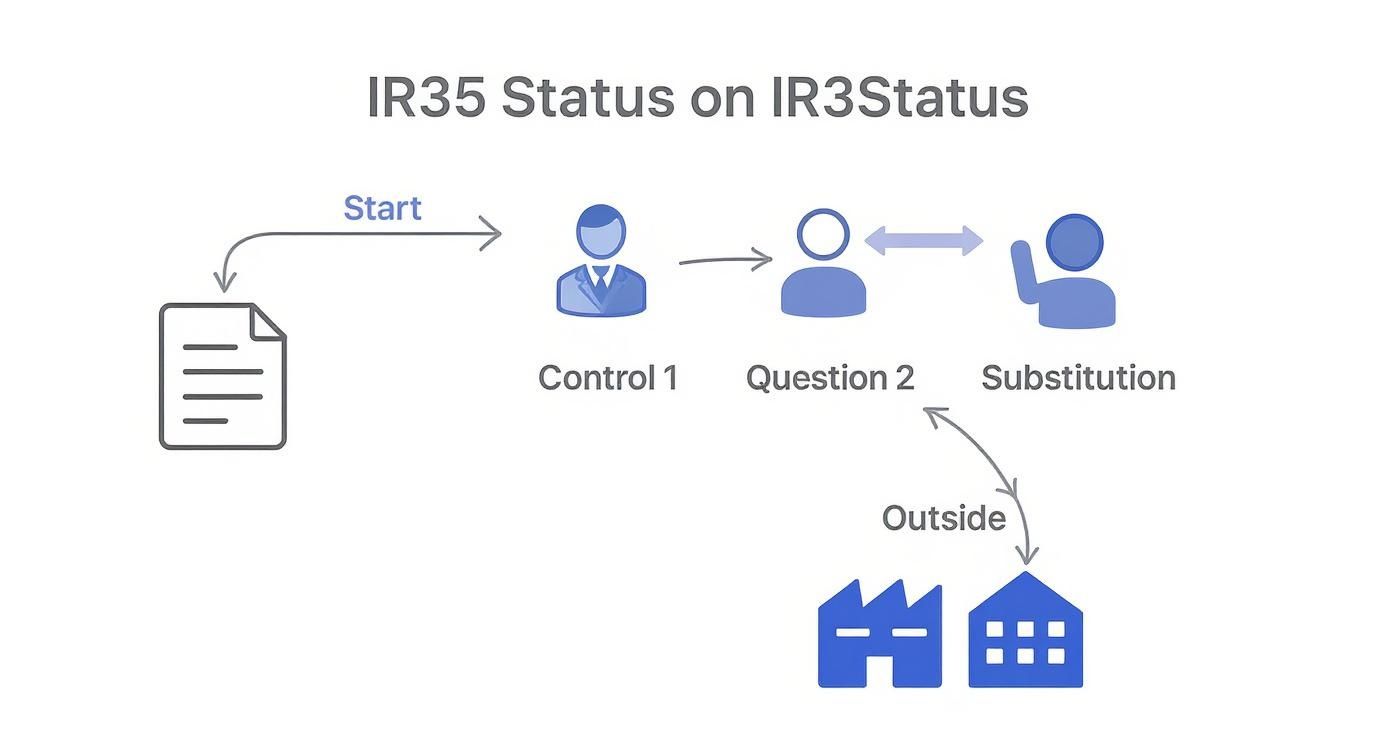
As you can see, having control over your work and the right to send a substitute are powerful indicators that you are operating outside IR35.
The Right of Substitution
Next, we have the principle of Substitution. This is a classic sign of being in business for yourself. Can you send someone else to complete the work in your place? A genuine business provides a service, and it should not matter which qualified individual from that business delivers it.
If your contract states that you personally must perform the work, it strongly suggests a personal service arrangement similar to employment. Critically, this right of substitution must be genuine. A clause in your contract that the client would never realistically accept in practice is considered meaningless.
Ask yourself this: "If I were ill or on holiday, could my limited company send another suitably qualified professional to do the job, and would the client be obliged to accept them?" If the answer is yes, you have a strong argument for being outside IR35.
Mutuality of Obligation
Finally, there’s Mutuality of Obligation, often shortened to MOO. This concept can feel abstract but is equally important. MOO exists when a client feels obliged to offer you continued work, and you feel obliged to accept it. This mirrors a typical employment contract, where an employer provides continuous work, and the employee is expected to be available to do it.
In a true contractor-client relationship, this obligation should not exist beyond the current project. Once you have delivered the contracted services, there should be no expectation from either party that more work will be automatically offered or accepted.
To help you put all these pieces together, here’s a quick comparison of the key differences.
Key Differences Between Inside and Outside IR35 Engagements
| Factor | Inside IR35 (Considered an Employee for Tax Purposes) | Outside IR35 (Considered a Genuine Business) |
|---|---|---|
| Control | The client directs how, when, and where the work is done. | The contractor has significant autonomy over their working methods. |
| Substitution | The contractor must provide the service personally. | The contractor has a genuine right to send a substitute. |
| Mutuality of Obligation (MOO) | An expectation of ongoing work exists beyond the current project. | The engagement is for a specific project with no obligation for future work. |
| Financial Risk | The contractor bears little financial risk; paid for time worked. | The contractor bears financial risk (e.g., correcting errors at their own cost). |
| Equipment | The client provides the necessary equipment. | The contractor uses their own equipment. |
| Integration | The contractor is integrated into the client's team (e.g., has a company email). | The contractor is clearly separate from the client's organisation. |
These factors, when viewed together, paint a clear picture of the true nature of your working relationship.
For a more detailed look into your own circumstances, you can learn more about how you can tell if you're inside or outside IR35.
By carefully weighing these three key principles against your real-world working practices, you can build a clear understanding of your position. Remember, it is the combination of all these factors, the reality of your engagement, that ultimately determines your IR35 status.
How Off-Payroll Working Reforms Changed the Rules

The contracting world was transformed by the off-payroll working reforms. Introduced first to the public sector in 2017 and then the private sector in 2021, these changes fundamentally shifted the responsibility for determining a contractor's IR35 status.
Previously, the responsibility was entirely yours. As a contractor, you had to assess each contract and decide whether you were inside or outside IR35. This is no longer the case. For most contracts today, that responsibility has moved up the supply chain to your end-client.
This is a significant change. If you work for a medium or large private-sector business, or any public sector organisation, they are now legally required to assess your engagement. It is arguably one of the biggest shake-ups to the contracting landscape in decades.
The Status Determination Statement Explained
At the centre of these new rules is the Status Determination Statement (SDS). This is an official verdict from your client. They must provide you (and any agency paying your limited company) with this document, and it cannot be a simple tick-box exercise.
The SDS must state clearly whether the client believes your contract falls inside or outside IR35. Crucially, they must also explain why they have reached that conclusion. This transparency is designed to prevent clients from making cautious, blanket decisions that place all contractors inside IR35.
Receiving the SDS is a critical moment. It dictates exactly how you will be paid for the project. If you are deemed 'inside IR35', the fee-payer (the client or your agency) must deduct income tax and National Insurance through PAYE before the payment reaches your company's bank account.
Your Right to Challenge a Decision
What if you receive an SDS and are convinced it is incorrect? The law gives you the right to challenge it. This is a formal, client-led disagreement process, not just an informal discussion.
You will need to present your case in writing, explaining exactly why you disagree and supporting your argument with evidence from your contract and daily working practices. The client then has a legal deadline of 45 days to review your challenge and respond.
When they reply, they must either:
- Uphold their original decision, but provide more detailed reasons.
- Issue a new SDS with a different determination.
If you decide to appeal, ensure your argument is robust and evidence-based. For a deeper dive, check out our guide on what has changed with the IR35 reforms and how it affects you.
The Small Company Exemption
There is one major exception where the old rules still apply, and the responsibility for IR35 status remains with you. This is the 'small company exemption'. If your end-client is a small business, it is your responsibility to assess the engagement.
Under the Companies Act 2006, a business is 'small' if it meets at least two of these three criteria:
- An annual turnover of £10.2 million or less.
- A balance sheet total of £5.1 million or less.
- 50 employees or fewer.
This rule is in place to protect small businesses from the administrative burden of the reforms. However, the impact on the wider contracting market has been huge. HMRC estimates the changes affected around 120,000 contractors and contributed to a fall of approximately 45,000 in new personal service companies being established after the reforms were introduced.
Your Options for an Inside IR35 Contract
Receiving an 'inside IR35' determination for a project is not the end of your contracting career. It is simply a different way of working for that specific engagement. For tax purposes, HMRC views the role as similar to permanent employment, meaning your tax and National Insurance must be handled accordingly.
This does not mean you have to close your limited company or abandon the contract. It just means you need to adjust your payment structure for that particular project to remain compliant.
The most common and straightforward solution is to work through a compliant umbrella company. This has become the standard method for managing inside IR35 contracts for contractors across the UK.
The Umbrella Company Solution
What is an umbrella company? It is an intermediary employer that manages the payroll for your contract. When you join one, you become their employee for the duration of that project. This simple arrangement resolves the IR35 issue for you, your agency, and the end client.
The process is remarkably simple:
- You sign a contract of employment with the umbrella company.
- The umbrella company then signs a commercial contract with your recruitment agency or the client.
- You continue working and submitting timesheets as normal. The umbrella company invoices the agency or client for your services.
- Once payment is received, the umbrella deducts the required PAYE income tax and National Insurance Contributions (NICs), just as any employer would.
- They then pay the remaining balance as a salary directly into your bank account, providing a full payslip detailing all deductions.
Because you are taxed at source as an employee, the 'disguised employment' issue that IR35 was designed to address is eliminated. It is a clean, low-risk arrangement for all parties.
Benefits of Using an Umbrella Company
Beyond ensuring compliance, working through a reputable umbrella company offers tangible benefits that provide security and stability. As their employee, you gain access to statutory employment rights.
This is a major advantage. You are not just a freelancer receiving payment; you have a continuous record of employment. This can be invaluable when applying for a mortgage or other forms of credit.
Here are the key benefits you can expect:
- Statutory Rights: You will be entitled to benefits like holiday pay, sick pay, and a workplace pension.
- Simplified Administration: The umbrella company manages all tax calculations and payments to HMRC. There are no complex spreadsheets or accountant fees for this contract.
- Continuous Employment: If you switch between different inside IR35 contracts using the same umbrella, it creates a single, unbroken employment history.
- Included Insurance: Most reputable umbrellas provide essential business insurance, such as Professional Indemnity and Public Liability, as part of their service.
This model provides an excellent balance: the flexibility of contracting combined with the security of employment. It allows you to focus on delivering high-quality work for your client, without being burdened by complex tax laws.
How to Operate Confidently Outside IR35

Operating outside IR35 is about more than just having the right contract clauses. It is about demonstrating, day in and day out, that you are a genuine, independent business. Every decision, from how you invoice to how you communicate, should clearly distinguish you as a service provider rather than an employee.
This section provides a practical toolkit for building a solid outside-IR35 case. We will cover the essentials, from your contract details to your daily working habits, so you can manage your work with confidence and maintain compliance.
Start with a Watertight Contract
Your contract is the foundation of your IR35 status. It must accurately reflect your working arrangement and include specific clauses that signify an "independent business." A generic online template will not suffice.
Ensure your contract is explicit on the key status tests:
- Right of Substitution: It must clearly state that your limited company can send a qualified substitute to perform the work. This must be a genuine right, not just a token clause.
- Control: The agreement should define what services you are delivering, not how you deliver them. It should be clear that you have full autonomy over your methods.
- Mutuality of Obligation: It needs to be a project-based contract with a defined end date. There should be no expectation of further work from either party once the project is complete.
A well-drafted contract is your first line of defence in the event of an HMRC inquiry. It sets the professional tone for the entire engagement.
Act Like a Business Every Day
While the contract is vital, your daily actions carry equal weight in an IR35 review. You must consistently behave as an independent entity. Put yourself in the position of a separate business interacting with a client and act accordingly.
This means consciously avoiding becoming too integrated into your client’s organisation. Small details, such as using your own business email address instead of a client-issued one, can make a significant difference.
The core principle is to maintain professional distance. You are a supplier providing a specialist service, not a member of the client's internal team. Your conduct should consistently reinforce this boundary.
Here are a few practical steps to strengthen your position:
- Use Your Own Equipment: Where possible, use your own laptop, software, and tools. Relying on the client's equipment suggests a level of dependency more akin to employment.
- Maintain a Business Presence: Have a professional website, business cards, and use your company letterhead for invoices. These are all hallmarks of a genuine business.
- Hold Professional Insurance: You should have your own Professional Indemnity and Public Liability insurance. This demonstrates that you are taking on the financial risks associated with your work. You can explore how being outside IR35 contributes to your overall tax efficiency in our detailed guide.
- Work with Multiple Clients: Having a portfolio of clients is one of the strongest indicators that you are in business for yourself and not dependent on a single source of income.
Despite initial concerns about the reforms, the contracting market has adapted. Research in early 2024 revealed that over 70% of contractors had successfully secured roles outside IR35, indicating that clients are becoming more comfortable with the rules.
By combining a strong contract with consistent, business-like behaviour, you can operate confidently outside IR35 and focus on what you do best.
Building Your Compliant Contracting Future
Understanding IR35 is a fundamental part of building a successful contracting career in the UK. As we've shown, with the right knowledge and a proactive approach, achieving full compliance is not just possible, but straightforward.
A compliant future depends on three key actions. First, you must understand the main status tests: control, substitution, and mutuality of obligation. Second, always be clear on who is responsible for determining your IR35 status for each contract.
Finally, you need to select the right operating model based on that status determination. This might involve working through your own limited company for an outside IR35 role or using a compliant umbrella company for a contract that falls inside.
Taking Control of Your Career
By actively managing your contracts, keeping detailed records of your working practices, and seeking expert advice when needed, you can operate with confidence and minimise risks. This proactive approach empowers you to build a resilient business that can adapt to different client needs and project demands.
The future for skilled, professional contractors in the UK is bright. Staying on top of compliance is not a burden; it is your single greatest asset for long-term success and financial security.
As you plan your next move, it is also wise to consider the wider financial landscape. While navigating IR35, it is a good idea to also understand the broader tax implications of forming a UK limited company.
Here at UmbrellaCompany.com, we specialise in providing the clear, compliant, and practical solutions you need. By staying informed and making smart choices, you can build the rewarding career you want, on your own terms.
IR35 Questions We Hear All the Time
Even after reviewing the details, it is normal to have a few remaining questions. Let’s address some of the most common queries we receive from contractors about IR35, helping you to complete your understanding.
What on Earth Is a Status Determination Statement?
A Status Determination Statement (SDS) is the official verdict from your client on your IR35 status for a specific engagement. It is a legal document introduced with the off-payroll working rules.
If you are working with a medium or large private company, or any public sector body, it is the end-client’s responsibility to provide one. They must send this statement to you (and any agency in the supply chain) before you start. It must clearly state whether they view the role as inside or outside IR35 and, importantly, explain why. They are also legally required to demonstrate that they have taken 'reasonable care' in making their decision.
Can I Fight an Inside IR35 Decision?
Yes, you can and you should if you believe the client has made an error. The rules include a formal disagreement process, giving you the right to challenge their determination.
To begin, you must present your case in writing to the client. This involves more than simply stating your disagreement; you need to support your position with solid evidence from your contract and working practices that indicates an outside-IR35 status. The client then has 45 days to respond. They will either uphold their decision and explain their reasoning in more detail, or they will issue a new SDS with a different outcome. A well-argued, evidence-led challenge offers the best chance of success.
Does an Umbrella Company Automatically Solve My IR35 Problems?
When a contract is determined as inside IR35, working through a compliant umbrella company is one of the cleanest and safest ways to ensure all your tax obligations are met correctly. It provides a straightforward solution to a complex problem.
The moment you become an employee of the umbrella company, you are taxed at source through PAYE on your earnings from that contract. This completely removes the 'disguised employment' issue that IR35 was designed to address.
Your umbrella company manages all PAYE tax and National Insurance contributions, issuing you with a proper payslip that details every deduction. For inside-IR35 work, this arrangement provides peace of mind and allows you to focus on the job without the stress of managing complex tax compliance.
Navigating the rules for IR35 and contractors can feel complex, but you do not have to do it alone. At UmbrellaCompany.com, we connect you with the expertise and tools to find a compliant, FCSA-accredited umbrella solution that is right for you. Compare trusted umbrella companies today.


