


Determining whether your contract is inside or outside IR35 is probably the single biggest financial decision you will make as a UK contractor. It is a decision that directly shapes your tax bill and, ultimately, your take-home pay. This makes an inside v outside IR35 calculator an absolutely vital tool for getting a clear picture of your potential earnings.
Your Guide to IR35 Status and Financial Impact
Navigating IR35 can seem daunting at first, but figuring out the financial side of things is actually quite straightforward once you know what you are looking at. The core of it is this: whether a contract puts you inside or outside the rules completely changes how you are taxed and paid. This guide is here to cut through the jargon and show you the real-world effect on your bank balance.
We will skip the dry theory and get right into the practical stuff. We will break down the key differences between each status, helping you size up new contracts with more confidence and plan your finances like a pro. If you need a refresher on the legislation itself, our deep dive into what is IR35 covers all the essential background.
Inside vs Outside IR35 Key Differences
Before you can make sense of a calculator's output, you need a solid grasp of what separates the two statuses. Each one comes with a different set of rules for tax, expenses, and administration. When you are assessing a new contract, using a thorough contract review checklist is a smart move for spotting those crucial terms and clauses that define your status.
This table gives a clear, at-a-glance comparison:

| Factor | Inside IR35 (Deemed Employment) | Outside IR35 (Genuine Business) |
|---|---|---|
| Tax Treatment | PAYE Income Tax & National Insurance are deducted at source. | Corporation Tax on profits; personal tax on salary & dividends. |
| Financial Control | Very little say in how you are paid. | Full control over your business finances and payment strategy. |
| Business Expenses | Extremely limited scope for claiming business-related expenses. | A wide range of legitimate business expenses can be claimed. |
| Responsibility | The fee-payer (your client or agency) handles the tax deductions. | Your limited company is responsible for all tax liabilities. |
| Employment Rights | You are entitled to some statutory rights, like holiday pay. | You have no employment rights from the end client. |
Key Financial Differences Between Inside and Outside IR35
The distinction between working ‘inside’ and ‘outside’ IR35 hits you right where it counts: your wallet. It is the single biggest factor determining how much of your day rate you actually get to keep. Getting your head around the financial mechanics of each status is non-negotiable before you even think about signing a contract.
When a contract lands you inside IR35, you are essentially treated as an employee for tax purposes. This means the company paying you, whether it is the end client or a recruitment agency, has to deduct PAYE Income Tax and National Insurance Contributions (NICs) before the money ever reaches your bank account. It is simple, sure, but it means you have far less control over your finances.
On the flip side, an outside IR35 determination means HMRC sees you as a genuine, independent business. This opens up more tax-efficient ways to pay yourself, typically through a mix of a small director's salary and dividends paid from company profits. You also get to claim a much broader range of legitimate business expenses, which helps to lower your overall tax bill.
Tax and Income: A Direct Comparison
The most glaring difference is how your income gets taxed. An inside IR35 role subjects your earnings to the full weight of employment taxes, which includes both Employee's and Employer's NICs. And that Employer's NIC? It is a cost that often gets passed down to you, effectively eating into your advertised day rate before you even see it.
This infographic lays out the core differences in tax, NI, and what you get (or do not get) under each status.
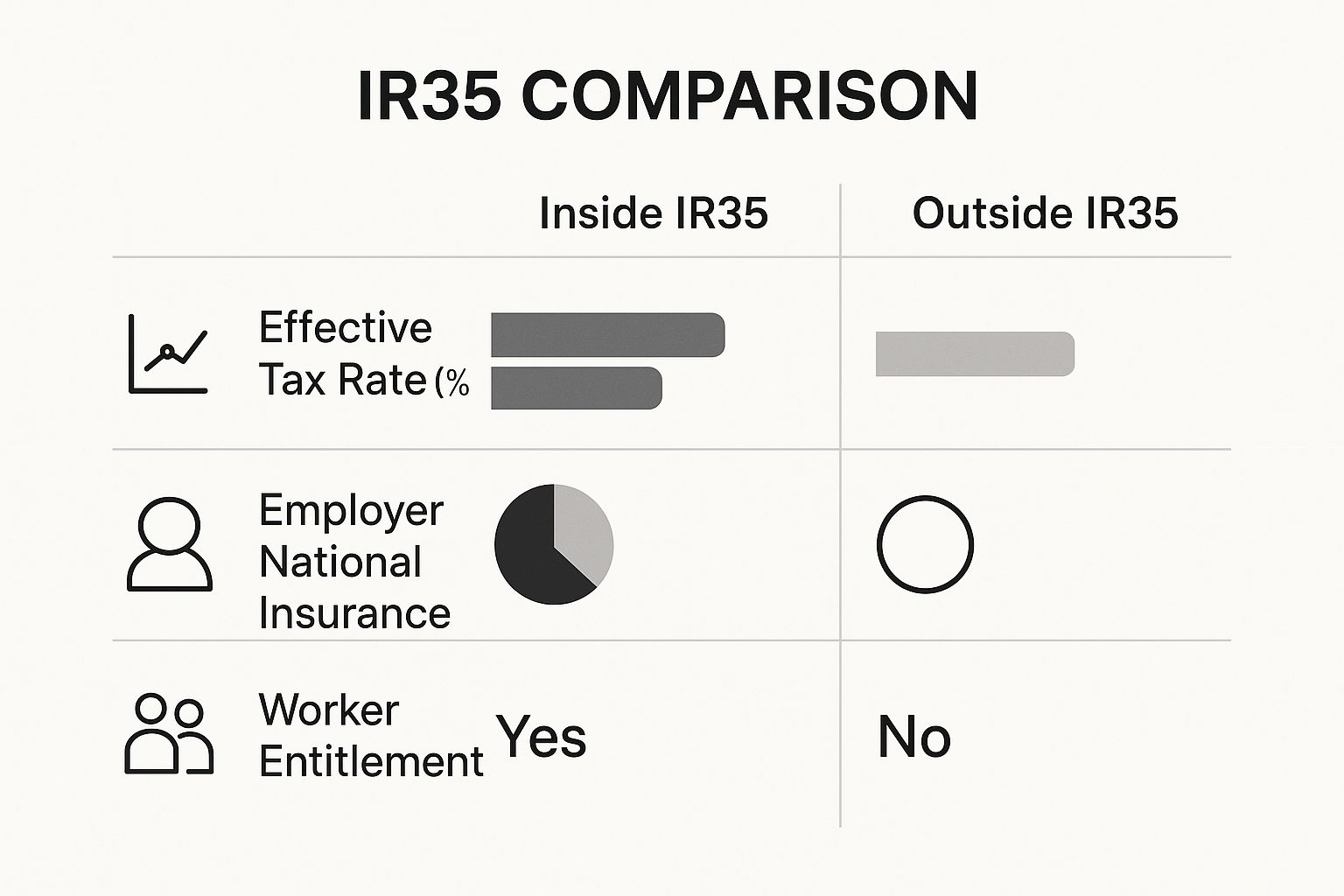
As you can see, while being outside IR35 has the potential for much higher take-home pay, it comes with the trade-off of more administration and zero employment rights.
Inside IR35 vs Outside IR35: A Quick Comparison
To put it all into perspective, here is a breakdown of the key financial and operational differences you will face.
| Factor | Inside IR35 (Deemed Employee) | Outside IR35 (Genuine Business) |
|---|---|---|
| Tax Treatment | PAYE Income Tax & National Insurance deducted at source. | Pay Corporation Tax. Remuneration via salary & dividends. |
| Take-Home Pay | Significantly lower due to employment taxes. | Higher potential take-home pay. |
| Expenses | Very limited claims, typically only travel to temporary workplaces. | Can claim a wide range of legitimate business expenses. |
| Admin Burden | Minimal. Handled by the fee-payer (client/agency). | High. Responsible for all company accounts, tax returns, VAT. |
| Financial Control | Low. Net pay is fixed after deductions. | High. You decide on salary, dividends, and investments. |
| Employment Rights | No statutory rights from the end client, but some via agency/umbrella. | None. You are a service provider. |
This table really highlights the trade-off: simplicity and predictability versus financial autonomy and higher earning potential.
The Real Impact on Your Take-Home Pay
The financial gulf between the two statuses can be massive. Let's take a contractor earning £90,000 gross on an outside IR35 contract. If that same role were deemed inside IR35, their net income could plummet to around £58,000. That is a drop of nearly £30,000.
Why such a huge difference? Because inside IR35 contractors are taxed just like regular employees, and the higher rates of income tax and NICs take a serious bite out of their net pay.
An inside IR35 status almost always results in a lower net income from the same gross contract value. This is why using an inside v outside IR35 calculator is so crucial for accurately forecasting your earnings and negotiating an appropriate day rate.
Beyond just crunching the numbers in a calculator, it is vital to get a grip on the wider financial picture. Understanding how to properly calculate net income and maximize profits is key for smart IR35 planning and long-term financial health, empowering you to make strategic calls on which contracts are actually worth your time.
How to Use an Inside vs Outside IR35 Calculator
An inside vs outside IR35 calculator is a fantastic tool for getting a clear, side-by-side forecast of your potential earnings. But like any tool, its usefulness comes down to how well you use it. Let us walk through the steps to get the most accurate financial picture possible from your calculations.

The screenshot above gives you an idea of a typical calculator interface. They are designed to be straightforward, but the quality of the output really hinges on the accuracy of what you put in.
Gathering Your Key Information
Before you dive in, it pays to have a few key pieces of information ready. Getting these figures right is absolutely vital for a reliable estimate.
- Your Day Rate: This is the gross amount you have agreed with your client or agency.
- Contract Duration: You will need the number of days you expect to work each week and the total number of weeks in the contract.
- Business Expenses: For an outside IR35 calculation, you will need a realistic estimate of your allowable business costs. Think travel, accommodation, professional subscriptions, and so on.
- Pension Contributions: Do not forget to include any personal or company pension contributions you plan to make. These can be highly tax-efficient and make a big difference to the final numbers.
Putting these details in will give you a solid baseline, but for a truly precise forecast, you will want to dig a little deeper.
Advanced Inputs for Greater Accuracy
To really sharpen your results, look for calculators that let you add more detailed inputs. It is these finer points that many contractors overlook, often leading to a nasty surprise when their actual take-home pay does not match the initial estimate.
An IR35 calculator is a financial forecasting tool, not a status determination tool. Its purpose is to show you the financial consequences of an IR35 status, not to decide what that status should be.
If you need help assessing your working practices, our guide explains in detail https://umbrellacompany.com/how-can-i-tell-if-im-inside-or-outside-ir35/.
Here are a few commonly missed inputs that can have a big impact:
- VAT Scheme: Are you on the Flat Rate Scheme or the standard VAT scheme? It makes a real difference to your net income.
- Salary and Dividends Mix: When you are outside IR35, the way you structure your remuneration directly affects your personal tax liability.
- Existing Income: If you have other income streams, they will influence your overall tax position and should be factored in.
These calculators have become an essential piece of kit for UK contractors. In fact, web traffic data from 2025 showed that over 100,000 contractors a month were using online tools to get a handle on their earnings, which just goes to show how crucial they are for proper financial planning. For those interested in the nitty-gritty, mastering essential Excel financial formulas can give you a much deeper insight into how these calculators crunch the numbers to arrive at that all-important final figure.
Making Sense of Your IR35 Calculator Results
Once you have plugged in your contract details, the inside vs outside IR35 calculator lays out two very different financial futures for you. Getting your head around these numbers is key, as they show the stark reality of how IR35 status hits your bottom line.
The figures might look a bit intimidating at first, but they are simpler than they appear. The inside IR35 output is basically a version of an employee payslip, while the outside IR35 result shows you the finances of a limited company director. The gap between those two final figures can be huge.
The Inside IR35 Calculation Explained
When you see the ‘inside IR35’ scenario, you are looking at what is left of your earnings after all the statutory deductions have been taken. This is all based on the assumption that you are a ‘deemed employee’ for tax purposes, which means your income gets processed through a payroll system just like a permanent member of staff.
The main deductions you will notice are:
- PAYE Income Tax: This is the standard income tax everyone pays, worked out against the current UK tax bands.
- Employee's National Insurance Contributions (NICs): A slice of your earnings is taken for Class 1 National Insurance.
- Employer's National Insurance Contributions (NICs): This is a hefty cost that the fee-payer (your client or agency) is supposed to cover. In reality, though, this cost is almost always passed down to you by being built into your day rate, which eats into your gross earnings before any other taxes are even touched.
This calculation gives you a clear, no-nonsense view of your net income if a contract is deemed inside the rules. It really brings home the tax impact of being treated like an employee.
Analysing the Outside IR35 Figures
The outside IR35 calculation paints a completely different picture. It models how you would be paid as a genuine business owner running your own limited company. It is not just one simple number; it is a breakdown of how you can structure your income.
The real power of an outside IR35 status lies in the flexibility to structure your pay tax-efficiently. This is precisely what creates the potential for much higher take-home pay compared to an inside engagement.
Here is what your outside IR35 results will usually show:
- Corporation Tax: Before you can pay yourself anything, your limited company has to pay Corporation Tax on its profits.
- Director's Salary: You will typically pay yourself a small, tax-friendly salary. It is subject to PAYE but is usually set low enough to avoid paying much, if any, National Insurance.
- Dividend Payments: Any profits left in the company can then be paid out to you as dividends, which are taxed at a much lower rate than salary income.
By putting these two scenarios side-by-side, you get a powerful insight into what your day rate is really worth under each status. That knowledge is absolutely vital when you are negotiating contracts and trying to make decisions that actually match your financial goals.
Practical Scenarios: Inside vs Outside IR35
Theory is one thing, but seeing how IR35 plays out in the real world is where it really clicks. It is the day-to-day working practices of a contractor that ultimately seal their IR35 fate, and that status directly controls their take-home pay.
So, let us walk through two very different contractor scenarios. We will look at how the rules apply and what the financial fallout looks like when we pop the numbers into an inside vs outside IR35 calculator.

Scenario One: The IT Project Manager
First up is Alex, an IT Project Manager. He has been brought into a major bank for a 12-month digital transformation programme. Alex is based at the bank's office five days a week, uses their laptop, and answers to a senior manager who outlines his daily tasks and priorities. A key point is that the bank expects Alex to deliver the work personally; sending a replacement would not be an option.
So, what does this mean for his IR35 status?
- Control: The bank clearly holds a significant amount of control over how, when, and where Alex carries out his work. This is a classic indicator of an employment-style relationship.
- Substitution: The contract lacks a genuine Right of Substitution. Alex has to do the work himself, which strongly points towards being inside IR35.
- Mutuality of Obligation (MOO): There is a solid expectation here. The client will provide work for the full year, and Alex is expected to be there to do it. This ongoing commitment is a mirror image of a typical employment contract.
With these factors in play, Alex’s contract is almost certain to be judged inside IR35. Our guide on what happens if I'm inside IR35 breaks down exactly what this means for him.
Scenario Two: The Freelance Graphic Designer
Now, let us look at Sarah, a freelance graphic designer. She is a completely different case. She runs her business from her own studio and is currently working for three different clients. She uses her own high-spec Mac and specialist design software, sets her own hours, and is contracted to deliver specific outcomes – a new logo here, a set of marketing brochures there.
Let us break down her working arrangement:
- Control: Sarah is in the driver's seat. Clients give her a brief, but she has total autonomy over how she delivers the final product.
- Substitution: Her contract has a robust substitution clause. If she was snowed under or unwell, she could bring in another trusted designer to complete the project, covering the cost herself.
- Mutuality of Obligation (MOO): Here, MOO is practically non-existent. Once a project is done and dusted, the client has no duty to offer her more work, and she has no obligation to take it if they do.
Sarah's setup is a textbook example of a genuine business-to-business relationship. Her contracts would be determined as outside IR35.
The crucial difference lies not in the profession, but in the working practices. It is the specific details of the engagement that determine your IR35 status, not your job title.
When you run these scenarios through a calculator using a day rate of, say, £500, the financial gap is enormous. For Alex, being inside IR35 means his take-home pay gets hit hard by PAYE tax and National Insurance deductions. In contrast, Sarah’s outside IR35 status allows her to run her company's finances in a more tax-efficient way, giving her a substantially higher net income from the exact same gross earnings.
What to Do After Your IR35 Status is Determined
Figuring out your IR35 status is not the end of the road, it is just the beginning. Whether you have landed inside or outside IR35, there is a clear, compliant path to take. Knowing what to do next is crucial for managing your contracts properly and keeping your finances in good shape.
The route you take from here splits depending on that all-important determination. An inside IR35 result will steer you towards a payment structure that looks a lot like traditional employment. On the other hand, an outside IR35 status means you will be stepping fully into your role as a genuine business owner. Both are completely manageable, as long as you know what is involved.
If You're Inside IR35
An inside IR35 determination essentially means your contract is treated as employment for tax purposes. The most common and hassle-free way forward is to work with an FCSA-accredited umbrella company. We step in as your employer, taking care of all the PAYE tax and National Insurance contributions for you.
There are some solid benefits to this approach:
- Total Compliance: All your tax obligations are handled correctly, which completely removes the risk of falling foul of HMRC.
- Statutory Rights: You will get access to employment rights you would not otherwise have, like holiday pay, sick pay, and a workplace pension.
- Simplicity: We handle all the payroll administration, leaving you free to get on with the actual contract work.
If You're Outside IR35
Getting an outside IR35 result confirms you are operating as a legitimate business. This gives you much more control over your finances, but it also brings some serious responsibilities. You will need to run your limited company properly to keep that status secure.
Your key duties will include:
- Managing all your own invoicing and business accounts.
- Filing annual accounts and your Corporation Tax return with HMRC.
- Making sure your contracts and day-to-day working practices consistently prove your outside IR35 status.
It is absolutely vital to get all your contracts professionally reviewed and to have the right business insurance, like professional indemnity. This acts as a crucial line of defence if HMRC ever decides to challenge your status. For a deeper dive into protecting your position, check out our guide on how to avoid IR35 tax issues.
No matter what an inside v outside IR35 calculator tells you, being proactive is key. A clear determination gives you the confidence to structure your contracts and finances in a fully compliant way.
Got Questions About IR35? We've Got Answers
Getting to grips with IR35 and how it hits your wallet can throw up plenty of questions. Let us tackle some of the most common queries contractors have when they start playing with an inside vs outside IR35 calculator.
How Accurate Are Online IR35 Calculators?
Online IR35 calculators are spot on for estimating your take-home pay, as long as the numbers you plug in are right. They use the latest UK tax bands, National Insurance rates, and standard expense allowances to give you a clear picture of your net income in both an inside and outside IR35 scenario.
But, and this is a big but, you have to remember what they are for. They are financial forecasting tools, not status determination tools. The accuracy of the pounds and pence it shows you is completely dependent on whether you have correctly identified your IR35 status in the first place.
In short, a calculator crunches the tax numbers for you; it does not tell you if you are compliant.
Can I Juggle Contracts Both Inside and Outside IR35?
Yes, absolutely. A contractor's IR35 status is decided on a contract-by-contract basis. It is completely normal for a contractor working through their own limited company to have a mix of clients, with some contracts falling inside IR35, while others are genuinely outside.
Each engagement has to be judged on its own merits. You need to look at the specific working practices and the terms of that particular contract. Your status with one client has no impact at all on your status with another.
What Happens If HMRC Disagrees With My Outside IR35 Status?
This is the scenario every contractor wants to avoid. If HMRC opens an investigation and successfully argues that your outside IR35 determination was wrong, it is your limited company that is on the hook. You will be liable for all the income tax and National Insurance contributions that should have been paid.
On top of that, HMRC can add interest and hefty financial penalties, creating a massive financial headache.
This is exactly why it is so vital to do your homework. Carry out a proper status assessment for every single contract, keep meticulous records of your working practices, and seriously consider getting tax investigation insurance. It could save you a fortune in professional fees if HMRC ever comes knocking.
At UmbrellaCompany.com, we provide tools and resources to help you compare compliant umbrella companies and navigate your IR35 obligations with confidence. Find the right support for your contracting career today at https://umbrellacompany.com.


