


An inside IR35 calculator is an online tool that shows you what you will actually bank when a contract falls 'inside' IR35. It takes your gross contract value, then deducts PAYE income tax and National Insurance contributions to give you a solid estimate of your net pay.
This guide will explain what being inside IR35 means for your earnings, what information you need for an accurate calculation, and how to make sense of the results.
What Does Inside IR35 Really Mean for Your Pay?
When a contract is deemed to be inside IR35, it complicates your finances. In short, it means HMRC sees you as an employee for tax purposes, a situation often called 'disguised employment'. As a result, your earnings are subject to the same tax rules as any permanent employee.
This significantly impacts your take-home pay. Instead of managing your own taxes through a limited company, your income is processed through PAYE (Pay As You Earn). That means deductions for:
- Income Tax at the appropriate rate
- Employee's National Insurance Contributions (NICs)
- Employer's National Insurance Contributions (NICs), which often comes out of your day rate too

The Financial Reality of an Inside IR35 Status
The difference in your pocket between an inside and outside IR35 contract can be substantial.
For example, a contractor earning £80,000 a year on an outside IR35 project might see around £62,000 of that after tax. If that exact same role is classified as inside IR35, their net pay could fall to roughly £48,000. That is a reduction of over 22% due to the extra tax and NI.
This is precisely why an inside IR35 calculator is such an essential tool for any contractor. It cuts through the complex figures to give you a clear, honest forecast of what will actually land in your bank account.
Using a good calculator lets you make informed decisions. You can properly evaluate contract offers and, crucially, negotiate your day rate to cover those hefty deductions. By understanding your potential net income from the start, you can plan your finances and avoid any unwelcome surprises.
For a more detailed breakdown of the rules, have a look at our guide on what being inside IR35 means for you.
Getting Your Details Ready for an Accurate Estimate
To get a number you can trust from our inside IR35 calculator, you will need to gather a few key pieces of information first. Getting these details right from the start means the estimate you see will be a proper reflection of your earnings, not just a vague guess.
The most important part of the puzzle is your contract rate. Whether you work on a day rate or an hourly one, this forms the foundation of the whole calculation. If you are not sure how to work out your daily rate, our contractor daily rate calculator guide is a great place to start.
Key Information for Your Calculation
Before you dive in, it’s worth gathering the essential details our inside IR35 calculator needs. Each piece of information helps to build a more precise picture of your take-home pay by accounting for your unique financial situation.
| Data Input | Why It's Needed | Example |
|---|---|---|
| Contract Rate | The starting point for your gross earnings. | £500 per day |
| Working Schedule | Determines your total income over the period before tax. | 5 days per week |
| Your Tax Code | Tells the calculator your personal tax-free allowance. | 1257L |
| Pension Contributions | Calculates your tax relief, which boosts your net pay. | 5% of gross pay |
| Student Loan Plan | Applies the correct repayment threshold and rate. | Plan 2 |
Having these specifics to hand transforms the tool from a simple estimator into a powerful financial planning resource, giving you a clear and dependable picture of your earnings.
Personal Details That Make a Big Difference
Next are your personal financial details. They might seem like small things, but they can have a surprising impact on your final take-home pay. The calculator needs them to apply the right deductions with pinpoint accuracy.
You should have the following ready:
- Your Tax Code: This dictates how much tax-free income you’re allowed. For the 2024/2025 tax year, the standard code is 1257L, but yours could be different. Check your payslip or HMRC account if you are unsure.
- Pension Contributions: If you plan to pay into a pension, enter the percentage here. This helps calculate your tax relief correctly and will show a more favourable net pay figure.
- Student Loan Repayments: Make sure you select the correct plan (e.g., Plan 1, Plan 2, or Postgraduate). The repayment thresholds and rates are different for each, and this directly affects your take-home amount.
Don't Forget Your Working Schedule
Finally, let's talk about your working pattern. The calculator needs to know how many days or hours you plan to work each week or month. This allows it to project your gross earnings over the contract period before any deductions are made.
With all these details prepared, you can use the inside IR35 calculator with real confidence. It’s about more than just getting a number; it’s about understanding your finances, which empowers you to make smarter decisions about your contracts.
Making Sense of Your Calculator Results
You've entered your contract details into an inside IR35 calculator. Now what? You are looking at a screen full of numbers, and it is not always immediately obvious what they all mean. Let's break it down so you can see exactly where your hard-earned money is going.
The first figure you’ll see is your Gross Contract Value. This is the total amount the client or agency agrees to pay for your services before anyone takes a slice. From here, a series of deductions are made, just as they would be for any permanent employee.
Understanding the Key Deductions
The largest deductions from your gross pay will be for tax and National Insurance. Any decent calculator will itemise these for you so there are no surprises. HMRC requires these for anyone who is considered an employee for tax purposes.
Here are the main deductions you will see:
- Income Tax (PAYE): This is calculated against your total earnings, factoring in your personal tax code.
- Employee's National Insurance: A standard contribution every employee makes.
- Employer's National Insurance: A significant cost that is nearly always deducted from your gross contract value, directly reducing your take-home pay.
- Umbrella Company Margin: The fee your umbrella company charges for its services, such as processing your payroll, providing employment rights, and handling administration.
This infographic shows a clear picture of how those deductions stack up, illustrating the journey from the gross value down to what you actually get to keep.
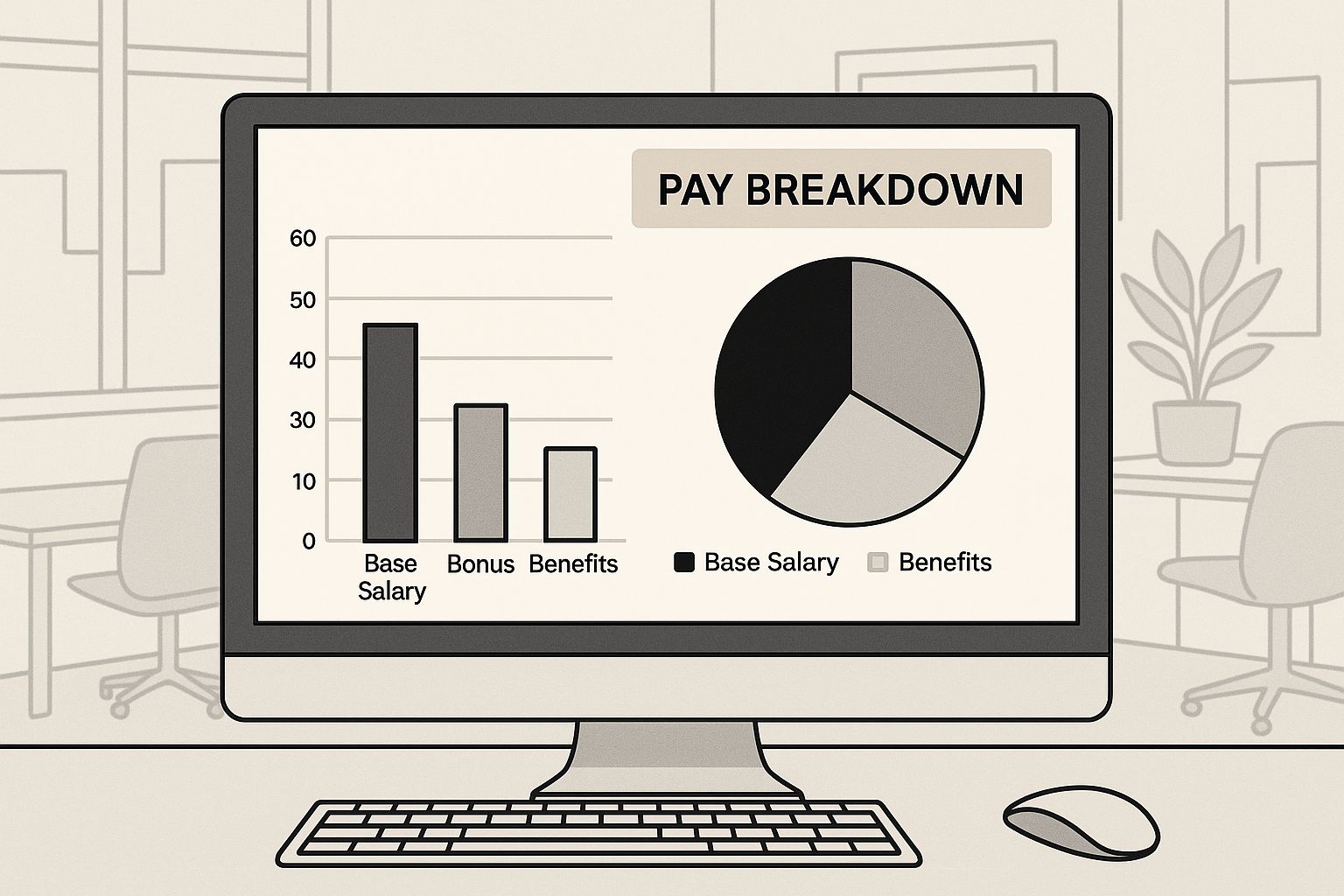
As the chart shows, a significant portion of your contract value is used for taxes and other employment costs before the money reaches your account.
A Real-World Pay Scenario
Let’s put this into practice. A contractor on a £250 daily rate, working inside IR35 through an umbrella, can typically expect to take home between 60-70% of their gross earnings.
If we do the maths, £250 a day for 220 working days gives a gross turnover of £55,000. But after the umbrella margin, PAYE, and both sets of National Insurance are deducted, the contractor’s net annual take-home pay lands at around £37,000. That means over 32% of their gross income is taken by tax and employment costs.
The final number you’re left with, after all the deductions are made, is your Net Take-Home Pay. This is the amount that will land in your bank account each pay period.
Getting to grips with these figures using a detailed inside IR35 calculator is crucial. It gives you the clarity to decide if a contract is financially viable and helps you negotiate your rate from a position of strength.
Feel free to run your own numbers through our IR35 take-home calculator for an instant, accurate estimate.
Comparing Your Pay Inside vs Outside IR35
There is no better way to grasp the real-world impact of your IR35 status than by seeing the numbers side-by-side. An inside IR35 calculator is brilliant for this, as it clearly highlights just how much your take-home pay can differ between the two scenarios.
When a contract falls inside IR35, you’re taxed at source through PAYE, almost exactly like a permanent employee. This means income tax, employee's National Insurance, and the employer's National Insurance Contributions (NICs) are all deducted from your day rate.

Financial Breakdown Inside vs Outside IR35
On the other hand, operating outside IR35 through your own limited company allows for greater tax efficiency. You can decide how you draw income, usually through a combination of a low salary and dividends, which are taxed at a more favourable rate.
This table gives a clear picture of how things stack up, showing just how different the financial outcomes can be on the same day rate.
| Financial Aspect | Inside IR35 (Via Umbrella) | Outside IR35 (Via Limited Co.) |
|---|---|---|
| Tax Structure | PAYE Income Tax and full NICs | Corporation Tax, low salary, dividends |
| Expenses | Very limited, similar to an employee | Wide range of allowable business costs |
| Net Pay Potential | Significantly lower due to higher taxes | Higher due to tax-efficient structure |
| Admin Burden | Minimal, handled by umbrella company | Higher, requires managing accounts |
It’s a tale of two very different approaches. Inside IR35 treats you as an employee for tax purposes. Outside IR35 recognises you as a legitimate business, giving you the financial control that comes with it.
The core difference lies in tax treatment. An inside IR35 status treats you as an employee for tax, while an outside status recognises you as a genuine business, affording you more financial flexibility.
Understanding this distinction is key to figuring out your net income potential. For more detail, have a look at our guide on outside IR35 tax efficiency. And if you are curious about the bigger picture, it is worth comparing the different business structures for tax purposes to see how they affect your bottom line.
By running both scenarios through a calculator, the financial trade-offs become crystal clear. This knowledge puts you in a much stronger position to evaluate contracts properly and negotiate your day rate to offset the tax burden of an inside IR35 role.
Smart Financial Moves for Inside IR35 Contractors
Receiving an inside IR35 determination can feel like a blow, especially when you see the potential dip in your take-home pay. But it’s not the end of the road. With a few shrewd moves, you can adapt your finances and make the situation work for you.
First, consider your day rate. Once you’ve run the numbers through an inside IR35 calculator, you will know exactly how much PAYE tax and National Insurance will affect your earnings. You can use these hard figures when negotiating a higher rate with your client or agency to soften the blow.
Many clients are aware of what an inside IR35 status means for a contractor's finances. If they want to retain your skills, they are often willing to have a sensible conversation about a rate increase.
Maximising Your Earnings
Rate negotiation is just one tool in your belt. One of the most effective ways to manage your income is by funnelling money into your pension directly through your umbrella company.
This is a brilliant, tax-efficient way to plan for your future. Here’s why it works so well:
- Your pension contributions are deducted from your gross earnings before any tax is calculated.
- This lowers your total taxable income, which in turn reduces the amount you pay in both income tax and NI.
- Essentially, you’re boosting your retirement pot while simultaneously cutting your immediate tax bill.
It is also easy to forget the upsides. An inside IR35 contract means you get statutory employment rights like paid holidays, sick pay, and a workplace pension. It’s a safety net that shouldn’t be overlooked.
Strategic Financial Planning
Beyond your pension, it’s worth taking a wider look at your finances. Understanding your new take-home pay is the first step, but you can also look into other avenues for optimisation. Researching the best tax strategies for high-income earners can often provide useful ideas.
By being proactive, you can turn an inside IR35 role from a financial headache into a perfectly workable part of your contracting career.
Common Questions About Inside IR35 Pay
We understand the world of IR35 can feel like a maze, and sometimes using an inside IR35 calculator just brings up more questions. To help clarify, we have answered some of the most common queries we hear from contractors like you.
Why Is My Take-Home Pay So Much Lower Inside IR35?
This is a common concern. The simple reason is that when your contract is inside IR35, you are taxed at source, just like a permanent employee.
Your gross pay is immediately subject to PAYE Income Tax, plus both employee's and employer's National Insurance contributions. This is very different from operating outside IR35, where you would typically draw a small salary and the rest in dividends from your limited company, giving you more control over your tax efficiency.
Can I Still Claim Business Expenses If I Am Inside IR35?
For most contractors, this can be a difficult adjustment. Expense claims are heavily restricted for inside IR35 contracts. You cannot claim for things like travel to your main client site or daily lunch costs, as HMRC views these as ordinary commuting, the same as for any employee.
Allowable expenses shrink to only what a permanent employee could claim directly from HMRC. This is a huge shift from the broader range of legitimate business costs you can offset when working outside IR35.
How Accurate Is An Inside IR35 Calculator?
Our calculator is designed to give you a very reliable estimate, using the latest tax and National Insurance rates from HMRC. However, its accuracy depends on the quality of the information you provide.
For the most dependable forecast, make sure the details you enter are correct. This means using your correct:
- Daily or hourly rate
- Official tax code (most people are on 1257L)
- Pension contribution percentage
- Student loan repayment plan
Get these right, and the tool can model your deductions precisely, giving you a projection you can trust.
Our calculator is a brilliant guide for financial planning, but it is built on the numbers you provide. It should not replace professional advice tailored to your unique financial situation.
Does Working Inside IR35 Affect My Employment Status?
Yes, but only for tax purposes. When you work inside IR35, you are treated as a ‘deemed employee’. This is what gives you access to certain statutory rights like sick pay and holiday pay, which are typically managed by your umbrella company.
This is a crucial distinction, though. This "employee" status is purely for tax and employment rights. It does not change the fundamental nature of your relationship with the client. You are still an independent professional providing a service, as defined in your contract, you just get paid and taxed like an employee.
Ready to see how your next contract stacks up? Use the UmbrellaCompany.com inside IR35 calculator today for an instant and accurate take-home pay projection.


