


If you're an IT professional staring at a contract offer and wondering whether this is the moment to leave permanent employment behind, you're not alone. Many people reach this point after years of delivering projects, picking up in-demand technical skills, and realising they want more control over how they work and what they earn.
Independent contracting can offer that control, but it also changes how you get paid, how tax works, and who carries the compliance risk. Those are the parts that often feel murky at the start.
The path itself is well established. The UK's freelance economy is valued at £140 billion annually as of 2024 and is powered by over 2 million self-employed professionals, including many IT specialists, according to IPSE's self-employed landscape research. That doesn't make contracting simple, but it should reassure you that you're entering a mature part of the UK labour market, not an edge case.
A strong start comes from understanding three things early: what an independent IT contractor is, how IR35 affects your choices, and which payment route fits the contract in front of you. If you're still deciding whether to make the move, our guide on how to become a contractor is a useful first step.
Embarking on Your Independent IT Contractor Journey

The first shift is mental. As an independent IT contractor, you're not just taking a different kind of job. You're offering a specialist service to a client who needs a result, whether that's a cloud migration, a security review, an app rebuild, or a short-term delivery boost.
That changes how you should think about your work. You stop measuring value by annual salary alone and start thinking in terms of contracts, deliverables, commercial risk, and working arrangements.
Why IT professionals move into contracting
Permanent roles suit many people. Contracting tends to appeal when you want one or more of these:
- More control over your time, including breaks between projects
- Access to specialist work, rather than general in-house support
- A clearer market value, often reflected in day rates
- Variety, especially if you enjoy new environments and technical challenges
A contractor might spend one engagement helping a financial services firm harden its cloud security, then move to a retail business that needs a short burst of engineering support for a platform launch. That variety is part of the appeal, but it also means you need to manage your own setup properly from day one.
What catches new contractors out
Most confusion starts with payment and status. New contractors often ask:
- Should I use an umbrella company or my own limited company?
- Is the contract inside or outside IR35?
- Who decides that status?
- What does my payslip mean?
Practical rule: If you don't understand how you'll be paid before you start the contract, pause and get clarity first.
Those questions aren't side issues. They shape your take-home pay, your tax position, and how much administration you'll be handling each month.
What an Independent IT Contractor Is and Is Not
An independent IT contractor is a business supplier. That's the cleanest way to think about it. A client brings you in to solve a defined problem or add specialist capability for a period, not to absorb you into the organisation as if you were just another employee with a different label.
That distinction matters because UK tax law pays close attention to arrangements that look like employment in practice.
According to HMRC's IR35 guidance, IR35 legislation was introduced in 2000 to tackle 'disguised employment', where someone works like an employee but is paid as a contractor to reduce tax liability. If you're weighing structures, our overview of types of business structure for contractors can help frame the options.
Contractor versus employee in plain English
A permanent employee usually joins the business in an ongoing way. The employer decides what work they do, how they do it, when they do it, and often where they do it. The relationship is expected to continue unless someone ends it.
An independent contractor is different. The client is buying expertise and output. The contract should reflect a business-to-business arrangement, even if the day-to-day working reality still needs cooperation and sensible boundaries.
A simple example helps.
- A permanent in-house IT support analyst might follow internal rotas, use company processes for every ticket, and stay in a continuing role with no fixed project end.
- A contract cybersecurity specialist might be engaged to assess exposure, review tooling, produce recommendations, and support remediation for a defined period.
Both may work on important systems. Only one is clearly there as a separate service provider.
The three ideas people hear but don't always understand
You will often hear three status concepts mentioned in contractor conversations. They sound legalistic, but the everyday meaning is straightforward.
Control
This asks how much say the client has over the way you work.
If the client controls your hours, methods, supervision, and routine in the same way they would control an employee, the arrangement starts to look more like employment. Contractors still have deadlines and project requirements, of course. The point is whether the client is buying your professional service or managing you as staff.
Substitution
This asks whether the work must be done personally by you, or whether a substitute could perform it if the contract allows and the circumstances support it.
In real life, substitution can be limited in specialist IT work because skills, access, and client approval all matter. But the concept still points to an important principle. A genuine business can supply services through qualified people. An employee normally cannot send someone else in their place.
Mutuality of obligation
This is often shortened to MOO, and it confuses people because the label is clunky.
In plain terms, it asks whether the client is obliged to keep offering work and whether you are obliged to keep accepting it. Ongoing expectation on both sides can make an arrangement look more like employment. A genuine contract engagement is usually more bounded.
You're not selling "being available like staff". You're selling capability for a defined need.
What an independent IT contractor is not
It's not solely a temporary employee with a higher rate.
It's not a label you add to your CV while working in exactly the same way as permanent staff.
And it isn't just about invoicing. Your contract wording, working practices, and payment route all need to line up with the actual situation of the engagement.
That matters most when a role sits close to the employee-contractor boundary. In those cases, sloppy assumptions create risk later.
The Pros and Cons of an IT Contracting Career
The attraction is obvious. Skilled contractors often move faster, choose projects more carefully, and avoid the slow progression path that can come with permanent roles. But the trade-off is responsibility. You take on more commercial uncertainty in exchange for more autonomy.

A balanced view matters here. According to IPSE's research on self-employed challenges and opportunities, 40% of freelancers are affected by late payments, yet 82% report satisfaction with independent work. That says a lot. People accept the friction because the upsides are meaningful.
What many contractors value most
- Flexibility: You can choose which projects to pursue and when to take time between assignments.
- Specialist focus: Contracting often lets you spend more time on delivery and less on internal politics.
- Varied exposure: You may work across different sectors, stacks, and delivery environments.
- Commercial clarity: A day rate can make your market value more visible than a salary band does.
For many IT people, the biggest benefit isn't money on its own. It's the ability to shape a working life that fits how they operate best.
The parts people underestimate
- Income gaps: Contracts end. Extensions don't always happen.
- Admin: Tax, onboarding documents, timesheets, insurance, and contract checks all need attention.
- Benefits: Paid holiday, sick pay, and employer pension contributions don't work the same way as in permanent employment.
- Late payment risk: Even where the work is done well, payment timing can still be frustrating.
A quick reality check
Some new contractors focus only on the headline rate. That's understandable, but it's incomplete. If you're moving from a permanent role, compare the full package, not just the daily number.
Consider:
- Pension planning
- Insurance
- Non-billable time
- Training and certifications
- Time spent finding the next contract
Contracting suits people who are comfortable managing both delivery and the business side of their work.
Who tends to do well
People usually settle into contracting more smoothly when they can already do three things confidently:
| Working habit | Why it matters |
|---|---|
| Deliver independently | Clients hire contractors to add capability quickly |
| Communicate clearly | Recruiters, clients, and project leads need confidence fast |
| Handle uncertainty | Gaps, changes, and status questions are part of the landscape |
If you like structure, certainty, and employer-managed benefits above all else, permanent work may still be the better fit. If you want autonomy and can cope with the moving parts, contracting can be a strong long-term choice.
Navigating IR35 and UK Contractor Compliance
IR35 sits at the centre of UK contracting because it affects how HMRC views the engagement for tax purposes. The practical question is simple, even if the rules feel messy. Are you operating as a genuine independent business, or does the contract really function like employment?
That question matters because tax treatment follows status.
Why IR35 exists
IR35 was brought in to deal with arrangements where someone looked like an employee in practice but was paid through a different structure. In IT, this issue appears often because clients regularly hire specialists for project work, and the line between genuine contracting and employee-like working can become blurred.
For a new contractor, the mistake is assuming IR35 is just a paperwork exercise. It isn't. It affects your contract choice, your payment route, and the amount of admin and tax friction you face.
Inside IR35 and outside IR35 in everyday terms
Inside IR35
If a contract is inside IR35, HMRC views it as more like employment for tax purposes.
That usually means the engagement is taxed in a way that broadly resembles employee pay. In practice, many contractors in this position use an umbrella company because PAYE is handled for them, deductions are processed correctly, and the administration is simpler.
Outside IR35
If a contract is outside IR35, the arrangement is treated as a genuine business engagement for tax purposes.
That doesn't automatically make one structure right for everyone, but it often gives more flexibility in how the contractor operates. The important point is that outside status should be supported by both the written contract and the actual working practices.
Key distinction: IR35 status is about the nature of the engagement, not about what you prefer your tax outcome to be.
Who decides status
Many new contractors get tripped up here. The rules changed over time, and older advice often hangs around long after it stopped being reliable.
The introduction of IR35 in 2000 was the starting point. The off-payroll reforms then shifted responsibility in stages. For public sector engagements, the rules changed in 2017. For medium and large private sector businesses, they were extended and fully implemented by April 2021, moving the compliance burden to the end client rather than the contractor, as outlined in the verified business context provided above.
That shift is one reason umbrella companies became far more common for inside IR35 contracts. Following the private sector reforms, a 2024 ContractorUK survey found that 45% of contractors now use an umbrella company for IR35 compliance, up from 28% before the changes, according to ContractorUK's reporting on IR35 reform.
If you're trying to understand how this applies specifically to tech roles, it's worth reading a focused guide on IR35 for IT contractors.
Why compliance is also operational
IR35 isn't the only compliance issue. IT contractors often need access to sensitive systems, development environments, or security tooling. That creates security responsibilities around access control, tracking, and offboarding.
A client should be able to:
- Control access tightly, using secure channels and strong credentials
- Track application-level permissions
- Remove access quickly when the contract ends
- Delete relevant access or data within minutes where appropriate
Those points come from TMCnet's discussion of key considerations when using independent contractors in IT. For contractors, the lesson is simple. Compliance isn't only about tax. It also includes how you are onboarded, what systems you can reach, and how cleanly you leave.
The practical response when you're offered a contract
When a recruiter calls with a role, ask these questions early:
- Has the client issued an IR35 determination?
- Will the role be paid via umbrella, agency PAYE, or another route?
- What are the deliverables and working expectations?
- What access, security, and offboarding rules apply?
If you're reviewing your own expenses and trying to maximize independent contractor tax deductions, keep UK rules and your chosen structure in mind. Generic advice from other markets can be useful for prompts, but your actual treatment depends on the UK setup and the contract status in front of you.
Choosing Your Payment Structure a Practical Comparison
This is the decision that usually feels most urgent once you have a role on the table. In the UK, an independent IT contractor will usually be paid through one of three routes: an umbrella company, a limited company, or agency PAYE.
Each route solves a different problem. None is universally best. The right answer depends on the contract, the IR35 status, and how much administration you want to carry yourself.
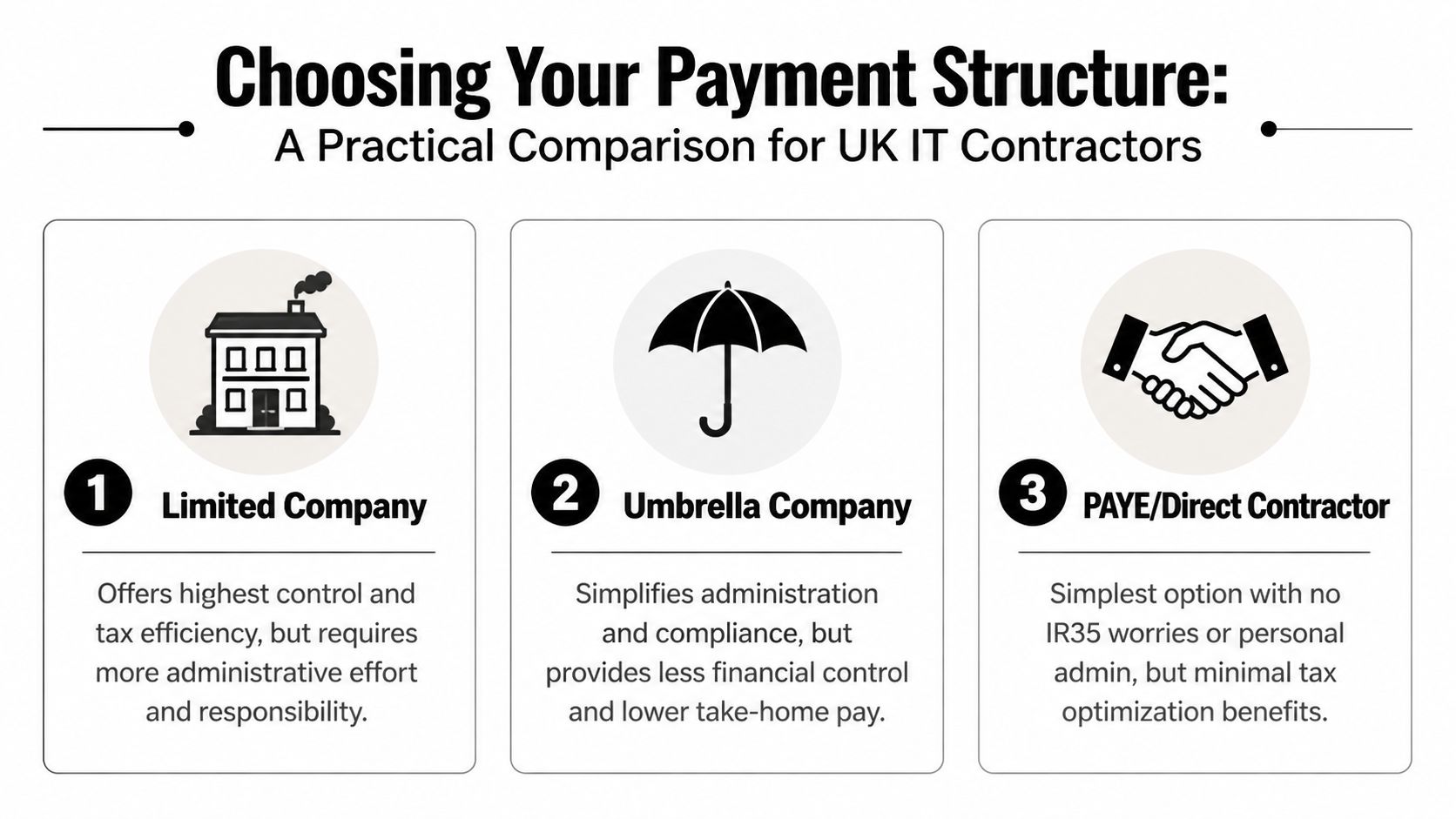
Umbrella company
With an umbrella company, you become an employee of the umbrella for payroll purposes. The agency or end client pays the umbrella, and the umbrella processes your pay under PAYE.
This route is common for inside IR35 work because it keeps tax handling straightforward. The umbrella deals with payslips, deductions, and employment-related admin.
It tends to suit contractors who want:
- Less administration
- A compliant route for inside IR35 contracts
- Faster setup
- Regular payroll handling
The trade-off is reduced control. You are not running your own company in the same way, and your take-home position will usually differ from someone operating through a limited company on an outside IR35 contract.
Limited company
With a limited company, you set up and run your own business. You contract with clients or agencies through that company and handle the associated responsibilities.
This often appeals to contractors who want:
- More control over their business
- A stronger business identity
- More direct involvement in invoicing and administration
- A route that fits outside IR35 engagements
The upside is control. The downside is workload. You need to manage bookkeeping, filings, record keeping, and the wider responsibilities that come with being a company director. You also need to be confident that your contract and working practices support the structure you choose.
Agency PAYE
Some contractors are paid directly on the agency's payroll. This is the simplest route from an admin perspective because the agency handles PAYE.
It often suits short-term assignments or contractors who prefer minimal setup. The trade-off is that it offers the least flexibility and little room for tailoring your business arrangements.
Agency PAYE is simple, but simplicity isn't the same thing as suitability. Check whether it fits the contract, not just whether it feels easiest.
Payment Options for UK IT Contractors
| Feature | Umbrella Company | Limited Company | Agency PAYE |
|---|---|---|---|
| How you're paid | PAYE via the umbrella | Through your own company | PAYE via the agency |
| Best fit | Often inside IR35 contracts | Often genuinely outside IR35 contracts | Short-term or straightforward payroll arrangements |
| Admin burden | Lower | Higher | Lowest |
| Control over business setup | Limited | Highest | Very limited |
| Compliance handling | Payroll and deductions are managed for you | You carry more responsibility | Agency handles payroll |
| Employment-style paperwork | Usually yes | Less like employment, depending on contract | Yes |
| Good choice when | You want simplicity and compliant payroll support | You want to operate as a business and can manage admin | You want the simplest route and accept less flexibility |
The real-world take-home pay question
Most articles stop at broad descriptions. What new contractors want to know is, "Which route leaves me better off?"
The honest answer is that take-home pay depends on your contract status, deductions, and working arrangement, so it shouldn't be guessed from headlines alone. What you can say with confidence is this:
- Inside IR35 roles often push contractors towards umbrella or PAYE-style arrangements for practical compliance reasons.
- Outside IR35 roles may make limited company operation more attractive for contractors who are comfortable with the admin.
- Simplicity has a cost, but so does complexity if you pick a structure you don't manage properly.
For a focused look at the operational differences, our comparison of umbrella versus PAYE for contractors is a useful reference point.
A simple way to choose
Use this decision filter:
- If the role is inside IR35 and you want straightforward payroll, umbrella is often the cleanest path.
- If the role is outside IR35 and you want to run your own business properly, a limited company may fit.
- If the engagement is being offered on agency payroll and you want very little admin, PAYE may be fine.
The mistake is choosing a payment route first and asking status questions later. Always do it the other way round.
Setting Your Rate and Securing Your First Contract
Many new contractors make one of two mistakes with pricing. They either convert their salary into a rough day rate and call it done, or they chase the highest number they can find on a job board without checking whether their experience really matches it.
A better approach is to tie your rate to market demand, your specialist value, and the practical cost of being independent.
According to Robert Half's UK salary guide, the independent IT contractor market is being driven by specialisations such as Kubernetes, machine learning with Python, and cybersecurity threat intelligence, with experienced contractor day rates ranging from £450 to £650. That gives you a credible benchmark, but not a guaranteed entitlement.
How to think about your rate
Start with the role, not your previous salary. Clients buy outcomes and specialist capability.
Your rate should reflect:
- Technical scarcity, especially if your stack is hard to hire for
- Delivery risk, such as rescuing a delayed project
- Contract length
- Location and working pattern
- Whether the work needs deep domain knowledge
A contractor who can lead a Kubernetes platform design or assess a live cyber threat environment is not priced the same way as someone doing generalist support work. Be honest about where you sit.
Where to research properly
Use current contract listings on platforms such as LinkedIn and Indeed to see what clients are asking for. Cross-check that against specialist recruiter conversations and your own network.
The quality of fit matters as much as the number itself. Dice's guide to becoming a tech contractor notes the importance of assessing technical match through portfolio review, references, and competency testing. Clients increasingly want proof that your technical stack aligns with immediate project needs, not just a broad claim that you can "pick things up quickly".
A strong contractor CV doesn't read like a job description. It shows what you delivered, what tools you used, and what changed because you were there.
Winning the first contract
Your first contract often comes from a recruiter search, a former colleague, or a direct client introduction. To improve your odds:
- Tailor your CV for contract hiring: Lead with key technologies, outcomes, and availability.
- Make your profile immediate: Recruiters scan for relevance in seconds.
- Show project credibility: List environments, platforms, and responsibilities clearly.
- Be ready to discuss IR35: Clients and agencies may ask early.
If you're updating your CV, these future software engineer resume strategies are a helpful prompt for tightening structure and making technical impact clearer.
Negotiating without undercutting yourself
Don't negotiate from fear. If a client wants specialist skills urgently, they are paying for access to capability and reduced delivery risk.
Good questions to ask include:
- What problem needs solving in the first month?
- Is the rate fixed or is there room based on experience fit?
- Is the contract likely to extend?
- What is the payment route and IR35 position?
The strongest negotiating position comes from clarity. When you can explain exactly why your skills fit the contract, rate discussions become easier and less defensive.
Your Quick Setup Checklist for Getting Started
A good contractor setup doesn't need to be dramatic. It needs to be orderly. The more cleanly you sort the basics before day one, the easier everything else becomes.

Start with the essentials
Confirm your contract status
Before you think about invoices or pay illustrations, check whether the role is inside or outside IR35 and who made that determination.Choose your payment route
Match the route to the contract. Don't pick based only on habit or a recruiter's shorthand explanation.Review the contract properly
Check the key points, including scope, notice, payment process, and any clauses around control, substitution, or restrictive wording.Prepare your core documents
Keep your CV, proof of ID, right-to-work documents, and bank details ready. Delays often happen because onboarding paperwork is incomplete.
Get your financial setup in place
If you're using a limited company, open a dedicated business bank account and keep business records separate from personal spending from the start. That separation saves confusion later.
If you're using an umbrella, read the payslip model carefully. Make sure you understand what the assignment rate is, what PAYE means in practice, and what the umbrella is responsible for processing.
For broader personal protection planning, some contractors also look into cover outside the contract itself. If that applies to you, this guide to finding life insurance when self-employed is a useful starting point.
Sort the protections people forget
A contractor usually needs more than technical skill and a signed contract.
Consider:
- Professional indemnity insurance
- Public liability insurance, where relevant
- Pension planning
- Savings for gaps between contracts
- A plan for illness or unexpected time away from work
These aren't glamorous tasks, but they support long-term stability.
Here is a quick walkthrough that can help you visualise the process before you begin onboarding:
Your first-day readiness check
Use this final pre-start list:
- Contract agreed: Terms reviewed and accepted
- Payment method confirmed: Umbrella, limited company, or agency PAYE
- Compliance complete: ID checks, right to work, and onboarding forms done
- Access expectations clear: Equipment, credentials, and security rules understood
- Rate and timesheet process confirmed: No surprises after your first week
- Personal buffer in place: Enough cash planning for timing gaps or payroll cycles
Start contracting like a business from day one, even if the assignment itself feels familiar.
The strongest setups are usually the simplest ones. Clear status, clear paperwork, clear payment route, and no guesswork.
If you're ready to compare compliant options for your next contract, Umbrella Company can help you review suitable umbrella providers quickly and choose a setup that fits your role, rate, and IR35 position.


