


A contract lands in your inbox. The rate looks good, the project suits your skills, then one line stops you: Professional Indemnity Insurance required.
If you are new to contracting, that phrase can feel like a hidden cost waiting to bite into your pay. You might be asking three sensible questions at once. What is it, why do I need it, and how much will this cost me?
That confusion is common. It is even harder if you work through an umbrella company, because insurance may be bundled into the service, partly covered, or left to you to arrange depending on the provider and the contract.
Your Guide to Indemnity Insurance Costs as a UK Contractor
The tricky part with indemnity insurance cost is that there is no single price list that works for every contractor. Your profession, your contracts, your claims history, and the way you work all affect the final premium.
There is also a real information gap for UK contractors using umbrella companies. Existing content does not clearly break down insurance costs for umbrella workers under IR35, and it does not properly quantify how that working arrangement changes budgeting when you compare providers, as noted in this discussion of the gap in available cost guidance from Insureon’s contractor insurance cost content.
That matters because insurance is not just a box-ticking exercise. It can affect:
- Your take-home pay, if the cost is bundled into umbrella fees or deducted indirectly through the overall pricing model
- Your ability to win work, if a client insists on a specific level of cover
- Your financial safety, if a dispute turns into a legal claim
- Your stress levels, because the wrong cover can leave you exposed even when you thought you were protected
A simple example helps. Say you are an IT contractor starting a new assignment. The agency asks for proof of professional indemnity cover before your start date. If your umbrella includes a group policy, you may already have something suitable. If not, you may need a separate policy fast, and the wrong choice can mean either overpaying or failing the contract requirement.
For a broader overview of how cover fits into contractor protection, this guide to contractor insurance in the UK is a useful starting point.
Key takeaway: indemnity insurance is part compliance cost, part career protection. The right question is not only “what is the cheapest option?” but also “what cover fits the work I do?”
What Professional Indemnity Insurance Covers
Professional indemnity insurance protects you if a client says your work, advice, or service caused them a financial loss.
Think of it as insurance for your professional judgement. If someone claims you made an error, gave negligent advice, missed something important, or delivered work that caused them to lose money, this policy is designed to respond.
The simplest way to think about it
If public liability insurance is about accidents involving people or property, professional indemnity is about mistakes in professional services.
A few contractor-style examples make that clearer:
- An IT contractor deploys code that causes a client’s system to fail
- A consultant gives advice that a client says led to a bad commercial decision
- A designer or architect produces work that contains an error and creates extra cost
- A marketing freelancer delivers campaign work that the client says breached agreed standards or caused loss
In those situations, the issue is not a physical accident. The issue is the professional service itself.
What the policy usually helps with
A professional indemnity policy commonly helps with:
- Legal defence costs, if you need solicitors to respond to a complaint or claim
- Settlements or compensation, where the policy covers the type of allegation being made
- Claims investigation, depending on the wording of the policy
This is one reason insurers price these policies carefully. Overall claims costs matter. UK insurers paid out approximately £277 billion in claims in 2018, an 8.6% increase from the previous year, according to EXL’s paper on optimising claims indemnity spend. When claim costs rise across the market, insurers adjust pricing and underwriting, which feeds into what businesses and contractors pay.
What it does not do
Professional indemnity insurance is often confused with other covers.
Here is the distinction in plain terms:
| Policy type | What it is mainly for |
|---|---|
| Professional Indemnity | Claims that your advice, service, design, or professional work caused financial loss |
| Public Liability | Claims involving injury to another person or damage to property |
| Employers’ Liability | Cover linked to employee injury or illness arising from work |
That difference matters when reading contracts. A client may ask for more than one type of insurance, and each serves a different purpose.
If you want a contractor-focused explanation of policy wording and suitability, this overview of contractor indemnity insurance can help you compare what is being requested.
Why contractors often underestimate it
Many contractors assume, “I only provide advice” or “I never physically handle anything risky”. That is exactly why professional indemnity exists.
Knowledge-based work can still create expensive disputes. A claim does not have to mean you were negligent. A client only needs to allege that your work caused them loss, and defending that allegation can be costly.
Practical point: the policy is not only there for when things go badly wrong. It is also there for the cost of responding when someone says they have.
The Key Factors That Determine Your Premium
Insurers do not price professional indemnity by guessing. They look at the risk you bring to the policy.
One contractor can pay far less than another, even when both work in broadly similar fields. That is why two quotes for what looks like the same cover can be surprisingly different.
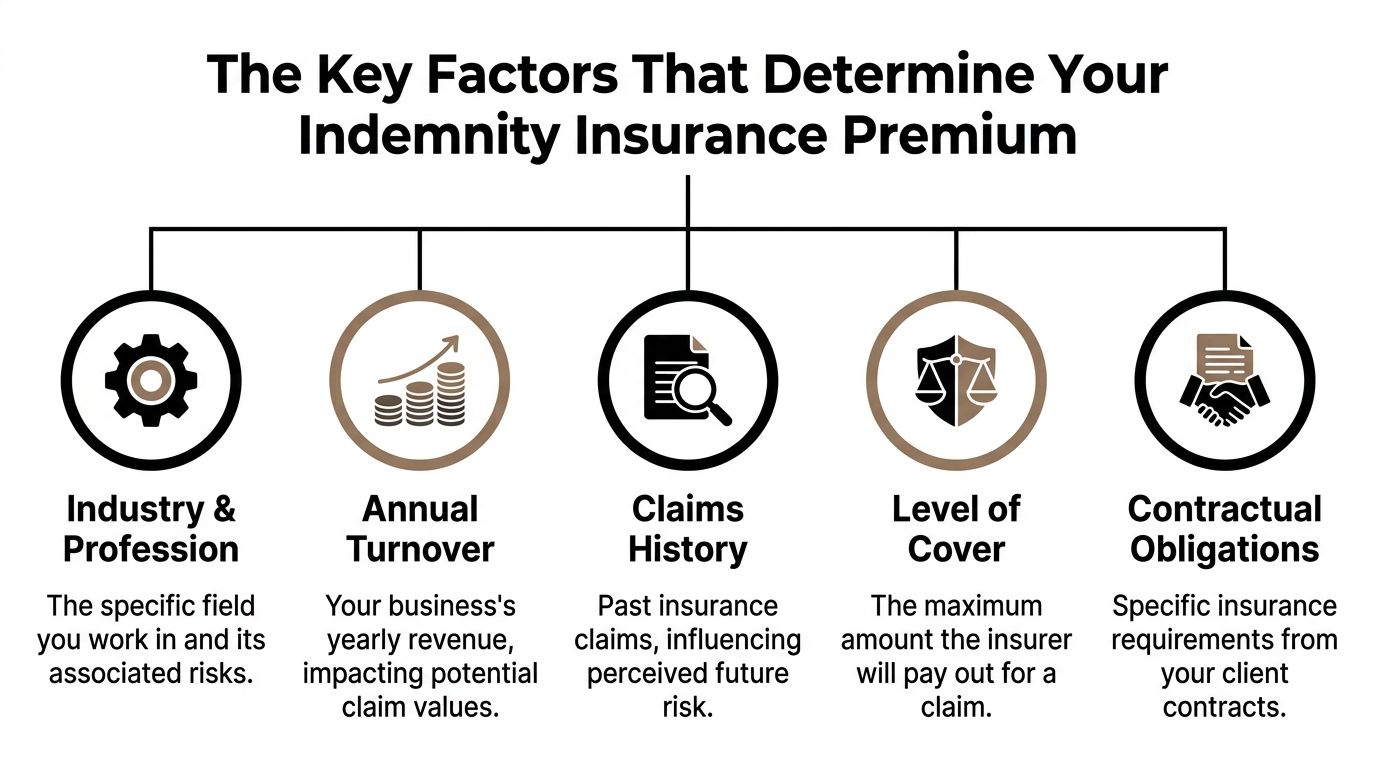
Professional indemnity premiums for UK professionals can vary by 5% to 50% across insurers because underwriting is highly individual, and factors such as turnover, claims history, and cover limits all shape the final price, as outlined by Wexford in its discussion of professional indemnity insurance cost.
Your profession and sector risk
This is one of the biggest pricing drivers.
Insurers ask a simple question first. If this person gets something wrong, how expensive could the consequences be?
A contractor in a lower-risk advisory role may attract a lower premium than someone working in architecture, engineering, regulated financial services, or technical delivery where mistakes can trigger larger losses.
That is why “contractor” is too broad to mean much to an insurer. They want to know the exact work you do.
Examples of details that matter include:
- Whether you give regulated or specialist advice
- Whether your work affects systems, financial outcomes, or compliance
- Whether clients rely heavily on your judgement
- Whether an error could delay a project or increase project costs
Your annual turnover
Turnover gives the insurer a rough sense of the size of your operation and the scale of work you handle.
Higher turnover does not automatically mean you are careless. It usually means you do more work, deal with larger contracts, or take on greater exposure. That can increase the potential value of a claim.
Insurers often use turnover as one way to estimate risk because a contractor managing bigger projects can create a bigger financial loss if something goes wrong.
Your claims history
A clean claims record usually helps.
If you have made previous claims, insurers may treat you as a higher risk, especially if the claims suggest repeated problems in the same area of work. On the other hand, a history of stable work with no claims can support better terms.
Behaviour over time matters here. Good record-keeping, clear contracts, and careful client sign-off can all help reduce disputes before they ever become claims.
Your level of cover
The cover limit is the maximum amount the insurer will pay for a claim, subject to the terms of the policy.
Clients often specify a minimum level of cover in the contract. Public sector and larger corporate clients are particularly likely to do this.
If a client wants a higher limit, your premium usually rises because the insurer is taking on more potential exposure. That does not mean the highest limit is always best. It means the right limit should match the work you do and the contracts you accept.
Your excess
The excess is the amount you agree to pay yourself if a claim arises.
In general, choosing a higher excess can reduce the annual premium. That can work well if you have cash reserves and want to control ongoing costs.
But it needs care. A cheaper premium is not much help if the excess would be painful to pay during a dispute.
A good rule: choose an excess you could realistically afford without disrupting rent, tax payments, or normal business cash flow.
Your contract terms
Contract wording influences risk more than many contractors realise.
If you sign agreements that accept wide liability, vague deliverables, or unrealistic performance obligations, insurers may see your work as more exposed. Clear contracts with sensible limits and precise scope can make your risk profile easier to insure.
This is especially relevant if you move between clients often. Every new contract can slightly change your exposure.
For contractors comparing standalone options, this guide to freelancer professional indemnity insurance is a practical next read.
Typical Indemnity Insurance Costs with Worked Examples
The most honest answer to “what does professional indemnity cost?” is, “it depends on what you do”.
Still, it helps to anchor that answer in real examples from the UK market.
One benchmark comes from architecture. According to the 2025 RIBA report, sole practitioner architects typically pay £2,500 to £5,000 annually for a minimum of £500,000 in professional indemnity cover, which shows how expensive cover can become in higher-risk professions (RIBA Benchmarking Report).
For lower-risk contractors, the cost is often much lower than that, but your exact figure depends on the factors already discussed.
Estimated Annual Professional Indemnity Insurance Costs 2026
| Profession | Annual Turnover | Cover Limit | Estimated Annual Premium |
|---|---|---|---|
| IT contractor | Lower turnover | £500,000 | Often lower than higher-risk technical professions, but varies by contract type and insurer |
| IT contractor | Higher turnover | £2 million | Usually higher than entry-level cover because of larger exposure and higher limit |
| Freelance writer or copywriter | Lower turnover | £500,000 | Often among the lower-risk end of the market, subject to client requirements |
| Management consultant | Mid-range turnover | £1 million | Depends heavily on advice risk, client sector, and policy wording |
| Architect sole practitioner | Practice turnover varies | £500,000 minimum | £2,500 to £5,000 annually based on the RIBA benchmark above |
| Engineer or design specialist | Varies | Varies | Often priced higher because claims can be severe |
The table stays general where hard UK-wide contractor data is not available. That is deliberate. It is better to be honest than to invent a neat but unreliable figure.
Worked example one
Sarah is an IT contractor. She works on implementation projects and a new client asks for £2 million of professional indemnity cover.
Her cost is likely to depend on several things at once:
- whether she only configures software or takes responsibility for business-critical systems
- whether she has ever had a prior claim
- whether the client contract pushes broad liability onto her
- whether she buys cover herself or accesses group insurance through an umbrella
Sarah might look at one quote and assume it is expensive because insurers dislike IT work. In practice, the quote may be high because the contract requires a larger limit or because the work touches critical systems.
Worked example two
David is a freelance writer producing website and thought leadership content.
His work may look lower risk than architecture or engineering, but that does not mean risk-free. A dispute could still arise if a client says content was misleading, late, or commercially damaging. He may need less cover than Sarah, but the exact amount still depends on his agreements and clients.
The key budgeting point for David is not to buy a policy just because it is cheap. He needs one that matches the liability he accepts in his contracts.
Worked example three
An architect working alone is in a different position entirely. The RIBA benchmark above shows that even a sole practitioner can face a substantial annual premium for relatively modest cover compared with the scale of claims that can arise in design work.
That example is useful because it reminds contractors that profession matters more than job title. Two self-employed people can both call themselves consultants and face very different indemnity insurance costs.
Helpful benchmark: if your work affects design, compliance, safety, regulated decisions, or major project outcomes, expect insurers to look at you more closely than they would a lower-risk advisory role.
How Umbrella Companies and IR35 Affect Your Insurance
For umbrella workers, professional indemnity can feel murky because you are not always buying it in the usual direct way.
Some umbrella companies include insurance within their service. Others include limited cover that may not fit every assignment. In some cases, a client contract may still require you to check whether the umbrella’s policy is sufficient for the work.
That is why the cheapest-looking umbrella is not always the cheapest overall.
Bundled cover through an umbrella
A group policy can be convenient.
You do not have to source the policy alone, compare technical wording, or handle renewals separately. In some cases, group buying power can make bundled cover more economical. Umbrella companies can often negotiate group insurance policies that reduce individual professional indemnity costs by 20% to 30% compared with buying standalone, and a 2025 ContractorUK survey cited in the same source suggested 40% of freelancers may overpay by not switching umbrellas for a better bundled deal (business.com discussion of indemnity insurance).
That convenience can make a real difference if you move between assignments or need insurance in place quickly.
Standalone cover you arrange yourself
A separate policy gives you more control.
That can be useful if:
- Your contract is unusual, and needs cover specific to a specialist service
- You work across several clients, with different insurance clauses
- You want control over limits and wording, rather than relying on a standard umbrella policy
- You need proof of specific cover, not just confirmation that the umbrella holds a general policy
The trade-off is administration. You need to choose the policy, understand the wording, and make sure it stays in force.
This short video gives a useful overview of the wider context around contractor insurance decisions:
Where IR35 comes in
IR35 affects how contractors work and how engagements are structured, especially when agencies and end clients want clear compliance around off-payroll rules.
Clients and agencies often become more cautious when a role sits inside IR35 or when the wider engagement model brings extra scrutiny. If you want a broader explainer on the way flexible labour models interact with off-payroll compliance, this piece on the contingent workforce and IR35 rules provides useful context.
From an insurance point of view, the practical questions are:
- who holds the policy
- whose work is covered
- whether the cover limit meets the contract requirement
- whether your particular assignment falls within the policy description
A simple comparison
| Option | Main advantage | Main drawback |
|—|—|
| Umbrella bundled insurance | Convenient and often cost-effective | May be generic or limited for specialist work |
| Standalone policy | Customized and under your control | More admin, more decisions, separate cost |
If your assignments regularly mention insurance clauses, checking the detail matters. This overview of IR35 insurance is useful when you want to understand how cover sits alongside the broader compliance picture.
Tip: never assume “insured” means “fully suitable for this contract”. Ask what the policy covers, the limit, the excess, and whether your services fall inside the wording.
Practical Steps to Reduce Your Indemnity Insurance Cost
Good news first. You are not powerless here.
A lot of contractors treat insurance as a fixed expense, but insurers do respond to lower-risk behaviour and better information. In early 2025, insurers in the UK professional indemnity market were offering discounts of 5% to 15% for firms that could show good claims histories and strong internal risk management procedures, according to Bellrock Advisory’s professional indemnity market update for January 2025.
Match the cover to the contract
Do not buy the largest limit just because it sounds safer.
Start with the requirements in your client contract, then sense-check whether that level reflects the work you do. Paying for an unnecessarily high limit can push up your premium without adding meaningful protection.
Improve the things insurers look at
Process matters here.
If you can show that you work carefully and consistently, you are easier to insure. Useful habits include:
- Clear statements of work, so both sides agree what you are delivering
- Written client sign-off, especially for milestones or final outputs
- Change control, so extra work does not creep outside the original agreement
- Good records, including emails, approvals, and version history
- Prompt issue reporting, so small concerns do not turn into large disputes
These habits are good business practice anyway. They also help support a cleaner risk profile.
Consider a higher excess carefully
If cash flow allows, choosing a higher excess may lower the annual premium.
But be realistic. Insurance should make financial shocks easier to absorb, not create a new one. A lower premium can be false economy if the excess would be unaffordable during a dispute.
Keep your claims record clean where possible
Not every disagreement becomes a claim. Often, strong communication and tidy documentation can stop a misunderstanding from escalating.
That does not mean avoiding legitimate notifications. It means reducing avoidable disputes through better process.
Compare the whole arrangement, not just the headline price
This matters especially for umbrella workers.
A lower umbrella margin does not always mean lower total cost if the insurance included is weak or unsuitable. Likewise, a standalone policy with a slightly higher premium may be better value if it properly covers the contracts you take.
When comparing options, ask for clarity on:
- What type of professional indemnity cover is included
- Whether your profession is covered
- What the limit is
- Whether the policy is enough for your client contracts
- Whether there are exclusions you should know about
Practical rule: look at indemnity insurance cost in the context of your full working setup, not as an isolated line item.
Frequently Asked Questions About Indemnity Insurance
Do I still need professional indemnity insurance if I work inside IR35
Sometimes yes, sometimes no. It depends on the contract, the client, and whether the umbrella company already provides suitable cover.
The important point is not your IR35 status on its own. The important point is whether your engagement requires professional indemnity and whether the policy in place covers your work.
Can I pay monthly instead of annually
Many insurers and brokers offer monthly payment options, but the exact arrangement depends on the provider. Some contractors prefer annual payment to keep the total cost simpler. Others choose monthly instalments for cash flow reasons.
Check whether paying monthly changes the overall amount payable and whether any finance arrangement applies.
What happens if I need to make a claim
You usually notify the insurer as soon as you become aware of a claim or a circumstance that might lead to one.
The insurer then reviews the facts, the policy wording, and the timeline. They may appoint solicitors or claims handlers. The key practical point is to notify promptly and avoid admitting liability before taking advice.
Will making a claim increase future costs
It can. Insurers often look at claims history during renewal.
That does not mean you should avoid using the policy when you need it. It means you should keep records, report issues early, and understand how the insurer wants notifications handled.
How do I know whether an umbrella company’s insurance is enough
Ask for the policy summary or confirmation of cover and compare it with your contract requirements.
Check four things in particular:
- The type of cover
- The cover limit
- Any exclusions relevant to your work
- Whether your profession or service type is included
If your client asks for a specific limit or wording, do not rely on assumptions.
Is professional indemnity the same as public liability
No. Professional indemnity deals with claims that your professional service caused financial loss. Public liability deals with injury or property damage claims involving third parties.
A contractor can need one, both, or neither, depending on the work and the contract.
Securing the Right Cover at the Right Price
Professional indemnity is not just another deduction to grumble about. It protects your income, your reputation, and your ability to keep working when a dispute appears.
The price you pay is shaped by your work, your contracts, your cover level, and how well you manage risk day to day. If you use an umbrella company, bundled insurance can be excellent value, but only if it fits the assignments you take.
It also helps to think about protection more broadly. If you are reviewing business risk beyond client claims, resources such as this guide to Investigation Insurance can help you understand where specialist cover may fit.
The smart move is simple. Check the contract, check the policy, and compare the total arrangement rather than chasing the lowest headline number.
If you want help comparing umbrella providers with the right support for your contract type, pay rate, and IR35 position, Umbrella Company can help you review your options quickly and choose a setup that protects both your earnings and your peace of mind.


