


Let's clear up a common misconception first. Standard income protection is your financial backstop if you're signed off work due to illness or injury. But here's the crucial part: it does not typically cover you if you are made redundant.
Redundancy is a completely different situation. It's a separate risk that needs its own specialist policy, often called unemployment cover, which you can sometimes get as an add-on or as a standalone plan. This guide explains the key differences and what contractors need to know.
Understanding Income Protection vs Redundancy Cover
Losing your income, whether through an unexpected illness or a sudden redundancy, is a massive worry for any professional. For contractors, the lack of a traditional employment safety net can make the concern feel even more acute.
It's vital to understand that insurance policies are built to cover very specific risks. Getting them mixed up can leave you dangerously exposed right when you need financial support the most.
Think of it like this: standard income protection is there to replace a portion of your earnings if a doctor says you're not fit to work. It is purely for health-related events. On the other hand, redundancy cover is designed specifically for when your role is eliminated for business reasons. The triggers for a claim are worlds apart.
What’s the Core Difference?
The main distinction boils down to why you have stopped working.
Standard income protection policies are crystal clear: the cause must be medical. If you are perfectly fit and able to work but your contract is terminated or your role is made redundant, a standard policy simply will not pay out. This is a common and costly misunderstanding.
For contractors, this is even more critical. The natural end of a contract isn't the same as being made redundant from a permanent job, which can add another layer of complexity. You need a policy that explicitly names and covers involuntary unemployment.
This simple flowchart helps to clarify which cover you might need.
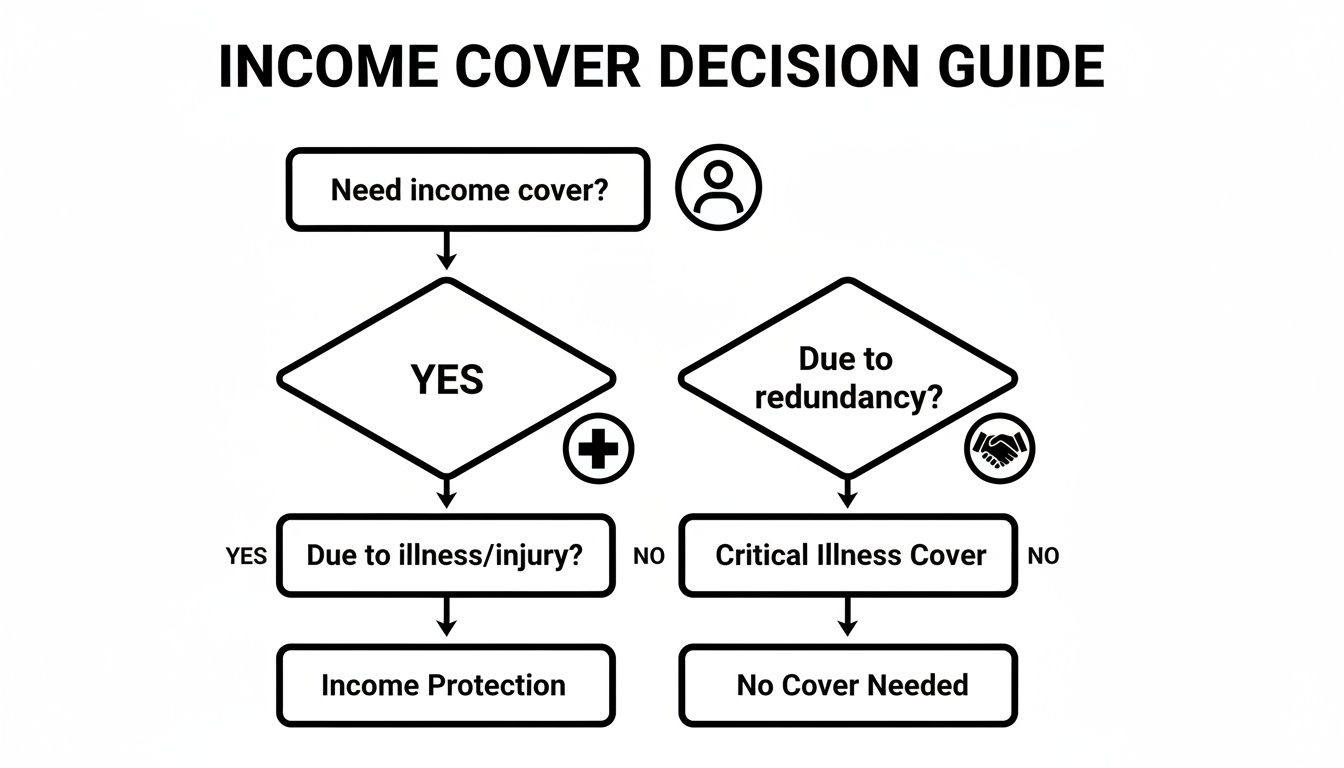
As you can see, the reason you need cover dictates the type of insurance you need, pointing you toward either health-based protection or job-loss-based protection.
To quickly highlight the different purposes of each insurance type, this table helps identify which cover might match your needs as a contractor.
Income Protection vs Redundancy Cover at a Glance
| Feature | Standard Income Protection | Redundancy or Unemployment Cover |
|---|---|---|
| Primary Purpose | Replaces income if you can't work due to illness or injury. | Replaces income if you lose your job through no fault of your own (involuntary redundancy). |
| Claim Trigger | A medical diagnosis or injury that prevents you from working. | Formal notification of redundancy from your employer or end client. |
| Typical Payout | Monthly tax-free payments, often after a deferred period (e.g., 1-12 months). | Monthly tax-free payments, usually after a waiting period (e.g., 30-90 days). |
| Who Is It For? | Almost all working individuals, especially the self-employed and contractors with no sick pay. | Employees and some contractors concerned about job security and market volatility. |
This at-a-glance view makes it clear: these are two distinct products for two very different problems. Relying on one to do the job of the other can lead to financial difficulty.
Securing the Right Protection
To build a truly robust financial plan, you have to look at both risks separately. This means thinking about your health, the stability of your industry, and the typical length and nature of your contracts. You can often find providers that bundle these protections together, but remember, they are still two distinct products.
For a contractor, having the right insurance isn't just about peace of mind; it's a fundamental part of managing your business and career. Your income is your greatest asset, and protecting it from all angles is essential for long-term stability and success.
To get a clearer picture of your options, it's well worth exploring different types of contractor insurance in the UK. Many specialist providers build packages that cater to the unique needs of independent professionals, often combining essential liability cover with personal income protection plans.
Why Is Redundancy Such a Big Deal for Contractors?

The freedom and flexibility of contracting are brilliant, but they come with a trade-off: much less job security. While permanent staff often have the safety net of long notice periods and statutory redundancy pay, contractors are usually the first to be let go when a client needs to tighten its belt.
This isn't a reflection of your skills or how well you're doing the job. It’s just the nature of project-based work. When a company cuts its budget or changes direction, ending a contractor's agreement is often the simplest and fastest way to reduce spending.
This built-in instability means contractors are far more exposed to shifts in the economy, making solid financial planning an absolute must.
The UK Labour Market Is Shifting
Recent trends in the UK economy have increased the risk of redundancy for everyone, but contractors are feeling it most acutely. Changes to tax policy and wider economic pressures are pushing many businesses to rethink their hiring plans and overall headcount.
The UK has seen the biggest surge in redundancies in a decade (outside of the pandemic), partly driven by tax changes affecting employers. The CIPD's Labour Market Outlook, which surveyed over 2,000 employers, found that a significant 32% of businesses are planning to cut staff through redundancies or reduced hiring. It’s a clear sign of dwindling employer confidence.
This creates a tough environment where there’s more competition for contracts and a greater chance of unexpected gaps between projects.
For contractors, economic uncertainty isn't just something you read about in the news; it's a direct threat to your income. Preparing for a contract to end early is no longer a 'nice-to-have'. It's a core part of managing your professional risk.
Why Are Contractors Often First on the Chopping Block?
When a business is feeling the financial squeeze, it looks for the quickest way to save money. Because contractors operate outside the usual payroll and employment law framework, they're often the most straightforward option.
Several things make contractors more vulnerable:
- Simpler Termination: It’s typically much faster and involves less red tape to end a contract than to make a permanent employee redundant.
- Project-Based Work: Many contracts are tied to specific projects. If that project gets scaled back or scrapped, the contractor roles linked to it are the first to go.
- Budget Flexibility: Contractor fees are often seen as operational costs, which can be easier for a company to cut from the budget than permanent staff salaries.
This is especially common in sectors like IT, finance, and project management, where big projects lean heavily on specialist, flexible talent. As soon as the project pipeline dries up, contractors feel the impact almost straight away.
The Need for a Personal Safety Net
Unlike permanent employees, contractors do not usually get statutory redundancy pay. The responsibility for building a financial cushion rests entirely on you. Just relying on your savings can be a risky game, particularly if a contract ends without warning and finding a new one takes longer than you'd hoped.
This is where specialist income protection redundancy cover becomes so vital. It acts as your personal safety net, providing a monthly income to cover your bills and essentials if you are made redundant.
Having this protection in place means you can navigate the job market without a sense of panic, knowing your finances are secure. It gives you the breathing space to find the right next role, rather than feeling forced to take the first contract that comes along. For a deeper dive into the business side of freelancing, you might find our guide on contracting in business useful.
How to Find the Right Redundancy Policy
Navigating the world of insurance can feel like trying to decipher a new language. When you're looking for a policy to cover redundancy, you'll come across very specific terms, and understanding them is crucial. Getting it right can be the difference between a policy that pays out when you need it and one that lets you down.
At its core, a good policy is transparent and fits your professional life perfectly. As a contractor, your situation is very different from a permanent employee's, so you have to dig into the details to make sure the cover is right for how you work.
Decoding Key Policy Features
To properly compare policies, you first need to get to grips with the building blocks that define how your cover works. Two of the most important are the deferment period and the payout duration. These features directly shape both the cost of your premium and the support you’ll get if you ever need to claim.
Deferment Period: Think of this as the waiting time between being made redundant and when the monthly payments begin. It can be anywhere from 30 days to 120 days or more. In essence, it's like the excess on your car insurance. A longer deferment period usually brings your monthly premium down, but it also means you’ll need a bigger emergency fund to see you through that initial gap.
Payout Duration: This simply dictates how long the policy will pay you a monthly income after your claim is approved. These policies are designed as a short-term safety net, so most will offer payouts for a period of 6 or 12 months. The idea is to give you a stable financial footing while you line up your next contract.
Understanding these two elements is the first step. For example, a policy with a 60-day deferment and a 12-month payout means you would have to cover your own costs for two months before the insurer starts paying out for the next year.
Watch Out for Common Exclusions
The small print is where an insurance policy really shows its true colours. Insurers are incredibly specific about what they will and will not cover, and knowing these exclusions upfront is essential if you want to avoid any nasty surprises down the line.
The best way to choose a policy isn't just to look at what it covers, but to properly understand what it explicitly excludes. This knowledge is your power, allowing you to pick cover that provides genuine, reliable protection without any hidden clauses that could trip you up later.
Here are some of the most common reasons a redundancy claim might be rejected:
- Voluntary Redundancy: If you put your hand up and choose to take a redundancy package, your policy will not pay out. The cover is strictly for involuntary unemployment.
- Dismissal for Misconduct: Losing your job because of poor performance or misconduct is not the same as redundancy and won't be covered.
- End of a Fixed-Term Contract: This is a huge one for contractors. Some standard policies won't cover the natural end of a contract, so you need to find one that is specifically designed for this scenario.
- Initial Exclusion Period: Nearly all policies have a waiting period right at the start, often around 120 days, where you cannot claim for redundancy. This is to stop people from taking out cover when they already know redundancies are on the horizon.
- Public Sector Roles: Due to different employment structures, some insurers have different terms or may not cover certain public sector roles at all.
What Insurers Look for During Application
When you apply for income protection redundancy cover, the insurer is trying to figure out your risk profile. They want to get a clear picture of your employment stability and how likely you are to make a claim.
Be ready to provide details about your role, industry, and your work history. They will likely ask how long you have been working continuously and might require you to have been with your current client or on a contract for a minimum period, say six months, before you can even apply. Being transparent here is absolutely key to making sure your policy is valid when you need it.
For related protections, many contractors also look into specific policies that cover their business risks. You can learn more about this by exploring our guide on IR35 insurance, which is another important consideration for independent professionals.
Unique Challenges for Umbrella Company Contractors

Working through an umbrella company gives you flexibility, but it also puts you in a slightly unusual employment spot. You’re an employee of the umbrella company, not the business you’re actually doing the work for. This structure creates some real headaches when a contract ends, especially around financial safety nets like redundancy pay and insurance.
Understanding this is crucial. Unlike a permanent employee, you aren’t made redundant by your end client; your assignment simply finishes. That distinction might sound small, but it’s a massive deal when it comes to claiming on an income protection redundancy policy. Insurers have very specific definitions for what counts as being made involuntarily unemployed.
The Statutory Redundancy Pay Problem
One of the biggest hurdles for umbrella contractors is the near-total lack of access to statutory redundancy pay. In the UK, you generally need to have worked for the same employer continuously for at least two years to qualify.
While you’re technically an employee of the umbrella company, your individual assignments with different clients are seen as separate bits of work. Unless you have a special overarching contract of employment that guarantees continuous work, the end of a project isn't a redundancy in the eyes of the law. It’s just the natural end of the agreement.
This leaves a huge gap in your financial defences compared to a traditional employee. It makes private insurance feel less like a sensible extra and more like an absolute necessity.
Proving Involuntary Unemployment
Here’s the core challenge: when you make a claim, you have to prove you were made redundant against your will. Insurers want to see that you lost your job through no fault of your own, but the standard proof (a formal redundancy letter) is something you’re unlikely to ever get.
From an insurer's perspective, a contract ending can just look like the expected conclusion of a fixed-term project. To have any chance of a successful claim, you need a policy that was specifically built for contractors and which explicitly recognises the end of an assignment as a valid reason to pay out.
For umbrella contractors, the small print in an insurance policy is everything. You have to find a provider that genuinely understands the nuances of contract work and clearly states that the non-renewal or early termination of a contract counts as involuntary job loss. Without that specific wording, you are almost guaranteed to have your claim rejected.
This is exactly where a specialist broker can be invaluable. They can navigate the market to find policies designed for the unique setup of an umbrella company for freelancers, making sure your cover actually matches the reality of how you work.
The table below highlights just how different the financial safety nets are for permanent staff versus umbrella contractors, making the case for private cover even clearer.
Financial Safety Nets for Permanent Employees vs Umbrella Contractors
| Financial Protection | Permanent Employee | Umbrella Company Contractor |
|---|---|---|
| Statutory Redundancy Pay | Yes, after two years of continuous service. | No, the end of a contract is not a legal redundancy. |
| Notice Period Pay | Yes, entitled to statutory and/or contractual notice pay. | Yes, but typically much shorter (e.g., 1-4 weeks). |
| Unfair Dismissal Rights | Yes, can claim after two years of service. | No, a contract ending is not a dismissal. |
| Automatic Pension | Yes, automatically enrolled into a workplace pension. | Yes, but relies on the umbrella company's scheme. |
| State Benefits | Yes, subject to eligibility criteria. | Yes, subject to eligibility criteria. |
| Private Insurance | Optional, but a good idea for extra security. | Essential, to cover the gap left by statutory protections. |
As you can see, the protections automatically afforded to permanent employees simply aren’t there for contractors. This reinforces the need to build your own robust financial buffer through specialist insurance.
How IR35 Influences Your Situation
The off-payroll working rules, better known as IR35, throw another spanner in the works. If your contract is deemed 'inside IR35', you’re treated like an employee for tax purposes. But here’s the catch: while you pay tax and National Insurance just like a permanent employee, you do not get the same employment rights, including that all-important statutory redundancy pay.
You end up with the tax responsibilities of an employee but none of the security that should come with it. In a shaky economic climate, this is a real problem. For example, recent ONS data showed UK redundancy levels hitting 156,000, while the number of payrolled employees dropped by 184,000 year-on-year. Contractors inside IR35 are hit hardest in this kind of market, with no automatic redundancy pay to soften the blow.
The Need for a Robust Financial Buffer
Given all these challenges, just relying on your savings is a risky game. The downtime between contracts can be unpredictable, and an emergency fund can vanish much faster than you would think.
A proper income protection redundancy policy is a structured, reliable buffer. It’s designed to provide a monthly income, usually for up to 12 months, giving you the stability to find your next contract without panicking. It allows you to keep up with your bills and focus on securing a role that fits your skills and ambitions, rather than grabbing the first thing that comes along out of desperation.
How to Make a Successful Insurance Claim
Losing a contract is stressful enough without a complicated insurance claim on top. But a little bit of preparation can make all the difference, letting you focus your energy on landing your next role instead of chasing paperwork.
The key is to act fast and be methodical. The very first thing you should do is dig out your policy documents and read them again, carefully. Think of this as your instruction manual. It lays out exactly what your insurer needs, how they define redundancy, and the specific steps you need to follow.
Your First Steps After Redundancy
Once you get the news, the clock starts ticking. Do not put it off; get in touch with your insurer as soon as you can. Most policies have a strict time limit for reporting a claim. This first call gets the ball rolling and gets a claims handler assigned to your case.
Next up, it’s time to gather your evidence. This is where being organised really pays off. Your insurer will want to see clear proof that your contract was terminated involuntarily and that it fits their definition of redundancy.
Typically, you will need to pull together:
- Proof of Redundancy: This is usually the official letter or email from your client or agency confirming your contract has ended.
- Contractual Documents: Keep your most recent contract handy. It shows your role, your rate, and when the project was originally meant to finish.
- Proof of Income: You’ll need payslips from your umbrella company to show what you were earning before you were made redundant.
- Identification: They will also ask for standard ID, like a copy of your passport or driving licence.
Having all this ready to go in one place will seriously speed things up.
Communicating Effectively with Your Insurer
When you speak to your insurance provider, be open and honest. They will have questions about your situation, so be ready to give them the full picture. Getting them all the information they ask for quickly and accurately is the best way to avoid hold-ups.
It’s a good idea to keep a log of every phone call and email. Note down dates, times, and who you spoke to. It helps you keep track of progress and creates a clear timeline if you need it. And if there's anything you're not sure about, do not be afraid to ask for clarification.
It turns out that a lot of UK workers have been in this boat. A study by MetLife found that a staggering 41% of us have been made redundant or had a long-term illness at some point. Despite this, only 15% actually have income protection, which shows a huge gap in our financial safety nets. You can find more insights in this UK worker study about why having that backup is so important.
Managing Your Finances During the Deferment Period
It’s crucial to remember that your payments won’t start the day you lose your contract. Nearly all policies have a deferment period, a built-in waiting time before the money starts coming in. This can be anything from 30 to 120 days, and you will need to cover your costs from your own pocket during this gap.
This is where an emergency budget is non-negotiable. Have a serious look at your outgoings and see where you can trim your spending for a little while. Make sure essentials like your mortgage, rent, bills, and food are covered first. A lean budget will make your savings stretch further and take a huge amount of financial stress off your shoulders while you wait for that first payment. Getting this right, alongside a successful claim, gives you the stable ground you need to go out and find your next great contract.
Common Questions About Redundancy Cover

To help you make a properly informed decision, we have pulled together clear, no-nonsense answers to the questions we hear most often from contractors. This section gets straight into the practical side of things, putting all the key details you need in one place.
Our goal is to tackle any lingering uncertainties you might have, building your confidence so you can choose the right path. Think of this as a complete resource you can come back to whenever you need a quick refresher.
How Much Does Redundancy Cover Cost for a Contractor?
There’s no single price tag. The cost of your premium will hinge on several factors, including your age, your line of work, the percentage of income you want to protect, and the length of your deferment period. It stands to reason that higher-risk occupations or policies that pay out for longer will come with a higher premium.
The best advice is always to shop around and get quotes from a few different providers. This is the only way to find a policy that gives you comprehensive cover without an eye-watering premium that does not fit your contracting budget.
Can I Get This Cover as a Limited Company Director?
Yes, you absolutely can, but it’s crucial to understand that the policy terms are often quite different. For directors, a claim is typically triggered by the company ceasing to trade or going into liquidation, not just a single contract coming to an end.
The key here is proving that the loss of work was genuinely ‘involuntary’. You have to dive into the policy wording to make sure it aligns perfectly with your business structure and the reality of how you operate.
Understanding the small print is non-negotiable. A policy is only valuable if its claim triggers match the real-world risks you face as a director, making careful review essential before you commit.
What Is a Deferment Period vs an Exclusion Period?
These two terms sound similar, but they do very different jobs. It’s vital not to get them mixed up.
A deferment period is the waiting time between your claim being approved and you receiving your first payment. You choose this when you take out the policy; common options are 30 or 90 days. A longer deferment period usually means a lower monthly premium.
An exclusion period is a fixed window at the very start of your policy, often the first 120 days, during which you cannot claim for redundancy at all. This is simply a safeguard for insurers to stop people from taking out cover when they already know redundancy is on the horizon.
Are Payouts from Redundancy Cover Taxable?
In most cases, no. If you pay the premiums personally from your after-tax income, the monthly payouts you receive are not subject to UK income tax. This is a massive plus, as it means every penny of the benefit goes towards supporting you.
However, if your limited company pays for the policy, the payouts could be treated as taxable income. We strongly recommend getting professional advice from a financial advisor to clarify how this would apply to your specific situation.
Navigating the world of contractor insurance can feel complex, but you do not have to do it alone. At UmbrellaCompany.com, we specialise in helping contractors find the right solutions for their needs. Compare trusted, compliant umbrella companies and get expert guidance to protect your income and career.
Find your perfect fit at UmbrellaCompany.com.


