


Deciding to switch from an umbrella company to your own limited company means you’re shifting from being an employee to a business director. It is a big step. You will need to register a new company, take on full financial responsibility, and in return, you get much greater control over your tax affairs. For contracts outside IR35, this almost always leads to higher take-home pay.
Is It Time to Move from an Umbrella to a Limited Company?
Making the leap from the simple life of an umbrella company to the freedom of your own limited company is a major decision for any contractor.
An umbrella company is a straightforward, low-admin payroll solution. It works much like a standard job, with tax and National Insurance deducted for you via PAYE. For many, especially those on short-term contracts or working inside IR35, it is the perfect setup. If you are looking for more detail on this structure, our guide explains what an umbrella company is and how it works.
But as your contracting career takes off, you might find the constraints of an umbrella service no longer fit your financial goals or professional ambitions. The main reason contractors start looking elsewhere? More financial control and better tax efficiency.
Why Contractors Make the Switch
The move is about more than just paperwork; it is a fundamental change in how you see yourself as a professional. Adopting something like the leveraged entrepreneur mindset can be a real eye-opener here.
Contractors often decide to switch when they are ready to:
- Improve Tax Efficiency: By taking a smaller salary and paying the rest in dividends, which are taxed at a lower rate.
- Gain Financial Control: You get direct oversight of your business income, expenses, and profit. No more waiting on payslips to see where your money went.
- Build a Brand: You can establish a professional business identity that can grow, take on multiple clients, and build a reputation.
- Claim More Expenses: You can deduct a much wider range of legitimate business costs, from office equipment and software to professional development courses.
Data shows these are the primary drivers. UK contractors consistently move to a limited company structure to get a better handle on their finances and improve tax planning. Dividend payments and a broader scope of claimable expenses, like office costs and training, are often heavily restricted under an umbrella setup.
To help you weigh the options, here is a quick comparison of the two structures.
Umbrella Company vs Limited Company: A Quick Comparison
| Feature | Umbrella Company | Limited Company |
|---|---|---|
| Legal Status | You are an employee of the umbrella company. | You are a director and shareholder of your own company. |
| Admin Burden | Very low. The umbrella handles payroll and tax. | Higher. You are responsible for all admin and compliance. |
| Tax Efficiency | Lower. All income is taxed via PAYE. | Higher (for outside IR35). You can use salary and dividends. |
| Expense Claims | Limited. Restricted to what HMRC allows for employees. | Broader. You can claim a wider range of business costs. |
| Control | Low. You are essentially an employee. | High. Full control over business finances and decisions. |
| IR35 Risk | Low. The umbrella handles IR35 compliance. | Higher. The responsibility for IR35 status rests with you. |
| Setup | Fast and simple. Can be done in under an hour. | More involved. Requires company registration and bank accounts. |
As you can see, a limited company offers more control and financial benefits, but that comes with more responsibility. The umbrella route is simpler but less flexible.
A key indicator that it might be time to switch is the IR35 status of your contracts. If you consistently secure work that is determined as 'outside IR35', operating as a limited company almost always becomes the more financially advantageous option.
Ultimately, the decision comes down to your personal circumstances. Are you ready for the added responsibility of being a company director? Do your contracts support the move? Answering these questions honestly is the first real step on your journey toward becoming your own boss.
Understanding IR35 and Your Contractual Obligations
The entire decision to leave an umbrella company for your own limited company boils down to one critical piece of legislation: IR35. It is also known as the off-payroll working rules.
Getting this right is not just a box-ticking exercise; it is the absolute foundation of running your business compliantly and tax-efficiently. A misstep here could lead to some very serious and expensive problems with HMRC down the line.
At its core, IR35 is all about figuring out if a contractor is a genuine business, or if they are really a ‘disguised employee’ for tax purposes. If your day-to-day working practices look a lot like a regular employee's, your contract will be deemed 'inside IR35'. When that happens, the tax advantages of a limited company disappear, and sticking with an umbrella company is almost always the smarter choice.
But if your contract and the way you work show you are genuinely self-employed, your engagement is 'outside IR35'. This is the green light you need. It allows you to operate through your limited company and benefit from a much more tax-efficient structure, typically involving a low salary topped up with dividends.

Determining Your IR35 Status
Since the rules changed in April 2021, the responsibility for deciding your IR35 status usually sits with your end client (for most private sector contracts). But that does not mean you can just take their word for it. As the director of your own company, you have to do your own homework. You need to be confident that their determination is correct to protect your new business.
HMRC looks at a few key things to make this call:
- Control: How much does the client dictate how, when, and where you do the work? The less control they have, the better your case for being outside IR35.
- Substitution: Can you send a qualified substitute to do the work instead of you? Having a genuine right of substitution is a massive pointer towards being a real business.
- Mutuality of Obligation (MOO): Is the client required to keep offering you work, and are you required to take it? A lack of this mutual obligation is a good sign you are operating outside IR35.
Grasping these concepts is non-negotiable. If you are ever in doubt, you absolutely must get professional advice or dig into a detailed guide on what IR35 is and how it affects your specific situation.
Updating Your Contractual Agreements
Once you are sure your contract is outside IR35, it is time to let your agency and end client know you are making the switch. This is more than just a quick email; it means your contracts need a formal update.
Your current agreement is with your umbrella company. The new one will be a direct, business-to-business contract between your new limited company and the agency or client.
This new contract must reflect that business-to-business relationship. It should clearly name your limited company as the service provider and include clauses that back up your outside IR35 status, things like focusing on deliverables, project-based work, and your rights as an independent supplier. Handling this switch professionally from the start ensures a smooth transition and helps shield your business from any future questions from HMRC.
Setting Up Your New Limited Company
So, you have decided a limited company is the right move for your contracting career. Excellent. Now comes the practical bit: actually setting it up. It is true that this involves a few more hoops to jump through than joining an umbrella company, but it is a perfectly manageable process when you take it one step at a time. This is where you officially create your own business entity.
First things first, you need a name for your company. This is not just a creative branding exercise; your chosen name has to be unique and not already on the books at Companies House. It also cannot be offensive or cheekily suggest you are connected with the government unless you have got special permission.
The Registration Process
Once you have landed on a name, it is time to make it official by registering with Companies House, the UK's registrar of companies. The good news is the online process is surprisingly quick, often taking less than 24 hours.
You will need to have a few key details ready for the registration:
- A registered office address: This must be a physical UK address where official mail can be sent. Bear in mind, this address becomes public record.
- At least one director: As a contractor setting up on your own, this will almost certainly be you.
- At least one shareholder: Again, this will typically be you, holding 100% of the company shares.
- A Standard Industrial Classification (SIC) code: This is just a simple code that tells everyone what your business actually does.
This infographic breaks down the core steps to get your company registered and ready to trade.
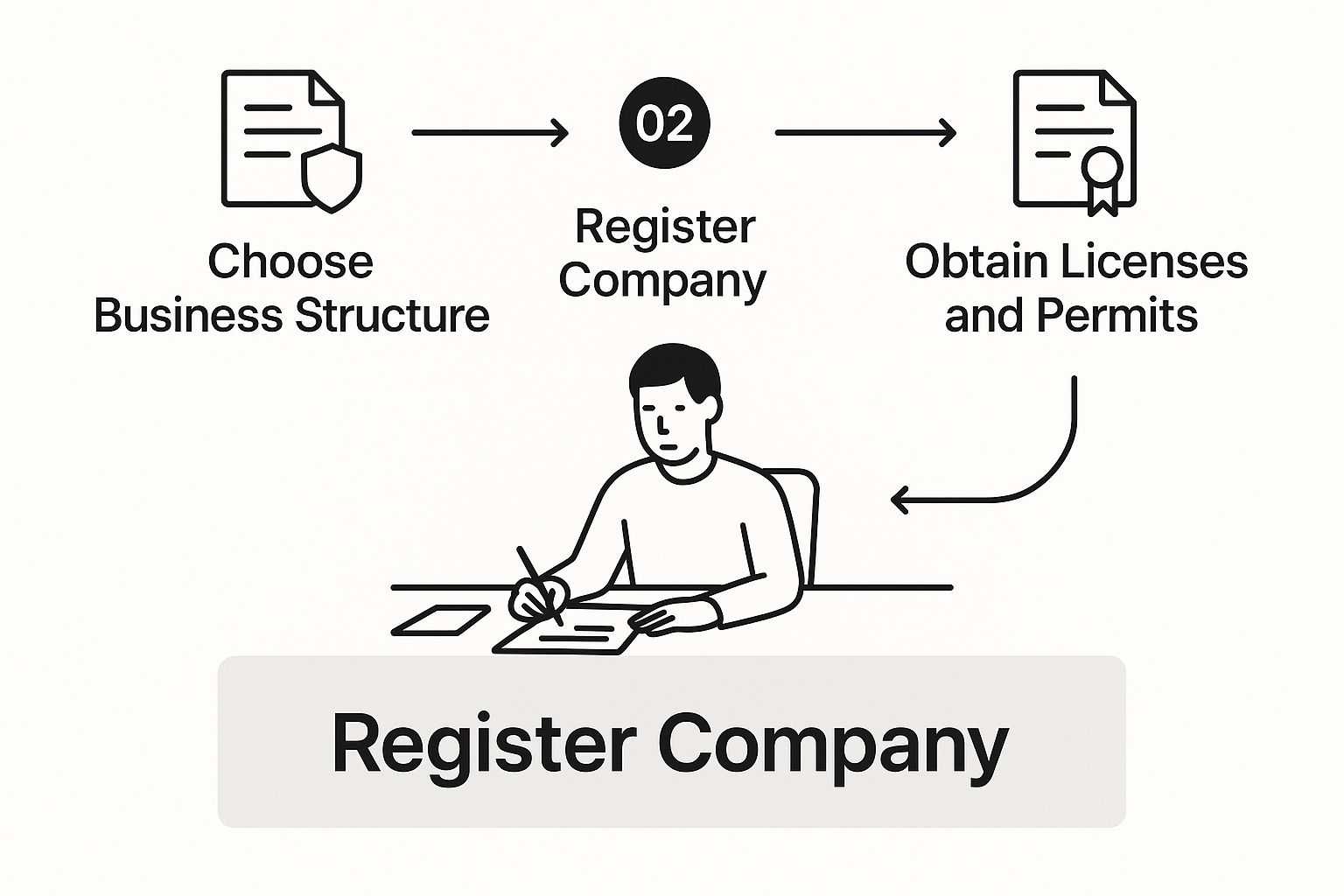
As you can see, registering the company is the formal starting line. It creates that crucial legal separation between your personal finances and the business's.
Essential Next Steps
Getting the company formed is a huge milestone, but it is really just the beginning. To operate properly and stay on the right side of the law, a few more tasks are non-negotiable. One of the most critical is opening a dedicated business bank account. This is a legal must-have. It keeps your company's money completely separate from your personal cash, which is fundamental to protecting your limited liability status.
Do not overlook the importance of professional support from day one. So many new directors fall into the trap of trying to juggle everything themselves, which can easily lead to expensive compliance headaches down the line. A good accountant ensures you are set up correctly for Corporation Tax, VAT, and PAYE right from the start.
Appointing a specialist contractor accountant is an absolute game-changer. They will not just handle the company formation for you; they will also advise you on the most tax-efficient way to structure your salary and dividends. Our guide on finding the best accountant for limited company contractors has a lot more detail on what to look for.
Finally, you need to think about getting the word out. To make sure your new company thrives, you need a steady stream of work, and online visibility is key. This comprehensive SEO guide for contractors is a great resource for improving your search engine rankings. Nailing these initial steps puts you on a strong, compliant footing, making the switch from an umbrella to a limited company a smooth and successful one.
Managing Your Company Finances and Tax Duties
When you leave the umbrella world and set up your own limited company, you effectively become your own finance director. It is a big shift in responsibility, for sure, but this is where the real rewards of being your own boss kick in. Instead of your pay being processed and deductions handled for you, you are now firmly in the driving seat.
This means you are responsible for everything from raising professional invoices for your clients to meticulously tracking every single business expense. Keeping good records is not just a box-ticking exercise; it is a legal requirement and will save you a world of pain down the line.
Understanding Your Key Tax Obligations
As a company director, you will need to get to grips with a few key taxes that were probably invisible to you under an umbrella setup. Keeping HMRC happy is now your number one priority.
The main taxes you will be managing are:
- Corporation Tax: This is a tax levied on your company's profits. At the end of your financial year, you have to prepare annual accounts, file a Company Tax Return, and pay any tax that is due.
- VAT (Value Added Tax): You are legally required to register for VAT if your company’s turnover crosses the current threshold, which is £90,000. That said, many contractors choose to register voluntarily well before they hit that figure.
- Self-Assessment: Because you will likely be taking income from dividends as a company director, you must file a personal Self-Assessment tax return each year to declare it.
Juggling these new duties can feel a bit overwhelming at first, which is exactly why getting expert support is so crucial. Our in-depth guide to accounting for contractors is a great place to start for a deeper dive into these financial responsibilities.
Paying Yourself The Smart Way
One of the biggest financial upsides of running a limited company is the flexibility you have in how you pay yourself. It is a world away from an umbrella arrangement where all your earnings are hit by PAYE tax and National Insurance.
Most contractors opt to pay themselves through a smart combination of a small salary and dividends. The salary is usually set at a level just high enough to qualify for state benefits like the State Pension, but low enough to keep PAYE tax and National Insurance contributions to a minimum. The rest of your company’s profits can then be distributed as dividends.
This salary-plus-dividend model is the absolute cornerstone of tax planning for limited company contractors. It allows you to extract profits from your company in a far more tax-efficient manner than a traditional salary alone, directly boosting your take-home pay.
The financial details really matter when you are making the switch. As a recent survey highlighted, contractors moving from an umbrella need to get their heads around how dividend tax, allowable expenses, and pension contributions all play into their final net income. You can find more insights on this from the contractor rate calculations on ContractorUK.com. Taking control of these elements is what makes the move truly worthwhile.
Making a Clean Break from Your Umbrella Company
The final piece of the puzzle is managing your exit from the umbrella company. You need to handle this professionally to avoid any loose ends or, worse, surprise tax headaches later on. It really just boils down to clear communication.
Your employment contract with the umbrella company will almost certainly have a standard notice period. The first thing you need to do is give them your formal notice in writing, stating your last working day. This simple act kicks off their offboarding process and makes sure everything is wrapped up properly.

If you are making this move, you are in good company. The UK's umbrella sector saw a massive surge after the off-payroll (IR35) reforms, with the workforce swelling to around 700,000 contractors. It is a well-trodden path. You can read more about the scale of the UK umbrella sector on ContractorUK.com.
Your Final Admin Checklist
Once your notice is in, you have got a few small but important admin tasks to tick off. Do not be tempted to skip over these, a small oversight now can cause a real headache down the line.
Before you officially sign off, make sure you:
- Settle All Expense Claims: Get any outstanding business expenses submitted. Trying to claim them after you have left is a much harder, and often impossible, task.
- Check for Outstanding Holiday Pay: As an employee, you have been accruing holiday pay. Check that it has been calculated correctly and will be included in your final payment.
- Review Your Final Payslip: Go through your last payslip with a fine-tooth comb. It should clearly itemise your final salary, any holiday pay, and expense reimbursements, along with the right tax and National Insurance deductions.
The single most important document you will get is your P45. This is the official record of your earnings and the tax you have paid up to your leaving date. Keep it somewhere safe. Your new company's accountant will need it to get your director's payroll set up correctly and ensure you are on the right tax code from day one.
Getting these final steps sorted closes the chapter on your time as an umbrella employee cleanly and compliantly. It clears the decks so you can focus all your energy on the exciting bit: running and growing your own limited company.
Have Questions About Going Limited? You Are Not Alone
Making the jump from the relative comfort of an umbrella company to running your own limited company is a big step. It is totally normal to have a few questions swirling around. Let us tackle some of the most common ones we hear from contractors thinking about making the switch.
How Quickly Can I Make the Switch?
You might be surprised at how fast you can get the core legal stuff sorted. Registering your new company with Companies House? That can often be done online in less than 24 hours.
But the full process takes a little longer than a day. You will need to open a business bank account, which is a legal requirement. Depending on which bank you go with, this can take a few days or even a couple of weeks. You also need to factor in the notice period you have to give your current umbrella company.
To be on the safe side, we generally advise contractors to plan for a two to four-week transition. This gives you plenty of breathing room to get all your ducks in a row without any last-minute panic.
Can I Use a Limited Company for an Inside IR35 Role?
Technically, yes, you can. But in reality, it is almost never a good idea from a financial perspective.
If your contract is deemed 'inside IR35', the company paying you has to deduct tax and National Insurance from your invoices before the money ever hits your company's bank account. This is handled just like they would for a permanent employee.
This completely wipes out the main tax advantage of having a limited company, paying yourself with a small salary and taking the rest in dividends. For virtually all inside IR35 contracts, staying with a compliant umbrella company is the simpler, more sensible path.
Using a limited company for an inside IR35 contract saddles you with all the admin of being a director, but with none of the tax benefits. It is often called the worst of both worlds for a reason.
What Does It Actually Cost to Set Up?
Getting your limited company off the ground is surprisingly affordable. The direct fee to incorporate with Companies House online is minimal (it is currently just £12).
That said, most contractors opt to use an accountant’s formation service. This typically costs somewhere between £50 and £150, but it is money well spent. This fee usually covers the Companies House charge and gets you some vital setup advice, help with VAT registration, and sorting out your PAYE scheme.
Of course, you will also need to budget for ongoing costs. A good contractor accountant will likely charge £80 to £150 per month, and you will need to factor in essential business insurance.
Do I Really Need an Accountant?
While there is no law saying you must have an accountant, going it alone is a risky strategy we would strongly advise against. A specialist contractor accountant is more than just a number-cruncher; they are a vital business partner.
They will make sure you are fully compliant with HMRC and Companies House rules, which saves a massive amount of stress and time. They handle everything from tax planning and payroll to VAT returns and filing your annual accounts and Corporation Tax return.
Think of it this way: their fee is a tax-deductible business expense that almost always pays for itself through clever tax planning and the sheer peace of mind you get from knowing it is all being handled correctly.
At UmbrellaCompany.com, we provide the tools and guidance to help you make the right choice for your contracting career. Whether you need to find a compliant umbrella company or get advice on your next steps, our platform is here to support you.


