


When you’re running your own limited company, figuring out the most tax-efficient way to pay yourself is one of the biggest financial puzzles you’ll solve. A classic and highly effective strategy is to pay yourself a small salary and take the rest of your income as dividends.
This approach cleverly uses your Personal Allowance and the Dividend Allowance to keep your Income Tax and National Insurance contributions to a minimum. Most directors will draw a salary right up to the National Insurance threshold and then switch to dividends.
In this guide, you will learn how the UK dividend tax system works, how to find the optimal salary-dividend mix, and how to stay compliant with HMRC's rules.
Laying The Groundwork For Dividend Tax Planning

Before you can start building a smart income strategy, you have to get to grips with the core parts of the UK’s dividend tax system. These rules are the bedrock of any solid plan. For company directors, knowing how all these pieces fit together is crucial for keeping your finances healthy and staying on the right side of HMRC.
Here at UmbrellaCompany.com, we spend our days helping contractors and directors navigate these complexities. The end goal is always the same: structure your pay in a way that’s fully compliant but also makes the most of every allowance the government gives you. If you skip this foundational knowledge, you are just asking to pay more tax than you need to or, worse, make a costly mistake.
Understanding Key Allowances And Tax Bands
The first two pillars of your strategy are always going to be the Personal Allowance and the Dividend Allowance. Think of these as your first line of defence against tax.
The Personal Allowance is the amount you can earn each year before you have to pay a penny of Income Tax. It is a generous amount, and you can use it against any income, including your salary.
The Dividend Allowance is a separate, smaller allowance just for dividend income. Any dividends you get that fall within this amount are completely tax-free, no matter what else you earn. It is a fantastic extra layer of tax relief.
To give you a clear picture, here are the key allowances and tax rates you'll be working with for the 2024/25 tax year.
UK Dividend and Income Tax Rates and Allowances
| Allowance / Tax Band | Threshold | Dividend Tax Rate |
|---|---|---|
| Personal Allowance | £0 – £12,570 | 0% |
| Dividend Allowance | £500 | 0% |
| Basic Rate | £12,571 – £50,270 | 8.75% |
| Higher Rate | £50,271 – £125,140 | 33.75% |
| Additional Rate | Over £125,140 | 39.35% |
Note: These figures are for the 2024/25 tax year. The Personal Allowance may be reduced for those earning over £100,000.
Understanding how these bands and allowances interact is the key to optimising your income.
How Income Tax Bands Affect Dividends
Once you’ve used up your allowances, any extra dividend income gets taxed based on your overall income level. This is what pushes you into different tax bands.
For example, the basic income tax band currently ends at £50,270. Anything you earn above that falls into the higher rate. So, once you've used your £500 tax-free Dividend Allowance, you’ll pay 8.75% on dividends if you're a basic rate taxpayer. But that jumps to a hefty 33.75% for higher rate taxpayers and 39.35% for additional rate taxpayers. You can always find the latest figures on the GOV.UK website.
This structure means that even a tiny bit of extra income can make a huge difference. Earning just £1 over the basic rate threshold pushes any subsequent dividends into the higher rate band, more than tripling the tax you’ll pay on them. It shows just how important precise planning really is.
One of the most common mistakes directors make is looking at their dividends in a vacuum. It’s your total income from all sources, salary included, that decides which tax band your dividends fall into. You need a complete picture of your finances to plan effectively.
When you're building a comprehensive tax plan, remember that it’s not just about dividends. Many business owners also need to know how to calculate Capital Gains Tax in the UK when selling other assets, as this can affect your overall financial strategy. A broader awareness helps you create a much more robust and resilient plan for the future.
Finding Your Optimal Salary and Dividend Mix
One of the smartest moves a limited company director can make is getting the balance between salary and dividends just right. This isn't just an abstract accounting theory; it's a hands-on way to structure your income that can lead to significant tax savings. Let’s walk through how you can find that sweet spot.
The most common, and usually most tax-efficient, approach is to pay yourself a small salary first. This isn't a random figure. The idea is to pay yourself just enough to qualify for state benefits, like the State Pension, but not so much that you trigger Income Tax or National Insurance contributions.
The Low Salary, High Dividend Strategy Explained
So, how does it work in practice? By drawing a salary up to the National Insurance (NI) Lower Earnings Limit, you ensure you get a qualifying year towards your State Pension. Taking it up to the Secondary Threshold is even better, as it means neither you nor your company pays any NI, but you still bank that qualifying year. It’s a genuine win-win.
Once you’ve set your salary at this optimal low level, you can then draw any further income as dividends. This method lets you use your tax-free Personal Allowance against your salary and your separate tax-free Dividend Allowance against your dividends. You’re essentially making the most of every tax-free pound available to you.
A Practical Worked Example
Let's put some real numbers to this for the 2024/25 tax year. Picture a director, Alex, whose limited company has made enough profit to draw down £50,270.
Scenario A: High Salary Only
If Alex just took the whole £50,270 as a salary, the tax implications would be pretty hefty.
- Income Tax: Alex would pay tax on everything above the £12,570 Personal Allowance. That’s £37,700 taxed at the basic rate of 20%, resulting in a £7,540 Income Tax bill.
- National Insurance: On top of that, both Alex (Employee's NI) and the company (Employer's NI) would face substantial National Insurance bills.
As you can see, a high-salary approach is rarely the best choice for directors of their own companies.
Scenario B: The Optimal Salary-Dividend Mix
Now, let's see what happens if Alex uses the low salary, high dividend model instead.
- Salary: Alex pays themself a salary of £12,570. This neatly uses up the full Personal Allowance, so no Income Tax is due. It also sits below the threshold where NI contributions kick in, so NI is £0 for both Alex and the company.
- Dividends: The remaining £37,700 is then taken in dividends.
Let’s calculate the tax on these dividends:
- The first £500 is completely tax-free, thanks to the Dividend Allowance.
- The remaining £37,200 falls squarely within the basic rate tax band and is taxed at a much lower 8.75%.
The total dividend tax bill comes to just £3,255. When you compare that to the £7,540 Income Tax bill (plus all the NI) in the first scenario, the savings are plain to see. It’s a powerful illustration of how a little structural planning can make a massive difference. For more in-depth strategies, check out our guide on how to pay less tax as a limited company.
Just remember, this strategy only works if your company has enough post-tax profits in the bank. You can only declare dividends from the money left over after you've paid your Corporation Tax bill.
The key to keeping everything above board is to follow a clear process for allocating your dividends, ensuring you stay compliant while being as tax-efficient as possible.
This infographic breaks down the simple, three-step process for managing your dividend payments each tax year.
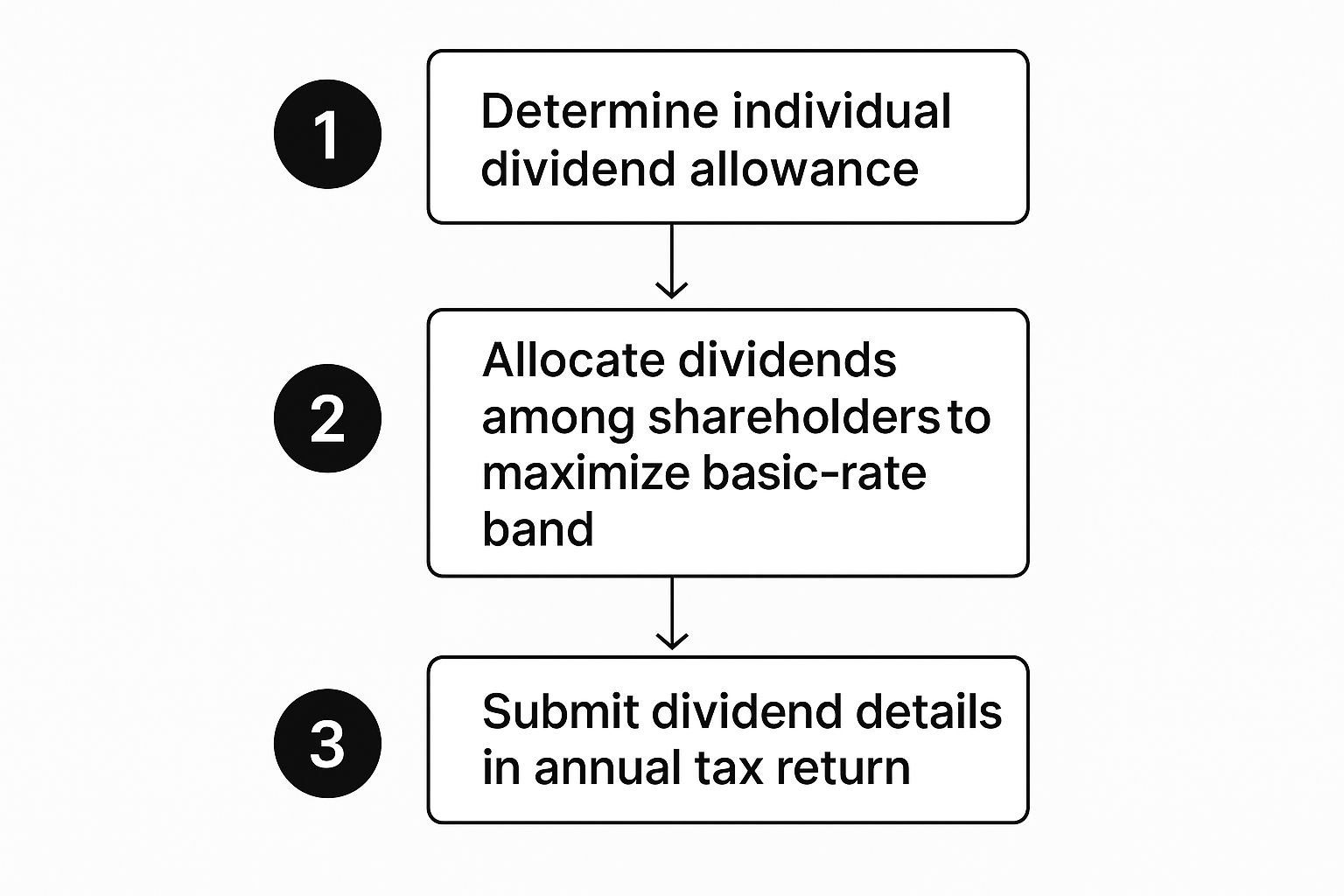
As you can see, it’s all about understanding your allowances first, then allocating your payments strategically before making sure everything is reported correctly to HMRC. To get a clearer picture of different scenarios, robust financial modelling can be a huge help. Following some 8 financial modeling best practices can give you real confidence in your decisions and help you plan ahead to avoid accidentally tipping into higher tax bands.
Using Advanced Dividend Structuring Techniques

Once you've got the basic salary and dividend mix down, you can start looking at more sophisticated ways to structure your company's payments. These aren't for everyone, but they can be incredibly useful for directors with more complex family or financial situations, offering greater flexibility and some serious tax savings.
We’re moving beyond simple remuneration here and into proper family and long-term financial planning. When done correctly and for genuine commercial reasons, these are perfectly legitimate ways to reduce the overall tax bill for your household. They do, however, require watertight record-keeping and a solid grasp of company law.
Issuing Dividends to a Spouse or Partner
One of the most common and effective strategies is bringing your spouse or civil partner into the business as a shareholder. This can be a real game-changer if your partner has unused tax allowances or sits in a lower income tax bracket than you.
By making them a shareholder, the company pays dividends directly to them. This lets your household make full use of their Personal Allowance, their Dividend Allowance, and their basic rate tax band. In effect, you can double the amount of tax-efficient cash you draw from the business. The whole point is to spread the income load across two people to maximise every available tax relief.
Using Alphabet Shares for Flexible Payments
To get this dividend-splitting strategy right, you'll almost certainly need to issue different classes of shares. These are often called alphabet shares, for example, creating 'A' shares for yourself and 'B' shares for your spouse.
This structure is what gives you, as directors, the power to declare different dividend amounts for each type of share. It means you could pay a larger dividend to your partner in the lower tax bracket and a smaller one to yourself as the higher-rate taxpayer, all completely above board.
But setting up alphabet shares properly is non-negotiable:
- Articles of Association: Your company's rulebook must be updated to allow for different share classes with different rights.
- Shareholder Agreement: You need a clear agreement that spells out the rights and rules attached to each class of share.
- Genuine Role: This arrangement has to be commercially sound. HMRC can challenge you under 'settlements' legislation if it looks like you've just given shares to a non-working partner to dodge tax. Ideally, they should have a real role or investment in the business.
The Importance of Strategic Dividend Timing
Another powerful, and often overlooked, tactic is being smart about when you declare and pay your dividends. Your dividend income is taxed in the tax year you actually receive the money, not necessarily when the board decides on it. That little distinction creates a valuable planning opportunity.
For instance, say your company has had a brilliant year and you're getting dangerously close to the higher-rate tax threshold. You could decide to delay paying a final dividend until after the new tax year kicks off on 6th April. This moves that income into the next tax year's pot, potentially keeping you in the basic rate band for the current one.
The key to compliant dividend timing is documentation. Every dividend declaration must be supported by board meeting minutes that clearly state the date of the decision and the amount to be paid. Without this paper trail, HMRC could challenge the timing of the payment.
The reverse is also true. If you're expecting a quieter year ahead, you might bring a dividend payment forward into the current tax year to use up any remaining allowances. Smart timing helps you smooth out your income over several years, avoiding those sudden spikes that can push you into a higher tax bracket. At UmbrellaCompany.com, we always tell our clients that careful planning and good paperwork are the absolute cornerstones of how to structure dividends for tax saving in the UK.
Managing Corporation Tax and Retained Profits
Your ability to draw dividends is tied directly to your company's financial health and its tax obligations. You simply can't plan your personal income without first getting your head around the critical link between Corporation Tax, company profits, and the rules for paying out dividends.
Here at UmbrellaCompany.com, we help directors walk this tightrope every single day. Get it right, and you stay compliant while keeping the business on solid ground. Get it wrong, and you could be facing some serious legal and financial headaches.
The Golden Rule: Post-Tax Profits Only
There’s one rule that is absolutely non-negotiable when it comes to dividends: they can only be paid from post-tax profits.
This means you must first work out your company's profit, deduct the Corporation Tax you owe, and only then can you distribute what’s left over to the shareholders. It's a strict sequence.
This leftover pot of money is what accountants call retained profits or retained earnings. It’s the only source from which dividends can legally be paid. Attempting to pay a dividend from money that hasn't been taxed yet is a massive red flag for HMRC.
Declaring a dividend when you don’t have enough retained profits to cover it results in an ‘illegal’ or ‘ultra vires’ dividend. HMRC can reclassify this payment as a director's loan which has to be repaid to the company, potentially triggering extra tax charges for both you and the business.
To Extract or To Retain? That Is the Question
Just because the profits are there doesn't mean you have to take them all out. This is where a bit of strategic business planning makes all the difference. You need to decide whether to extract the maximum available for your personal income or to leave some of that cash in the business.
Keeping funds in the company has some real advantages:
- Fuelling Future Growth: Retained profits are the capital you need to invest in new kit, training, or expansion plans.
- Building a Financial Buffer: It creates a vital safety net to see you through quiet periods or cover unexpected business costs.
- Smoothing Your Income: It allows you to manage your personal income more effectively across different tax years, helping you avoid sudden spikes that might push you into a higher tax bracket.
Deciding how much to retain means thinking like an investor in your own business. When weighing this up, understanding the principles behind calculating intrinsic value can offer a clearer picture of your company's true worth, guiding whether to re-invest or distribute. This forward-thinking approach perfectly balances your immediate personal tax planning with the long-term financial health of your limited company.
Balancing Profits with IR35 Considerations
The strategy of retaining profits is particularly powerful for directors operating firmly outside of IR35. If your contracts are determined to be 'inside IR35', HMRC effectively sees you as an employee for tax purposes, and the game changes completely. The normal salary and dividend mix goes out the window.
For those operating outside IR35, managing retained profits is a cornerstone of legitimate tax planning. However, it's absolutely crucial that your working practices consistently reflect your self-employed status to sidestep any challenges from HMRC. If you need guidance in this tricky area, our expert advice on how to avoid IR35 tax offers essential tips for staying on the right side of the line.
Ultimately, managing your company's profits isn't just an accounting exercise; it’s a strategic decision. It requires you to wear two hats: one as a director focused on growing the business, and the other as a shareholder focused on taking tax-efficient income. Striking that balance is the key to long-term financial success.
Staying Compliant and Avoiding Common Pitfalls

Structuring your dividends for tax efficiency is a perfectly legitimate and smart move for any limited company director. But this kind of planning demands careful attention to detail. You’ve got to stay on the right side of HMRC.
Get the paperwork wrong or miscalculate your profits, and a tax-saving strategy can quickly turn into a costly compliance headache.
Here at UmbrellaCompany.com, we help directors navigate these rules every day, making sure their payment structures are both effective and completely above board. It all comes down to understanding the process, keeping meticulous records, and steering clear of the common mistakes many directors accidentally make.
The Essential Paperwork Trail
For every single dividend your company pays, you must have a clear and accurate paper trail. This isn't just good practice; it's a legal requirement. HMRC will expect to see that you’ve followed the correct corporate procedures for every distribution.
There are two documents you absolutely must have:
- Board Meeting Minutes: Before a dividend can be paid, the directors need to hold a board meeting to formally declare it. You have to record, sign, and safely keep the minutes of this meeting. They should clearly state the dividend amount per share and the date it was declared.
- Dividend Vouchers: Each shareholder needs a dividend voucher for every payment they receive. Think of it as a payslip for your dividends. It must include key details like the company name, the shareholder's name and address, the number of shares they own, and the total dividend paid.
Without this documentation, HMRC could easily challenge the validity of the payments.
The Danger of Illegal Dividends
One of the biggest traps you can fall into is declaring a dividend when your company doesn't have sufficient retained profits. As we’ve covered, dividends can only be paid from the profits left over after you’ve accounted for Corporation Tax.
If you pay a dividend your company can’t actually afford from its post-tax profits, it’s classed as an ‘illegal’ or ultra vires dividend. The consequences can be severe. HMRC might reclassify the payment, often treating it as a director's loan that has to be paid back to the company.
Directors can be held personally liable to repay illegal dividends. This means if the company's finances take a downturn, you could be forced to pay the money back out of your own pocket, completely wiping out any tax benefits you were hoping for.
Navigating IR35 and Dividend Rules
It's also crucial to understand how your dividend strategy interacts with IR35 legislation. The tax-efficient salary and dividend model is designed for directors whose work falls firmly outside the scope of IR35.
If your contract is deemed 'inside IR35', HMRC considers you an employee for tax purposes. This means all your income must go through PAYE, subject to Income Tax and National Insurance, just like a regular salary. The dividend route simply isn't an option.
If you're looking for more guidance on this, we have an in-depth article that explores how to pay less income tax as a director while staying compliant.
The Shifting Sands of Dividend Allowances
Finally, staying compliant means keeping up with ever-changing tax laws. Dividend taxation has seen huge reforms over the years, making careful planning more important than ever.
Before April 2016, UK dividends had a 'notional tax credit'. That was scrapped and replaced by a £5,000 Dividend Allowance, which has been steadily cut down to £2,000, then £1,000, and now just £500.
At the same time, the tax rates on dividends have crept up. They now stand at 8.75% for basic rate taxpayers, 33.75% for higher rate taxpayers, and 39.35% for additional rate taxpayers on any dividend income above that tiny allowance.
This constant shrinking of the tax-free allowance means more directors are paying tax on their dividends than ever before, hammering home the need for precise and compliant planning.
Frequently Asked Questions About Dividend Planning
When it comes to getting dividends right for tax purposes, we find many company directors run into the same questions. The rulebook can feel a bit dense, but the core ideas are actually quite straightforward once you get the hang of them.
Here at UmbrellaCompany.com, we guide our clients through these very points every day. This section answers the most common queries we hear, with clear, practical advice to keep you both tax-efficient and on the right side of HMRC.
Can I Pay Myself Only In Dividends?
You technically can, but it's rarely the smartest move from a tax perspective. By not taking any salary at all, you're wasting your tax-free Personal Allowance.
Even more critically, you won’t be making any National Insurance contributions for the year. This can leave a gap in your NI record, which directly affects your entitlement to the State Pension down the line. A small salary, at least up to the National Insurance threshold, is almost always the best place to start before you even think about dividends.
What Happens If I Declare An Illegal Dividend?
This is a serious one. An illegal dividend is any payment your company makes when it doesn't have enough post-tax retained profits to cover it. The fallout can be messy and expensive.
HMRC can reclassify the payment, usually treating it as a director's loan that you have to pay back to the company. If you don't repay it quickly, it can trigger extra tax charges for both you and the business. In a worst-case scenario, directors can be held personally liable to repay the money out of their own pockets.
How Do Pension Contributions Affect My Dividend Strategy?
Pension contributions are a fantastic tool for tax planning that works hand-in-glove with your dividend strategy. They cut your tax bill in two powerful ways.
Company Contributions: When your company pays into your pension, it’s treated as an allowable business expense. This reduces your company's profit, which directly lowers your final Corporation Tax bill. Simple and effective.
Personal Contributions: Any contributions you make from your own pocket can extend your basic rate tax band. This means you can earn more income, including dividends, before being tipped into the higher rate of tax.
Weaving pension planning into your dividend withdrawals is a smart way to squeeze every bit of efficiency out of your earnings. For a wider look at tax-saving tactics, check out our guide on the best ways to reduce tax as a contractor in the UK.
Do I Really Need An Accountant For This?
While it's possible to manage your own accounts, we strongly advise getting a qualified accountant on your side. Tax rules are not only complicated, but they change all the time.
A good accountant makes sure your payment structure is optimised for tax efficiency and, crucially, is fully compliant with all the current HMRC regulations. Their expertise isn't just a cost; it's an investment that helps you sidestep expensive mistakes, saves you a ton of time, and gives you real peace of mind.
An accountant's role goes beyond just filing your returns. They provide strategic advice, help you plan for the future, and act as a crucial defence against common pitfalls, ensuring your financial structure is robust and secure.
Juggling dividends, salaries, and tax rules can feel like a headache. By understanding the key allowances and following a compliant process, you can structure your income in a way that significantly reduces your tax bill.
UmbrellaCompany.com cuts through the complexity by helping you compare and choose the right umbrella company for your situation, so you can operate efficiently and compliantly.


