


For contractors, cutting down your PAYE tax bill often comes down to smart structuring. If you are with an umbrella company, salary sacrifice pension contributions are a powerful tool. For those running a limited company, it is about striking the right balance between a low salary and tax-efficient dividends, while claiming every allowable business expense.
These are not loopholes; they are legitimate strategies to lower your taxable income and keep more of what you earn. This guide will walk you through the key methods you can use to reduce your PAYE tax legally and effectively.
Your PAYE Obligations as a UK Contractor

Before we get into the tactics for lowering your tax bill, let's make sure we are on the same page about what PAYE actually means for you. The Pay As You Earn system is simply HMRC's method for collecting Income Tax and National Insurance Contributions (NICs) straight from your earnings as you get paid.
It does not matter if you are the director of your own limited company or working through an umbrella company, PAYE is a central part of your financial world. It is designed to ensure your tax is paid in real-time, which helps you avoid a dreaded, massive tax bill at the end of the year.
Understanding Your Payslip
Think of your payslip as more than just proof of payment; it is a detailed breakdown of your earnings and deductions. The two main deductions you will always see are:
- Income Tax: This is calculated based on which tax bands your earnings fall into. You get a Personal Allowance each year, an amount you can earn completely tax-free before you start paying Income Tax.
- National Insurance Contributions (NICs): These payments build up your entitlement to state benefits like the State Pension. The amount you pay is tied to your employment status and how much you earn.
While the UK's PAYE system has its own quirks, the principle of taxing at the source is common worldwide. For a different perspective, this guide on Navigating PAYG in Australia offers some interesting parallels on managing payroll tax obligations.
The Impact of IR35 on Your Tax
For any contractor in the UK, one of the biggest factors influencing your tax is IR35, also known as the off-payroll working rules. Put simply, your IR35 status decides who is responsible for your tax.
Understanding your IR35 status is not just a box-ticking exercise. It is the absolute first step in structuring your finances properly. Getting this wrong can lead to serious tax bills and penalties down the line.
If your contract is determined to be ‘inside IR35’, you are treated as an employee for tax purposes. This means your client (or umbrella company) has to deduct Income Tax and NICs through PAYE before the money ever hits your account. This significantly limits your options for tax planning.
On the other hand, if you are working ‘outside IR35’, you are viewed as genuinely self-employed. This gives you the freedom to operate through your own limited company and offers much more flexibility in how you draw your income, opening up opportunities for real tax efficiency.
Getting your head around the rules is crucial. You can dive deeper with our detailed guide on what IR35 is. Building this foundational knowledge is the key to managing your finances smartly and making decisions that legally reduce your tax bill.
Balancing Salary and Dividends for Tax Efficiency
If you are contracting through your own limited company, one of the smartest things you can do to lower your PAYE tax is to get strategic about how you pay yourself. It is all about finding that sweet spot between a director's salary and dividend payments.
This is not a shady loophole; it is a standard, HMRC-approved practice used by countless successful contractors. The goal is simple: structure your income to legally reduce what you owe in Income Tax and National Insurance Contributions (NICs).
The Low Salary, High Dividend Strategy
The classic approach is to pay yourself a small salary and take the bulk of your company’s profits as dividends. You set your salary just high enough to qualify for state benefits like the State Pension, but low enough that you pay little or no Income Tax and NICs.
Your salary is a legitimate business expense, which shaves a bit off your company's Corporation Tax bill. The real win, though, comes from the dividends. They are paid out of post-tax profits and, crucially, they are not subject to National Insurance. This makes them a far more tax-efficient way to draw cash from your business.
Setting Your Optimal Salary
So, what is the "perfect" salary? It changes each tax year, but the principle is the same. You want to set it above the Lower Earnings Limit to secure your qualifying year for the State Pension, but ideally below the threshold where you start paying employee's NICs.
For the 2025/26 tax year, the go-to figure for many contractor-directors is £12,570. Why this number? It perfectly matches the personal tax-free allowance, meaning every penny is yours to keep before tax kicks in. Dividends are then taxed at their own, lower rates. Just be aware that most single-director companies cannot claim the Employment Allowance, so careful planning around National Insurance thresholds is vital. If you want a deep dive into the numbers, Coman and Co offer a great breakdown of optimal contractor salaries.
Why Dividends are So Much Better for Your Pocket
Once you have paid your modest salary, you can distribute the company's remaining profits as dividends. They come with their own tax-free allowance and are taxed at much friendlier rates than salary.
Here is why this works so well:
- No National Insurance: This is the big one. Neither you nor your company pays a penny of NICs on dividends. Compared to a salary, this can easily save you over 20%.
- Lower Tax Rates: Dividends have their own tax bands (basic, higher, and additional), which are all lower than the equivalent income tax bands for salary.
- You are in Control: You decide when to declare dividends. This flexibility lets you time your income to stay under certain tax thresholds, which can be incredibly useful.
The image below gives a sense of how claiming all your allowable expenses frees up more profit to be taken as tax-efficient dividends.
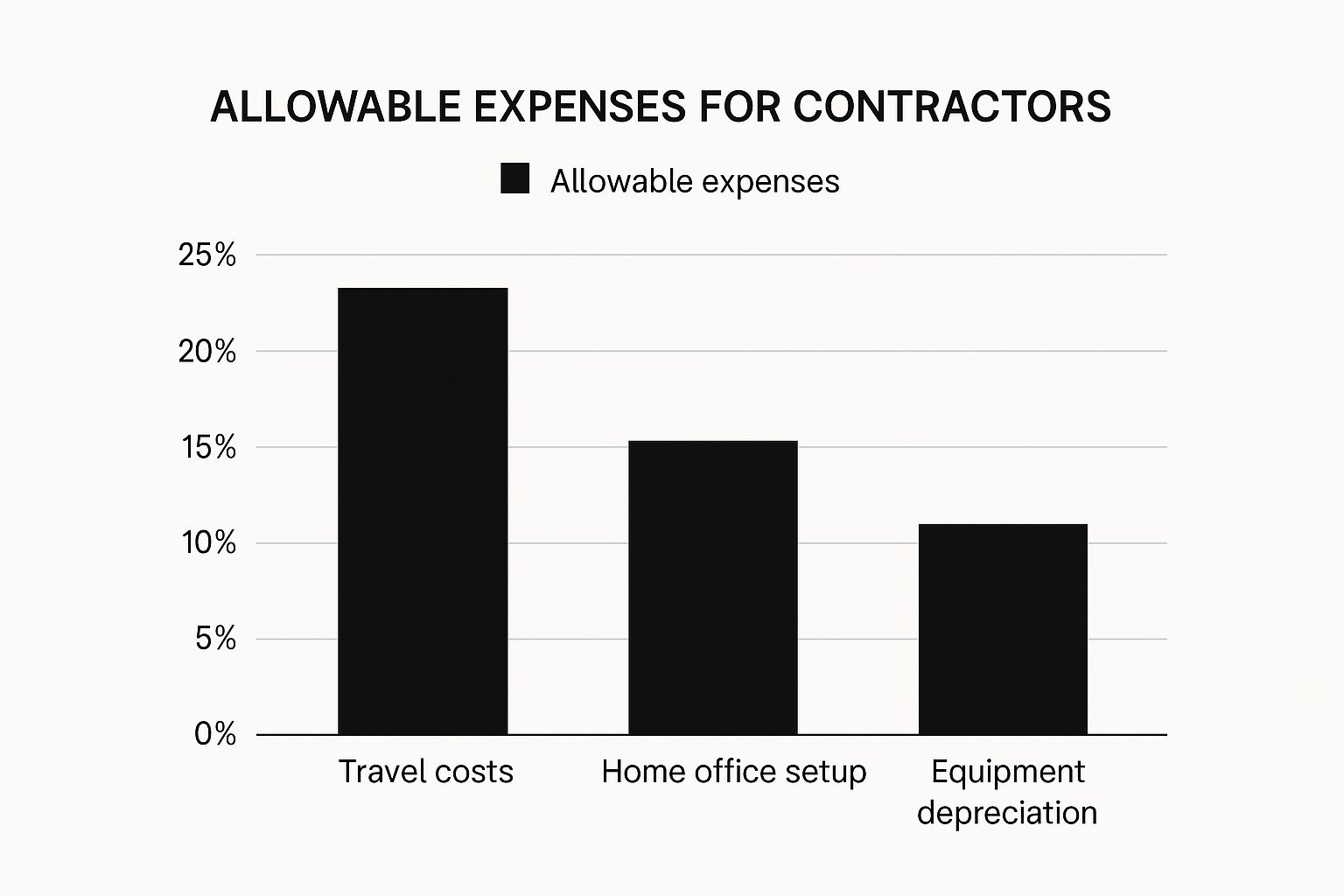
As you can see, keeping on top of your expenses, especially things like travel, directly boosts the amount of profit you can pay out in dividends.
A Quick Example: Salary vs. Dividends
Let's make this real. Imagine your limited company has £50,000 in profit ready for you to take. First, we will look at the tax efficiency of taking a pure salary versus splitting it between a low salary and dividends.
Salary vs Dividend Tax Efficiency Comparison
| Income Component | £50,000 Pure Salary | £12,570 Salary + £37,430 Dividends |
|---|---|---|
| Salary | £50,000 | £12,570 |
| Dividends | £0 | £37,430 |
| Tax/NI Impact | Subject to higher Income Tax and both employee/employer NICs. | Salary is tax/NI free. Dividends are taxed at lower rates with no NICs. |
| Take-Home Pay | Significantly lower. | Substantially higher. |
The difference is stark. Taking it all as salary means a hefty chunk goes to HMRC in Income Tax and National Insurance. But with the split strategy, you pay yourself a £12,570 salary (tax and NI-free) and take the remaining £37,430 as dividends. Your tax bill on those dividends is dramatically lower.
This strategic split is the foundation of smart tax planning for contractors. For more practical advice on this, take a look at our guide on how to maximise your take-home pay as a contractor. It is a must-read for keeping more of what you earn.
Using Pension Contributions to Lower Your Taxable Income

One of the most effective, HMRC-approved ways to shrink your taxable income is by contributing to a pension. This is not just about stashing cash away for retirement; it is a savvy strategy to cut your tax bill right now, whether you are a limited company director or working through an umbrella company.
Think of it as a win-win. You are building a nest egg for your future self while simultaneously optimising your current tax position.
How Pension Contributions Work for Limited Company Directors
If you run your own limited company, paying into your pension directly from your business account is a brilliant tax-efficiency move. These payments are classed as an allowable business expense, putting them in the same category as your salary or accountancy fees.
What does this mean in practice? The entire contribution is deducted from your company's profits before Corporation Tax is calculated. That immediately lowers your company’s tax liability.
But the benefits do not stop there. Because the money bypasses you and goes straight into your pension, it is not considered personal income. You sidestep both employee's and employer's National Insurance Contributions, plus any personal Income Tax on that sum. It is a triple saving.
The Power of Salary Sacrifice for Umbrella Contractors
For contractors paid via an umbrella company, the go-to method is a salary sacrifice scheme. It is a simple arrangement: you agree to forgo a portion of your gross salary, and your umbrella company pays that exact amount into your pension fund on your behalf.
The real magic here is that the contribution is made from your gross, pre-tax earnings. This immediately reduces your total taxable income, so your PAYE deductions are calculated on a smaller figure.
Imagine your gross pay for a period is £5,000. If you sacrifice £500 into your pension, HMRC will only assess tax and NI on the remaining £4,500. You get instant tax relief at your highest rate, making it an incredibly efficient way to save.
Most compliant umbrella companies, including those we recommend on UmbrellaCompany.com, have streamlined salary sacrifice options ready to go.
Navigating Pension Allowances
While pensions are a fantastic tool, you cannot contribute an unlimited amount. The government sets an Annual Allowance, which caps how much you can put into your pensions in a tax year while still getting tax relief.
Currently, this allowance is typically £60,000 or 100% of your earnings, whichever is lower. It is a generous cap that most contractors will not have to worry about, but it is vital to keep an eye on your total contributions, particularly if you have more than one pension pot.
You might also be able to use the 'carry forward' rule to use any unused allowance from the past three tax years. It is always smart to run this by a financial adviser to make sure you are playing by the rules.
Avoiding the Personal Allowance Taper
Smart pension planning becomes absolutely critical for higher-earning contractors. As soon as your 'adjusted net income' tips over £100,000, your tax-free Personal Allowance starts to shrink. For every £2 you earn above this line, you lose £1 of your allowance, until it vanishes completely at £125,140.
This creates a brutal effective tax rate in that income bracket.
By making a pension contribution, however, you can lower your adjusted net income. If you contribute enough to bring your income back under the £100,000 threshold, you can completely restore your tax-free Personal Allowance. This is a powerful, strategic move that provides a significant and immediate boost to your take-home pay.
Claiming Every Allowable Business Expense
One of the most straightforward ways for contractors to lower their tax bill is to get into the habit of claiming every single allowable business expense. It is surprising how many people leave money on the table by simply overlooking legitimate claims.
Every valid expense you claim chips away at your company's profit, which directly reduces your Corporation Tax liability. This means more post-tax profit is available for you to draw as dividends. It is not just about good bookkeeping; it is a core part of smart tax planning.
What Can You Actually Claim?
HMRC's golden rule is that an expense must be "wholly and exclusively" for business purposes. This might sound a bit strict, but it covers a much wider range of costs than you might think. The key is to ask yourself, "Is this purchase helping my business operate?"
Here are some of the most common expenses contractors often claim:
- Office Costs: The basics like stationery, printer ink, and business postage all count. If you rent a dedicated office space, the rent and bills are claimable too.
- Business Travel: Any journey to a temporary workplace or client site is fair game. This includes mileage if you use your own car, train tickets, and parking fees.
- Accommodation and Subsistence: If a project requires you to stay away from home overnight, your hotel bill and reasonable food and drink costs are allowable.
- Professional Subscriptions: Your annual fee for a relevant professional body or organisation can often be deducted, as long as it is on HMRC's approved list.
- Equipment and Software: That new business laptop, your work mobile phone, and subscriptions to software like Microsoft 365 or a project management tool are all valid claims.
Home Office and Training Expenses
Two areas contractors frequently underclaim are the costs of working from home and investing in their own skills.
If you regularly work from home, you can claim for a portion of your household running costs. The simplest way is to use HMRC’s flat rate of £6 per week, which does not require any complicated calculations. Alternatively, you can work out a proportion of your actual bills (like mortgage interest, council tax, and utilities) based on how much of your home you use for business.
Do not underestimate the power of small, consistent claims. That £6 per week for home working might seem minor, but it adds up to over £300 in legitimate, tax-deductible expenses over a year without needing a single receipt.
Likewise, investing in yourself is an investment in your business. Training courses designed to update or maintain the skills you need for your current contracts are an allowable expense. It is a great way to stay competitive while also trimming your tax bill.
Mastering Your Record-Keeping
The cardinal rule of expenses is simple: keep meticulous records. If HMRC ever asks for proof, you need to have it. A lost receipt is a lost opportunity to save tax.
A few practical tips can make all the difference:
- Use Accounting Software: Modern tools like FreeAgent or Xero are a game-changer. You can snap photos of receipts on your phone and log expenses in seconds.
- Have a Separate Business Bank Account: This is a must for limited companies anyway, but it also makes life so much easier. It creates a clean separation between your personal and business finances.
- Review Regularly: Do not let it pile up. Just setting aside an hour each month to go over your expenses will keep you organised and prevent a last-minute scramble when your tax return is due.
By diligently claiming everything you are entitled to, you ensure your business operates as tax-efficiently as possible. For a deeper dive into this, our guide on how to pay less tax as a contractor covers more strategies. You might also find some interesting pointers on maximising business expense claims, though it is written from a New Zealand perspective.
How to Navigate Critical Tax Thresholds

For contractors who have worked hard to build their income, understanding the UK's tax thresholds is not just about compliance, it is about smart financial strategy. It is a common and painful surprise to find that crossing certain income lines can trigger a sharp jump in your tax rate. A seemingly small pay rise can actually leave you with less in your pocket.
Knowing where these financial tripwires are is the first step. The second, and more important, is having a plan to deal with them. This is where you can make a real difference to your bottom line and avoid handing over more tax than you need to.
The £100,000 Personal Allowance Taper
One of the sneakiest thresholds is the £100,000 mark for your ‘adjusted net income’. The moment your earnings tip over this amount, your tax-free Personal Allowance of £12,570 starts to get chipped away. HMRC claws it back at a rate of £1 for every £2 you earn above the threshold.
This creates what many of us in the industry call the 60% tax trap. Why? Because your income between £100,000 and £125,140 is not only hit with the 40% higher rate tax, but the loss of your tax-free allowance means you are effectively being taxed at 60% on that slice of your earnings. By the time your income reaches £125,140, your entire Personal Allowance has vanished.
The Additional Rate Tax Threshold
Another key number to watch is the additional rate tax threshold. The goalposts moved on this recently, directly impacting how contractors can manage their PAYE tax. From 6 April 2023, the threshold was slashed from £150,000 down to £125,140.
What this means in practice is that every pound you earn above this point is taxed at a hefty 45%. For contractors pulling in high day rates, especially those working inside IR35, the dent in take-home pay is significant.
Actionable Strategies to Stay Below the Thresholds
Hitting these tax cliffs is not a foregone conclusion. With a bit of forward thinking, you can legally structure your finances to stay on the right side of these critical lines.
Here are a few of the most effective methods contractors use:
- Make Strategic Pension Contributions: This is probably your most powerful tool. A pension contribution, whether made personally or through your limited company, directly reduces your adjusted net income. Paying in enough to bring your income back below £100,000 can fully restore your Personal Allowance, delivering a huge, immediate tax saving.
- Time Your Income: If you run your own limited company, you have a lot of control. If a big project is about to push you over a threshold near the end of the tax year, think about deferring a dividend payment until the new tax year kicks off in April. Simple, but effective.
- Make Charitable Donations: Giving to charity via Gift Aid is another great way to lower your adjusted net income. The donation is grossed up, so for every £80 you give, the charity can claim an extra £20. You, in turn, can claim tax relief on the full £100.
Imagine a contractor earning £110,000. By making a gross pension contribution of £10,000, they bring their adjusted net income down to exactly £100,000. This single move reclaims their full Personal Allowance and saves them thousands in tax.
This kind of proactive planning is non-negotiable. For higher earners, navigating these rules demands a proper strategy. It is well worth exploring some of the best tax strategies for high-income earners to get a broader view of your options.
The complexity here also shines a light on how crucial it is to understand your IR35 status. Being deemed 'inside IR35' can really limit your flexibility in managing your income. We dig into this in more detail in our guide on how to avoid IR35 tax. By staying on top of the rules and planning ahead, you can structure your finances to get the best possible outcome.
Don't Get Caught Out by UK Tax Changes
As a contractor, you know the UK tax landscape is never static. What was tax-efficient last year might not be this year. Staying on top of these shifts is not just about ticking compliance boxes; it is fundamental to keeping your tax planning sharp and effective.
Think of it this way: knowing what is coming allows you to have much more productive conversations with your accountant and adapt your strategy before the rules change. It is the difference between being proactive and reactive.
The Tax Adjustments You Need to Watch
The government's Spring and Autumn Statements are must-watch events for contractors. They signal shifts in National Insurance, allowances, and other rules that directly impact how you structure your finances, whether you are working through your own limited company or an umbrella.
A big one on the horizon is the increase in Employers' National Insurance Contributions (NICs) from 6 April 2025. This will bump up the cost of paying a salary via PAYE for both limited company directors and umbrella companies. The silver lining? Dividends remain untouched by NICs, which only reinforces their value as a way to take money out of your company tax-efficiently. You can get the full rundown on how the April 2025 tax changes will affect contractors and what it means for your bottom line.
Staying informed is your first line of defence against surprise tax bills. Even small tweaks in legislation can take a big bite out of your take-home pay.
How Does This Actually Affect Your Strategy?
These changes demand a smart response. That looming hike in Employers' NICs, for example, should prompt any limited company director to take a hard look at their salary level. It might make sense to lean more heavily on dividends to extract profits.
Here is a practical look at what this means for you:
- For Limited Company Directors: Most single-director companies cannot claim the Employment Allowance, so you will feel the full force of the NICs rise. This makes it even more crucial to pinpoint that sweet spot for your salary, enough to qualify for state benefits, but not so high that you are paying unnecessary tax.
- For Umbrella Company Contractors: You do not have the same direct control, but understanding these cost pressures helps you pick a good, compliant umbrella company. It also shines a spotlight on salary sacrifice pension schemes, which become an even more powerful tool for bringing down your taxable income.
Staying Compliant, Prepared, and Ahead of the Game
The goal is always the same: be completely compliant while being as tax-efficient as you possibly can. This is not about reacting to headlines; it is about anticipating the changes.
One of the best investments you can make is a regular review with a specialist contractor accountant. They live and breathe this stuff. They will help you navigate the fine print of new legislation and fine-tune your approach. Whether that means adjusting your salary/dividend mix, topping up your pension, or reassessing your IR35 status, staying one step ahead ensures your tax strategy works for you. That proactive stance is what really makes the difference in successfully reducing your PAYE tax liability as a contractor.
Your Contractor Tax Questions Answered
We get a lot of questions from contractors trying to get their heads around PAYE tax. It is a common pain point, so we have answered a few of the most frequent queries we hear.
Can I Actually Do Anything About PAYE if I’m Inside IR35?
Yes, you can, although the toolkit is smaller. If you are working through an umbrella company, your single most powerful move is making pension contributions through a salary sacrifice scheme.
It is a straightforward agreement where you give up a portion of your salary, which then goes directly into your pension before any tax or National Insurance is taken off. This gives you instant tax relief at your highest rate. It is a brilliant way to build your retirement pot while trimming your tax bill today.
Should I Use a Company Pension or a Personal One?
For limited company directors, this one is usually a no-brainer: a company pension almost always wins on tax efficiency. Why? Because the contribution counts as an allowable business expense, which shaves money directly off your Corporation Tax bill.
While you still get tax relief with personal contributions, putting money in through the company tackles both your personal and corporate tax liabilities in one go. It is a double win.
What’s the Biggest Mistake Contractors Make with Expenses?
Honestly? It is just poor record-keeping. We see so many contractors leaving money on the table simply because they have not kept receipts or have not bothered to log their business mileage properly. Every lost receipt is a missed opportunity to lower your tax bill.
The fix is simple: use good accounting software or a dedicated expense-tracking app. These tools let you snap photos of receipts and log details on the move. It ensures you have the proof HMRC requires and that you claim for every single thing you are entitled to.
We hope this guide has given you a clear understanding of how to reduce your PAYE tax as a contractor. The key takeaways are to structure your income smartly, claim all allowable expenses, and use pension contributions to your advantage.
At UmbrellaCompany.com, we help you compare trusted, compliant umbrella companies to find the perfect fit for your contracting career. Find your ideal umbrella company in minutes.


