


You have set up your limited company. The next big question is: how do you actually pay yourself? Getting this right is one of the most important things you will do as a company director.
For most UK contractors and freelancers, the best approach is a combination of a small salary and dividends. This structure is by far the most tax-efficient way to take money out of your business, and it is the method we will be focusing on in this guide.
How to Pay Yourself from a Limited Company

Mastering how to withdraw funds from your company is key to maximising your take-home pay. It is not just about taking money out; it is about doing it smartly to minimise what you hand over to HMRC.
The classic low-salary, high-dividend strategy works so well because it keeps your tax and National Insurance (NI) contributions to a minimum. A small director’s salary also counts as a qualifying year for your State Pension, so you are building for the future while being tax-savvy today.
Here is a quick overview of the main ways to extract money from your company, which we will explore in detail.
Key Methods for Withdrawing Money from Your Company
| Payment Method | Tax Efficiency | Key Benefit |
|---|---|---|
| Director's Salary | Moderate | Qualifies for State Pension; is a deductible business expense. |
| Shareholder Dividends | High | No National Insurance due; lower tax rates than salary. |
| Director's Loan | Low | A short-term loan, not income, but has strict repayment rules. |
| Pension Contributions | Very High | A highly tax-efficient way to save for retirement. |
Getting this structure right from day one will make a huge difference to your bottom line.
Throughout this guide, we will walk you through exactly what you need to do. We will cover:
- Setting up your company's payroll (PAYE) correctly.
- Figuring out the optimal salary to pay yourself each year.
- Understanding the rules around declaring and paying dividends.
- Keeping the right records to stay on HMRC’s good side.
- Other options to consider, like company pension contributions.
Getting the Salary vs. Dividend Mix Right

When it comes to paying yourself from your limited company, getting the balance between salary and dividends right is the cornerstone of a tax-efficient strategy. It is what makes the biggest difference to your take-home pay.
The go-to approach for most contractors is to draw a small salary, typically up to one of the National Insurance (NI) thresholds. This ensures you are making qualifying years towards your State Pension, often without actually having to pay any NI contributions from your own pocket or the company's. It is a smart, low-cost way to build up your pension entitlement.
Beyond that small salary, you can then draw down the company’s remaining profits as dividends. Remember, these are paid out after the company has settled its Corporation Tax bill.
For the 2024/25 tax year, this means you could take a salary up to the personal allowance of £12,570 completely tax-free. Dividends are then taxed at a much lower rate, starting at just 8.75% for basic rate taxpayers. This combination is a tried-and-tested method for maximising your income.
We have explored this in much more detail in our dedicated guide to salary versus dividends.
How to Set Up and Run Your Company Payroll
Once you have settled on a salary figure, you will need to run a compliant payroll. This is not optional, it is a legal requirement.
Your first move is to register your limited company as an employer with HMRC. This gets you set up with a PAYE (Pay As You Earn) scheme, which is how you will handle tax and National Insurance deductions. We cover this step-by-step in our guide to setting up a PAYE scheme.
With your PAYE scheme active, you must report every salary payment to HMRC on or before payday. This is done through Real Time Information (RTI) submissions.
Getting the right payroll software makes this a whole lot easier. You could start with HMRC’s free basic tools, but many contractors find that dedicated accounting software like FreeAgent or Xero is worth the investment. They integrate payroll with your other accounts and can really simplify the administration.
A quick but critical point: you must issue a proper payslip for every salary payment. Keeping detailed records of all payroll activity is non-negotiable. It is your best defence against any future HMRC queries and helps you avoid some hefty penalties.
How to Legally Declare and Pay Dividends
You cannot just transfer cash from your business account and call it a dividend. Getting this wrong can land you in hot water with HMRC, so there is a formal process you need to follow every single time.
It all starts with a directors' meeting. You need to officially declare the dividend and, crucially, record this decision in the company's meeting minutes. This creates a paper trail proving the dividend was properly authorised.
For each shareholder receiving a payment, you will then need to issue a dividend voucher. Think of it as a payslip for your dividend. It is a legal document that confirms the details for both the shareholder's tax return and the company's records. You can find the exact details you need on each voucher in our guide on how to pay yourself dividends.
This process, much like running payroll, is about following set procedures to stay compliant.
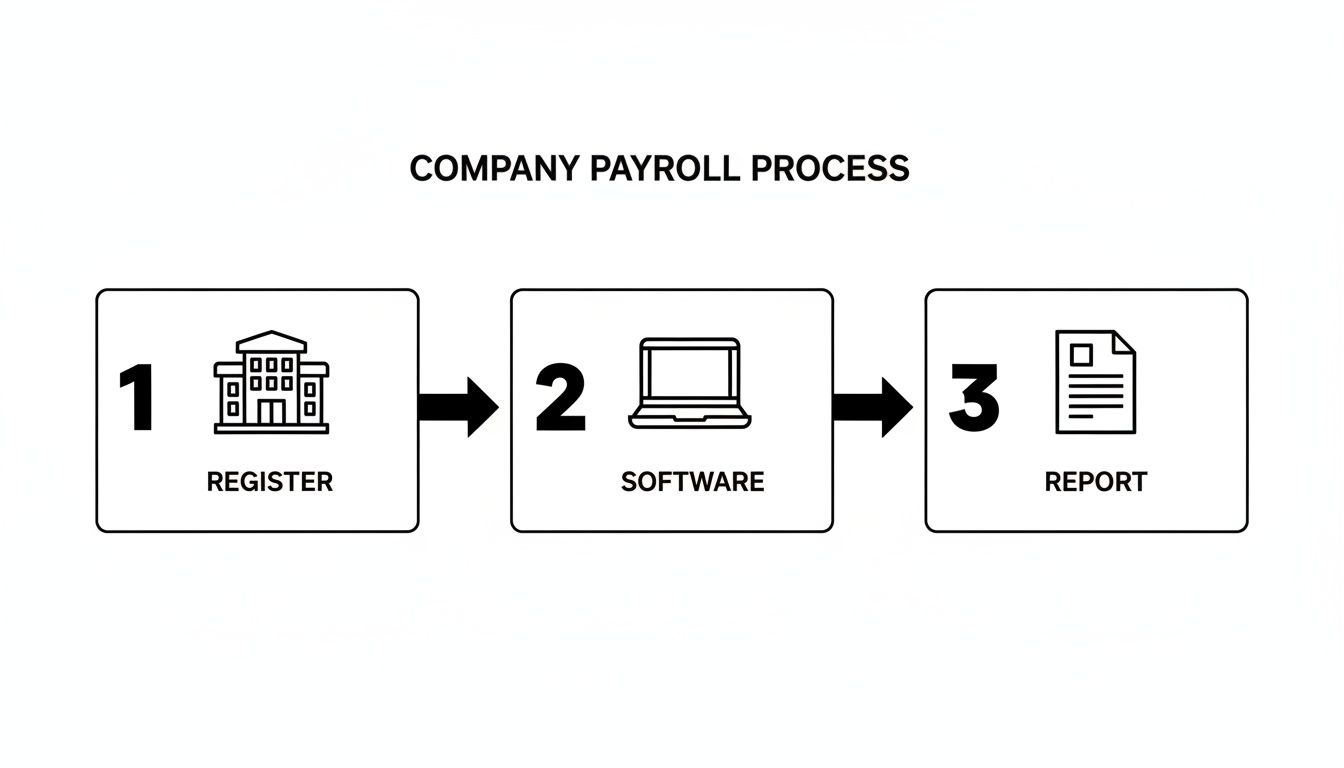
While the diagram above shows the flow for payroll, the principle is the same for dividends: formal steps and proper reporting are non-negotiable.
The golden rule: you can only declare dividends from your company’s post-tax profits. If you pay out more than the company has earned after Corporation Tax, it is classed as an 'illegal dividend'. This can create a real mess, often requiring you to repay the money and leading to potential penalties. Always, always check your available profits before you declare anything.
Advanced Tax Planning: Pensions and Director's Loans
Once you have your salary and dividend strategy sorted, there are a couple of other useful tools for managing your company's cash flow and your own finances: company pension contributions and director’s loans.
Making a pension contribution directly from your company is one of the most tax-efficient moves you can make. These contributions are almost always a deductible business expense, which means they lower your company’s profit and, in turn, its Corporation Tax bill. It is a fantastic way to build your retirement pot while saving tax right now.
A director's loan is another option, letting you borrow money from your business. Think of it as a short-term, flexible bridge. For instance, HMRC's 2024/25 figures show that loans up to £10,000 are a common way for directors to take money tax-free between dividend payments.
But you have to be careful here. These loans come with strict rules. To avoid a hefty Section 455 tax charge of 33.75%, the loan must be repaid to your company within nine months of your accounting year-end. Getting this wrong can lead to serious penalties, so it is vital to manage them properly. You can find more details on the rules for tax-free loans at CrystalUmbrella.com.
When an Umbrella Company Is a Smarter Choice
Running a limited company is not the right move for every contractor, especially as the rules around us keep changing. The biggest reason to reconsider? IR35.
If HMRC deems your contract to be 'inside IR35', the tax efficiency that makes a limited company so attractive pretty much vanishes. In that scenario, an umbrella company often becomes a much simpler and more compliant way to get paid.
It is also a great option if you are only contracting for a short period, or you simply do not want the hassle of company accounts and tax returns. An umbrella company acts as your employer, sorting out all the PAYE tax and National Insurance deductions for you, and you get statutory employment rights in the process.
Here is a useful tip: even if you keep your limited company, you can still use an umbrella for pension contributions. The rules for 2024/25 confirm that pension payments up to £60,000 can be deducted as a business expense, which is a fantastic way to lower your corporation tax bill. LITRG has a good breakdown of the new rules for umbrella companies.
Not sure which path is for you? Our guide on umbrella company vs limited company walks you through the pros and cons of each.
Wrapping Up: Making the Right Choice
Choosing how to pay yourself from a limited company is a big decision, but it does not have to be complicated. By blending a small, tax-efficient salary with dividends from your company's profits, you can legally maximise your take-home pay while meeting all your obligations to HMRC.
Remember the key takeaways:
- Salary and Dividends: This is the most common and tax-efficient structure.
- Stay Compliant: Always follow the correct procedures for running payroll and declaring dividends.
- Keep Good Records: Document everything from board minutes to dividend vouchers.
- Consider Alternatives: Don't forget powerful tools like pension contributions.
If you are unsure about navigating IR35 or simply prefer a hands-off approach to your payroll and tax, an umbrella company can be an excellent alternative. We are here to help you figure out the best path forward for your contracting career.


