


Figuring out how to pay yourself from a limited company is one of the first big questions every director faces. Get it right, and you can be incredibly tax-efficient. Get it wrong, and you could hand over thousands in unnecessary tax to HMRC.
For most UK directors, the smartest strategy is almost always a combination of a small salary and the rest in dividends. It’s a tried-and-tested approach that helps you make the most of your tax-free Personal Allowance and minimise how much National Insurance you have to pay. This guide will explain how to set this up correctly.
A Director's Guide to Getting Paid
When you’re a company director, you cannot just dip into the business bank account like a sole trader. Every penny you take has to be accounted for properly, either as a salary or a dividend. Nailing this process isn’t just about staying on the right side of HMRC; it’s about structuring your pay to reduce both your personal tax and your company’s Corporation Tax bill.
Based on our experience helping thousands of contractors, the most effective method breaks down into two simple parts:
- A low, tax-efficient salary: You pay yourself a small salary, just enough to qualify for your State Pension credits but low enough to avoid shelling out for income tax and National Insurance. This salary is a legitimate business expense, which handily reduces your company's taxable profits.
- Dividends for everything else: Once all your business costs and taxes are covered, the remaining profit can be paid out to you as dividends. Because dividends are taxed at lower rates than salary and do not attract National Insurance at all, they're a brilliant way to top up your income.

It sounds simple, and it is, but it’s a detail many directors miss. They often forget about keeping up their National Insurance record, which is vital for building up your State Pension entitlement. This balanced salary-and-dividend strategy takes care of that automatically.
The real trick is finding that 'sweet spot' for your director's salary. It needs to be high enough to trigger your National Insurance credits for the year, but not so high that you start paying unnecessary tax. Dividends then make up the rest of your take-home pay in a much more tax-friendly way.
Let’s take a look at the key differences between these two payment methods. For a quick snapshot, this table gives you a clear comparison.
Salary vs Dividends At a Glance
| Feature | Salary | Dividends |
|---|---|---|
| Tax Treatment | Treated as an allowable business expense for the company. | Paid out of post-tax profits. Not a business expense. |
| National Insurance | Subject to both Employee's and Employer's NI Contributions. | Not subject to any National Insurance Contributions. |
| Tax Rates | Taxed at your personal income tax rates (20%, 40%, 45%). | Taxed at lower dividend tax rates (8.75%, 33.75%, 39.35%). |
| Timing | Paid regularly (e.g., monthly) through a PAYE payroll system. | Can be paid at any time, provided the company has sufficient profit. |
| State Pension | A qualifying salary builds entitlement to the State Pension. | Dividends do not count towards State Pension entitlement. |
| Paperwork | Requires running a payroll, RTI submissions to HMRC, and payslips. | Requires board meeting minutes and issuing dividend vouchers. |
Understanding these distinctions is the first step. Now, this guide will walk you through exactly how to set this structure up, making sure you stay compliant while putting more money in your pocket.
Finding Your Optimal Director's Salary
Figuring out your director’s salary isn’t about just giving yourself the biggest payslip you can. It’s more of a strategic game. The real goal is to land on a figure that, when combined with your dividends, leaves you with the most money in your pocket after tax.
You're looking for that sweet spot. It needs to be high enough to count as a qualifying year for your State Pension, which is crucial for your future. At the same time, you want it low enough to sidestep any hefty income tax and National Insurance bills. Getting this balance right is the foundation of paying yourself smartly from your own company.
The Key UK Tax Thresholds to Know
To nail down that perfect salary, you must keep an eye on a few key numbers that HMRC sets out each tax year. These thresholds dictate the best salary to pay yourself.
- The Personal Allowance: This is your tax-free buffer. For the 2024/25 tax year, it’s £12,570. You will not pay a penny of income tax on earnings up to this amount.
- The Lower Earnings Limit (LEL): As long as you earn above this, you’re banking a qualifying year for your State Pension, even without paying any National Insurance.
- The Secondary Threshold (ST): This is the trigger point where your company has to start paying Employer's National Insurance on your salary.
Paying yourself a salary right up to your Personal Allowance is a classic move. You get the cash tax-free, and better yet, your company can write it off as a business expense. That directly shaves money off your final Corporation Tax bill.
Why £12,570 Is the Optimal Salary
For the 2024/25 tax year, the most tax-efficient salary for most directors running their own company is now £12,570 a year.
Now, that figure matches the personal allowance, but the interesting part is why it is the new magic number. It all comes down to shifts in National Insurance. Directors used to stick to a salary around £9,100 to stay under the Employer's NI threshold.
Even though paying £12,570 means your company will have a small Employer's NI bill to pay, this is easily cancelled out by the much bigger saving you make on Corporation Tax. For a deeper dive on this, you can find more insights about the latest director salary recommendations.
This marks a strategic shift. The Corporation Tax savings from the higher salary now comfortably outweigh the small NI cost, making it the smarter financial play for most directors.
Calculating the Impact on Your Take-Home Pay
Let’s put some real numbers to this. Say you go with the optimal salary of £12,570.
Your company puts this down as a business cost. That move immediately cuts its taxable profit by £12,570, saving you a chunk of Corporation Tax. You personally receive the full £12,570 with no income tax taken off, and you have secured that all-important qualifying year for your State Pension.
Think of this salary as the base layer of your income. Any other profit your company makes can then be paid out to you as dividends. These are taxed at much lower rates than salary, which is where the real efficiency kicks in. This two-part strategy is the most effective and legal way to minimise your tax burden.
Using Dividends to Maximise Your Earnings
Right, so you’ve sorted out your tax-efficient director's salary. What next? This is where dividends come in as your main way of drawing the rest of your company's profits.
But here’s the crucial bit: dividends are not a business expense like a salary. They are a distribution of profits to shareholders. This can only happen after your company has paid all its bills and settled its Corporation Tax with HMRC.
Understanding that distinction is everything. It’s the very reason the salary-plus-dividend model is so effective for limited company directors. You use the small salary to chip away at your company's tax bill, then take the remaining profits as dividends, which keeps your personal tax low and completely sidesteps National Insurance.
The Right Way to Declare a Dividend
You cannot just move money from the business account to your personal one and call it a day. HMRC has very clear rules on this, and getting it wrong can lead to what’s called an 'illegal dividend'. That’s a headache you do not want, believe us, as it can bring penalties and a lot of tax complications.
The process boils down to creating a clear paper trail. Even if you’re the only person in the company, acting as the sole director and shareholder, you still have to follow the official steps. They’re non-negotiable.
Here’s the essential paperwork you absolutely must have on file:
- Board Meeting Minutes: You need to hold a formal board meeting (even if it is just you) to declare the dividend. This decision gets officially recorded in your company minutes, noting the dividend amount and the date it was declared.
- Dividend Vouchers: For every single dividend payment, you must create a dividend voucher for each shareholder. Think of it as a certificate. It needs to show the date, company name, shareholder's details, and the dividend amount paid.
Don’t let the formality put you off; it is simpler than it sounds. The board minutes are your company's official decision, and the dividend voucher is the 'payslip' for that dividend. These documents are your proof to HMRC that you're doing things by the book.
How Dividend Tax Actually Works
Dividends are treated very differently from salary income when it comes to tax. The big win is that they are completely free of National Insurance. They are, however, subject to dividend tax, which you will handle through your annual Self Assessment tax return.
How much tax you pay hinges on your total income for the year, which includes that director's salary you’re taking. Your total income places you into a specific tax band.
Everyone gets a tax-free Dividend Allowance, which for the 2024/25 tax year is £500.
Once you’ve used that up, the tax rates on your dividends are:
- Basic Rate: 8.75%
- Higher Rate: 33.75%
- Additional Rate: 39.35%
The key thing to remember is that your salary uses up your Personal Allowance first. Your dividends are then stacked on top of that salary to figure out which tax bands they fall into.
A Quick Example: Putting It All Together
Let's walk through a common scenario. Say you’re paying yourself the optimal director's salary of £12,570 for the 2024/25 tax year. It has been a good year, and your company has enough profit left over (after Corporation Tax) to pay you an extra £40,000 in dividends.
Here's how the tax on that would work out:
- Salary: Your £12,570 salary is entirely covered by your £12,570 Personal Allowance. So, you pay zero income tax and no NI on it. Simple.
- Total Income: For tax purposes, your total income is £12,570 (salary) + £40,000 (dividends) = £52,570.
- Dividend Tax Calculation:
- The first £500 of your dividends is tax-free because of your Dividend Allowance.
- The next chunk, £37,700, falls squarely into the basic rate band (which goes up to £50,270). This portion is taxed at 8.75%, which works out to £3,298.75.
- The final £1,800 tips you into the higher rate band. This is taxed at 33.75%, which is £607.50.
Your total dividend tax bill for the year would come to £3,906.25.
By structuring your pay this way, you've kept your tax liability as low as possible. To get a feel for different profit levels, our detailed guide explains how to pay yourself dividends and lets you explore more scenarios. It’s this strategic approach that ensures you keep more of your hard-earned cash while staying fully compliant.
Putting It All Into Practice
Knowing the theory behind salaries and dividends is one thing, but getting your hands dirty and actually implementing it is where a lot of directors get stuck. Let's move from the 'what' to the 'how' and walk through the practical steps for managing your pay.
We’ll break down the process for both your director's salary and any dividend payments, making sure you’re doing everything by the book and keeping HMRC happy.
Managing Your Director's Salary and Payroll
To pay yourself a salary, even a small one, you absolutely must run a formal payroll system. This is not just good practice; it is a legal requirement to ensure Tax and National Insurance are reported correctly.
Here’s a quick rundown of what you need to do to get set up:
- Register as an employer with HMRC: You have to do this before you can pay anyone, including yourself. Once you are registered, HMRC will give you the PAYE reference numbers you will need for your payroll submissions.
- Choose your payroll software: There are loads of HMRC-recognised software options out there. Many are even free if you only have one or two employees. This software does the heavy lifting, calculating the tax and NI for you.
- Run your payroll regularly: Most directors find it easiest to run payroll monthly. The software will create a payslip and tell you exactly what, if anything, needs to be paid to HMRC.
- Submit Real Time Information (RTI): Each time you run payroll, you have to send a Full Payment Submission (FPS) to HMRC. This is just a report detailing the payment and deductions for that period, and it's usually sent automatically by your software.
It might sound a bit technical, but modern payroll software has made this surprisingly simple. Once it is all set up, staying compliant is often just a matter of a few clicks each month.
The Formal Process for Paying Dividends
Unlike a salary, dividends do not touch your payroll system. But they come with their own strict legal procedure that you have to follow to the letter. You cannot just transfer money from the business account to your personal one, as that could be deemed an illegal dividend.
The infographic below shows the simple, three-step flow for declaring a dividend legally.
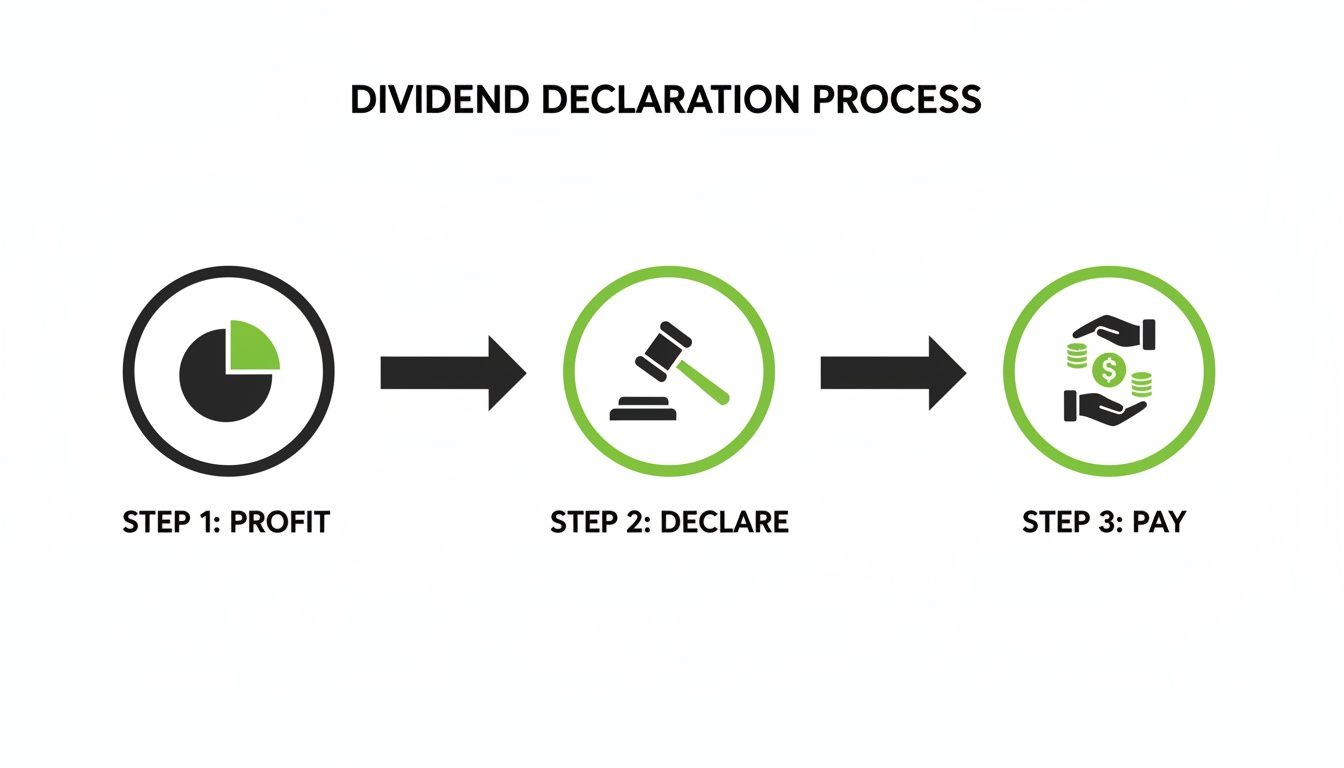
As you can see, you can only pay dividends from post-tax profits, and the decision has to be formally documented before any money changes hands.
To stay compliant, you need to create a clear paper trail for every single dividend payment. This boils down to two key documents:
- Board Meeting Minutes: You must hold a board meeting (even if it's just you in the room!) to formally declare the dividend. The decision, the date, and the amount all need to be recorded in the company's official minutes.
- A Dividend Voucher: For each shareholder getting a dividend, you need to issue a corresponding dividend voucher. This document is like a receipt and must show the company name, date, shareholder's name, and the dividend amount.
Think of these documents as your proof. If HMRC ever investigates your company's finances, the board minutes and dividend vouchers are the first things they will ask for to confirm your dividends are legitimate.
Timing Your Payments for Healthy Cash Flow
Finally, a quick word on timing. How often should you actually pay yourself?
For your salary, monthly is the standard. It creates a predictable business expense and makes it really straightforward to manage your RTI submissions to HMRC.
With dividends, you have got a bit more flexibility. While you can declare them whenever you like, many directors find a quarterly or bi-annual schedule works best. This rhythm gives you a chance to review the company's performance and make sure you have enough retained profit to cover the payment without putting a strain on your cash flow.
You can use our limited company take-home calculator to model different scenarios and plan your withdrawals. This kind of structured approach is key to keeping the business financially stable.
Right, so you have got the salary and dividend mix sorted. It is the bread and butter for most company directors, and for good reason. But do not stop there.
Think of your limited company as a financial toolkit. Salary and dividends are your most-used tools, but there are other, more specialised instruments that can give you extra flexibility and, crucially, tax efficiency. Let's dig into a few of the most useful ones: director's loans, pension contributions, and expenses.
What About a Director's Loan?
Sometimes you just need a short-term cash injection for something personal, and a director's loan can seem like an easy fix. In essence, you are borrowing money from your own company. It is a handy option, but be warned: this is an area where HMRC has some very sharp teeth.
You absolutely must track every penny in a Director's Loan Account (DLA). If that loan balance ever creeps over £10,000 during the tax year, it is immediately classed as a benefit-in-kind. That means paperwork (a P11D form) and a potential Class 1A National Insurance bill for your company.
The real killer, though, is the repayment deadline. Fail to pay the loan back in full within nine months and one day of your company's year-end, and your company gets hit with a painful tax charge. It's called the S455 charge, and it's currently a whopping 33.75% of whatever you still owe. HMRC puts this in place to stop directors from treating their company like a tax-free piggy bank.
The Smartest Move: Company Pension Contributions
Now for one of the most powerful (and strangely overlooked) perks of running your own company: paying into your pension directly from the business. This is not just a good idea; it is a brilliant one.
Here’s the magic behind it:
- Slash Your Corporation Tax: Pension contributions are a legitimate business expense. That means they come straight off your profits before Corporation Tax is calculated. Less profit, less tax. Simple.
- Dodge Personal Tax & NI: The money flows from your company's bank account directly into your pension pot. It never hits your personal account as income, so you sidestep both income tax and National Insurance completely.
- Build Wealth, Fast: You can put a serious amount away, too. The annual allowance is a generous £60,000 for the 2024/25 tax year. It is an incredibly efficient way to shift significant chunks of company profit into your future retirement fund.
It is a genuine win-win. You lower your company's tax bill today while building a secure financial future for yourself.
Don't Forget to Claim Your Expenses
This last one sounds almost too simple, but it makes a real difference. If you pay for business-related costs with your own money, your company must reimburse you.
This is not 'income' in the traditional sense, but it puts tax-free cash straight back into your pocket. It is just the company paying you back for costs that were its responsibility in the first place. You would be surprised how many directors let small things slide.
Make sure you are claiming for everything you’re entitled to:
- Business Travel: Mileage for using your own car, train fares, even flights.
- Working from Home: You can claim a flat-rate allowance for using your home as your office.
- Subscriptions & Training: Industry memberships, software subscriptions, or courses that help you do your job.
Getting disciplined about this stuff is fundamental. Every legitimate expense you claim reduces your company's taxable profit and ensures you are not personally subsidising your own business.
How IR35 Changes Your Pay Strategy
The off-payroll working rules, better known as IR35, can completely upend how you pay yourself from your limited company. If your contract is deemed 'inside IR35', it fundamentally alters your payment structure, essentially wiping out the tax advantages of the classic salary and dividend model.
When a contract falls inside IR35, HMRC basically sees you as an employee for tax purposes. This means all the income from that specific contract must be processed as a 'deemed salary'. It gets hit with the full force of PAYE Income Tax and National Insurance Contributions (NICs), just as if you were on a standard payroll.
This single change removes the option to draw low-tax dividends on that income, which is the cornerstone of tax-efficient planning for most company directors. All of a sudden, the admin that comes with running a limited company can feel like a heavy burden for a much smaller take-home pay.
When an Umbrella Company Makes More Sense
Trying to operate inside IR35 through your own limited company involves some pretty complex 'deemed payment' calculations, often leading to higher accountancy fees and a greater compliance risk. This is precisely why so many contractors in this boat find that using a compliant umbrella company is a much simpler and safer way forward.
An umbrella company effectively becomes your employer, handling all the tax and NI deductions correctly right from the start. It takes the administrative headache and the worry of getting the deemed payment calculation wrong completely off your plate.
While running a limited company offers fantastic flexibility, its main tax benefits are lost on an inside-IR35 contract. At that point, the simplicity and security an umbrella company offers often outweigh the hassle of limited company administration.
Comparing Your Options
Let's put the two main paths for an inside-IR35 engagement side-by-side:
- Limited Company (Inside IR35): You are on the hook for calculating the deemed salary and making sure the right tax and NI are paid over to HMRC. This means more admin and a higher risk of getting it wrong.
- Umbrella Company: The umbrella company handles all the payroll, tax, and NI deductions for you. This brings peace of mind and significantly less paperwork.
Think about something like the Employment Allowance. It is a key tax relief for some small businesses, but it is not available to companies where a single director is the only employee paid above the NI threshold. It is these kinds of specific rules that can really affect your net pay, making the straightforward approach of an umbrella company much more appealing when IR35 is in the picture.
Ultimately, the choice comes down to balancing tax efficiency against your administrative workload and appetite for risk. For a deeper dive, our detailed guide on IR35 for contractors has all the information you need to make the right call.
Director Pay: Your Questions Answered
Getting your head around the rules for paying yourself as a director can feel a bit daunting at first. Let's tackle some of the most common questions we see from limited company contractors to give you some clarity and confidence.
Can I Just Take Money from the Business Account?
It is a tempting thought, but the answer is a hard no. This is one of the biggest tripwires for new directors.
Unlike being a sole trader where the money is all yours, a limited company is a separate legal entity. You cannot just dip into the business bank account for personal cash. Every single pound you take out has to be properly recorded as either a salary (via PAYE), a dividend, a repayment of a director's loan, or a reimbursed business expense. Get this wrong, and you are heading for a nasty tax headache with HMRC.
How Often Should I Pay Myself a Salary and Dividends?
There is no single right answer, but a common and practical rhythm is to run your salary through payroll monthly. This keeps things neat and tidy, makes your company's costs predictable, and keeps your HMRC reporting (through Real Time Information, or RTI) straightforward.
Dividends offer a lot more wiggle room. A lot of directors find a quarterly schedule works well. This gives you a chance to step back, look at the company's performance, and make sure you have actually got enough profit left after tax before you declare anything. It’s a smart way to manage your cash flow.
Crucial point: You can only declare dividends from retained profits after you’ve set aside money for Corporation Tax. Paying out a dividend your company cannot afford isn't just bad business, it's illegal.
What Happens if I Don’t Pay Myself a Salary?
You could choose not to take a salary at all, but for most directors, it is not the best move.
If you do not pay yourself a salary that at least crosses the Lower Earnings Limit, you will not be making any National Insurance contributions. That means the year will not count towards your State Pension entitlement, which could leave you short when you eventually retire.
The tried-and-tested strategy is to blend a small, tax-efficient salary with dividends. This way, you bank those all-important pension credits while keeping your personal and company tax bills as low as possible.
Figuring out the best pay structure gets even trickier when rules like IR35 are in the mix. UmbrellaCompany.com makes it simple to compare compliant umbrella solutions, helping you find the right setup for your contracting career. Find your perfect umbrella company today.


