


As a director and shareholder, taking dividends is essentially about distributing your limited company's profits after you've paid Corporation Tax. But it's not as simple as just moving cash from your business account to your personal one. The process involves formally declaring the dividend at a directors' meeting, creating a paper trail with board minutes, and issuing a dividend voucher as proof of payment.
Why Dividends Are Key for Company Directors
For any limited company director, figuring out how to pay yourself is one of the biggest financial decisions you will make. A regular salary has its place, of course, but really getting to grips with how dividends work can make a huge difference to your tax efficiency.

This guide is all about demystifying that process for UK directors. We will cover everything from the legal checks you need to make beforehand to how you will handle the tax on your Self Assessment, giving you the confidence to take money out of your business the right way.
Understanding the Core Difference
The first thing to get your head around is that dividends are a share of your company's post-tax profits. They are not a business expense like a salary, which gets deducted before your Corporation Tax is worked out.
This is the fundamental reason why a mix-and-match approach is so popular with UK directors. The classic strategy is to take a small, tax-efficient salary topped up with larger dividend payments. It’s a structure designed to keep both your personal and company tax bills as low as possible.
Let's break that down:
- Salary: This is an allowable business expense, so it reduces your company's Corporation Tax liability. The downside? It's subject to both Income Tax and National Insurance Contributions (NICs).
- Dividends: This is a distribution of profit after the company has already paid Corporation Tax. The big win here is that dividends are not subject to NICs, which can lead to significant tax savings.
This distinction is crucial. Here at UmbrellaCompany.com, we see countless contractors and freelancers put this strategy to good use, but it absolutely has to be planned carefully to stay compliant.
A well-planned remuneration strategy combining a low salary and dividends is often the most tax-efficient way for a company director to be paid. The main advantage is the saving on National Insurance, which applies to salaries but not to dividends.
To make this clearer, let's look at a quick comparison.
Salary vs Dividends: A Quick Comparison
Deciding on the right mix of salary and dividends is a key part of your financial planning. This table lays out the main differences to help you see how each one works.
| Feature | Director's Salary | Director's Dividends |
|---|---|---|
| Source of Funds | Paid from company revenue before tax. | Paid from company profits after Corporation Tax has been deducted. |
| Tax Treatment for Company | An allowable business expense that reduces the company's Corporation Tax bill. | Not a business expense; has no impact on the company's Corporation Tax liability. |
| Personal Tax | Subject to Income Tax and National Insurance Contributions (both employee's and employer's). | Subject to Dividend Tax rates but completely exempt from National Insurance. |
| Timing | Can be paid regularly (e.g., monthly) through PAYE payroll, regardless of company profit. | Can only be paid if the company has sufficient retained profits available. |
| Qualifying for State Benefits | Counts as "qualifying earnings" for things like the State Pension, if paid above the Lower Earnings Limit. | Do not count as earnings for State Pension or other contributions-based benefits. |
| Paperwork | Requires running a PAYE payroll, issuing payslips, and making real-time submissions to HMRC. | Requires board meeting minutes to declare the dividend and issuing a dividend voucher for each shareholder. |
Ultimately, the goal for most directors is to find the sweet spot between the two, using a salary to unlock state benefits while using dividends for the bulk of their income to maximise tax efficiency.
Why Correct Process Matters
Paying yourself a dividend correctly is about much more than just the money transfer. There's a specific, legally required process you have to follow. If you get it wrong, you could face serious problems, with HMRC potentially reclassifying the payment as a salary or an illegal director's loan, which comes with some nasty tax implications.
We will walk you through all the practical steps you need to take. We will cover the essential paperwork, how to calculate exactly what your company can afford to pay out, and how to manage your personal tax bill properly. This will help you see both the opportunities dividends offer and the critical compliance rules you simply cannot ignore.
Meeting the Legal Requirements for Dividend Payments
Before you can actually pay yourself a dividend, there are a few legal hoops to jump through. This isn't just about ticking boxes; it's about protecting you and your company and making sure everything is above board in the eyes of HMRC. Get this part right, and you will save yourself a world of headaches later on.

The whole process boils down to one simple rule: you can only pay dividends out of distributable profits. These are the profits your company has left over after it has paid all its bills and, crucially, settled its Corporation Tax liability. If you try to pay a dividend when there are not enough profits, it’s classed as an 'illegal' dividend, and that can lead to some pretty serious consequences.
Confirming You Have Sufficient Distributable Profits
First things first, you need to be absolutely sure your company has enough retained profit to cover the dividend you want to declare. And we do not mean a back-of-the-envelope calculation, you need to look at the hard numbers.
This means digging into your company's accounts. They will show you all your income, less your business costs and Corporation Tax, which leaves you with a figure for retained earnings. This is the pot of money from which you can legally draw dividends.
Let's say your consultancy business made a post-tax profit of £40,000 last year, and you had £10,000 in retained profits from previous years. Your total distributable profits would be £50,000. You could not just decide to pay yourself a £60,000 dividend because the money simply isn't there.
It's always better to be cautious here. We always advise clients to get their accountant to prepare some up-to-date management accounts before every single dividend declaration. It ensures your decision is based on the most current financial picture and stops you from accidentally overpaying.
Always remember, dividends are a reward from success, not a tool for cash flow. They can only be paid from the profits your company has already made and paid tax on. Mistaking revenue for profit is a common and costly error.
Holding a Directors' Meeting and Documenting the Decision
Once you have confirmed the profits are there, the next legal step is to formally declare the dividend. This has to be done at a directors' meeting, and that decision must be officially recorded.
Even if you're a one-person band (the sole director and shareholder) this step is not optional. You still need to hold a "meeting" with yourself and write down the resolution. This paperwork is your legal proof that the payment was a properly authorised dividend.
The key document you need is the board minutes. These notes must clearly state:
- The date of the meeting.
- The names of the directors who were present.
- The total dividend amount being declared.
- The shares on which the dividend is being paid.
Without these minutes, HMRC could easily challenge the payment. They might argue it was actually a salary, which would mean it's subject to PAYE tax and National Insurance. Or worse, they could class it as an unauthorised director's loan, which brings its own set of painful tax rules. This is why a clear paper trail is non-negotiable. At UmbrellaCompany.com, we constantly stress that good record-keeping is your best defence.
Understanding the Impact of Share Classes
How your company's shares are set up also plays a huge part in how dividends are paid. If all shareholders hold the same type of shares (known as 'ordinary shares'), then any dividend has to be split in proportion to how many shares each person owns.
For example, if you own 75% of the shares and your business partner owns 25%, you must receive 75% of the total dividend, and they get the other 25%. You cannot just change these proportions whenever you feel like it.
However, some companies use different share classes (like 'A' shares and 'B' shares). This can give you a bit more flexibility, potentially allowing directors to issue different dividend amounts to different shareholders. Setting up multiple share classes is a complex area, so it's vital to get professional advice to make sure it's done correctly and for sound commercial reasons.
Working Out How Much You Can Actually Pay Yourself
Alright, let's get down to the brass tacks: working out exactly how much you can safely and legally take from your company as a dividend. This is not guesswork; it's a critical calculation based on your company's real-world performance. Getting this number right is the bedrock of paying yourself dividends correctly.
The whole process boils down to one crucial figure: your distributable profits. This is the pot of accumulated, post-tax profit your business has available. It's a hard limit – you cannot, under any circumstances, pay a dividend that exceeds this amount.
The Core Calculation for Your Dividend Pot
To figure out your distributable profits, you first need to look at your company's net profit for the period. In simple terms, that’s all the money you’ve invoiced, minus all your allowable business expenses, think salaries, software subscriptions, insurance, and so on.
From that net profit figure, you then have to subtract your upcoming Corporation Tax bill. It's only after you’ve accounted for the taxman's slice that you arrive at the true amount of profit available to you. Paying dividends from pre-tax profits is a common and very dangerous mistake.
The basic formula looks like this:
- Net Profit (Revenue minus all business costs)
- Less: Your Corporation Tax liability
- Equals: Profit available for distribution (your dividend pot)
It's also essential to factor in any profits or losses carried over from previous financial years. A cracking year could be dampened by previous losses, which would reduce the amount you can legally pay out now.
A Practical Example: An IT Consultancy
Let's see how this works in practice. Imagine you run a small IT consultancy as a limited company. Here’s a quick breakdown of how the numbers might look after a successful quarter.
Revenue Generated: Your consultancy brings in a total of £40,000 in client invoices.
Deduct Business Expenses: You deduct your running costs. This includes your own salary (£3,000), software licences (£1,000), insurance (£500), and home office costs (£300). Your total expenses come to £4,800.
Calculate Net Profit: This leaves you with a net profit (before tax) of £35,200 (£40,000 – £4,800).
Account for Corporation Tax: Now, you must set aside the Corporation Tax due on that profit. Assuming a 19% rate, that’s £6,688 (£35,200 x 19%).
Determine Your Distributable Profits: After taking off the tax, your total distributable profit for the quarter is £28,512 (£35,200 – £6,688).
This £28,512 is the absolute maximum dividend you could legally declare for that period. Taking a penny more would be an illegal, or 'ultra vires', dividend.
The Dangers of an Illegal Dividend
Dipping into the pot for more money than is legally available as distributable profit results in an illegal dividend. This is not just a slap on the wrist; the consequences can be severe and put you in a sticky financial situation personally.
If HMRC spots an illegal dividend, they can reclassify that excess payment. It might be treated as a director's loan, which comes with its own complicated tax rules and must be repaid to the company, often with interest. Worse, it could be reclassified as salary, making it subject to PAYE Income Tax and National Insurance for both you and the company.
The most serious risk? As the shareholder who received the payment, you could be held personally liable to repay the unlawful amount back to the company. This is a cornerstone of UK company law designed to protect the company's creditors.
Why You Should Consider Leaving Some Profit in the Business
Just because you can take the maximum dividend does not always mean you should. In fact, it’s often a very smart move to leave some of that profit in the business bank account.
Retaining some earnings gives your company a vital financial cushion. You can use it for:
- Future Growth: Investing in new kit, training, or a much-needed marketing push.
- Managing Cash Flow: Covering the bills during quieter months or when clients are slow to pay.
- Unexpected Costs: Building a rainy-day fund for when a key piece of equipment fails or you get an unexpected bill.
By retaining profit, you're building resilience and safeguarding the long-term health of your company. A strategy we often see at UmbrellaCompany.com is for directors to take out a consistent, planned dividend each quarter, allowing the leftover profit to build up as a buffer for whatever opportunities or challenges lie ahead.
How to Document and Pay Dividends Correctly
Once you have crunched the numbers and confirmed the profits are there, the next vital step is creating a solid paper trail. This is not just about being organised; it's a non-negotiable for HMRC. Getting the documentation right is your proof that a payment is a legitimate dividend and not something else, like a salary or an unauthorised director's loan.
Getting this right keeps you compliant and is your first line of defence in any potential HMRC enquiry. For every single dividend you pay, you need two key documents: the board meeting minutes and a dividend voucher for each shareholder.
This simple flowchart shows how you get from company profit to a dividend in your pocket.
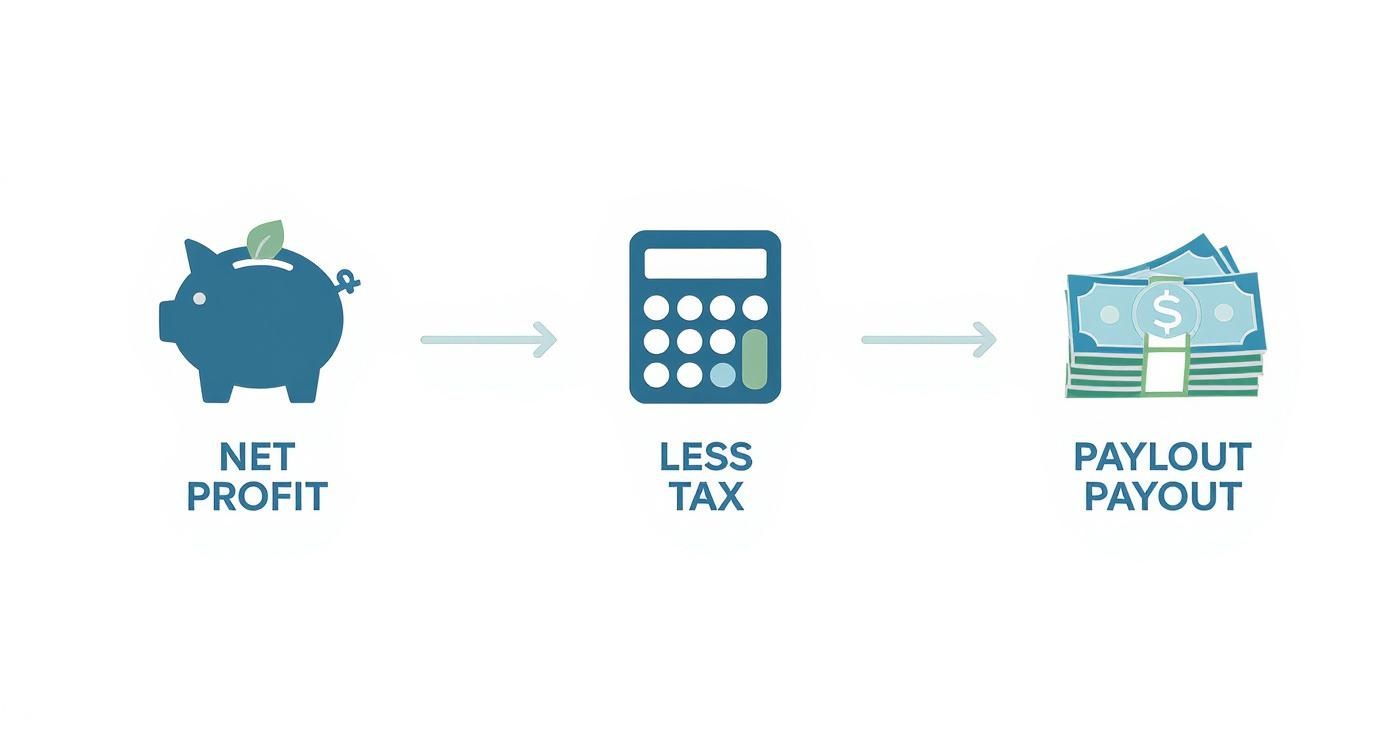
As the graphic makes clear, dividends can only ever come from post-tax profits, which is why your bookkeeping has to be spot on.
Creating Board Meeting Minutes
As we mentioned, every dividend has to be formally declared at a directors' meeting. The record of that meeting, known as the board minutes, is the first piece of your paper trail. This still applies even if you're a one-person band, the sole director and shareholder of your company.
Think of the minutes as the official, internal green light for the payment. They do not need to be complicated, but they must contain these key details:
- Company Name and Number: Clearly state which company is declaring the dividend.
- Meeting Details: Note the date of the meeting and list the directors who were present.
- Dividend Declaration: Specify the total dividend amount being declared and the accounting period it relates to.
- Authorisation: A director needs to sign the minutes to make them official.
These minutes must be filed away safely with your company's statutory records. Trust us, they're the first thing an HMRC inspector will ask for to check your dividend payments are legitimate.
Issuing a Dividend Voucher
The second document you cannot skip is the dividend voucher. This is basically the 'payslip' for the dividend, and you issue one to every shareholder who gets a payment. It's a crucial record for both the company and the individual, you will need it when it comes to filling out your personal Self Assessment tax return.
Every dividend voucher you create must show:
- The date of the payment.
- The company's name.
- The shareholder's name and address.
- The number of shares that shareholder owns.
- The total dividend payable to them.
- A director’s signature.
You need to create a fresh dividend voucher for every single dividend payment you make. So, if you pay yourself dividends quarterly, that means you'll need four separate sets of board minutes and vouchers for the tax year. Keeping these organised from the start will save you a world of pain later.
At UmbrellaCompany.com, we always advise directors to set up a simple, repeatable process for their paperwork. Create a template for your board minutes and dividend vouchers. That way, you can just fill in the blanks each time, ensuring nothing important ever gets missed.
Making the Physical Payment
With all the paperwork sorted, you can finally make the payment. The cleanest and most common way to do this is a simple bank transfer from your company's business account to the shareholder's personal bank account. It creates a clear, easily traceable transaction.
Another option is to credit the dividend amount to a Director's Loan Account (DLA). This is handy if you do not need the cash right away but want to officially draw the funds from the company's profits. The money is then recorded as something the company owes you, and you can withdraw it personally whenever you like.
Whichever route you go down, it's absolutely crucial to keep these transactions separate from your day-to-day personal finances. A clean audit trail is your best evidence that you've followed all the right procedures.
Navigating Personal Tax on Your Dividends
Once you have legally paid a dividend from your company, the spotlight moves from business compliance to your personal tax return. Getting a firm grip on how HMRC taxes this income is key to smart financial planning and avoiding a nasty surprise when the tax bill lands.
Don't worry, it's not as complex as it might first appear. The UK has a specific system for dividends with its own allowances and tax bands. What you will ultimately owe depends entirely on your total income for the tax year.
The UK Dividend Allowance
Every UK taxpayer gets a Dividend Allowance. This is a set amount of dividend income you can receive each tax year without paying a penny of tax on it, no matter what your other earnings are.
It’s worth noting that this allowance has been shrinking in recent years. For the 2024/25 tax year, the Dividend Allowance is set at £500. So, the first £500 of dividends you receive is completely tax-free.
Just be aware, this is not a separate allowance like your main Personal Allowance. Instead, it uses up the first part of your tax band. Think of it as a 0% tax rate on your first chunk of dividend income, rather than an extra tax-free amount on top of everything else.
Understanding the Dividend Tax Bands
After you have used up your £500 Dividend Allowance, any further dividends are taxed. The rate you will pay is determined by which Income Tax band your total income pushes you into.
For the 2024/25 tax year, the dividend tax rates are:
- Basic Rate: 8.75% on dividends that fall within the basic rate band (£12,571 to £50,270).
- Higher Rate: 33.75% on dividends that fall within the higher rate band (£50,271 to £125,140).
- Additional Rate: 39.35% on dividends over £125,140.
To figure out which rate applies, you need to add your total dividend income to your other income for the year, like your director's salary. This combined total shows which tax bands your dividends occupy.
A Practical Example of Dividend Tax Calculation
Let's walk through a common scenario to see how this plays out in the real world. Imagine you're a director who has taken a tax-efficient salary and a dividend from your company profits.
- Director's Salary: £12,570 (this uses up your Personal Allowance, so no Income Tax is due on it).
- Dividend Income: £40,000.
- Total Income: £52,570.
Here’s the step-by-step tax calculation:
- Your salary of £12,570 uses up your entire tax-free Personal Allowance.
- The first £500 of your dividends is covered by the Dividend Allowance, so that's also tax-free.
- The next £37,200 of your dividends falls squarely into the basic rate band. This portion is taxed at 8.75%, which comes to £3,255.
- The remaining £2,300 of your dividends tips your total income over the basic rate threshold and into the higher rate band. This amount is taxed at 33.75%, adding £776.25 to your bill.
- Your total personal tax liability on the dividends is £4,031.25 (£3,255 + £776.25).
By carefully balancing your salary and dividend mix, you can strategically manage which tax bands your income falls into. This is fundamental to maximising your take-home pay as a limited company director.
Reporting Dividends on Your Self Assessment
You must declare any dividend income to HMRC through your annual Self Assessment tax return. This is where you bring all your income streams together, salary, dividends, and anything else, so HMRC can work out your final tax position.
The deadline to file your online tax return and pay what you owe is 31st January after the tax year ends. So, for the 2023/24 tax year (which ended 5th April 2024), your deadline is 31st January 2025. It’s crucial to hit these dates, as HMRC issues automatic penalties for late filing and payment.
Staying Informed About Tax Changes
It’s also smart to keep an eye on the wider economic picture. For example, UK dividend payouts jumped by 8.0% to £94.3 billion in 2022, with underlying dividends (excluding special one-offs) climbing an impressive 16.5% to £84.8 billion. This kind of growth, often fuelled by sectors like oil and banking, can influence future government tax policy.
As you can find out by reviewing these dividend trends, staying informed is vital for good financial planning. Government policies on tax rates and allowances can, and often do, change. These shifts can directly affect your remuneration strategy, which is why at UmbrellaCompany.com, we help contractors navigate these complexities to ensure their payment structure always remains as efficient as possible.
Common Dividend Mistakes and How to Avoid Them
Even the most meticulous company directors can trip up when paying dividends. These slip-ups can lead to stressful and expensive compliance headaches with HMRC, but understanding the common pitfalls is the best way to keep your payment strategy on solid ground.
Honestly, a few simple checks are all it takes to stay on the right side of the taxman.
The biggest clanger we see is paying an illegal dividend. This is what happens when you pay a dividend without having enough distributable profits in the company to cover it. You absolutely must base your decision on up-to-date management accounts, not just a healthy-looking business bank balance.
Overlooking the Paper Trail
Another all-too-common mistake is getting sloppy with the paperwork. It’s critical to remember that every single dividend payment needs its own supporting documents. It does not matter if it's a small amount or part of a regular payment plan, without the right paper trail, HMRC could reclassify the payment.
For every dividend you issue, you need to have:
- Board meeting minutes that formally declare the dividend. Yes, this is still required even if you’re the only director.
- A dividend voucher for each shareholder who gets paid. This is their official receipt and is essential for their personal tax records.
Skipping the paperwork might seem like a minor time-saver now, but it can create enormous problems down the line. A clean, consistent paper trail is your best defence to prove every payment was a legitimate distribution of profit.
Taking Irregular Payments
It’s tempting to just dip into the company bank account whenever you need cash for personal bits and pieces. Be careful. Taking money out irregularly without formally declaring it as salary or a dividend is a massive red flag for HMRC.
These withdrawals can easily be seen as unauthorised director's loans or even reclassified as salary, which would make them subject to PAYE tax and National Insurance.
The easiest way to sidestep these issues is to get a clear, repeatable process in place. Working with an accountant provides real peace of mind and ensures everything is handled by the book. Here at UmbrellaCompany.com, we always stress that a disciplined approach is the foundation of any tax-efficient remuneration strategy.
A Few Final Questions on Director Dividends
Directors often have a few lingering questions when it comes to the nitty-gritty of paying themselves dividends. Let's clear up some of the most common ones we hear.
Can I Pay Myself Dividends Every Month?
Absolutely. You can pay yourself dividends as often as you like, monthly, quarterly, or whenever suits you. These are known as interim dividends.
The only catch? The company must have enough distributable profits to cover the payment each and every time you declare one. You cannot just set it and forget it. Every single payment requires its own board minute and dividend voucher to stay on the right side of the law.
What Happens If I Take an Illegal Dividend?
Taking a dividend when your company does not have the retained profits to cover it is a serious misstep. This is considered an unlawful (or ultra vires) payment.
If this happens, you and any other shareholders who knew the score could be held personally liable to pay the money back to the company. Worse still, HMRC might just decide to reclassify the whole payment as a salary, landing you with a bill for both PAYE tax and National Insurance. It’s a costly mistake to make.
Do I Pay National Insurance on Dividends?
No, and this is the main reason dividends are so popular with company directors.
Dividends are completely exempt from National Insurance contributions, for both you and your company. This is the cornerstone of the classic tax-efficient strategy for limited company directors: a small salary topped up with larger, more flexible dividend payments.
Figuring out the most efficient way to pay yourself as a contractor can feel like a minefield. At UmbrellaCompany.com, we specialise in helping contractors find compliant and effective payment solutions.
Our comparison tool can help you find the right setup for your unique situation. Find out more at https://umbrellacomnpany.com


