


Want to pay less tax as a UK contractor? The secret is not a complicated scheme, but a solid grasp of four key areas: your business structure, claimable expenses, pension planning, and understanding your IR35 status.
These are not loopholes. They are the legitimate, HMRC-compliant foundations for boosting your take-home pay. This guide will walk you through each one, giving you the practical knowledge to manage your finances effectively.
Your Guide to Contractor Tax Efficiency

Figuring out the UK tax system when you are a contractor can feel like a maze. But the first step to making real, legal savings is simply understanding your options. Here at UmbrellaCompany.com, we aim to provide you with practical, no-nonsense strategies to manage your money well.
This guide explores the details. We will look at the real-world differences between using a limited company versus an umbrella company, dive into what you can actually claim as an expense, and show you how to use your pension as a powerful tax-saving tool.
Understanding the Contractor Tax Landscape
The political mood around contractor tax is always shifting. The government's recent spending reviews have kept things stable for now, with the Chancellor announcing major public investment in autumn 2024 and spring 2025.
However, there are always whispers about reforms to Personal Service Companies (PSCs) and the ongoing Loan Charge saga, which means you can never rule out future changes. You can get the latest on this from the 2025 Spending Review for contractors.
Staying on top of potential changes is absolutely vital. A proactive approach means you can adjust your tax strategy as needed to protect your earnings, making sure you are always working in the most efficient and compliant way possible.
To become properly tax-efficient, you need to concentrate on the things you can control. This guide will give you the confidence and knowledge to do just that, focusing on:
- Business Structure: Making the right choice between a limited company and an umbrella company.
- Expense Claims: Legally reducing your taxable profit by claiming every allowable business cost.
- Pension Planning: Using contributions to lower your Corporation Tax bill if you are a limited company director.
- IR35 Compliance: Knowing your status to avoid unexpected tax demands.
Master these elements, and you will be well on your way to keeping more of the money you have worked so hard to earn.
Choosing Your Business Structure for Tax Savings
How you structure your business is one of the most fundamental decisions you will make as a contractor. It has a direct, and often significant, impact on your tax bill and, ultimately, your take-home pay.
For many UK contractors, the most tax-efficient path is setting up a limited company, often called a Personal Service Company (PSC). On the other hand, working through an umbrella company offers a much simpler, more hands-off approach.
The Tax Edge of a Limited Company
The main advantage of a limited company is the flexibility in how you draw your income. You can pay yourself a small, tax-efficient salary and take the rest of the company’s profits as dividends. Since dividends have a lower personal tax rate than salary income, this blended approach can seriously reduce your overall tax and National Insurance contributions.
Unlike a sole trader or umbrella employee, your limited company is a separate legal entity. It pays Corporation Tax on its profits. For the 2025/26 tax year, the first £50,000 of profit is taxed at 19%. By keeping some profit in the business rather than taking it all out, you can better manage your personal tax liability.
This structure also unlocks the ability to claim a much broader range of legitimate business expenses. Every pound you claim reduces your company’s taxable profit, which in turn lowers your Corporation Tax bill.
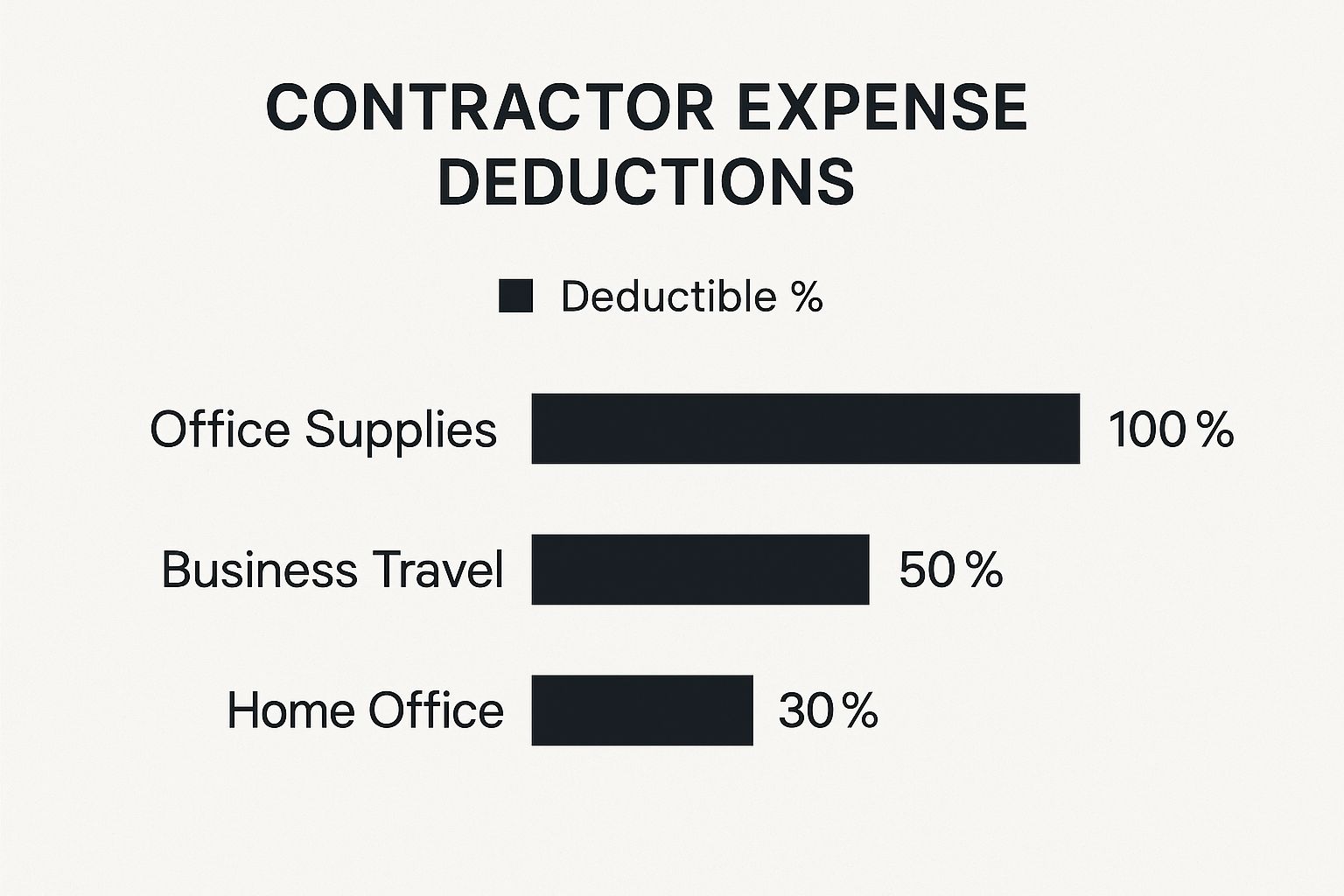
As the image shows, you can offset costs incurred purely for business against your company's profit, directly cutting the tax you owe.
The Simplicity of an Umbrella Company
If running a company sounds like too much administration, an umbrella company is a great alternative. It effectively becomes your employer for the duration of your contract.
This is a very straightforward setup, especially if your contract falls inside IR35. You just submit your timesheets, and the umbrella company handles everything else. Your PAYE tax, National Insurance, and any other deductions are all sorted before the money reaches your bank account. It is just like being a permanent employee.
While you can still claim some work-related expenses, the rules are much tighter than with a limited company. For many contractors who just want to get on with the job without the paperwork, this is the perfect solution. Some professionals, such as those looking for an umbrella company for contract lawyers, often find this simplicity is exactly what they need.
To give you a clearer picture, let's break down the key differences.
Limited Company vs Umbrella Company: A Tax Efficiency Comparison
This table shows the main operational and tax differences between the two most common contractor structures.
| Feature | Limited Company (PSC) | Umbrella Company |
|---|---|---|
| Tax Structure | Pay Corporation Tax on profits. Extract income via a low salary and dividends. | All earnings are processed via PAYE, subject to Income Tax and NI. |
| Take-Home Pay | Potentially higher due to tax planning (dividends, expenses). | Generally lower, as all income is taxed as salary. |
| IR35 Status | Director's responsibility to determine IR35 status for most contracts. | Ideal for 'inside IR35' contracts. The umbrella handles all tax compliance. |
| Admin Burden | Higher. Requires bookkeeping, statutory accounts, and tax returns. | Very low. Submit timesheets, and the umbrella company handles the rest. |
| Expense Claims | A wide range of allowable business expenses can be claimed to reduce profit. | Limited to expenses not reimbursed by the client, and rules are strict. |
| Control | Full control over business finances and decisions. | No control over the company; you are an employee. |
The choice really boils down to a trade-off. A limited company gives you greater potential for tax savings but comes with more administration, while an umbrella company is a hassle-free way to get paid.
Making the Right Choice for You
So, which one is right for you? Think about your contract’s value, how long it is likely to last, and its IR35 status.
If you are on a high-value, long-term contract that is clearly outside IR35, a limited company will almost certainly leave you better off financially. But if you are doing shorter-term gigs or working on projects that are inside IR35, the sheer convenience of an umbrella company is hard to beat.
Maximising Your Allowable Business Expenses

When it comes to smart tax planning, claiming every legitimate business expense is essential. Each valid claim reduces your company's taxable profit, which means a smaller Corporation Tax bill. Simple, right?
Yet, many contractors leave money on the table because they do not realise the full scope of what HMRC considers an allowable expense. It is about thinking beyond the obvious. Office supplies and software are easy wins, but the real savings are often hidden in the nuances of rules for travel, training, and working from home.
Getting these details right is fundamental to paying less tax as a contractor.
Distinguishing Between Business and Personal Costs
Here is the golden rule from HMRC: an expense must be "wholly and exclusively" for business purposes. This is the single biggest pitfall for contractors, especially when costs blur the line between professional and personal life.
Take travel. A trip to a client's office or a temporary workplace? You can claim the full cost. But your daily commute from home to a permanent work location is seen as a personal journey and is not allowable. This is why keeping clear mileage logs and notes on your travel purpose is so crucial.
Your mobile phone is another classic grey area. If the contract is in your limited company's name and it's for business, the whole cost is usually allowable. But if you are using your personal phone, you can only claim for the business-related portion of the bill, which needs careful calculation.
Meticulous record-keeping is your best friend here. Modern bookkeeping tools and receipt-scanning apps make it incredibly easy to log expenses on the go. You will thank yourself for having a clean, HMRC-compliant audit trail when your financial year-end arrives.
Common Allowable Expenses For Contractors
To get the most out of your claims, you need to know what you are entitled to. This is not an exhaustive list, but it covers some of the most common (and valuable) expenses contractors can claim:
- Office Equipment: Your laptop, printer, office desk, and any software you need to do your job.
- Professional Subscriptions and Memberships: Fees for bodies relevant to your profession (like BCS for IT professionals) are a fair claim.
- Training and Development: Courses that keep your skills sharp for your current contract are usually claimable.
- Professional Indemnity Insurance: An absolute must-have for most contractors and, thankfully, fully deductible.
- Home Office Allowance: You can either claim a simple flat rate from HMRC or calculate a proportion of your actual household bills (like heating and electricity) based on how much you use your home for business.
The Importance of Organisation
Staying organised is not just good practice; it is non-negotiable. If you neglect your records, you are not just risking missed claims, you could face HMRC penalties for inaccurate accounts.
Using cloud accounting software is a game-changer for managing your finances. You can link your business bank account, categorise spending as it happens, and securely store digital receipts. It makes the whole process much more straightforward.
For more ideas, you can explore some of the best ways to reduce tax as a contractor in our detailed guide. By building these good habits now, you ensure your expense claims are robust, compliant, and working hard to lower your tax bill.
Using Pension Contributions to Lower Your Tax Bill
When it comes to cutting your tax bill, pension contributions are one of the smartest, most effective moves a contractor can make. Savvy contractors use this strategy because it provides a double benefit: a significant tax saving now while building up a solid nest egg for the future. It is a genuine win-win.
The key is to have your limited company pay directly into your personal pension. This is called an employer contribution, and it is where the real tax efficiency lies. HMRC sees this payment as a legitimate business expense, just like your software subscriptions or accountancy fees.
This simple action reduces your company's profits, which means you pay less Corporation Tax.
How Employer Contributions Save You Tax
Unlike contributions you make from your own pocket (which are limited by your earnings), there is technically no cap on what your company can pay in. The only real rule is that the contribution must be ‘wholly and exclusively’ for the business. For a typical contractor where you are the main person earning the fees, this is almost never an issue.
Let's walk through a quick example.
Imagine your limited company is on track to make £60,000 in profit this year. If you get the company to pay £10,000 into your pension, that profit figure immediately drops to £50,000 before any tax is calculated.
That single payment directly reduces your Corporation Tax bill. At the current 19% rate, that £10,000 contribution saves your company £1,900 in tax. That is money in your pension pot, not with the tax authority.
Understanding the Allowances
Of course, you cannot just put unlimited funds into your pension without a few rules. HMRC has a couple of key allowances you need to keep on your radar:
- Annual Allowance: For the 2024/25 tax year, you can contribute up to £60,000 into your pension. This is a generous limit that covers both your company's contributions and any personal ones you might make.
- Lifetime Allowance (LTA): The LTA was abolished in April 2024, but it was replaced with new caps on how much you can take out tax-free. You need to be aware of the Lump Sum Allowance (£268,275) and the Lump Sum and Death Benefit Allowance (£1,073,100).
These rules are there to keep things fair, but they still give contractors massive scope for tax-efficient saving.
By using your pension strategically, you are essentially redirecting cash that would have been lost to tax and putting it straight into your own retirement fund. It is a foundational part of any serious plan for how to pay less tax as a contractor. We always suggest having a chat with a good financial adviser to work out a pension strategy that fits you perfectly.
Navigating IR35 and Its Tax Implications

When you are trying to figure out how to pay less tax as a contractor, your IR35 status is a huge piece of the puzzle. The off-payroll working rules, which everyone knows as IR35, are HMRC’s way of deciding whether you are a genuine independent business or a ‘disguised employee’.
If you are found to be ‘inside IR35’, it means you will be taxed at source, much like a permanent employee. For any contractor running a limited company, this wipes out the tax advantages for that specific contract. Your income suddenly becomes subject to PAYE tax and National Insurance.
Getting a handle on your IR35 risk is not just about ticking compliance boxes. It is about protecting your financial future and making sure your business structure is actually working for you.
Key Factors in an IR35 Determination
HMRC does not just glance at your contract; it examines the reality of your day-to-day working relationship with a client. Three core principles always sit at the heart of an IR35 assessment. Understanding them is your first line of defence.
These principles help paint a clear picture of your real employment status:
- Control: This is all about who has the final say over how, when, and where you do your work. If your client is dictating your working hours and micromanaging every step, it starts to look a lot like an employment relationship.
- Substitution: A proper business should be able to send a suitably qualified substitute to do the work in its place. If you personally have to provide the service and cannot send a replacement, your ‘outside IR35’ case gets much weaker.
- Mutuality of Obligation (MOO): This comes down to the expectation of ongoing work. In a genuine contractor arrangement, the client has no obligation to offer you more projects, and you have no obligation to take them.
Strengthening Your Outside IR35 Position
To show that you are operating as a genuine business, your contract and your actual working practices need to be in perfect alignment with an ‘outside IR35’ status. This means setting clear boundaries with your client from day one.
For instance, your contract must include a clear substitution clause. What is even better? A real-world example of you having used a substitute on a project. You should also avoid any clauses that hint at an employment-like relationship, such as getting access to staff perks like holiday pay or invitations to the company Christmas party.
The Status Determination Statement (SDS) is a critical document your client issues, outlining their decision on your IR35 status. You have the right to challenge this determination if you disagree, but you will need to back it up with solid evidence based on your working practices.
If you feel unsure about where you stand, we have a helpful article that goes deeper into how to avoid IR35 tax. It is far easier to get things right at the start of a contract than to try and challenge a determination later. By carefully managing these factors, you can operate confidently outside IR35 where it is appropriate.
Exploring VAT Schemes for Additional Savings
Most contractors only think about Value Added Tax (VAT) when they have to register. However, it can be a surprisingly effective way to improve your company’s finances. Choosing to register for VAT, even before you hit the legal threshold, can genuinely boost your bottom line.
For the 2025/26 tax year, the VAT registration threshold is £90,000. If your turnover is approaching that number, you will need to register. But you can also do it voluntarily before you reach that point. This lets you reclaim the VAT you spend on business purchases, which can be a real boost to your cash flow. If you want to explore the pros and cons, you can learn about the benefits of VAT registration for contractors.
The Standard VAT Scheme
With the standard VAT scheme, things are quite straightforward. You add 20% VAT to your invoices, which your client pays you. You then pass this collected VAT on to HMRC, but not before you have deducted any VAT you have paid out on your own business costs.
This works particularly well if you have significant business expenses that include VAT, for example new IT equipment, software licences, or your accountant’s fees.
Unlocking Savings with the Flat Rate Scheme
This is where things get interesting. For many contractors, the real opportunity lies with the VAT Flat Rate Scheme. It is designed to simplify your accounting, but it has a very welcome side effect: it can directly increase your net income.
Instead of meticulously tracking all the VAT on your purchases, you just pay HMRC a fixed, lower percentage of your total VAT-inclusive turnover.
The exact flat rate percentage is tied to your industry, but most contractors find themselves classed as a ‘limited cost business’. This label applies if your spending on goods is less than either 2% of your turnover or £1,000 a year. If that sounds like you, your flat rate is 16.5%.
This might not seem like a huge drop from the standard 20%, but it creates a direct financial gain on every single invoice. You charge clients 20% VAT but only hand over 16.5% to HMRC. You get to keep the 3.5% difference as company income.
Let’s see how that plays out with a quick example:
- You invoice your client for £5,000 (plus VAT).
- You add £1,000 in VAT (20%), making the total invoice £6,000.
- Your client pays you the full £6,000.
- You pay HMRC £990 (which is 16.5% of £6,000).
- The leftover £10 is profit for your company.
Ten pounds might not sound like much, but if you do that on every invoice for a year, it quickly adds up to hundreds, or even thousands, of pounds in extra, legally retained cash. It is a simple but incredibly powerful tactic for any contractor looking to run a more efficient business.
Your Top Contractor Tax Questions, Answered
Working for yourself brings up many questions, especially around tax. We are often asked the same things, so let's clear up some of the most common queries for UK contractors.
Can I Claim My Daily Commute as an Expense?
This is probably one of the most frequently asked questions, and HMRC’s answer is a very clear no. The trip from your home to your main place of work is just a regular commute, the same as it is for any employee. You cannot claim it back.
The rules change, however, when you travel to a temporary workplace. For example, if your main contract is based in Manchester but you have to travel to a client’s office in Birmingham for a two-week project. That journey is an allowable expense. It is the "temporary" nature that makes all the difference.
Do I Have to Register for VAT?
You do not have a choice once your turnover hits the VAT threshold, which is currently £90,000 in any 12-month rolling period. If you miss that deadline, you could face a penalty from HMRC.
But many contractors do not wait until they are forced to. Registering for VAT voluntarily can be a smart move. It means you can start reclaiming the VAT on your business purchases, from a new laptop to your accountancy fees. For some, particularly those on the Flat Rate Scheme, it can even generate extra income.
Deciding when to register for VAT is a strategic choice. While it adds an administrative task, the ability to reclaim VAT or profit from the Flat Rate Scheme often makes it a financially smart move well before it becomes a legal necessity.
What Happens If My Contract Is Inside IR35?
If a client determines your contract is inside IR35, you are essentially treated as an employee for tax purposes for that specific job. Your income is subject to PAYE Income Tax and National Insurance contributions, which are deducted before the money even reaches your business bank account.
This really changes the situation. It removes the main tax advantage of using a limited company for that contract, as you can no longer draw your income as tax-efficient dividends.
Getting these rules right is crucial for keeping as much of your hard-earned money as possible. At UmbrellaCompany.com, we help by letting you compare compliant umbrella companies that specialise in managing contractor tax, especially for those inside IR35 roles. You can find the right one for you in under a minute. https://umbrellacompany.com


