


As a contractor, one of the smartest things you can do is structure how you get paid to legally minimise your National Insurance bill. For those of us running a limited company, the go-to strategy is paying yourself a small salary (just enough to hit the National Insurance threshold) and then taking the rest of your income as dividends.
Dividends aren't subject to NI, which makes this a completely legitimate way to reduce what you hand over to HMRC. It also ensures you still get your qualifying year for state benefits.
Your Guide to Contractor National Insurance

Understanding how National Insurance Contributions (NICs) work is the first real step to paying less. For contractors, the rules change depending on whether you are a limited company director or a sole trader. Knowing the lay of the land is what allows you to make better financial moves.
At UmbrellaCompany.com, we provide clear, straightforward advice to help you keep more of the money you work so hard for. This guide will walk you through the essential strategies for NI optimisation, starting with the basics of the system itself.
Key NI Classes for Contractors
The type of National Insurance you pay depends on how your business is set up. For most contractors, it will be one of these two:
- Class 1 NICs: This is for directors of limited companies (and any employees you might have). It has two parts: the employee’s contribution comes off your salary, and the employer’s contribution is an extra cost paid by your company.
- Class 4 NICs: This applies to self-employed sole traders. It is calculated based on your business profits and you typically pay it along with your Income Tax when you file your annual Self Assessment.
Understanding NI Thresholds
The good news is you do not pay NI on every penny you earn. Both Class 1 and Class 4 NICs only begin once your earnings go above certain government-set limits, known as thresholds.
This is where the low salary strategy comes into play. By paying yourself a salary right up to the Primary Threshold for Class 1 NICs, you avoid paying any employee contributions but still bank a qualifying year towards your State Pension.
To give you a quick reference, here are the main thresholds you need to be aware of.
Key National Insurance Thresholds for Contractors
This table provides a quick summary of the NI thresholds and what they mean for your salary.
| Threshold Name | Annual Amount | What It Means for a Contractor |
|---|---|---|
| Lower Earnings Limit (LEL) | £6,396 | Earn above this to get NI credits for the State Pension without paying NI. |
| Primary Threshold (PT) | £12,570 | You start paying employee's Class 1 NI on earnings above this level. |
| Secondary Threshold (ST) | £9,100 | Your company starts paying employer's Class 1 NI on your salary above this. |
Sticking to a salary between the Secondary and Primary thresholds (£9,100 to £12,570) is often the sweet spot for many directors, as it avoids both employee and employer NI while still qualifying for the State Pension.
The impact of National Insurance rates on your net income can be huge. For example, the main employee NICs rate recently dropped to 8% from 10%, but the employer's contribution stayed at a hefty 13.8%.
Given that NI raises around £172 billion for the government in a typical year, it is a massive part of the tax landscape. You can read more about recent NI changes and how they affect businesses on BDO.co.uk. This is precisely why getting your income structure right from the start is so critical.
Finding the Right Salary and Dividend Balance
One of the smartest moves for any limited company contractor is getting the mix of salary and dividends right. This is not a shady loophole; it is a completely legitimate and long-established way to structure your income to be more tax-efficient, specifically by paying less National Insurance.
By setting this up correctly, you get far more control over what you take home. The strategy itself is straightforward: you pay yourself a small salary and take the rest of your company's profits as dividends.
Why a Low Salary and High Dividend Model Works
The power of this approach comes down to how HMRC treats these two types of income. Dividends are a distribution of your company’s post-tax profits, and crucially, they are completely exempt from National Insurance. Both the employee's and employer's NI contributions are only ever calculated on salary.
This is where the real savings kick in. For example, a salary above the NI threshold brings a 13.8% employer's NI charge for your company, plus an 8% employee’s NI charge for you on earnings over £12,570. If you keep your salary low, you can slash these charges or wipe them out entirely.
Key Takeaway: The goal is to set a salary that is just high enough to count as a qualifying year for things like the State Pension, but low enough to avoid handing over unnecessary National Insurance. Dividends then form the bulk of your income, with no NI to pay.
Setting Your Optimal Salary Level
Most contractors we work with pin their salary to one of two key HMRC thresholds. It generally comes down to these common strategies:
- Salary at the Secondary Threshold (£9,100): At this level, neither you nor your company pays a penny in National Insurance. It is that simple. You just need to make sure your earnings are above the Lower Earnings Limit (£6,396) for it to count as a qualifying year for your State Pension.
- Salary at the Primary Threshold (£12,570): Taking your salary right up to this limit means you personally pay no employee NI. It also matches your tax-free Personal Allowance. Your company will have to pay a small amount of employer’s NI on the portion between £9,100 and £12,570, but this cost is a deductible expense that reduces your Corporation Tax bill.
Basing your salary around NI thresholds has been the go-to strategy for savvy contractors for years. If you look back, you can see that as the government thresholds changed, so did contractor pay structures. Between 2010 and 2018, for instance, most of us were working with NI thresholds that hovered somewhere between £7,200 and £8,400.
Ultimately, the best choice depends on your own finances. For a much deeper dive, have a look at our detailed guide on how to structure your contractor income in the UK. Getting this balance right from the very beginning is fundamental to running your business effectively.
Using Pension Contributions to Lower Your NI Bill
As a contractor, pension contributions are one of the most powerful tools in your financial arsenal. It is a classic win-win: you build a nest egg for the future while significantly cutting your tax and National Insurance liabilities right now. You are essentially turning money that would have gone to the taxman into a long-term personal asset.
When your limited company makes an employer pension contribution for you, HMRC treats it as an allowable business expense. This directly reduces your company’s profit, which in turn lowers its final Corporation Tax bill.
The real magic, though, is that the money goes straight from your business into your pension pot. It is never treated as salary. That means no employer’s National Insurance (13.8%) and no employee’s National Insurance is due on the entire amount.
How Employer Contributions Work in Practice
Let’s run through a quick example. Imagine your company has £10,000 in profits that you are planning to take out as a dividend.
If you instead contribute this £10,000 directly into your pension as an employer contribution, the full amount lands in your fund. Your company then deducts the £10,000 as a business expense, saving on Corporation Tax. And crucially, neither you nor the company pays a penny of National Insurance on it.
This makes it one of the most tax-efficient ways to extract money from your business. It is a completely different beast to making personal contributions from your post-tax income. While personal top-ups still get tax relief, employer contributions give you that extra NI saving, making them a cornerstone of learning how to pay less tax as a contractor.
Understanding the Contribution Limits
While it is a fantastic strategy, you cannot just put unlimited funds into your pension. HMRC sets an Annual Allowance, which caps the amount you can contribute each tax year while still getting tax relief.
For the current tax year, the standard Annual Allowance is a generous £60,000. It is vital to keep an eye on your total contributions from all sources to make sure you do not go over this limit.
Important Note: Be aware that if your 'adjusted income' goes over a certain threshold, your Annual Allowance can be reduced, or 'tapered'. It is always a good idea to check the latest HMRC guidance or have a chat with a financial adviser to confirm your personal limit.
There used to be a Lifetime Allowance to worry about, but the charge for exceeding it was scrapped from April 2023. The rules are still in flux, so keeping updated on any changes is key.
Making sizable pension contributions directly from your company is simply a smart financial move. It hits your NI bill, cuts your Corporation Tax, and helps you build a secure future. At UmbrellaCompany.com, we are all about giving contractors the know-how to make these kinds of informed decisions.
Tapping into Expenses and Salary Sacrifice Benefits
Claiming legitimate business expenses is a core part of running a limited company, but its impact on your National Insurance bill is often overlooked. Every valid expense you claim, from a train ticket to a new laptop, reduces your company's taxable profit. This leaves more cash in the business, which you can then take out as NI-free dividends.
Beyond standard expenses, a powerful tool is salary sacrifice. It is a straightforward, HMRC-approved arrangement where you agree to a lower salary in exchange for a non-cash benefit.
Because you never receive that part of your salary as cash, it becomes invisible to National Insurance. Neither you nor your company pays a penny of NI on its value. Think of it as smartly restructuring your pay to get more for your money.
How Does Salary Sacrifice Actually Work?
Let's put it into practice. Imagine you are on a salary of £50,000. You could enter into a salary sacrifice agreement to drop this to £45,000. In return, your company agrees to pay that £5,000 difference directly into your pension.
The outcome? Your National Insurance contributions (both yours and the company's) are now calculated on the lower £45,000 salary. That £5,000 top-up to your pension is completely shielded from NICs, saving everyone money while giving your retirement savings a healthy boost.
A Word of Warning: The key here is getting the paperwork right. A salary sacrifice scheme must be a formal, contractual change. Your employment contract needs to be officially amended to show the lower cash salary before you are paid. You cannot just decide to do it informally or apply it backwards.
Which Salary Sacrifice Schemes Still Work?
HMRC keeps a close eye on these arrangements, and the rules have tightened over the years. While some of the old favourites have lost their tax perks, several excellent options are still available for contractors.
The most common and effective schemes include:
- Pension Contributions: This is the big one. Your company paying directly into your pension is the cleanest and often most financially rewarding way to use salary sacrifice.
- Cycle to Work Schemes: A classic for a reason. Your company can buy a bike and safety gear for your commute, with the cost deducted from your gross pay.
- Ultra-Low Emission Vehicles (ULEVs): Getting a company car with very low CO2 emissions can still be an attractive, NI-efficient option.
- Childcare Vouchers: The main scheme is now closed to new joiners, but if you signed up before October 2018, you might still be able to benefit.
By making smart use of these schemes, you can really cut down your NI liability. A higher-rate taxpayer who sacrifices £1,000 of salary into their pension not only saves on their own NI but also saves their company the 13.8% employer's contribution. It is a clever way to turn a tax bill into something that genuinely benefits you.
At UmbrellaCompany.com, we help contractors navigate these choices to build a remuneration strategy that works for them.
How IR35 Status Affects Your National Insurance
The off-payroll working rules, better known as IR35, are arguably the single most important factor determining how much National Insurance you will pay. Your IR35 status can completely change your tax situation.
Understanding where you stand is not just a good idea; it is absolutely essential for managing your finances properly.
The Impact of an 'Inside IR35' Ruling
If your contract is deemed ‘inside IR35’, it means HMRC sees your working relationship as being similar to that of a permanent employee.
When this happens, the client or agency paying you (the fee-payer) is legally required to deduct PAYE tax and National Insurance directly from your invoice. This all happens before the money even hits your company bank account.
This completely removes the NI-efficient salary and dividend structure. All your income is treated as employment income, getting hit with both employee's and employer's National Insurance Contributions. It severely limits your options for paying less NI.
What Happens When You're 'Outside IR35'
On the flip side, operating ‘outside IR35’ means your engagement is recognised as a genuine business-to-business service.
This status puts you firmly back in control of your limited company's finances. It allows you to use all the NI optimisation strategies we have discussed, like balancing a low salary with tax-friendlier dividends.
One of the biggest recent shake-ups for contractors has been the reform of National Insurance Contributions. Shifting employer NIC rates have a direct impact on those of us who act as employers through our own limited companies. These reforms underscore just how vital it is to stay on top of tax planning to legally minimise NI.
You can read more professional insights about how recent NI changes affect contractors on ProfessionalSaver.co.uk.
This infographic gives you a clear picture of the average savings contractors can achieve when operating outside IR35.
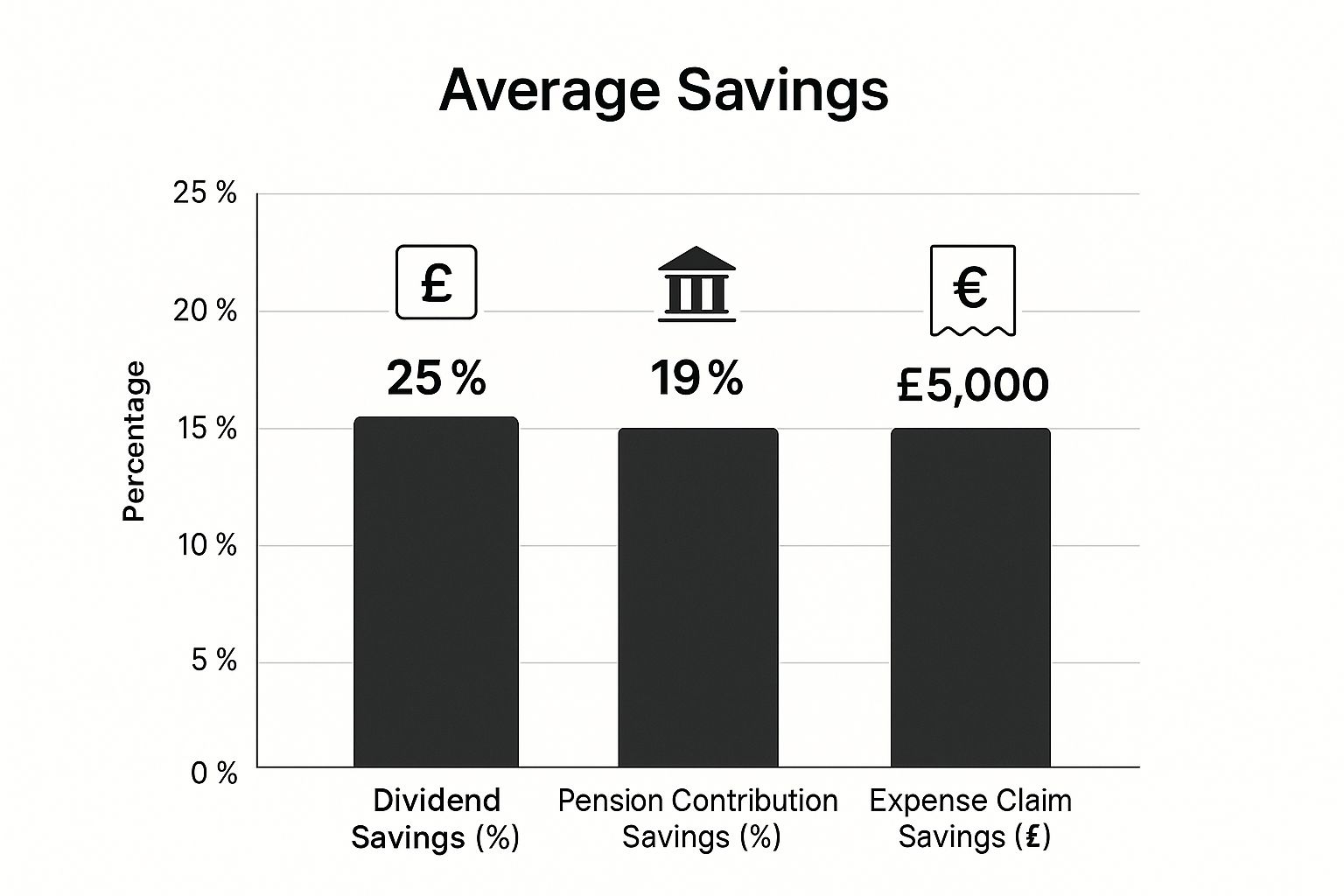
The data speaks for itself. The ability to use dividends, make pension contributions, and claim legitimate business expenses offers substantial financial benefits that are simply unavailable to those inside IR35.
Inside IR35 vs Outside IR35 NI Treatment
To put it plainly, your IR35 status dictates how your earnings are taxed. Here’s a quick comparison of how National Insurance is handled depending on which side of the line you fall.
| Factor | Inside IR35 | Outside IR35 |
|---|---|---|
| Who Pays NI | The fee-payer (client/agency) deducts both Employee's & Employer's NI from your gross pay. | Your limited company pays Employer's NI on your salary; you pay Employee's NI. |
| Basis of NI Calculation | NI is calculated on your entire fee (deemed salary), minus minimal allowable expenses. | NI is only calculated on the salary you choose to pay yourself. |
| Dividend Option | Not available. All income is taxed as salary. | Yes. You can draw most of your income as dividends, which are not subject to NI. |
| Control Over NI | You have virtually no control. It’s deducted at source like a regular employee. | You have significant control through salary level, dividends, and other strategies. |
As you can see, being outside IR35 gives you far more flexibility and control over how much National Insurance you ultimately pay.
Key Takeaway: Your IR35 status is the gateway to NI efficiency. An 'outside IR35' determination unlocks the potential for significant savings, while an 'inside IR35' status largely removes it.
Figuring out your status can feel daunting, but it is a critical first step. Getting it wrong can lead to costly tax investigations and demands for backdated NI payments. We have put together a comprehensive resource explaining the nuances of the legislation, which you can explore in our guide on what IR35 is and how it works.
Got Questions About Reducing Your Contractor NI?

When it comes to National Insurance, it is natural for contractors to have a lot of questions. In fact, many of the same queries pop up time and again. We have pulled together some of the most common ones we hear at UmbrellaCompany.com to give you clear, practical answers.
Understanding the nuances can make a genuine difference to your take-home pay. Let's tackle those specific "what if" scenarios to help you navigate your NI obligations with more confidence.
Can I Put My Spouse on the Payroll to Lower My NI Bill?
Yes, you can. Employing a spouse or partner in your limited company is a well-established and legitimate way to structure your finances, and it can help trim your overall National Insurance liability.
The crucial point here is that it cannot be a token gesture. They must be paid a genuine salary for real work they are doing for the business, such as admin, marketing, or bookkeeping. As long as their salary is commercially justifiable for the work they do, it is an allowable business expense, which in turn reduces your company's profit and its Corporation Tax bill.
A Quick Tip: Paying your spouse a salary up to the NI Primary Threshold (£12,570) is often the sweet spot. This makes full use of their tax-free Personal Allowance without triggering any employee NI contributions on their end.
When Should I Re-evaluate My Salary Level?
The best time to review your own salary is right at the start of each new tax year, which begins on 6th April. This is because HMRC typically announces updated National Insurance thresholds and rates that come into effect from that date.
By checking the new thresholds annually, you can tweak your salary to make sure you are staying in the most NI-efficient band. It is an easy thing to forget, but letting it slide could mean you accidentally drift into a higher NI bracket or miss a simple opportunity to optimise your pay.
It is also a good idea to have a look if:
- Your personal financial situation changes significantly.
- You think a contract might be determined as inside IR35, as this would force a completely different payment structure.
- The government makes major changes in the Spring Budget or Autumn Statement.
How Do Benefits in Kind Affect National Insurance?
Benefits in Kind (BiKs) are non-cash perks you might get as a director, like a company car or private medical insurance. HMRC assigns a 'cash equivalent' value to these benefits, and your company will usually have to pay Class 1A National Insurance on that value.
The rate for Class 1A NI is currently 13.8%, the same as the standard employer's contribution. It is something your company pays annually. For you personally, you will pay income tax on the benefit's value, but typically not employee's National Insurance.
This can sometimes make certain benefits a slightly more NI-efficient way to take remuneration compared to a straight salary bump, but you always have to weigh up the full tax implications. For a deeper dive into this, you can check out some of the best ways to reduce tax as a contractor in our dedicated guide.


