


As a UK company director, you have a surprising amount of control over how much income tax you pay. It’s not about finding obscure loopholes; it's about structuring your pay, pension, and expenses in the smartest, most legally compliant way possible.
The most popular and effective methods usually come down to a few core strategies: paying yourself a small salary topped up with dividends, making company pension contributions, and claiming every single allowable business expense you are entitled to.
Your Guide to Director Tax Efficiency in the UK

Getting to grips with director tax planning is simply about making smart, HMRC-friendly decisions on how you draw money from your limited company. A well-thought-out financial strategy does not just maximise your take-home pay; it ensures you stay fully compliant and out of trouble.
Here at UmbrellaCompany.com, our goal is to help directors navigate these choices. This guide is packed with actionable advice on the key areas where you can genuinely reduce your personal tax bill. It’s all about setting up your finances to be as efficient as possible while still supporting your company's growth.
Before we dive in, here’s a quick overview of the most effective strategies we'll be covering. Think of this as your cheat sheet for director tax planning.
Key Director Tax-Saving Strategies at a Glance
| Strategy | Primary Benefit | Key Consideration |
|---|---|---|
| Salary & Dividend Mix | Reduces National Insurance Contributions (NICs) significantly. | Must be paid from post-tax company profits. |
| Claiming Expenses | Lowers the company's Corporation Tax bill. | Expenses must be "wholly and exclusively" for business purposes. |
| Company Pension | Both personal and company tax bills are reduced. | Funds are locked away until you reach pension age. |
| Other Reliefs & Allowances | Can provide extra tax savings on specific activities. | Eligibility rules can be complex (e.g., R&D, SEIS/EIS). |
These are the building blocks of a solid tax plan for any director. Let's get into the specifics of how they work.
What We'll Be Covering
We’re going to focus on the legitimate, high-impact methods that form the foundation of effective tax planning for any UK company director.
Here’s what this guide will walk you through:
- Balancing Salary and Dividends: We will look at the 'sweet spot' for your salary to minimise National Insurance while keeping your state pension credits ticking over, then topping up with dividends.
- Claiming Allowable Expenses: A deep dive into what you can, and should, be claiming to cut your company’s Corporation Tax bill. Every legitimate cost helps.
- Maximising Pension Contributions: Discover how paying into your pension through the company is one of the most powerful tax-saving tools available.
- Using Other Tax Reliefs: We will touch on some of the other reliefs and allowances out there that might apply to you.
It’s also crucial to remember how your working arrangements affect all of this. If you’re a contractor working through your own limited company, you absolutely need to understand where you stand with IR35. You can get up to speed with our detailed guide on what IR35 is and why it matters to UK contractors.
By proactively managing how you're paid and what you claim, you can legally keep more of your hard-earned money. The key is to plan ahead and stick to HMRC's rules.
Right, let’s get into the practical steps you can take.
Finding the Right Mix of Salary and Dividends
When you are a company director, how you structure your own pay is one of the most powerful levers you have for managing your personal tax bill. It’s not about finding loopholes; it’s about finding the sweet spot between salary and dividends, a practical, HMRC-compliant strategy that can save you a bundle each year.
The go-to approach for most directors is to pay yourself a relatively small, tax-efficient salary. This is usually set at a level that lines up with the National Insurance (NI) thresholds. The logic is simple: the salary is just enough to count as a qualifying year for your state pension, but low enough to minimise or even wipe out any NI contributions for both you and your company.
Once that salary baseline is sorted, you can then draw the rest of your income from the company as dividends. This is where the real magic happens.
Why Dividends are a Director's Best Friend
Dividends are simply payments made to shareholders from a company's profits after Corporation Tax has been paid. Because the company has already settled its tax bill on that profit, HMRC taxes the dividends you receive as an individual at a much lower rate than your salary.
This two-step shuffle, low salary and higher dividends, is the bedrock of tax planning for thousands of UK directors. It directly slashes your National Insurance bill and lets you take advantage of the much friendlier dividend tax rates.
Here’s why it works so well:
- Lower National Insurance: Salaries get hit with both Employee's and Employer's National Insurance Contributions (NICs). By keeping your salary low, you dramatically shrink this liability.
- Favourable Tax Rates: The tax you pay on dividend income is significantly lower than the income tax rates on an equivalent salary, especially once you are a higher or additional rate taxpayer.
- Flexibility: As long as your company has enough retained profit in the bank, you can pay out dividends at different points during the year, giving you more control over your personal cash flow.
This infographic shows how this strategy is all about making the most of your allowances and reliefs.
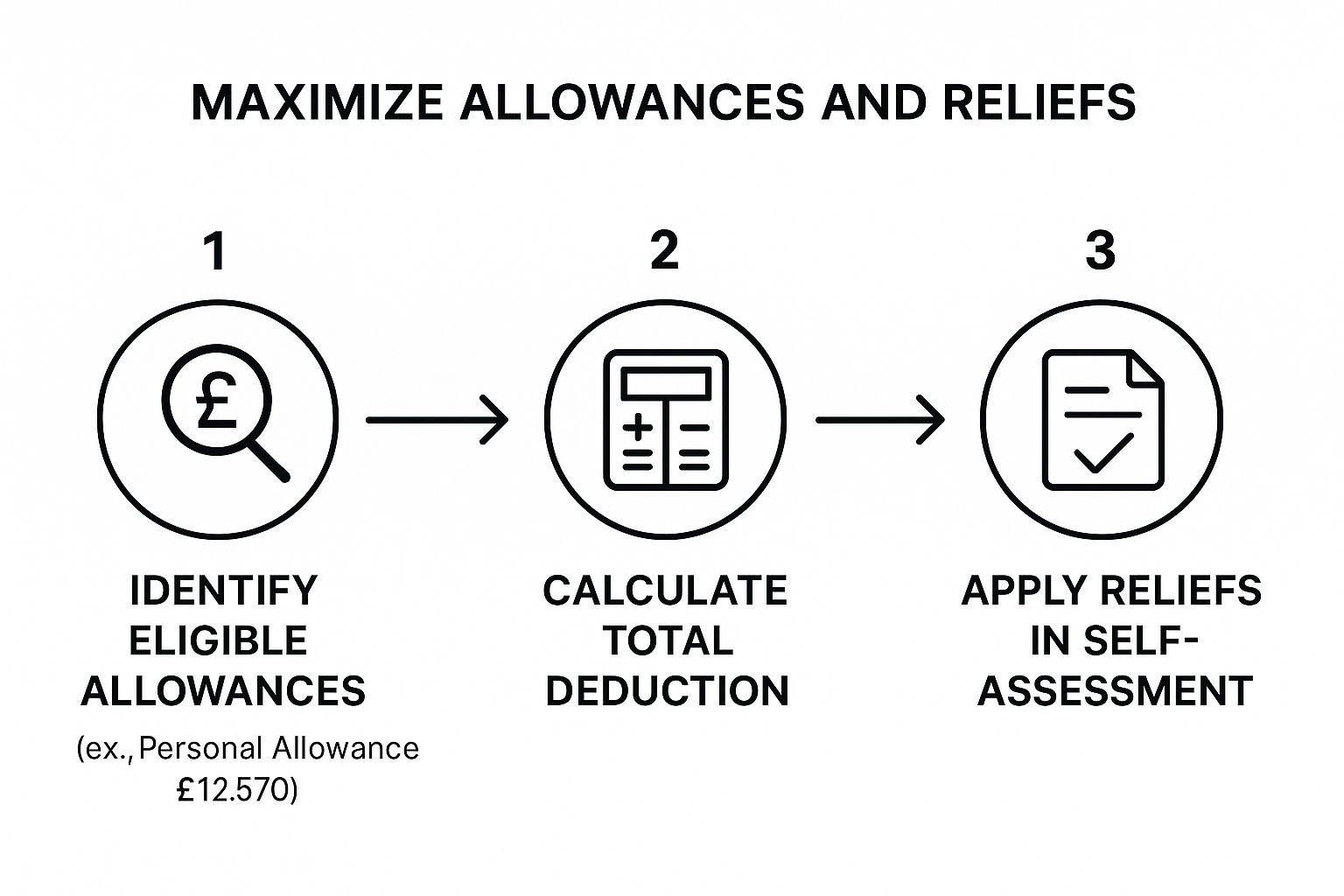
The key takeaway is that by using every allowance available, from your Personal Allowance to the Dividend Allowance, you’re systematically chipping away at your taxable income before the taxman even starts his calculations.
A Real-World Comparison: Salary vs Dividends
To see just how much difference this makes, let's imagine two directors, both wanting to take home £50,000.
Director A takes a £50,000 salary: They will be paying income tax and full employee's National Insurance on everything above their Personal Allowance. On top of that, the company gets stung with employer's NICs, adding a hefty extra cost.
Director B takes a £12,570 salary and £37,430 in dividends: This director pays zero income tax or NI on their salary. The company pays no employer's NICs either. They will, of course, pay tax on the dividends above their tax-free allowances, but the total tax hit is substantially lower.
The savings for Director B can easily run into several thousand pounds every single year. It’s a crystal-clear example of how getting your pay structure right directly impacts your bank balance.
Getting the Numbers Right
For the 2025/26 tax year, the dividend tax rates are 8.75% for basic-rate taxpayers, 33.75% for higher-rate taxpayers, and 39.35% for additional-rate taxpayers. Compare that to income tax on employment, which can be 20%, 40%, or 45%. You can see why the salary and dividend mix is so popular.
If you want to dig deeper into the exact figures for your situation, it's worth reading a dedicated guide on how much to pay yourself as salary vs dividends.
The Legal Paperwork for Declaring a Dividend
While dividends are fantastic, you absolutely must follow the correct legal process. You cannot just move money from the business account to your personal one and call it a day, as that’s a fast track to problems with HMRC.
To declare a dividend properly, you have to:
- Hold a directors' meeting: You need to formally decide to pay a dividend and record this decision in the meeting minutes.
- Check you have enough profit: Dividends can only be paid out of retained, post-tax profits. If the company does not have the cash reserves, paying a dividend is illegal.
- Create a dividend voucher: For every dividend payment, you must issue a voucher. This is a simple document showing the company name, date, shareholder's name, and the dividend amount. It’s your paper trail for both you and HMRC.
Sticking to these steps is not optional. It ensures you stay fully compliant and that your entire tax strategy is built on solid, legal ground. Here at UmbrellaCompany.com, we always recommend directors work closely with their accountant to make sure every box is ticked.
Maximising Your Allowable Business Expenses
Every legitimate business expense you claim chips away at your company's taxable profit. This directly lowers its Corporation Tax bill, leaving more cash in the business to be paid out as dividends or reinvested for growth. It’s one of the most fundamental parts of running a tax-efficient limited company.
While most directors are on top of claiming for obvious things like office supplies or new software, many miss out on less apparent but equally valid expenses. Getting proactive about tracking and claiming everything you’re entitled to is the secret to optimising your company’s tax position and, ultimately, your personal income.
The Golden Rule: Wholly and Exclusively
For an expense to be allowable for tax purposes, it must be incurred "wholly and exclusively" for your business. This is HMRC's core principle, and it’s the test you need to apply to every potential claim you make.
This means the cost cannot have a dual purpose. For instance, your daily commute to your permanent office is not an allowable expense because the journey has a private purpose: getting you from home to work.
However, if you travel from your office to visit a client, the mileage for that specific trip is allowable because its sole purpose is business-related. Getting your head around this distinction is absolutely crucial for staying compliant.
Common Expenses Directors Overlook
Once you move past the basics of rent and supplies, you'll find plenty of other legitimate costs that directors often forget to claim. A disciplined approach to expense tracking ensures you do not leave money on the table.
Here are some of the most frequently missed opportunities:
- Use of Home as Office: If you regularly work from home, your company can pay you a flat rate of up to £6 per week (£26 per month) completely tax-free, with no receipts needed. You can calculate a proportion of your actual household bills like heating and electricity instead, but this requires much more detailed record-keeping.
- Professional Development: Training courses, subscriptions to professional bodies, or industry magazines that are directly relevant to your business are all allowable. If a course helps you do your job better, it’s a valid claim.
- Business Travel and Subsistence: This covers everything from train tickets to meet clients and hotel stays for business trips to reasonable meal costs while you are away from your normal workplace.
Developing a robust system for tracking expenses is not just about compliance; it is an active strategy to reduce your tax bill. Every pound claimed is a pound less of profit that HMRC can tax.
Practical Examples of Allowable Expenses
Let's see how this plays out in the real world. Imagine you're the director of a small IT consultancy.
Scenario A: The Annual Staff Event
You decide to host a summer party for your small team to boost morale. HMRC allows for an annual event exemption of up to £150 per head (including VAT). So long as the event is open to all employees and the total cost per person stays under this limit, the entire cost is an allowable expense, with no personal tax implications for you or your staff.
Scenario B: Upgrading Your Skills
You spot a specialised project management course that would help you win larger, more lucrative contracts. The course costs £1,200. Because this training directly enhances your ability to perform your duties and grow the business, the full cost is an allowable expense. Simple as that. It reduces your company's profit by £1,200.
These strategies are not just for directors. If you want to learn more about wider tax-saving opportunities, have a look at our guide on the 9 best ways to reduce tax as a contractor in the UK.
Keeping Meticulous Records
The absolute key to claiming expenses successfully is impeccable record-keeping. HMRC can ask to see your records at any time, so you have to be ready.
At UmbrellaCompany.com, we always advise directors to:
- Use dedicated accounting software: Tools like Xero or QuickBooks are brilliant for this. They make it easy to snap photos of receipts and categorise expenses on the go.
- Maintain a separate business bank account: This creates a clean divide between business and personal spending, which will simplify your bookkeeping massively.
- Keep all receipts and invoices: Even for tiny purchases, a clear paper trail is non-negotiable.
Building these habits from day one ensures your expense claims are always backed by solid evidence, giving you peace of mind and keeping your tax bill as low as legally possible.
Using Pension Contributions to Cut Your Tax Bill
Ask any seasoned director about their tax strategy, and you'll almost certainly hear them mention their pension. Making pension contributions directly from your company is one of the single most powerful tax-saving moves you can make. It’s a win-win: you’re building a nest egg for the future while simultaneously slicing a chunk off your immediate tax bill.
Here’s how it works. When your limited company pays into your personal pension, that payment is usually treated as an allowable business expense. This reduces your company's profit, which directly lowers the amount of Corporation Tax you owe.
And the good news does not stop there. This whole process completely sidesteps both employee and employer National Insurance contributions. It also avoids personal income tax. The money goes straight from your company’s bank account into your pension pot without HMRC getting a look-in.
Understanding the Annual Allowance
Naturally, there are rules. The main one you need to keep on your radar is the Annual Allowance, which for the 2024/25 tax year stands at a generous £60,000.
This is the maximum you can pop into your pension from all sources (your company, personal top-ups, etc.) in one tax year and still get tax relief. For most directors, £60,000 is more than enough headroom to make a real difference.
It’s worth noting the contribution must also pass HMRC's "wholly and exclusively" test, which essentially means it has to be a commercially justifiable expense. For a director who is the lifeblood of the business, contributions right up to the annual allowance are almost always seen as perfectly reasonable.
Unlocking Extra Capacity with Carry Forward
What happens if you have a bumper year and want to contribute more than £60,000? This is where a clever little rule called ‘carry forward’ becomes your best friend.
Carry forward lets you use up any of your unused Annual Allowance from the previous three tax years. The only condition is that you must have been a member of a registered pension scheme during those years.
Let's break it down with an example:
- Year 1: You only put in £20,000 (leaving £40,000 unused).
- Year 2: You contributed £30,000 (leaving £30,000 unused).
- Year 3: You added £25,000 (leaving £35,000 unused).
In the current tax year, you could potentially contribute your full £60,000 allowance for this year plus the £105,000 you carried forward. That’s a total company pension contribution of £165,000 in a single year, which would create a massive dent in your company’s Corporation Tax bill.
This is an absolute game-changer for directors whose profits can be a bit up and down. It lets you make hay while the sun shines, funnelling extra cash into your pension in the good years to make up for the leaner ones.
Pension vs Salary vs Dividend: A Clear Comparison
To really see the power of this strategy, let’s compare how a £10,000 chunk of company profit finds its way to you. We'll assume you’re a higher-rate taxpayer for this.
| Payment Method | Key Deductions | Amount in Your Pocket/Pension |
|---|---|---|
| Salary | Employer's NI, Employee's NI, 40% Income Tax | Approx. £4,887 |
| Dividend | 25% Corporation Tax, 33.75% Dividend Tax | Approx. £4,969 |
| Pension | None. Reduces Corporation Tax bill. | £10,000 |
The difference is stark, isn't it? A pension contribution puts more than double the amount in your name compared to taking it as salary or dividends. On top of that, the company saves £2,500 in Corporation Tax it would have paid before even thinking about a dividend.
Of course, the funds are locked away until you can access your pension (currently age 55, rising to 57 from 2028), but the tax efficiency is simply unbeatable. For a deeper dive into improving your earnings, check out our guide on how to maximise take-home pay as a contractor.
This approach really should be a cornerstone of any director's financial planning. A good accountant or financial adviser can help you pinpoint the right level of contributions for your business, making sure you squeeze every drop of value from this fantastic tax-saving opportunity.
Looking at Other Valuable Tax Reliefs
Once you’ve got the basics of salary, dividends, and pensions sorted, there are a few other reliefs and allowances that can really move the needle on your tax bill. They can feel a bit more niche, but ignoring them is like leaving money on the table.
Think of these as the next level of tax planning. They often reward specific business activities, like innovation or making greener choices. Tapping into them lowers your Corporation Tax, which leaves more profit in the company pot for you to draw on later.
Research and Development (R&D) Tax Reliefs
This one is a big deal, but so many directors I speak to overlook it. If your company is genuinely trying to create something new or improve an existing product or process through technology or science, you could be sitting on a goldmine with R&D tax reliefs.
A lower Corporation Tax bill for the company means more profit left over for dividends. It’s that simple.
The government is keen to support innovation. In April 2024, the old schemes were merged into a single, simpler one. For small to medium-sized companies that are heavily invested in R&D (spending over 30% of their total costs on it), the benefits are huge. We’re talking enhanced deductions of up to 86% and even a payable tax credit. It’s a powerful way to free up cash. If this sounds like it might apply to you, it is worth digging into the details; you can discover the latest updates for innovative UK companies.

Tax-Efficient Company Benefits
Sometimes, it’s much smarter to have the company pay for things directly rather than taking a higher salary to cover them yourself. HMRC actively encourages this for certain things, especially green initiatives.
The star of the show right now is the electric company car. The Benefit-in-Kind (BIK) tax you’ll pay is incredibly low compared to a petrol or diesel equivalent. It means you can drive a brand-new car, paid for by the business, for a tiny personal tax hit. It’s one of the best perks out there for directors.
A few other benefits worth considering:
- Private medical insurance: It’s still a taxable benefit, but it’s often cheaper to arrange it through the company than buying a policy personally.
- Trivial benefits: This is a great little perk. You can give yourself and your staff small, one-off gifts like a bottle of wine or a shop voucher up to £50 a time, completely tax-free. As a director, you are capped at £300 for the year.
The right company benefits let you enjoy valuable perks at a fraction of the cost you would pay out of your post-tax income. It is all about making the company's money work for you personally, in a tax-efficient way.
Bringing Family Members on Board
Here’s another classic strategy: making your spouse or civil partner a shareholder. Now, this is not just a paper exercise, they need to have a genuine role in the business. But if they do, it's a fantastic way to use their personal tax allowances that might otherwise go to waste.
By paying them a dividend from their shares, you can make use of their:
- Personal Allowance (£12,570 for 2024/25)
- Dividend Allowance (£500 for 2024/25)
- Basic rate tax band
You are essentially spreading the company's profits across two people, which can massively reduce your household's overall tax bill.
A word of caution, though. This has to be set up properly to be legitimate in the eyes of HMRC. The share structure must reflect reality. Always get professional advice from your accountant before you go down this road to make sure you are doing it by the book.
Director Tax Planning: Your Questions Answered
When you're running your own limited company, getting your head around the tax side of things can feel like a minefield. We get it. As specialists in contractor and director finances, we see the same questions pop up time and again. Let's clear up some of the most common queries.
What's the "Best" Salary for a Director?
This is the million-dollar question, isn't it? The exact figure shifts with each new tax year, but the strategy behind it is pretty consistent. You want to pay yourself just enough to bank a qualifying year for your State Pension, but not so much that you start handing over a chunk of it in National Insurance Contributions (NICs).
For most directors, the sweet spot is a salary set right around the National Insurance Secondary Threshold. This is the level where employers, in this case, your company, start having to pay NICs. By staying under this threshold, neither you nor your company pays a penny in National Insurance, but you still get that crucial tick on your pension record. Any profit you want to take out on top of that is usually best drawn down as dividends.
Is It Risky to Just Take Dividends Instead of a Salary?
The low-salary, high-dividend strategy is a classic for a reason, it's incredibly tax-efficient. But you have to do it by the book. The main pitfall here is declaring an illegal dividend. This happens if you pay yourself a dividend when your company simply does not have enough post-tax profit in the bank to cover it.
To keep everything above board, you must always:
- Check your company has sufficient retained profit before you declare any dividend.
- Hold a proper board meeting to approve the payment. Yes, even if it's just you! Keep minutes of this decision.
- Create a proper dividend voucher for every single payment.
Skip these steps, and you could be in hot water with HMRC. They might reclassify the payment as a salary, leaving you with a painful bill for back-dated tax and National Insurance.
Can I Claim for Working from Home?
You absolutely can, and you absolutely should. So many directors miss this trick. HMRC gives you a couple of ways to do it. The easiest route is to claim the flat rate of £6 per week (£26 per month) from your company. It does not require any receipts or fiddly calculations, and it’s completely tax-free.
If you want to claim more, you can work out a proportion of your actual household bills, like heating, electricity, and your internet connection. This takes a bit more effort, you'll need detailed records to justify how you've split the business and personal use of each bill, but it can result in a bigger claim.
Honestly, not claiming for home office use is like leaving money on the table. It is a straightforward, HMRC-approved method for cutting your company's taxable profit.
It is also crucial to know the difference between smart tax planning and tax avoidance. For contractors, this often comes down to IR35. Getting a handle on how to avoid IR35 tax traps is vital to ensure your working setup does not get you into trouble, which could completely derail your tax strategy. Keeping yourself informed is the best way to keep your planning on solid ground.


