


As a UK contractor, understanding how to increase your net income really boils down to understanding your options. The single most effective way to maximise your take-home pay is by choosing the right way to operate. Usually, that means picking between a limited company or an umbrella company, especially when your contracts fall outside IR35. This choice opens the door to a tax-efficient mix of salary and dividends.
Your Core Strategies for Boosting Contractor Pay

Jumping into the world of contracting means you're now in the driver's seat of your finances, a level of control that most traditional employees never experience. Knowing how to maximise your take-home pay isn't about finding dodgy loopholes; it’s about making smart, strategic decisions that are fully compliant with HMRC rules.
The first and biggest decision you’ll make is your business structure. For many, operating as a limited company director offers the highest potential net income, particularly for any work that’s clearly outside IR35. This setup lets you draw a small, tax-friendly salary and take the rest of your earnings as dividends, which are taxed at a much lower rate than PAYE income.
But it doesn't stop there. Beyond the big decision on structure, a few other key tactics come into play. We think of these as the fundamental pillars that support a solid financial strategy for any serious contractor in the UK.
Key Areas of Focus
- Claiming Every Legitimate Expense: Business expenses are your best friend. They reduce your company's profit, which directly lowers your Corporation Tax bill. Everything from your accountancy fees and business insurance to necessary travel and even a portion of your home office costs can make a real difference.
- Smart Pension Contributions: This is a big one. Making employer pension contributions through your limited company is an incredibly tax-efficient way to save for your future. The money goes into your pension pot before any Corporation Tax is calculated, giving you a double win.
- Negotiating Your Rate: The most straightforward way to earn more is simply to ask for it. Securing a higher day rate is all about knowing your market value, understanding the client's needs, and having the confidence to articulate why you're worth it.
- Boosting Your Operational Efficiency: Time is money, especially non-billable time. Sharpening up your business processes saves hours that you could be spending on paid work. For instance, implementing workflow automation can be a game-changer, helping you cut down on admin and minimise errors.
This guide is designed to walk you through these proven strategies. We'll give you practical, real-world insights to help you keep more of your hard-earned money and build a clear roadmap for financial success.
Quick Guide to Increasing Your Contractor Take-Home Pay
To help you get a quick overview, we've put together a simple table that summarises the most effective strategies. It breaks down what to focus on, the kind of impact you can expect, and what you need to keep in mind for each one.
| Strategy | Potential Impact on Pay | Key Consideration |
|---|---|---|
| Optimise Salary & Dividends | High | Requires operating a limited company and being outside IR35. |
| Claim All Legitimate Expenses | Medium | Lowers Corporation Tax. Requires meticulous record-keeping. |
| Make Company Pension Contributions | High | Very tax-efficient, but funds are locked away until retirement. |
| Negotiate a Higher Day Rate | High | The most direct method, but depends on market demand and your skills. |
| Increase Operational Efficiency | Medium | Frees up non-billable time, allowing more focus on earning. |
Ultimately, combining a few of these strategies will have the biggest cumulative effect. It's about finding the right balance that works for your specific situation and long-term goals.
Limited Company vs Umbrella: Which Is Right for You?
Choosing how you'll operate as a contractor is probably the biggest financial decision you'll make. It’s a straight choice between setting up your own limited company or using an umbrella company, and it directly affects how much of your day rate actually lands in your bank account.
The right path for you really boils down to a few things: your contract's IR35 status, your appetite for admin, and what you want to achieve long-term.
The Limited Company Route: Control and Tax Efficiency
Going down the limited company route puts you squarely in the driver's seat. You're the director, you control the finances, and it offers a brilliant way to maximise your take-home pay, provided your contract is outside IR35.
The structure allows you to blend a small salary with dividends. The strategy is tried, tested, and effective: pay yourself a salary up to the tax-free personal allowance, then take the rest of the company's profits as dividends. Why? Because dividends aren't subject to National Insurance and are taxed at much friendlier rates than regular salary income.
For the 2024/25 tax year, for example, the personal allowance is £12,570. Drawing a salary up to this level is completely tax-free. Everything on top, taken as dividends, is taxed far more gently than it would be through PAYE.
Of course, this control comes with director's responsibilities. You’ll be on the hook for filing annual accounts, managing Corporation Tax, and making sure every bit of paperwork is compliant with HMRC. It’s not for everyone.
The Umbrella Company Option: Simplicity and Security
Working with an umbrella company is a much simpler, hands-off arrangement. Think of them as your employer for the duration of the contract. They handle all your tax and National Insurance deductions through PAYE, just like a permanent employee.
You get a proper payslip, and all the administrative headaches are taken care of, leaving you free to just focus on your work.
This simplicity is a massive draw, especially for contractors whose contracts fall inside IR35. In that scenario, the tax advantages of a limited company are pretty much wiped out anyway. You also get statutory employment rights like holiday and sick pay, which you don't as a limited company director. Our guide on umbrella companies vs PAYE digs into this in more detail.
What's the trade-off? A lower take-home pay. The umbrella company will take its margin, and all your income is hit with standard PAYE tax and National Insurance, which is less efficient than the salary-and-dividend model.
Choosing your operating structure isn't just a financial decision; it's a lifestyle one. A limited company offers the highest potential reward for those comfortable with director duties, while an umbrella company provides a straightforward, hassle-free path for those who prioritise simplicity.
This decision tree can help you visualise which path might suit your circumstances better.
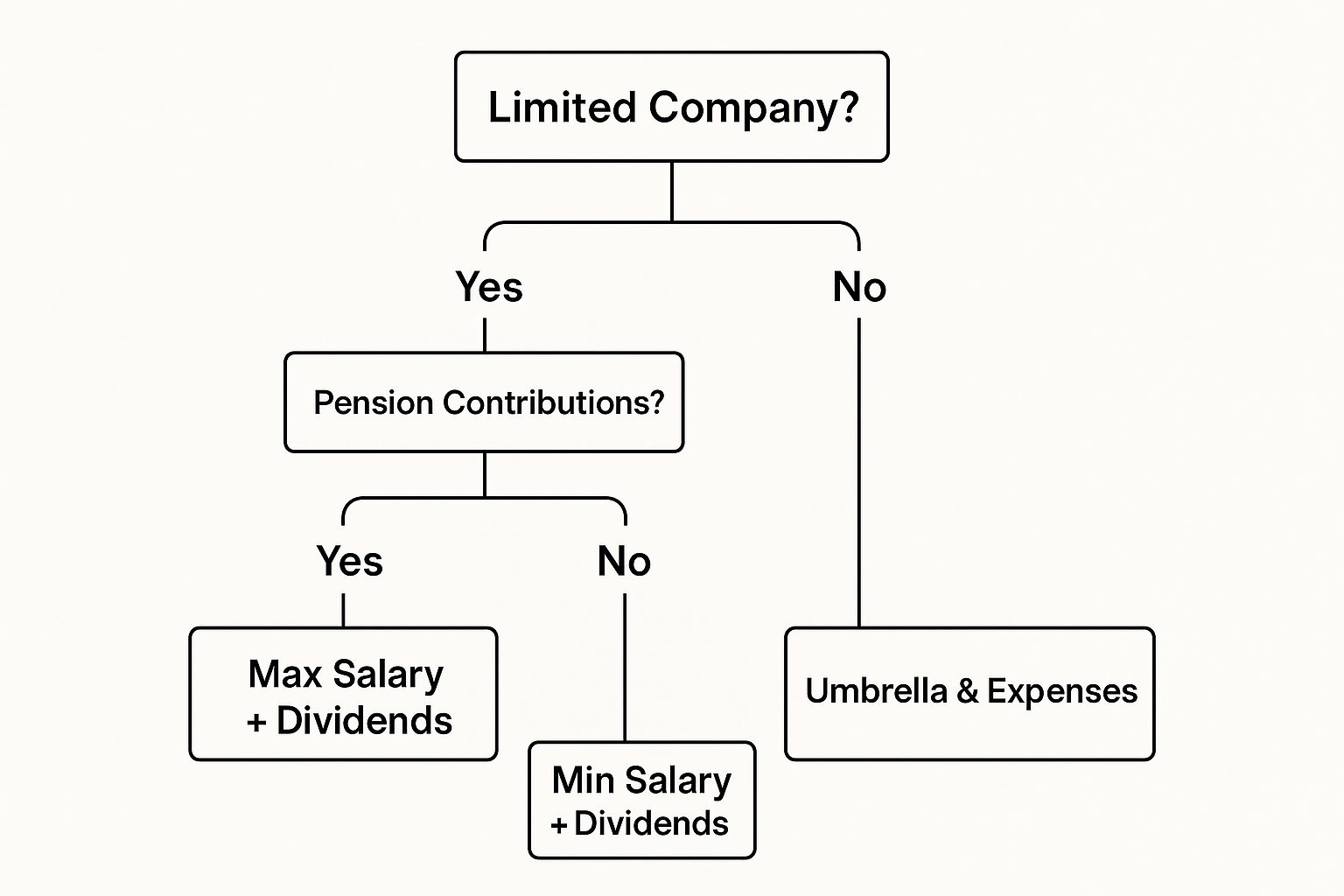
As you can see, the limited company path opens up more strategic choices around salary and pension planning, whereas the umbrella route keeps tax and expenses management incredibly simple.
Claiming Expenses to Reduce Your Tax Bill

One of the most direct ways to lower your Corporation Tax bill is by claiming every allowable business expense you can. It's a fundamental part of running a limited company. Doing this reduces your company's taxable profit, which means more money stays in your business, ready for you to draw down. Think of it less as a chore and more as a crucial financial discipline.
The golden rule from HMRC is that any cost must be 'wholly and exclusively' for your business. It's a simple concept: if you bought it just for your work, it's likely a claimable expense. Anything personal is a no-go, and for items with mixed use, you can only claim the business portion.
This is exactly why keeping on top of your receipts and invoices is so important. Good, organised records aren't just for your own peace of mind; they're the proof you need to back up every single claim.
What Can You Actually Claim?
Most contractors know the basics, but many are surprised by just how broad the list of allowable expenses really is. Getting a handle on this means you can confidently claim everything you're entitled to, which directly boosts your take-home pay.
Here are some of the most common things limited company contractors claim for:
- Office Equipment and Software: Your laptop, monitors, a subscription to Microsoft 365 or specialist software all count. Even the small stuff like stationery adds up.
- Travel and Accommodation: This covers travel to a temporary client site. You can claim for mileage if you use your own car, train fares, and any necessary hotel stays for overnight projects.
- Professional Training and Subscriptions: Any course that helps you maintain or improve the skills you need for your current contract is fair game. Your annual subscription to a professional body is also claimable.
- Accountancy Fees: The money you pay your accountant to handle your company's books and tax returns is a legitimate business cost.
- Business Insurance: Getting the right Business Insurance for Contractors is not only essential for protecting your business but also a fully tax-deductible expense.
Home Office Expenses Explained
If you work from home, a portion of your household running costs can be claimed. HMRC offers a couple of ways to do this, so you can pick the one that makes the most sense for you.
The easiest method is to claim a flat rate of £6 per week (that’s £312 a year). You don't need to show any receipts, making it a simple, hassle-free option.
Alternatively, you can work out a proportion of your actual bills, like electricity, heating, and broadband. This takes a bit more effort with your record-keeping but could lead to a bigger claim if your work-from-home costs are high. We dive deeper into this and other strategies in our guide on the best ways to reduce tax as a contractor in the UK.
A common misconception is that claiming expenses is about finding loopholes. In reality, it's about accurately logging the genuine costs of running your business to ensure you only pay tax on your true profit. Staying organised is the key.
By diligently tracking and claiming all your legitimate business costs, you're taking control of your company's tax liability. It’s one of the most reliable and straightforward ways to maximise what you take home at the end of the day.
Using Your Pension for Maximum Tax Efficiency
Think of your pension as more than just a retirement fund. For a savvy limited company contractor, it's one of the most powerful tools in your arsenal for boosting your net income, both today and down the line.
When you make contributions directly from your company, you're not just building a nest egg; you're actively shrinking your Corporation Tax bill. Why? Because pension contributions are treated as an allowable business expense. They're deducted from your profits before the taxman takes his cut.
This is a classic win-win. You lower your immediate tax burden while securing your long-term financial health. It's a cornerstone of smart financial planning for any serious contractor.
The Double Tax Advantage of Company Contributions
Here’s where it gets really good. When your limited company pays into your pension, that money leaves the business without being touched by Corporation Tax. Better yet, it completely sidesteps personal income tax and National Insurance contributions because you're not drawing it as a salary or dividend.
It's an incredibly efficient way to pull value out of your business.
We all know the standard ways to lower our tax liabilities, like claiming for travel, equipment, and other essentials. But pension contributions are in a league of their own. Payments your company makes are fully deductible against corporation tax, which immediately puts a dent in your taxable profits.
Understanding the Annual Allowance
Of course, there are limits. HMRC sets an Annual Allowance on how much you can squirrel away into your pension each tax year while still getting tax relief. For the 2024/25 tax year, that magic number is £60,000.
You need to keep an eye on your contributions to stay within this cap. But here's a handy feature called 'carry forward'. It lets you use any unused allowance from the previous three tax years, which is a lifesaver in those bumper years when you've had a particularly profitable run.
Pumping larger contributions into your pension when company profits are high is a brilliant move. You can knock a huge chunk off an unusually large Corporation Tax bill while making serious headway on your retirement goals.
This flexibility allows you to adapt your strategy to your company's performance. You might contribute less in a lean year, but you can catch up during a boom by dipping into your carry forward allowance. Getting this right often depends on your payroll setup, a topic we dive into in our guide on which payroll solution gives the highest take-home pay.
Pension Planning for Higher Earners
This strategy becomes absolutely critical for contractors earning over £100,000. As soon as your adjusted net income ticks over this threshold, your tax-free Personal Allowance starts to erode, creating a punishingly high effective tax rate on every pound you earn between £100,000 and £125,140.
By making a company pension contribution, you can reduce your adjusted net income, often enough to hang on to your full Personal Allowance.
This doesn't just save you a packet in income tax. It channels that cash straight into your retirement fund instead of handing it over to HMRC. It's a proactive way to manage your earnings and make your financial structure work as hard as you do.
How to Negotiate a Higher Day Rate

While smart tax planning is a cornerstone of maximising your income, let’s not forget the most straightforward method: earning more in the first place. Negotiating a higher day rate can feel a bit awkward, but it's an essential skill for making sure your earnings truly match your market value and hard-won expertise.
Before you even think about having that conversation, you need to do your homework. Solid research is the bedrock of any successful negotiation. Spend some time benchmarking your skills and experience against what the market is currently paying. Check out job boards, have honest chats with recruiters, and connect with fellow contractors in your field to get a realistic picture of the going rates.
Building Your Case for a Higher Rate
Once you've got a target rate in mind, the real work begins: articulating your value with confidence. This isn't just about plucking a number out of thin air; it’s about building a watertight case that justifies why you're worth it.
- Lean on your specialisms: Got a rare certification or deep experience with niche software? Make sure you highlight any skills that are in high demand but short supply.
- Show, don’t just tell: Get ready with concrete examples of how you've delivered real value on past projects. Use metrics if you can, like "I boosted efficiency by 15%" or "my involvement helped deliver the project two weeks ahead of schedule."
- Tailor it to the client: Frame your pitch around their specific problems. Explain exactly how your unique experience will solve their headaches or push their project towards its goals.
This evidence-based approach completely changes the dynamic. You shift the conversation from a simple haggle over price to a discussion about the value you bring. You’re not just a cost on a spreadsheet; you’re an investment that delivers a tangible return.
Your day rate isn't just a number. It’s a reflection of the professional value and positive impact you bring to a client's project. Negotiating with confidence is all about being prepared to demonstrate that value clearly and without apology.
Factoring in Market and Economic Changes
A savvy negotiation also takes the wider economic climate into account. With the cost of living and running a business on the rise, protecting your net earnings is more critical than ever. Don’t be afraid to weave these external pressures into your rate discussions.
Recent market trends are on your side. A 2024 study revealed that average day rates for UK freelancers shot up from £457 to £576 in just one quarter, with more increases on the horizon. This kind of data is powerful ammunition to support your own rate adjustment.
And don't forget that your IR35 status plays a big role here. A contract that falls inside IR35 often justifies a higher gross rate to compensate for the lower take-home pay after PAYE deductions. We cover more on IR35 and its impact on high take-home pay options in our detailed guide. By staying informed and presenting a well-reasoned case, you put yourself in the best possible position to secure a rate that truly reflects your worth.
Common Questions on Contractor Pay
When you’re a contractor, figuring out the best way to get paid can feel like navigating a minefield. There's a lot of jargon and plenty of conflicting advice. Let's cut through the noise and tackle some of the most common questions we hear from contractors trying to maximise their take-home pay.
Is a Limited Company Always the Best Option for My Pay?
Not always, and getting this right is crucial. For contracts that are genuinely outside IR35, running your own limited company is almost always the most tax-efficient route. It opens the door to the classic low salary, high dividend model, which can seriously reduce your tax and National Insurance bill.
But here’s the catch: if your contract falls inside IR35, those tax advantages pretty much disappear. You'll be taxed just like a regular employee, which makes a limited company a lot of administrative hassle for very little reward. In that scenario, a compliant umbrella company is often the simpler, more practical choice. The first thing you must do is get the IR35 status of each contract properly assessed.
How Does IR35 Directly Impact My Earnings?
Think of IR35 as the single biggest factor that dictates your potential earnings. When a contract is flagged as ‘inside IR35’, it’s HMRC’s way of saying they see you as an employee for tax purposes. That means your entire income gets hit with PAYE income tax and National Insurance, just like someone on the permanent staff.
On the flip side, a contract that’s safely ‘outside IR35’ gives you the freedom to operate as a proper business. This is what unlocks the ability to use that highly efficient salary and dividend structure through your limited company, which is the cornerstone of earning the highest possible take-home pay.
Your IR35 status isn't just a compliance headache; it dictates the entire financial strategy for your contract. Getting it right from the start is absolutely fundamental.
Can I Claim Expenses for a Home Office?
You absolutely can, provided you’re operating through your own limited company. HMRC gives you two main ways to go about this:
- The Flat Rate: This is the no-fuss option. You can claim a simple, fixed amount of £6 per week (£312 a year) without needing to keep any receipts or do complicated sums. Easy.
- The Actual Costs Method: If you want to claim more, you can work out a fair proportion of your actual household running costs. This could include a percentage of your electricity, heating, or broadband bills based on how much you use a dedicated space for business. It takes a bit more effort with record-keeping, but it can often lead to a bigger claim.
What Should I Do if My Earnings Exceed £100,000?
Crossing the £100,000 threshold is a great milestone, but it comes with a sting in its tail. Once your 'adjusted net income' goes over this mark, your tax-free Personal Allowance starts to shrink. This creates a notoriously high effective tax rate on your earnings between £100,000 and £125,140.
One of the smartest moves you can make here is to pay into your pension through your company. These contributions reduce your adjusted net income, which can help you hang on to your full Personal Allowance. Not only do you get a massive tax break, but you’re funnelling that cash into your retirement fund instead of handing it over to the taxman. It's a win-win.
Ready to find a compliant umbrella company that fits your needs? At UmbrellaCompany.com, we make it simple to compare trusted, accredited providers. Find the perfect match for your contract in just a minute.


