


Getting paid. It’s the lifeblood of any freelancer in the UK, but creating the right invoice can feel like a chore. This guide is here to change that.
We are breaking down exactly how to invoice as a freelancer, turning what can be a complex task into a simple, manageable part of your workflow. We will cover the legal must-haves for every invoice and help you navigate the tricky bits, like VAT and IR35.
Your Essential Guide to UK Freelancer Invoicing
Learning how to create and send a proper invoice is one of the most fundamental skills you will need for a successful freelance career. It is not just about getting paid. A professional invoice reinforces your brand, helps maintain a great relationship with your client, and most importantly, keeps you on the right side of HMRC.
Getting this process right from day one will save you a world of headaches later on.
This guide is designed to give you clear, practical advice that you can actually use, no matter how you operate. Whether you are a sole trader, the director of your own limited company, or working through an umbrella, we will cover the specifics that apply to your setup. We know the nuances can feel a bit overwhelming at first, but we are here to simplify it all.
What You Will Learn in This Guide
Throughout this article, we will walk through every critical part of the invoicing process. The goal is to give you the knowledge to build a solid, reliable system for your business and handle your finances with confidence.
Here is a look at what we will cover:
- The essential bits and pieces every UK invoice must include to be legally compliant.
- How to get your head around complex topics like VAT registration and IR35 considerations.
- The key differences in invoicing when you are a sole trader, limited company director, or using an umbrella company.
- How to set clear payment terms and professionally chase up late payments (without awkwardness).
- Best practices for record-keeping that will make your Self Assessment tax return a breeze.
By the end of this, you will have everything you need to create invoices that get you paid promptly, letting you get back to the work you actually enjoy.
And if you are just starting out, you might also find our guide on when to register as self-employed a useful next read.
Crafting a Professional and Compliant Invoice
A great invoice does more than just ask for the money you have earned. It is a final touchpoint that reinforces your professionalism, builds client trust, and crucially, keeps you on the right side of HMRC.
Getting these details right from the start saves you a world of hassle. It means fewer questions from the client's accounts team and a much smoother path to getting paid on time. Think of it as the professional handshake that closes out a successful project.
What Every UK Invoice Must Include
To be a legally valid document in the UK, your invoice needs a few non-negotiable elements. Miss one, and you could face payment delays or compliance headaches later. The smart move is to build a template you can reuse, locking in these essential fields.
At a bare minimum, every invoice you send needs to show:
- The word ‘Invoice’ right at the top. It sounds obvious, but it stops anyone from confusing it with a quote or a delivery note.
- A unique invoice number. A simple sequential system like 001, 002, 003 is perfect. It makes tracking payments and referencing jobs a breeze.
- The date you issued the invoice.
- Your business name and address. For sole traders, this is simply your own name and your business address.
- Your client’s full company name and address. Double-check you have got their correct legal entity name, not just a trading name.
- A clear description of what you did. Be specific to avoid any "what was this for again?" questions.
A properly structured invoice is not just a request for payment; it is a legal record of the transaction. It protects both you and your client by confirming the work done and the agreed cost, creating a clear paper trail for accounting and tax returns.
Nailing these basics shows you are organised and serious about your business, which instantly gives clients confidence.
To help you get it right every time, here is a quick checklist of the must-have components for any UK invoice.
Essential UK Invoice Components Checklist
Use this checklist to ensure every invoice you send is legally compliant and professional, helping you get paid faster.
| Component | Description | Why It's Important |
|---|---|---|
| 'Invoice' Title | The word "Invoice" displayed prominently at the top. | Clearly identifies the document's purpose, distinguishing it from quotes or statements. |
| Unique Invoice Number | A sequential number (e.g., INV-001, 2024-01) that you never reuse. | Essential for your record-keeping, tracking payments, and for HMRC compliance. |
| Invoice Date | The date the invoice was created and sent to the client. | Establishes the start of the payment term (e.g., 30 days from this date). |
| Your Details | Your full business name (or your name if a sole trader) and address. | Identifies you as the seller and is a legal requirement. |
| Client's Details | The client's full legal company name and address. | Ensures the invoice is directed to the correct entity, preventing processing delays. |
| Service Description | An itemised list of the services provided or products sold. Be specific! | Avoids confusion and disputes by clearly stating what the client is paying for. |
| Costs Breakdown | A line-by-line breakdown showing quantity, unit price, and total for each item. | Provides transparency and helps the client's accounts department process the payment. |
| Total Amount Due | The final total amount, clearly showing the subtotal, any VAT, and the final figure. | The most important number on the page! Make it bold and unmistakable. |
| Payment Terms | Your expected payment window (e.g., "Payment due within 30 days"). | Sets clear expectations and gives you a firm date to chase if payment is late. |
| Payment Details | Your bank account name, sort code, and account number for BACS transfers. | Makes it as easy as possible for the client to pay you without needing to ask for details. |
| Company Info (Ltd Co) | If you are a limited company, you must include your registered name, number, and office address. | This is a legal requirement under the Companies Act 2006. |
Running through this list before you hit 'send' is a five-minute job that can save you weeks of chasing payments.
Detailing Your Services and Costs
The heart of your invoice is the breakdown of charges. Vague lines like "Consulting work" are a red flag for accounts departments and an invitation for delay. They need to know exactly what they are authorising payment for.
Instead, get into the habit of itemising everything.
For each service, list out:
- A clear, concise description (e.g., "Copywriting: 5 x website pages" or "Graphic design: Q3 marketing brochure").
- The quantity (e.g., number of hours, days, or articles).
- The unit price (your hourly rate, day rate, or a fixed price per item).
- The total for that specific line item.
At the bottom, make sure you show the subtotal (the total before tax), any VAT amount (if you are VAT registered), and the final total amount due. Labelling these clearly makes life much easier for the person processing your payment.
For a deeper dive into managing your finances as a contractor, check out our complete guide to accounting for contractors.
Making it Easy to Get Paid
Finally, do not make your client work to pay you. Your invoice needs to spell out exactly how and when they should send the money.
Clearly state your payment terms (e.g., ‘Payment due within 30 days’). This sets a clear deadline and is your reference point if you need to chase later. Then, provide your bank details for a BACS transfer, including your account name, sort code, and account number.
One last thing: if you operate as a limited company, it is a legal requirement to include your full registered company name, Companies House registration number, and registered office address on all invoices. It is not just good practice; it is the law, and it cements your professional standing.
Navigating VAT, IR35, and Business Structures
How you have set up your freelance business has a massive impact on the way you invoice. The rules for a sole trader, a limited company director, or someone working through an umbrella company are all slightly different, especially when tax enters the picture.
Getting your head around these differences is key to staying on the right side of HMRC, keeping your cash flow healthy, and avoiding any nasty surprises down the line. Let us break down some of the most important rules you will come across.
To Charge VAT or Not to Charge VAT?
Value Added Tax, or VAT, is a tax you might need to add to your invoices, but it is not a given for every freelancer. You are only legally required to register for VAT if your VAT-taxable turnover goes over £90,000 in any 12-month period.
This turnover is the total value of everything you sell that is not exempt from VAT. As soon as you cross that line, you must register.
- If you are not VAT-registered: You just invoice for your services. No VAT line item, no extra charge. Simple.
- If you are VAT-registered: You must add the standard rate of VAT (currently 20%) to your invoices and make sure your unique VAT registration number is clearly shown.
Some freelancers choose to register for VAT voluntarily, even before they hit the £90,000 threshold. This can make sense if you buy a lot of VAT-rated things for your business (like a new laptop or software subscriptions), as you can claim back the VAT you pay. It does add another layer of admin, though, so it is a decision worth thinking about carefully.
The Impact of IR35 on Your Invoicing
IR35, also known as the off-payroll working rules, is tax legislation designed to spot contractors who are, for all intents and purposes, acting like employees of their clients. Your IR35 status completely changes how you get paid and, as a result, how your invoicing works.
If your contract is determined to be ‘outside IR35’, you are operating as a genuine business. You will invoice your client directly through your limited company, just as we have been discussing. You are in charge of sorting out your own taxes.
But if your contract falls ‘inside IR35’, things are very different. Your client or recruitment agency is now responsible for deducting Income Tax and National Insurance right from the source, just like they would for an employee. This means you do not send a traditional invoice for your gross fee. Instead, the payment that hits your account will have already been taxed. Our guide offers a lot more detail on IR35 for contractors.
This decision tree gives you a quick visual check to see if your invoice is ready and compliant before it goes out.
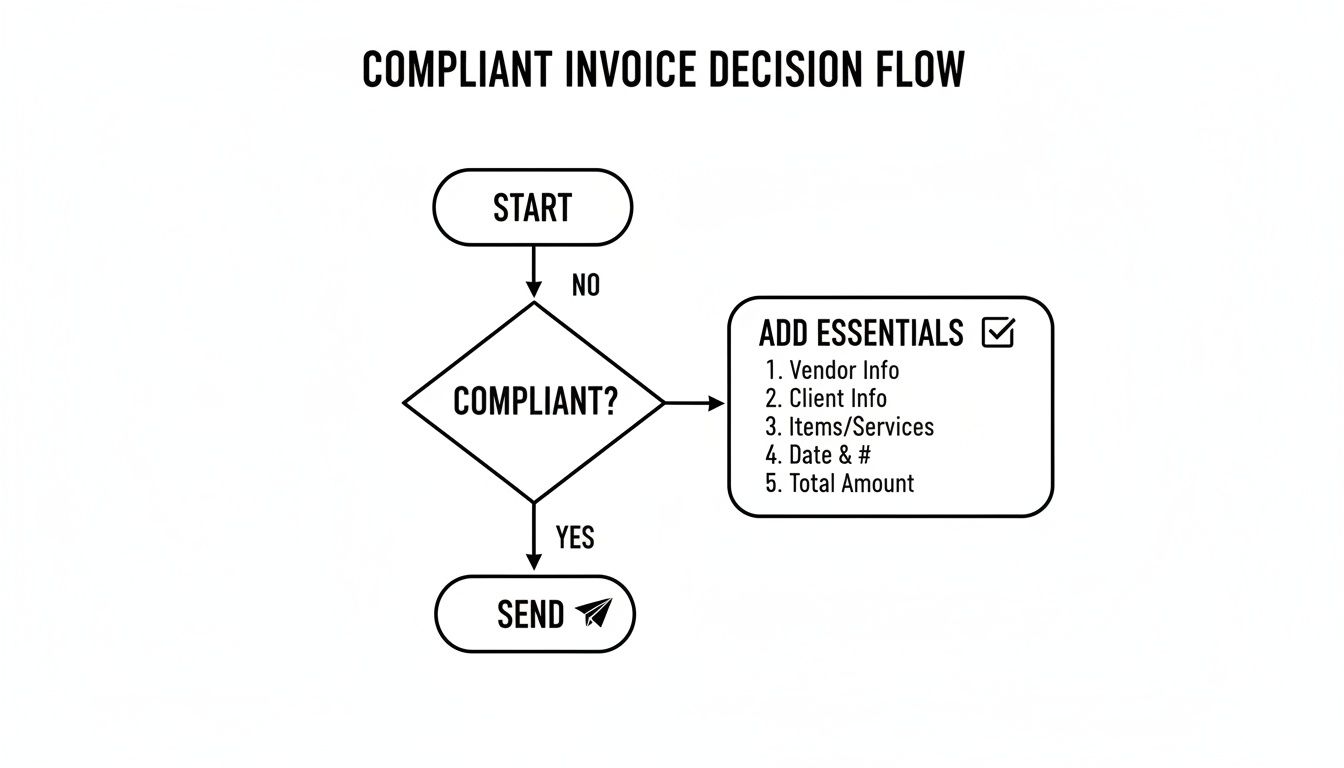
Running through this simple flow can save a lot of back-and-forth later by ensuring you have included everything your client's finance team needs.
Business Structures and Invoicing Differences
The way your business is structured dictates the small print on your invoices and your overall tax responsibilities. Each setup has its own quirks and best practices.
- Sole Traders: You are the business. Your invoices need to show your own name and any trading name you use. You are personally on the hook for your business's taxes and any debts.
- Limited Companies: Your business is its own legal entity, separate from you. Invoices must feature the full registered company name, company number, and registered office address. You will pay Corporation Tax on your profits.
- Umbrella Companies: When you work through an umbrella, you technically become their employee. They handle all the invoicing with the client or agency, and they manage all your tax and NI deductions through PAYE. You get a payslip, not a payment against an invoice you have personally sent.
Setting Clear Payment Terms to Get Paid Faster
The secret to getting paid on time often comes down to one thing: setting crystal-clear payment terms before you even start the work. This is your best line of defence against late payments and the cash flow headaches they cause.
It is not about being pushy; it is just good business. When you agree on the rules upfront, there is no room for confusion. Your client’s accounts team knows exactly when your invoice is due and how to pay it, which means they can process it without a hitch. Honestly, it is one of the most fundamental parts of freelancing.
A Comparison of Common Freelance Payment Terms
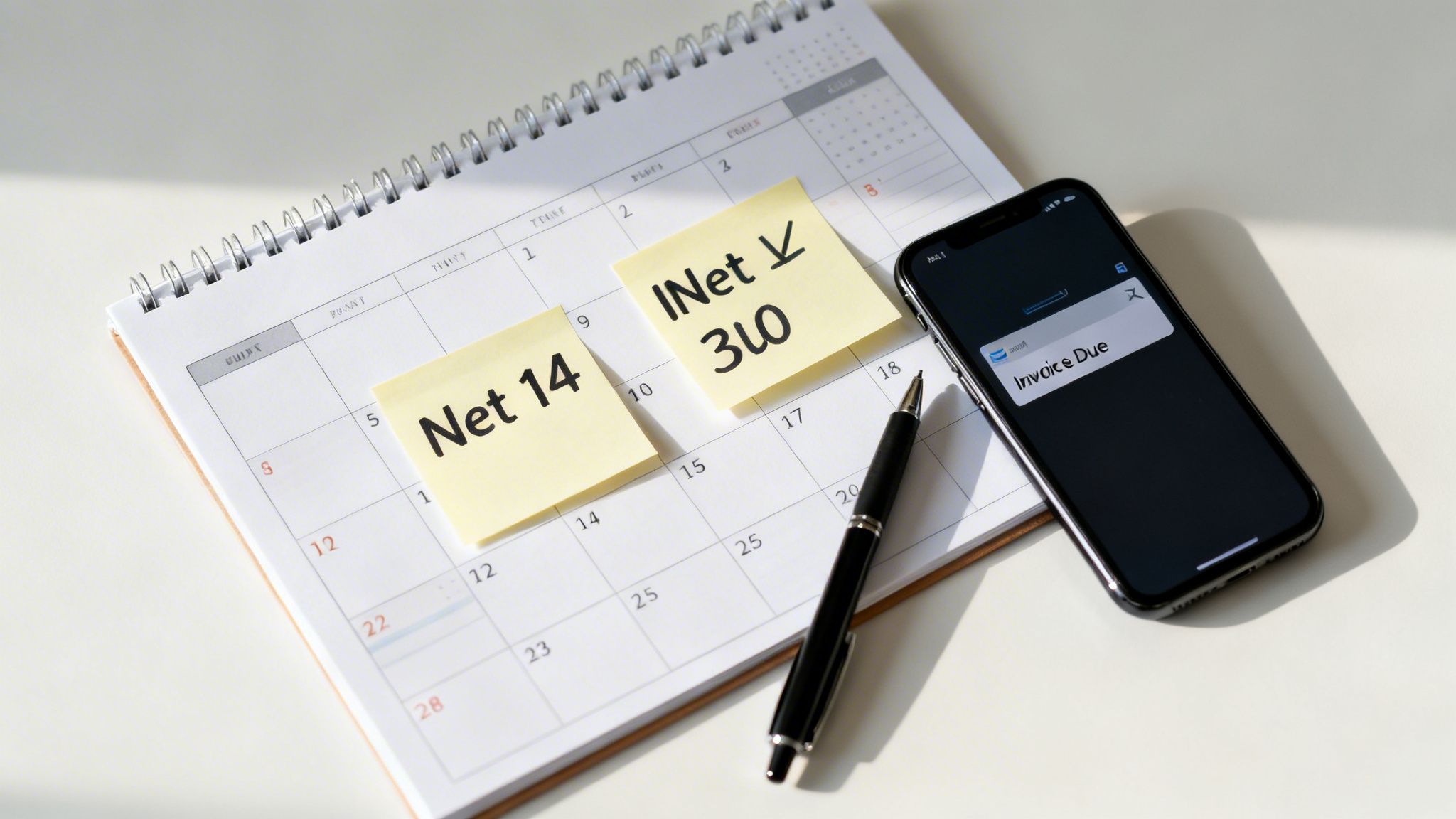
When it comes to payment terms, you will see phrases like ‘Net 14’ or ‘Net 30’ thrown around. Do not let the jargon intimidate you. ‘Net’ just refers to the total amount you are owed, and the number is how many days the client has to pay up. Picking the right one depends on your cash flow needs and your client’s size.
This table breaks down the most common options to help you decide what works for you.
| Payment Term | Best For | Pros | Cons |
|---|---|---|---|
| Payment on Receipt | Urgent or one-off jobs where you need funds quickly. | The fastest way to get paid and great for your cash flow. | Can be unrealistic for larger companies with rigid payment cycles. |
| Net 14 | Shorter projects and regular clients. A good middle ground. | Keeps money flowing in steadily, usually within two weeks. | Might be too quick for big corporate clients who process in monthly batches. |
| Net 30 | Larger corporate clients or long-term projects. | The industry standard; most big businesses are set up for this. | Can mean a long wait for your money, which can be tough for new freelancers. |
| 50% Upfront | Large projects with significant initial costs or new clients. | Reduces your risk and provides working capital to get started. | Some clients may be hesitant to pay before any work is delivered. |
Ultimately, there is no single "best" term. A mix-and-match approach often works well. You might use Net 14 for a small startup client but agree to Net 30 for a big corporate gig. The key is to get it agreed and written down.
The best place to make these terms official is in your contract. If you need a starting point, our freelance contract template for the UK is a great resource.
How Often Should You Invoice?
Your invoicing schedule should mirror the rhythm of your work. Trying to fit every project into the same invoicing box just does not work. When you time your invoices to match project delivery, they make more sense to the client and get approved faster.
Here are a few common schedules to consider:
- At the end of the project: Perfect for smaller, self-contained jobs. You finish the work, send the invoice, and you are done.
- Monthly on a retainer: If you have a retainer agreement, invoicing on the same day each month (like the 1st or the last working day) creates a brilliant, predictable routine for both you and your client.
- At key project milestones: This is a lifesaver for big, long-term projects. Billing at specific stages (say, after the initial designs are approved) breaks up the payments and keeps cash coming in. For example, a developer might invoice 50% upfront, 25% after the beta launch, and the final 25% when the site goes live.
Having a clear, organised approach to your payment terms is the best way to avoid chasing money. It shows you are a professional and sets respectful boundaries right from the start.
Sending Your Invoice the Right Way
Once your invoice is ready to go, how you send it really matters. A professional delivery helps ensure it lands with the right person and does not get swallowed by a chaotic inbox.
The standard method is to attach a PDF to an email. A PDF looks clean, cannot be easily edited, and works on any device. Make your email subject line impossible to ignore; something like “Invoice [Your Invoice Number] for [Project Name]” works perfectly.
If you are juggling several clients, do yourself a favour and look into invoicing software. Platforms like Xero, FreeAgent, or QuickBooks are absolute game-changers. They can create and fire off professional invoices, tell you when they have been opened, and even send polite reminders for you. It frees up so much admin time and genuinely helps you get paid faster.
A Professional Guide to Chasing Late Payments
Chasing an overdue invoice is never comfortable, but let us be honest, it is an inevitable part of freelance life. The trick is to have a professional, systematic approach that protects your cash flow without torching your client relationships. Handled correctly, it is just another business process, not a confrontation.
The most important thing is to act promptly. The moment an invoice sails past its due date, your process should kick in. A friendly, polite reminder is usually all it takes. More often than not, a late payment is a simple oversight or an admin hiccup, not a deliberate refusal to pay.
Your First Steps: The Polite Follow-Up
Your initial contact should be gentle and assume the best. An invoice could be languishing in a spam folder, or maybe it is just waiting for the next scheduled payment run. A calm, professional email is the perfect first move.
We would recommend waiting until the invoice is just one or two days overdue, then sending a message with a crystal-clear subject line like “Friendly Reminder: Invoice [Invoice Number]”.
Here is a simple template you can adapt:
Hi [Client Name],
Hope you are having a good week.
This is just a polite follow-up to check on the status of invoice [Invoice Number], which was due for payment on [Due Date]. I have re-attached it here for your convenience.
Please let me know if you have any questions.
Best wishes,
[Your Name]
This approach is non-confrontational and gives the client an easy out. If you do not hear back within a few working days, it is time to pick up the phone for a friendly chat.
When to Escalate Your Approach
If a week has passed since that first email and you have been met with silence, your follow-ups need to become a bit firmer, though still professional. From this point on, you should be documenting every single communication attempt.
Your escalation plan could look something like this:
- 7 Days Overdue: Send a second email that is a little more direct. Reference your previous message and ask if there is a problem with the invoice that is holding things up.
- 14 Days Overdue: Time for another phone call. If you cannot get hold of your main contact, do not be afraid to ask to speak with someone in the accounts or finance department.
- 21 Days Overdue: Send a final, more formal email. State clearly that the payment is now significantly overdue and mention that you may have to start late payment proceedings if it is not settled soon.
It is crucial to remain professional throughout this. Losing your cool will not get you paid any faster, and it could seriously damage your reputation.
And this is not a small problem. Late payments are a huge headache for UK freelancers. A staggering 62% of small businesses are dealing with overdue invoices. The admin burden is immense, with 5% of UK SMBs spending over 10 hours a week just chasing payments. For a freelancer, that is not just an inconvenience; it is a threat to your livelihood. You can discover more insights about the impact of late payments on freelancers to see why a solid follow-up process is a survival strategy.
Your Legal Rights: UK Late Payment Legislation
When polite reminders fall on deaf ears, you have legal tools at your disposal. The Late Payment of Commercial Debts (Interest) Act 1998 is a powerful piece of legislation that lets you add charges to an overdue invoice.
Under these rules, for business-to-business transactions, you can claim:
- Statutory Interest: This is calculated at 8% plus the Bank of England base rate. You can start charging this from the day after the invoice was due.
- Fixed Sum Compensation: You can also add a one-off compensation fee to cover your recovery costs. The amount depends on the size of the debt:
- £40 for debts up to £999.99
- £70 for debts between £1,000 and £9,999.99
- £100 for debts of £10,000 or more
Often, just informing a client that you intend to add these statutory charges is enough to prompt an immediate payment. If you do, you can then issue a revised invoice that includes these additional amounts.
The Final Stages: Letter Before Action and Small Claims
If the invoice is still unpaid after 30 days and you have exhausted all other options, it is time for a Letter Before Action. This is a formal letter that clearly states the outstanding amount, references the late payment legislation, and warns that you will begin court proceedings if the debt is not settled within a specific timeframe (14 days is standard).
This letter has to follow a specific legal format, so it is wise to use a template from a reputable source like Citizens Advice or to seek a bit of legal guidance.
Should this final warning be ignored, your absolute last resort is the small claims court. For debts under £10,000 in England and Wales, this is a relatively straightforward and low-cost online process designed for people to use without needing a solicitor. While it should always be the very last option, knowing it is there gives you the confidence to enforce your payment terms and make sure you get paid for your hard work.
Bringing in the Tech: Tools and Software to Streamline Your Invoicing
A solid invoicing system does more than just get you paid. It buys you back time, cuts down on stress, and makes the whole tax season thing a lot less painful. Honestly, moving from a manual spreadsheet to a proper system is one of the best upgrades you can make to your freelance business.
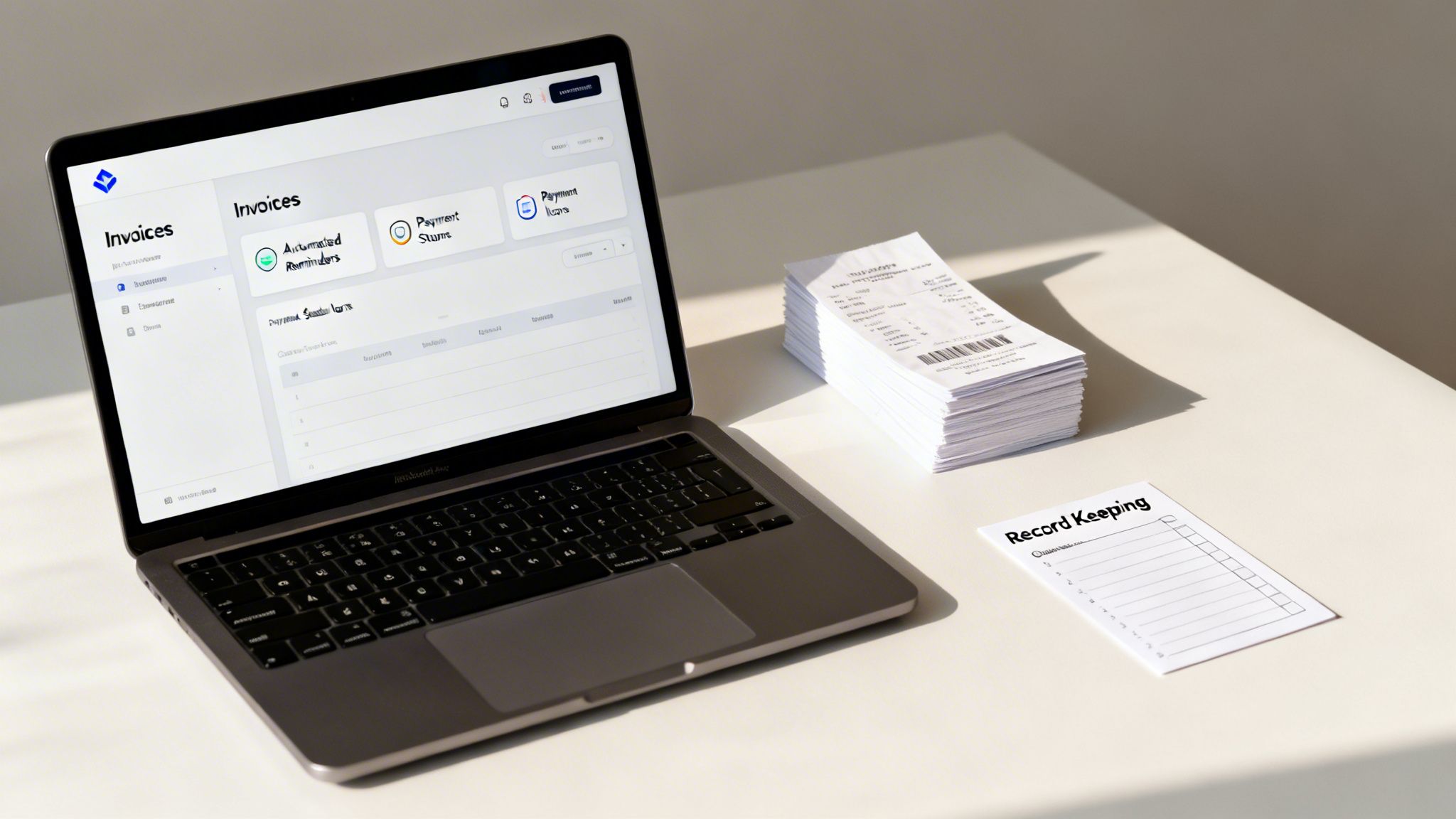
Look, starting out with a simple spreadsheet is absolutely fine. We have all been there. But you will quickly find that dedicated tools have some serious perks. They handle the repetitive stuff, slash the chances of a typo throwing everything off, and give you a clear picture of your finances with a single glance.
Choosing Your Invoicing Weapon
The right tool can completely change the game for your financial admin. For freelancers just dipping their toes in, a well-organised spreadsheet can definitely do the job. You can knock up a basic template to track invoice numbers, dates, client details, amounts, and payment status. It is a low-cost way to get your head around the essentials.
But as your client list grows, dedicated accounting software becomes a non-negotiable. Platforms like Xero, QuickBooks, and FreeAgent are built from the ground up for small businesses and freelancers like us.
The advantages are huge:
- Automated Invoice Creation: They churn out professional, compliant invoices in seconds.
- Payment Reminders: The software can automatically send those polite (or not-so-polite) nudges about overdue payments for you.
- Real-Time Tracking: You get an instant dashboard showing which invoices are paid, pending, or late.
- Expense Management: Most let you snap photos of receipts and log business expenses, which is a lifesaver come tax time.
Using proper accounting software is not just about shaving a few hours off your admin. It gives you a more professional image, helps you keep cash flowing, and hands you the financial data you need to make smarter decisions about your business.
Staying on the Right Side of HMRC
No matter what system you use, keeping accurate and organised records is a legal must. HMRC has pretty strict rules about what you need to keep and for how long. Getting this right is your best defence against a dreaded tax audit.
Think of your financial records as the evidence that backs up everything on your Self Assessment tax return. A good system is not just a nice-to-have; it is essential for staying compliant.
What to Keep, and For How Long
For sole traders and freelancers, HMRC expects you to keep records of all your business income and outgoings. This means a lot more than just having copies of the invoices you have sent.
Your record-keeping should cover:
- All sales and income: Basically, a copy of every single invoice you have issued.
- All business expenses: Hang on to receipts for everything from software subscriptions to train tickets for client meetings.
- VAT records: If you are VAT-registered, you have to maintain detailed VAT accounts.
- PAYE records: This applies if you employ anyone (which includes yourself if you are a limited company director).
- Personal income records: You will also need details of any other income you get from other sources.
So, how long does this pile of digital (or physical) paperwork need to hang around? HMRC rules state you must keep your records for at least 5 years after the 31st January submission deadline for that tax year.
Let us break that down. For the 2023-24 tax year (which ends on 5 April 2024), you would need to keep all your records until at least the end of January 2030. It pays to be organised.
Right, so you have got your invoicing process down, but what happens when something a bit unusual crops up? It is bound to happen. Over the years, we have seen just about every invoicing query you can imagine, so let us tackle some of the most common ones head-on.
How Do I Invoice an International Client?
Invoicing clients outside the UK is straightforward, but clarity is absolutely crucial.
The first thing to do is make sure your invoice clearly states the currency you expect to be paid in, for instance, GBP £. You would be surprised how often this is missed, and it can cause real headaches and delays later on.
Good news on the tax front: you generally do not need to charge UK VAT for services provided to a client who is entirely based overseas. It is still a good idea, though, to do a quick check if any local taxes in their country might apply.
To make the actual payment process painless, you will need to provide your IBAN and BIC/SWIFT code on the invoice, right alongside your usual bank account number and sort code. This is essential for international bank transfers.
What if I Make a Mistake on an Invoice?
We have all done it. You hit 'send' and then spot a glaring typo or the wrong figure. Do not panic. The professional way to handle this is to issue a credit note.
Think of a credit note as an 'anti-invoice'. It officially cancels out the incorrect one you have already sent.
Your credit note needs its own unique number (just like an invoice) and must clearly reference the original invoice number it is cancelling out. Once that is sent, you can then create and issue a brand new, correct invoice with a new invoice number. This keeps the paper trail clean for both you and your client, which your accountant will thank you for.
Can I Charge for Overtime or Extra Revisions?
Yes, you can, but only if it was agreed in your contract from the get-go.
This is why a solid contract is so important. It should clearly spell out the standard scope of work, and just as importantly, your rates for any additional work or extra rounds of revisions that fall outside that scope. It should also detail how you will get client approval before you start racking up those extra hours.
If you do not have that agreement in writing beforehand, trying to charge for work that goes beyond the original brief becomes very difficult to enforce. It can lead to awkward conversations and potentially damage your client relationship.


