


The awkward stretch between projects is where most contractors feel the pressure. One job is wrapping up, invoices are still moving through accounts, and you need the next piece of work lined up before the gap gets expensive.
That's why learning how to get subcontract work matters so much. It isn't only about finding names of platforms or firing off another round of cold emails. The contractors who stay busy usually have a tighter system. They know where the better opportunities sit, how to pitch in a way that sounds commercial rather than needy, how to price without undercutting themselves, and how to keep the compliance side clean so a good contract doesn't turn into a tax problem later.
Your Guide to Winning Consistent Subcontract Work
Subcontracting is no longer a side lane of the UK labour market. It's a major way work gets delivered. Since 2008, the number of contractors in the UK has risen by 36% to 1.91 million. They represent 15% of the total UK workforce and contributed an estimated £109 billion to the economy in 2015, according to Contractor Calculator's review of the UK contracting landscape.
That matters for one simple reason. You're not chasing something obscure. You're operating inside a well-established part of the market where main contractors, agencies, consultancies and end clients already expect to buy specialist delivery on a subcontract basis.
Most weaker advice on this topic stops at “join a few job boards”. That's not enough. Job boards can help, but they rarely create a reliable pipeline on their own. Good subcontractors treat business development like delivery work. They build a repeatable process, they qualify leads quickly, and they make it easy for a buyer to trust them.
Practical rule: The best subcontract work usually comes from positioning and follow-up, not from being first to click “apply”.
A more reliable playbook looks like this:
- Build multiple lead sources: Don't rely on one recruiter, one platform, or one client contact.
- Pitch to the buyer's problem: Main contractors care about reduced risk, clean delivery, and fewer surprises.
- Price with a structure: If you can't explain your rate, you'll end up negotiating against yourself.
- Get the paperwork right: Written agreements, scope, payment terms and IR35 position all need checking before work starts.
- Onboard properly: Clients remember how easy you were to work with, not just whether you could do the job.
Some subcontractors stay trapped in one-off gigs because they keep solving the same problem from scratch. A better approach is to create a system you can run every week. That's how you move from hunting for work to building a steady flow of it.
Where to Find High-Quality Subcontracting Opportunities
The best opportunities don't all sit in one place. If your whole pipeline depends on one jobs feed, you're vulnerable the moment that source dries up. Stronger subcontractors spread their search across a few channels and use each one differently.
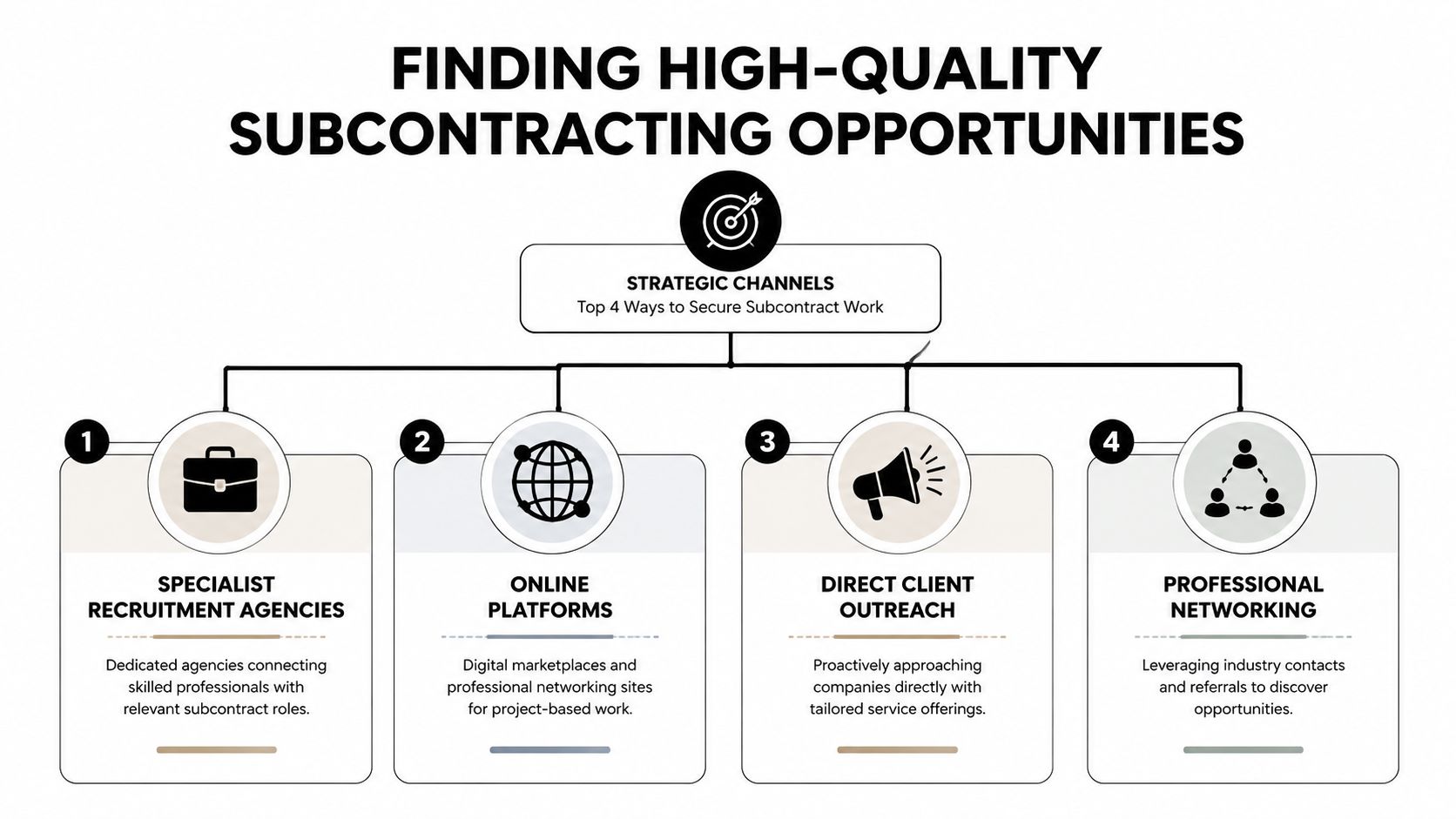
Specialist recruitment agencies
A good recruiter can save you time, but only if they understand your niche. Generalist agencies often send irrelevant roles, vague briefs, or rates that collapse once the client starts pushing back.
Look for recruiters who already place people in your trade, discipline, or contract type. That usually means:
- Sector fit: They understand construction, software, media, engineering, payroll, or whichever lane you work in.
- Market honesty: They'll tell you when a brief is weak, under-scoped, or priced badly.
- Repeat contact: They come back to you because they know what you deliver.
If you're using agencies, keep your profile sharp and current. A recruiter should be able to forward a concise CV, portfolio, or capability statement without rewriting half of it.
Online platforms and contractor marketplaces
Platforms work best when you treat them as shop windows, not magic machines. LinkedIn matters. So do sector-specific directories and role boards. Keep your headline clear, your recent work visible, and your service offer obvious.
If you want a practical place to monitor openings, Umbrella Company also keeps a jobs board for subcontractors that can help you spot live demand.
What usually works on platforms:
- Clear positioning: Say exactly what you do, who you help, and what sort of contracts you take.
- Proof near the top: Put examples, outcomes, industries, or project types where buyers see them quickly.
- Direct next step: Make it easy for someone to message you, book a call, or request availability.
Direct outreach to clients
Direct outreach is where many subcontractors win better work, especially once they stop sending generic messages. Main contractors and agencies often need backup capacity before they publicly advertise it. A short, relevant note can land at exactly the right time.
If you want to tighten your outreach process, these effective lead generation techniques are useful for structuring prospecting without turning it into spam.
Buyers respond to relevance. A short email tied to a real delivery problem beats a long “just checking in” message every time.
Underserved markets most people ignore
The gap opens up here.
Generic guides often miss that 68% of UK software subcontractors miss public tenders, despite 22,000+ new bids appearing on Contracts Finder in 2024. Furthermore, 54% of UK creative agencies outsource technical tasks, creating a significant, untapped market.
That means two channels deserve far more attention than they usually get:
- Public sector portals: Contracts Finder and related procurement routes can look clunky, but they do contain real subcontracting opportunities.
- Creative and specialist agencies: Agencies often need technical delivery they can't handle in-house, especially when client demand lands suddenly.
Professional networking that actually produces work
Networking works when it's specific. “Let me know if you hear of anything” is forgettable. “If you see overflow work in payroll transformation, contract review, shopfitting estimation, or React build support, I've got availability next month” is useful.
Keep a short list of people to stay visible with:
- former project managers
- estimators
- delivery leads
- agency account managers
- trusted subcontractors in adjacent trades
That mix gives you more than leads. It gives you referrals with context, which usually convert better than cold opportunities.
Crafting a Pitch That Wins the Contract
Most losing pitches have the same problem. They talk about the contractor. Winning pitches talk about the job.

A buyer doesn't need your life story. They need confidence that you understand the scope, can slot into the programme, and won't create more management work for them. That's why a customized pitch usually beats a high-volume approach.
What a strong pitch includes
A good subcontracting pitch has five parts:
A useful opening line
Show that you've looked at the role, project, client, or sector. Keep it specific.A clear fit statement
Explain what you do in one or two lines, in commercial terms.Relevant proof
Mention similar project types, deliverables, or environments. Link to portfolio samples where appropriate.Delivery reassurance
Signal reliability. Mention communication, documentation, site coordination, handover quality, or availability.A simple next step
Ask for a short call, a scope review, or the chance to price a package.
For project-based work, it also helps to understand how to make quotes that win jobs, especially when your written quote is doing the selling before anyone speaks to you.
A simple pitch template
You don't need to sound polished. You need to sound useful.
Working template:
Hi [Name], I saw you're looking for support on [project or work type]. I specialise in [specific service] and usually help [type of client or contractor] when they need extra delivery capacity without adding overhead.My recent work has included [relevant example or project type], with a focus on [outcome such as programme control, technical delivery, documentation, snag-free handover, or client reporting].
If it helps, I can review the scope and confirm whether I'm a fit, along with availability and pricing.
Best,
[Name]
Keep it short enough to read on a phone. Long messages often signal uncertainty.
Speak in scope, outcomes and risk
This is where newer subcontractors often slip. They list software, tools, qualifications, or years in the trade, but never explain why those things matter to the person buying.
A stronger proposal sounds like this:
Instead of “I'm highly experienced in contract administration”
Say “I can keep document control, change requests and reporting moving without adding pressure to your PM.”Instead of “I'm available immediately”
Say “I can step in quickly and pick up a defined package without disrupting the existing team.”
If your engagement is likely to be outcome-led, a proper statement of work template and guidance can help you frame your offer in a way buyers understand.
A short video can also help sharpen how you present value in a proposal.
What doesn't work
Three things usually weaken a pitch fast:
- Generic copy: Buyers can spot pasted outreach instantly.
- Too much autobiography: They care more about fit than career chronology.
- No call to action: If you don't suggest a next step, the conversation stalls.
The best pitch feels less like a sales message and more like a calm, competent answer to a delivery problem.
Pricing Your Services and Negotiating Your Rate
Pricing gets easier when you stop treating it as guesswork. Newer subcontractors often pick a number they hope sounds fair, then fold as soon as someone says it's too high. That's not negotiation. That's reacting.
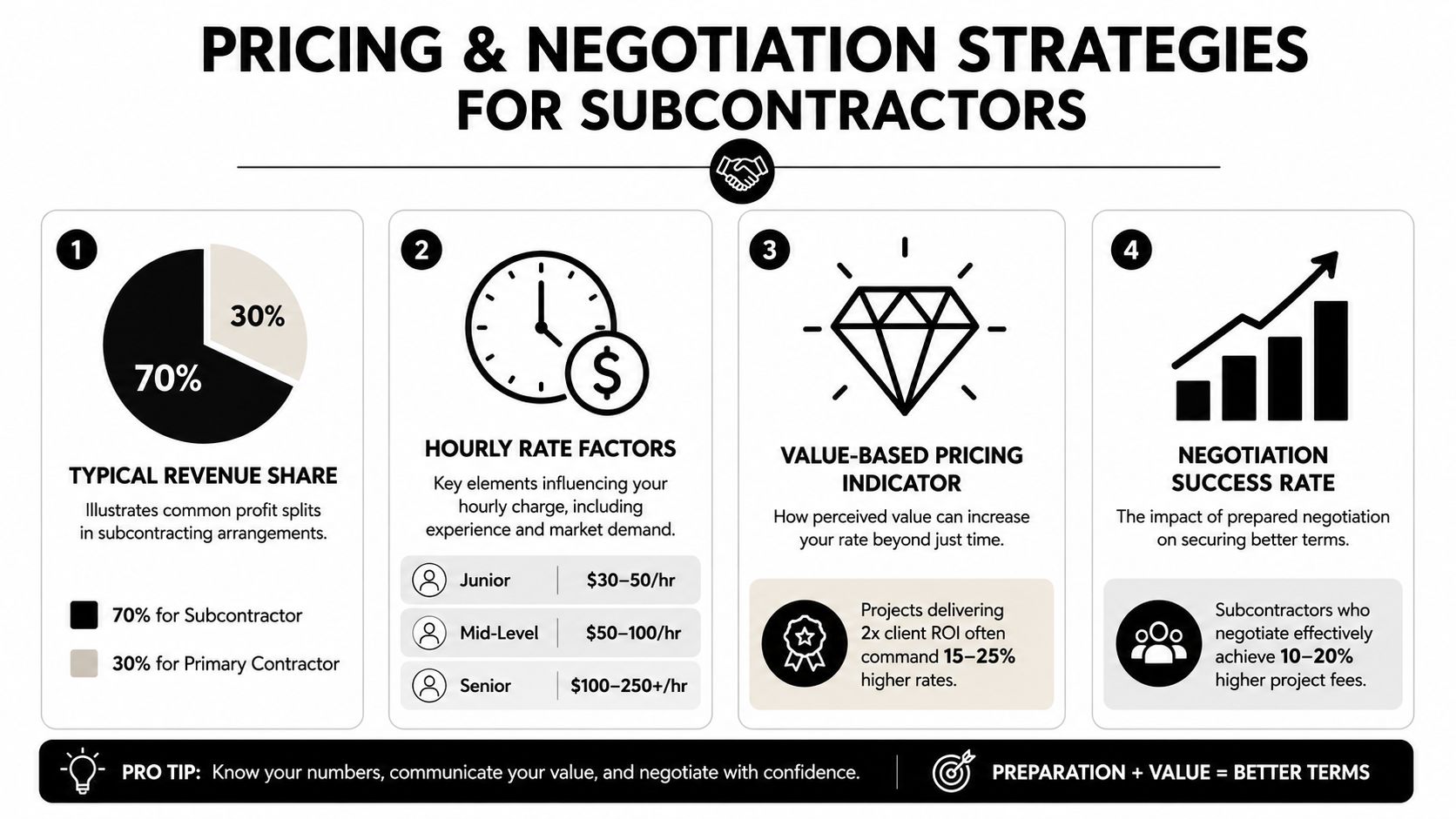
A better starting point is to anchor your rate to the commercial structure of the job. A key UK benchmark is that subcontractors typically receive 30–80% of total job revenue, with 50% being standard after material costs are deducted. If subcontractors provide all equipment and materials, they should aim for approximately 80% of the revenue, based on this UK subcontractor revenue benchmark discussion.
Pick the right pricing model
Different jobs need different pricing structures. One rate model won't suit every engagement.
| Pricing model | Best used when | Main advantage |
|---|---|---|
| Day rate | Scope may move, client wants flexibility | Simple to agree and easy to vary |
| Fixed project fee | Deliverables are well defined | Protects value if you work efficiently |
| Retainer | Ongoing support is needed each month | Smoother cash flow and better planning |
A day rate works well when the buyer is still shaping the work. A fixed fee is better when the scope is stable and both sides know what “done” looks like. A retainer suits long-running support, advisory input, or recurring technical delivery.
How to justify your rate without waffling
Clients don't object to price in the abstract. They object when the price feels detached from the risk, responsibility, or output involved.
Frame your rate around:
- Complexity of the scope: Hard jobs cost more than straightforward ones.
- Speed and reliability: If you can start quickly and deliver cleanly, that has value.
- Buyer management time saved: A subcontractor who needs less chasing is worth more.
- Tools, materials, and commercial exposure: If you're carrying more of the operational load, your rate should reflect it.
Don't defend your rate with emotion. Explain what sits behind it and what the client gets for it.
How to handle pushback
When a client says your price is high, don't rush to discount. Ask what they're comparing it to. Sometimes they're benchmarking against employed labour, a junior supplier, or a poorly defined quote.
Good responses include:
- Reduce scope, not only price: Strip out optional tasks or phases.
- Offer options: Present a day-rate route and a fixed-fee route.
- Clarify assumptions: A lot of “price objections” are really scope misunderstandings.
- Walk away when needed: Some jobs are badly priced from the start.
If you want to sense-check a contract rate against take-home implications, a contractor rate calculator is useful before you commit.
A practical negotiating habit
Anchor first where you can. If you let the buyer define value before you've explained your structure, you'll spend the whole conversation trying to recover ground.
State your price clearly, tie it to scope, and stay quiet long enough for the other side to respond. Contractors who panic-fill the silence often negotiate against themselves before the buyer has even pushed back.
Understanding Contracts IR35 and Staying Compliant
Winning the work is one thing. Making sure the contract is workable, legal, and tax-aware is another. Plenty of subcontractors get caught out at this stage, especially when they rely on verbal agreements, recycled templates, or assumptions about IR35.
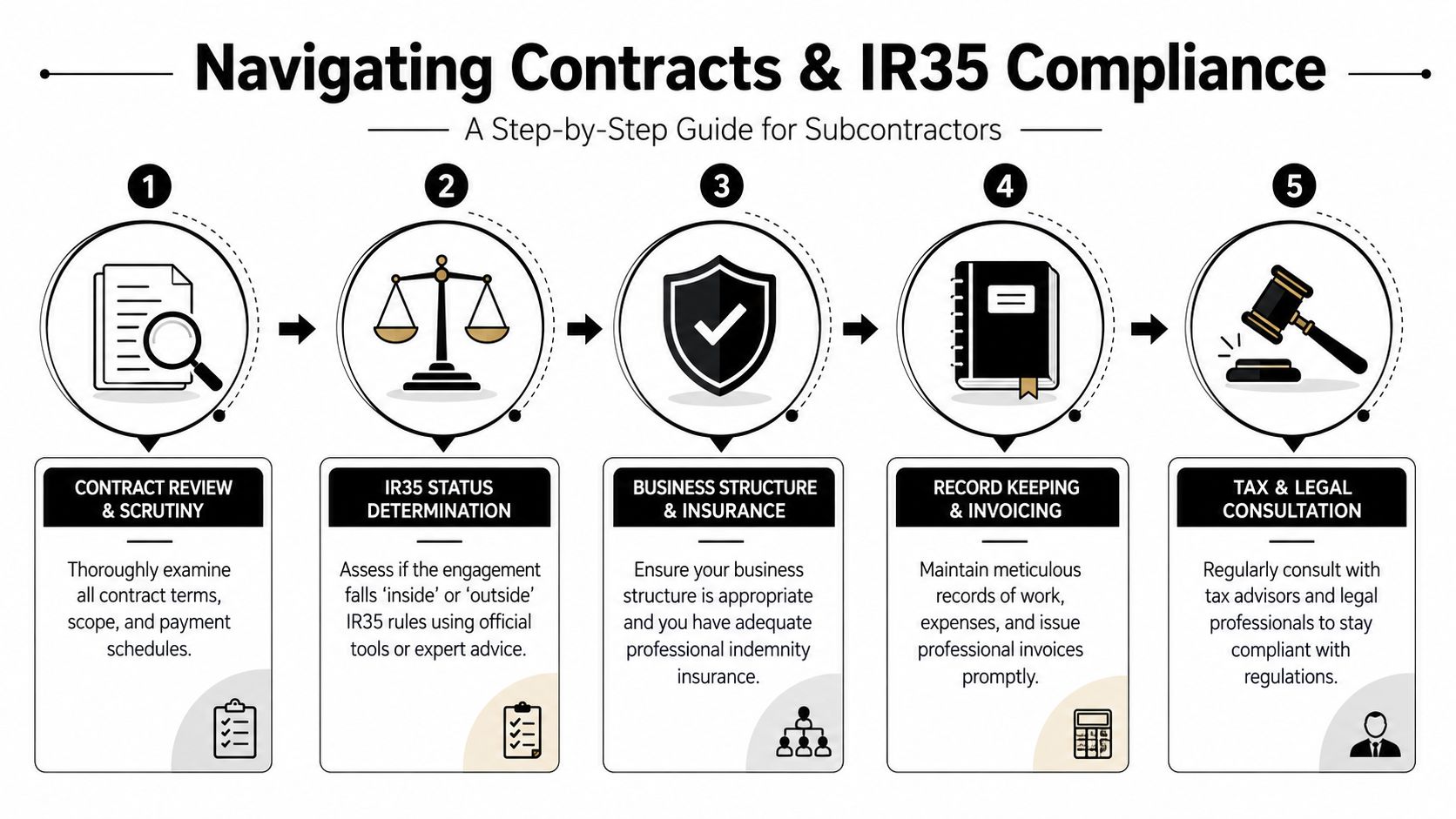
Start with one rule. Always get a written agreement in place before the work begins. If the client says they'll sort paperwork later, slow the process down. Scope, payment terms, termination terms, substitution wording where relevant, and responsibility for equipment or materials all need to be clear.
What to check in the contract
Before you sign anything, review the commercial basics carefully.
- Scope of work: The contract should match the job you've discussed.
- Payment terms: Check invoice timetable, approval process, and due dates.
- Variation process: Extra work needs a clear route for approval and charging.
- Liability wording: Don't accept broad liability you can't realistically control.
- Status and engagement structure: The document should reflect how the work will operate in practice.
If the wording and the reality drift apart, that can cause trouble later.
The IR35 point many contractors still miss
For private sector engagements, responsibility for status determination changed some time ago, but confusion still hangs around. For engagements in the private sector starting after 6 April 2021, the end client is legally responsible for determining IR35 status, unless they are a 'small business'. They must issue a Status Determination Statement (SDS) to the contractor, as explained in Kingsbridge's guide to IR35 responsibility.
That gives you a practical question to ask before you accept the job:
“Who is making the IR35 determination for this engagement, and when will I receive the SDS?”
If the buyer can't answer that clearly, pause. You need that point resolved early, not after you've started.
Inside IR35 and outside IR35 in practical terms
Inside IR35 means the engagement is treated more like employment for tax purposes. Outside IR35 means the engagement is considered a genuine business-to-business arrangement for tax purposes.
The label matters because it affects how you work, how you're paid, and what you can claim. If you're operating inside IR35, you need to understand the payroll and compliance implications before focusing only on the headline rate.
For a deeper look at the rules and common scenarios, this guide on IR35 for contractors is worth reviewing.
Keep the paperwork aligned with reality
A contract doesn't protect you if day-to-day working practices tell a different story. If the document says one thing and the engagement operates another way, the actual working arrangement is what people will examine.
That means you should keep records of:
- agreed scope and changes
- invoices and approvals
- project communications
- deliverables and sign-offs
- any evidence showing independent working practices where relevant
A clean contract is only half the job. The working arrangement has to support it.
Subcontractors who stay commercially tidy usually have fewer disputes, fewer payment arguments, and far fewer nasty surprises when someone finally reads the paperwork properly.
Your Professional Onboarding Checklist
The first week of an engagement often decides whether you'll get asked back. Clients form a view quickly. If they have to chase you for basics, repeat information, or untangle admin that should have been sorted already, confidence drops fast.
That's why onboarding needs structure. A common pitfall for contractors is failing to establish a rigorous onboarding process for subcontractors. Without this, client skepticism increases, which can damage a contractor's reputation and reduce subcontract success rates significantly, according to Trade Recruit's guidance on subcontractor hiring processes.
What to lock in before delivery starts
Use a checklist. It sounds simple because it is.
- Confirm contacts: Get the decision-maker, day-to-day manager, finance contact, and technical lead.
- Agree communication channels: Email, Teams, Slack, WhatsApp, site meetings, or formal progress calls, decide early.
- Reconfirm scope: Check that the work matches the signed agreement.
- Set reporting rhythm: Weekly updates, milestone check-ins, or delivery reviews should be agreed upfront.
- Align on tools: Project management platforms, shared drives, document naming, and approval routes matter more than people think.
Financial and administrative checks
A subcontractor who handles admin cleanly is easier to trust.
Make sure you know:
- How invoicing works: Format, purchase order requirements, submission date, and who approves payment.
- When payment is due: Don't leave this vague.
- What evidence is needed: Timesheets, completion notes, sign-offs, or delivery reports.
- Whether insurances or certificates need sending over: Some clients won't release work until their files are complete.
Good onboarding reduces friction. Reduced friction makes repeat work far more likely.
The professionalism clients actually notice
Clients appreciate technical skill, but they remember reliability. They remember whether you joined the project smoothly, whether updates were clear, and whether they had to chase for basics.
Three habits help immediately:
- Send a short start-up email summarising scope, contacts, timings and invoice details.
- Raise uncertainties early, before they turn into delivery issues.
- Keep a written trail of decisions, especially if scope begins to drift.
A tidy start makes the rest of the engagement easier. It also makes referrals easier, because the client can describe you in one sentence: competent, easy to work with, and commercially switched on.
Frequently Asked Questions About Subcontracting
A few questions come up repeatedly when people start taking subcontract work seriously. Getting these clear early saves confusion later.
Is a subcontractor the same as a freelancer
Not always. The terms overlap, but they aren't identical in practice.
A freelancer is a broad label for someone working independently. A subcontractor usually delivers part of a wider contract, often under a main contractor, agency, or lead supplier.
| Aspect | Subcontractor | Freelancer |
|---|---|---|
| Client relationship | Usually engaged by a main contractor, agency, or lead supplier | Often engaged directly by the end client |
| Scope | Delivers a defined part of a larger project or service | May deliver a standalone service directly |
| Commercial context | Often works within another party's contract obligations | Often sets direct terms with the client |
| Typical focus | Integration, handover, coordination, compliance | Direct service delivery, advisory, or creative output |
Can you work for more than one main contractor at the same time
Yes, if your contracts allow it and you can deliver properly. The practical issue isn't permission as much as capacity. If overlapping commitments damage quality, communication, or deadlines, the short-term revenue isn't worth it.
Check for exclusivity terms, confidentiality clauses, and obvious conflicts of interest. If two clients operate in the same space, be careful with information handling and access.
What insurance should a subcontractor consider
The exact cover depends on your trade, but most subcontractors should at least think about:
- Public liability insurance: Important if your work could cause injury or property damage.
- Professional indemnity insurance: Relevant where advice, design, specification, or professional judgement is involved.
- Employers' liability insurance: Usually relevant if you employ staff.
- Tools, equipment, or trade-specific cover: Important where you carry kit or work on site.
If a client asks for evidence of cover, send it promptly and make sure the details are current.
Should you always use a written contract
Yes. Even for a small job. Especially for a small job.
A short agreement is far better than relying on memory, message threads, or a verbal promise. The contract doesn't need to be bloated. It does need to be clear about scope, payment, timing, and what happens if the work changes.
What's the biggest mistake new subcontractors make
They chase work reactively, accept vague terms, and hope the details sort themselves out later. Better subcontractors do the opposite. They qualify the opportunity, pitch with a clear commercial angle, price with logic, and tidy up the paperwork before work begins.
If you've secured a role and need support choosing the right payment route for an inside IR35 contract, or you want to compare compliant options before you start, Umbrella Company helps contractors and freelancers find umbrella companies that fit their rate, role, and sector.


