


Finishing one contract and starting the next often feels straightforward until payroll paperwork gets involved. A lot of contractors only start searching for how to get p45 when they’ve already left a role, joined a new assignment, and realised their tax code might be wrong if they don’t move quickly.
That’s why this matters. If you’re moving from a permanent role, an agency engagement, or one umbrella arrangement to another, your P45 is one of the key documents that helps your new employer tax you properly from the outset. Get it in hand early and the transition is usually smooth. Leave it too late and you can end up with avoidable payroll friction just when you want your first payment to land cleanly.
What a P45 Is and Why Contractors Need One
A P45 is the document your employer issues when you stop working for them. It records your pay, tax code, and National Insurance contributions for the current tax year, which runs from 6 April to 5 April, and HMRC guidance says the employer issues it when you leave through their payroll process, as explained in HMRC’s guide to P45 and P60 forms.
For contractors, that matters more than many people expect. You might think of a contract ending as just another admin handover, but from a payroll point of view, it marks the point where one PAYE record stops and another begins.

What your P45 actually does
Your P45 gives your next employer the information they need to continue taxing you correctly in the same tax year. If you’re joining an umbrella company, that payroll team uses the details from the form to place you on the right footing from day one.
Without it, your new employer may have to use an emergency tax code until your records catch up. In practice, that can mean tax being taken at the basic rate without any personal allowance until it’s sorted, which is exactly the kind of issue contractors want to avoid when changing assignments.
Practical rule: Your P45 isn’t just a leaving document. It’s a handover document for your next payroll.
Why contractors get caught out
Employees usually expect a P45 because they’re clearly leaving a job. Contractors don’t always think in those terms, especially if they move quickly between contracts, agencies, or payroll arrangements.
That’s where confusion starts. If you’ve been paid under PAYE, you should expect a P45 when that employment ends. If you want a clearer grounding in how the tax side works before you move roles, it helps to understand how PAYE works for contractors.
A simple way to think about it is this:
- Leaving a PAYE role: your employer should issue the P45.
- Starting a new PAYE role: your new employer uses it to apply the correct tax code.
- Joining an umbrella company: the form helps avoid payroll delays and unnecessary tax corrections later.
How to Request Your P45 from an Employer or Agency
If you’re wondering how to get p45 paperwork moving, start with the most recent employer that paid you through PAYE. That might be a direct employer, a recruitment agency, or your previous umbrella company. The key point is simple. The organisation that employed you and ran your payroll is the one that should issue it.
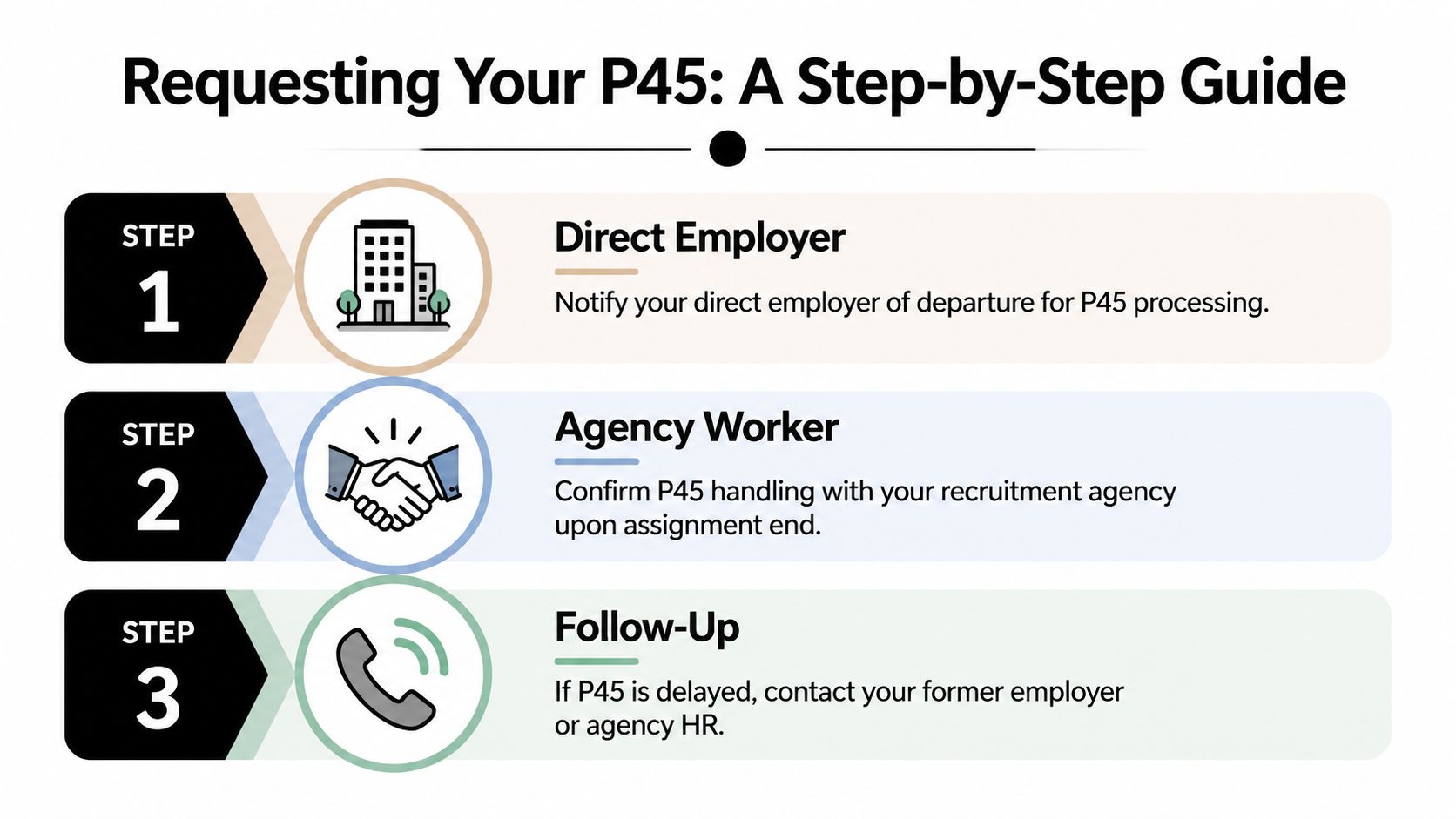
Who you should contact
Different working arrangements create different points of contact.
| Your previous setup | Who usually issues the P45 | Best first contact |
|---|---|---|
| Permanent or fixed-term employment | Your employer | Payroll or HR |
| Agency worker paid as an employee | The agency, if it employed you | Payroll consultant or payroll team |
| Previous umbrella company | The umbrella company | Payroll or compliance team |
If you’ve formally resigned from a role before moving into contract work, it’s worth making sure that process was cleanly documented. A well-worded notice email helps avoid payroll loose ends, and this guide on how to write a resignation letter is a useful reference if you’re still wrapping up your exit properly.
What to say when you ask
You don’t need a long explanation. Short and clear works best.
Email template
Subject: Request for P45
Hello [Name or Payroll Team],
I’ve now finished my employment with [company name]. Please could you confirm when my P45 will be issued and sent to me.
My details are:
Full name: [your name]
NI number: [your NI number]
Employee number, if known: [number]
Last working day: [date]Thank you,
[your name]
Phone script
- Open directly: “Hello, I’m calling to check the status of my P45 after leaving employment.”
- Give identifiers: “My full name is [name], and my last working day was [date].”
- Ask for action: “Can you tell me when it will be issued, and whether it will be posted or emailed?”
What works and what doesn’t
A few practical habits make this easier.
- Contact payroll, not just your line manager: Managers often know you’ve left, but payroll issues the form.
- Use your last working day in the request: That helps the team locate the right record faster.
- Ask how it will be delivered: Some employers post it, others send secure digital copies.
- Keep the request in writing: If there’s a delay, you’ve got a record of when you asked.
What usually doesn’t work is waiting passively and assuming it will appear at the right moment. If your final pay has been processed and nothing has arrived, follow up promptly.
A polite written request solves most P45 delays faster than repeated informal chasing.
If you’re moving into contract work for the first time, it’s also worth understanding the employer setup behind payroll by reading how to set up a PAYE scheme. Even if you won’t run one yourself, it helps explain why payroll teams handle P45s the way they do.
Your P45 When Working with Umbrella Companies
Many contractors get mixed messages. You may have been self-employed before, paid through your own limited company, or coming from a direct PAYE role. The important distinction is that when you join an umbrella company, you join as an employee under PAYE for tax purposes.
Many contractors moving from direct employment into umbrella arrangements aren’t sure how their old P45 fits into the new setup. As explained in FreeAgent’s P45 FAQs for UK workers, self-employed people don’t get P45s, but a contractor joining an umbrella company does so as an employee under PAYE, so the umbrella needs the P45 from previous PAYE work to apply the correct tax code from the start.

Why the umbrella company asks for it
When contractors first join an umbrella, they sometimes see the P45 request as a box-ticking exercise. It isn’t. Payroll uses that information to continue your tax record properly within the current tax year.
That means the request serves several real purposes:
- Correct tax code setup: Your earlier pay and tax details help payroll avoid temporary coding problems.
- Cleaner first payday: Fewer manual corrections are needed after your first timesheet goes through.
- Less chance of over-deduction: If the tax record starts accurately, your take-home pay is less likely to be distorted by avoidable emergency coding.
If you’re still getting clear on the employment relationship, this overview of how an umbrella company works helps place the P45 in context.
What happens if you don’t have it yet
You can still usually start work. That’s the practical answer most contractors need. The absence of a P45 doesn’t always stop onboarding, but it can affect payroll accuracy if first payment arrives before the right tax details do.
That’s why timing matters. Contractors often move fast between assignments, and payroll doesn’t always wait for perfect paperwork if a start date is live.
Here’s a straightforward way to think about the trade-off:
| Situation | Likely outcome |
|---|---|
| You provide the P45 before the first payroll cut-off | Payroll can usually apply your details more cleanly |
| You join before it arrives | You may need an alternative starter process |
| You ignore the issue and hope it sorts itself out | You increase the chance of tax corrections later |
A quick explainer may help if you want the broader payroll picture.
Contractors switching between umbrellas
This is one of the most overlooked scenarios. If you leave one umbrella company and join another, the old umbrella should issue a P45 because that employment has ended. The new umbrella then uses it like any other employer would.
That handover is especially important when there’s little gap between assignments. Contractors often focus on rates, start dates, and compliance checks, but the P45 is what helps the new payroll record line up properly.
If you’ve moved from one PAYE employer to another, including umbrella to umbrella, treat the P45 as part of onboarding, not as afterthought admin.
What to Do if Your P45 Has Not Arrived
A delayed P45 is frustrating, but it’s also something you should deal with quickly. For contractors, delay can hit cash flow at exactly the wrong moment, between assignments or just after a new one starts.
Guidance aimed at contractor payroll shows that delays in receiving a P45 can affect cash flow because a new umbrella company may need to use an emergency tax code, and it also highlights the New Starter Checklist as a practical alternative if the P45 isn’t available by the first payday, as noted in Sapphire’s payroll forms guidance for contractors.

Chase it in stages
You don’t need to escalate immediately. A calm, documented sequence usually works best.
Send a first follow-up
If you’ve left and haven’t received anything, contact payroll or HR and ask for a status update.Ask for a firm issue date
Don’t settle for “it’s being processed”. Ask when it will be sent and by what method.Follow up in writing again
If no document arrives, send a second email that refers to your previous request and your leaving date.Explain the impact
Let them know you’ve started, or are about to start, a new PAYE role and need the form for accurate tax treatment.
A stronger follow-up message
If your first email didn’t get anywhere, use something a little firmer.
Hello [Payroll or HR],
I’m following up on my earlier request for my P45 following the end of my employment on [date]. I need this for my new PAYE employment, and I’d be grateful if you could confirm when it will be issued.
Please let me know today if possible whether it will be sent by email or post.
Kind regards,
[your name]
If payroll can’t wait
Sometimes your new employer or umbrella company has to process payroll before the P45 arrives. In that case, the practical fallback is often the New Starter Checklist.
That isn’t a perfect substitute for a P45, because it doesn’t carry the same leaving-employment details from your previous PAYE role. But it gives the new employer enough information to set you up while the missing document is still being chased.
A few points matter here:
- Complete it accurately: Don’t guess or select the wrong statement just to get payroll moving.
- Tell your new payroll team the P45 is outstanding: That helps them understand the setup may need updating later.
- Keep copies of your emails: If tax needs correcting later, your paper trail helps.
If you want to understand why your first payslip may look different when this happens, it helps to read about the emergency tax code and how it affects pay.
Waiting quietly is the worst option. If your P45 hasn’t arrived, act before the first payday rather than after it.
Lost Your P45? How to Fix It and Manage Your Tax
Losing a P45 feels like a bigger problem than it usually is. The main thing is not to panic and not to delay telling your new employer.
The practical fix is normally to move forward without it, rather than trying to pause your start date until the original document turns up. Your new employer or umbrella company can usually ask you to complete a New Starter Checklist so payroll can begin.
What to do instead of searching for a replacement
In real life, contractors often search for “replacement P45” when the better question is, “How do I get taxed correctly without one?” That shift matters.
Use this sequence:
- Tell your new employer immediately: Let payroll know the P45 has been lost, not just delayed.
- Complete the New Starter Checklist: This gives payroll enough information to begin processing.
- Check your tax code after your first payslip: Make sure the coding looks sensible for your situation.
- Contact HMRC if something looks wrong: If the code doesn’t reflect your circumstances, ask HMRC to review it.
How to stay in control of the tax side
Once payroll is live, don’t assume the record will correct itself quickly. Contractors who move often between roles benefit from checking their own tax position.
A sensible routine is to:
- review your first payslip from the new employer
- compare the tax code shown with what you expected
- check your Government Gateway Personal Tax Account if you use it
- keep your final payslip from the previous role for reference
That last point helps more than people think. Even without the original P45 in front of you, your final payslip can still give useful context when you’re speaking to payroll or HMRC about what changed.
A quick note on employment status
Contractors sometimes mix up P45 questions with IR35 questions. They overlap, but they aren’t the same issue.
A P45 is about PAYE employment ending and another PAYE employment beginning. IR35 is about how tax status is determined for contract work. If you move into an umbrella arrangement for an inside IR35 assignment, the umbrella’s payroll setup is what makes the P45 relevant again.
Frequently Asked P45 Questions for UK Contractors
Do sole traders get a P45
No. A sole trader doesn’t receive a P45 in the way an employee does. The verified guidance for this topic distinguishes self-employed people from PAYE employees, so if you’re working purely as a sole trader, your tax affairs are handled through Self Assessment rather than a leaving-employment form.
Can I start a contract without my P45
Usually, yes. Starting work and being paid correctly are related, but they aren’t always dependent on the P45 arriving first. If it’s missing, your new employer may use a starter process instead and update payroll later when the position is clearer.
Do I get a P45 when leaving an umbrella company
Yes, if that umbrella company employed you under PAYE and your employment with them ends. In that case, the umbrella is the employer that should issue the P45.
What if I have more than one contract at the same time
The answer depends on how you’re engaged. If you have simultaneous roles under different PAYE employments, each employment has its own payroll treatment. A P45 is only relevant when one of those employments ends.
Can my agency issue the P45 instead of the umbrella
Only if the agency directly employed you and operated your PAYE. If the umbrella employed you, the umbrella is the party that should handle it.
Is a P45 the same as a P60
No. They serve different points in the tax cycle. A P45 is issued when employment ends during the tax year. A P60 is the end-of-year record for continuing or completed employment within that tax year.
Most contractor P45 confusion comes from one question. Who was the actual employer for PAYE purposes?
Your P45 Checklist and Next Steps
Contractors usually handle P45s well when they treat them as part of the contract handover, not as an afterthought once payroll goes wrong.
Checklist
Confirm who employed you under PAYE: That’s the organisation you need to request the P45 from.
Ask early: Contact payroll or HR as soon as your role ends.
Keep it in writing: Save emails and note dates of calls.
Pass it to your new employer quickly: Especially if you’re joining an umbrella company.
Use the New Starter Checklist if needed: Don’t hold up payroll if the form is delayed or lost.
Check your first payslip: Make sure the tax code and deductions look reasonable.
Escalate if necessary: If the form still doesn’t arrive, keep chasing professionally and involve HMRC if needed.
A smooth P45 process often comes down to working with organised, compliant payroll providers. If you’re comparing your next options, choosing the right umbrella setup can make these transitions much easier.
If you’re looking for a reliable PAYE partner for your next contract, Umbrella Company helps you compare trusted umbrella companies for your role, rate, and working style, so it’s easier to find a provider that handles onboarding and payroll admin properly from the start.


