


Work is tailing off, the handover notes are nearly done, and the question turns up fast. Where is the next contract coming from?
That moment catches both new and experienced subcontractors. The problem usually isn't willingness to work. It's building a repeatable way to find the right work, with the right client, on terms that won't create problems later.
The UK market gives plenty of scope for subcontracting, but it doesn't behave like a standard job market. The Office for National Statistics reported 4.2 million self-employed workers in 2024, around 12.4% of total employment, which helps explain why so many people now rely on contract and subcontract routes rather than permanent roles, as noted in Umbrella Company's guide to jobs for subcontractors. That scale brings opportunity, but it also means more competition for the better briefs.
Your Roadmap to Securing Subcontractor Work
If you want to know how to find subcontractor jobs, treat it as a pipeline problem, not a one-off search. Waiting until a contract ends is usually too late. The strongest subcontractors keep several channels moving at once, so they're never relying on a single recruiter, one old client, or a general job board that's full of poor-fit roles.
A practical search has four moving parts:
- Target the right buyers: Focus on firms that regularly outsource specialist work.
- Use the right channels: Mix job boards, agencies, procurement notices, and direct approaches.
- Apply properly: Send customized proposals, not a recycled CV with a different file name.
- Check compliance early: Clarify payment route, contract status, and IR35 position before you commit.
That final point gets left too late far too often. A contract can look attractive on paper and still be a poor choice once payment terms, status determination, and payroll method are clear. Good subcontractor work is not just about the headline rate.
Practical rule: Judge an opportunity in full. Scope, notice period, payment timing, and compliance matter just as much as the day rate.
If you're newer to contracting, it helps to understand the wider setup before chasing work. Our guide on how to become a contractor in the UK covers the basics that shape how subcontractors win and manage assignments.
Identifying Where the Best Opportunities Are Hidden
The best subcontractor opportunities rarely start on the big job boards. They usually surface earlier, around firms that have already won work and now need extra capacity, specialist skills, or local delivery support.
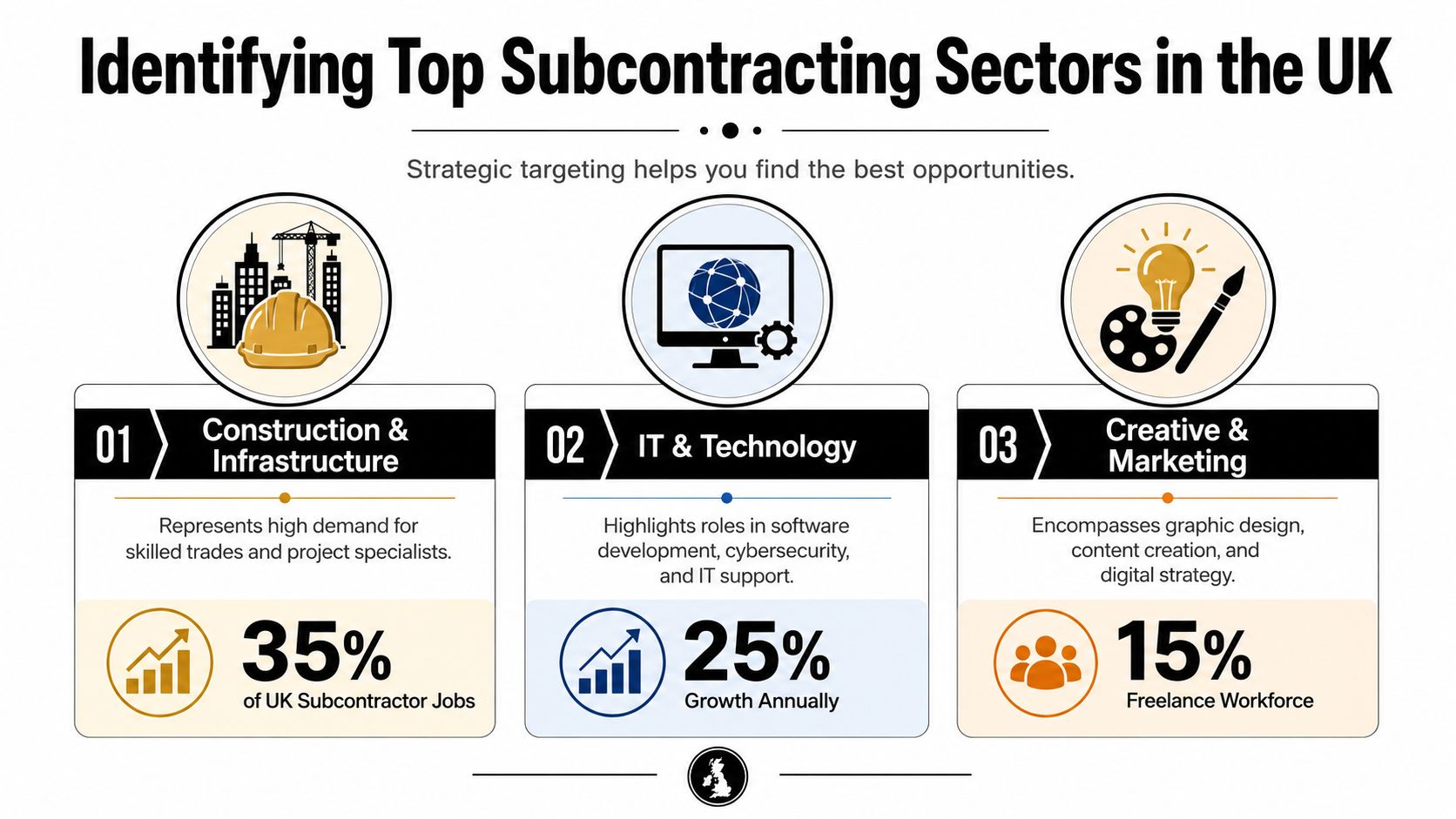
Construction shows this clearly. The industry employs about 2.7 million people and contributes roughly 6% of total UK employment (Samsearch's overview of subcontractors in the UK market), and much of that work moves through layered supply chains rather than direct hiring. The implication is that many subcontractor opportunities appear first around main contractors, frameworks, and project awards, not on mainstream vacancy sites.
Start with buyer behaviour
Track how your sector buys external support.
In construction and infrastructure, work is often packaged through a principal contractor who brings in specialist trades and regional subcontractors as delivery windows firm up. In IT, buyers often use subcontractors when a project needs niche expertise, short-term delivery support, or extra hands during a migration or rollout. In creative and marketing, subcontracting tends to follow agency overflow, white-label work, or campaign-specific production needs.
The search becomes much sharper once you stop asking, “Where are the jobs posted?” and start asking, “Which organisations are likely to need subcontractors next?”
That also helps with compliance. A buyer that regularly uses subcontractors will usually have a clearer onboarding process, defined payment route, and a more settled view on status and IR35 than a business hiring this way for the first time. We see plenty of contractors chase a strong headline rate, then discover late payment terms, unclear status decisions, or a payroll setup that makes the contract less attractive than it first looked.
Build your shortlist around organisations such as:
- Main contractors with repeat project flow: Repeat wins often lead to repeat subcontract packages.
- Framework holders and delivery partners: New awards often create an immediate need for delivery capacity.
- Agencies and consultancies with delivery teams: They may sell the full programme, then subcontract specialist parts.
- Regional firms with active pipelines: Local presence still counts, especially for site-based and hybrid work.
Build a target list before you apply
A shortlist of realistic buyers will produce better conversations than a long list of random names. For each company, note:
| What to track | Why it matters |
|---|---|
| Service line | Shows whether your specialism fits their delivery model |
| Region | Helps you avoid chasing work outside your workable area |
| Project type | Tells you whether they use your skills repeatedly or only occasionally |
| Decision maker | Gives you a direct route for follow-up |
| Recent contract activity | Signals whether more subcontract packages are likely |
Keep one more column for payment and engagement notes. If a firm only hires through PAYE or pushes everyone into an umbrella arrangement, you need to know that before spending time on a proposal. If they engage outside IR35 through a limited company, the contract wording and working practices still need checking early.
That is one reason target lists outperform broad searching. You are not only identifying who buys subcontracted work. You are also filtering for buyers who can onboard properly and pay compliantly. If you need ideas for where to start, our guide to companies that subcontract work is a useful reference point.
Mastering Digital Job Boards and Procurement Portals
A subcontractor can lose a day applying for roles that were never a fit in the first place. The brief looks right, the rate looks workable, then the client wants PAYE only, the contract points to inside IR35, or the onboarding route is unclear. Good searching cuts out that waste early.
Online platforms still matter, but they do different jobs. Generic job boards are useful for speed and market signals. Procurement portals are better for spotting where funded work is heading before the wider market catches up. We advise treating both as filters, not just places to send applications.

Use job boards to read the market properly
Sites such as Jobserve, CWJobs, and specialist recruiter boards can show where demand is building. They also show how buyers are classifying work. That matters because the route to payment affects whether a role is commercially attractive at all.
Review listings with four questions in mind:
- What skills appear repeatedly? Repeated tools, tickets, systems, or sector terms usually point to real demand.
- How is the engagement described? Look for references to subcontracting, fixed-term delivery, limited company engagement, PAYE, or inside IR35.
- Who is hiring? An agency brief needs a different follow-up from a direct client or a principal contractor.
- How clear is the assignment? Vague scope and rushed start dates can signal poor project control, which often creates payment and status problems later.
That last point gets missed too often. A role may look attractive until you ask how timesheets are approved, who signs off milestones, or whether the client has made an IR35 status decision. If those answers are fuzzy at advert stage, expect friction after acceptance.
For a broader list of channels worth monitoring, our guide to subcontractor job boards and search routes is a practical starting point.
Procurement portals show demand earlier
Procurement portals are not only for firms bidding as prime suppliers. They are one of the best ways to see which sectors, authorities, and delivery partners will need specialist support in the next phase of a project.
In the UK, public sector opportunities above the relevant threshold are published through official procurement routes. For subcontractors, the useful signal often comes before the award. A framework notice can show which services are being packaged together. An award notice can show which contractor now needs delivery capacity on the ground.
That changes how you search. Instead of waiting for a recruiter to advertise a subcontract role, you can identify likely winners and approach them with context.
Search procurement portals with a commercial filter
A simple weekly routine works well:
Search by CPV code or service category
This removes a lot of irrelevant notices and helps you track the right work packages consistently.Filter by geography and contract size
A strong opportunity in the wrong region, or at a scale that does not match your setup, is still a poor use of time.Read the lot structure carefully
Lots often show where specialist subcontractors fit, especially on larger service, build, and transformation contracts.Track incumbent suppliers and award notices
That tells you who is likely to need extra delivery support soon.Check engagement and payment practicalities early
Before you spend time on outreach, find out whether the supplier uses direct contracts, PAYE, umbrella arrangements, or mixed models. If the work sits inside IR35, rate expectations and take-home pay need testing before the conversation gets too far.
Many subcontractors protect margin. Winning work at a day rate that only makes sense outside IR35 is not a good result if the engagement later turns into payroll employment or an umbrella-only route with deductions you had not priced in. We encourage contractors to ask those questions early, because compliant payment is part of the job opportunity, not admin to deal with later.
Use the advert to prepare your response
Strong listings contain language you can reuse in your proposal or CV. Save the key phrases, required systems, site constraints, and delivery outcomes. Then tailor your application around that wording.
If your CV needs tightening for this kind of work, this self-employed resume guide is a useful reference for presenting project-based experience clearly.
If procurement searching is unfamiliar, this video explains the process:
Crafting Proposals and CVs That Secure Interviews
A generic CV rarely wins subcontract work on its own. It tells people where you've been. It doesn't always tell them why you're the right person for this piece of work, under this delivery model, at this point in the project.
That's why strong subcontractors send a proposal-led application. Even when the client asks for a CV, your real job is to reduce uncertainty. You need to show that you understand the brief, can slot into the project quickly, and won't create delivery friction.
Know the difference between a CV and a proposal
Your CV is background. Your proposal is the sales document.
A useful proposal usually includes:
- A short opening summary: State the role or work package you're responding to and your fit.
- Your reading of the brief: Show that you understand the client's problem, not just the task list.
- How you'd approach delivery: Explain how you'd handle the assignment in practical terms.
- Relevant evidence: Highlight comparable projects, sectors, systems, or environments.
- Commercial clarity: Confirm availability, location, and any operational constraints.
Mirror the buyer's language
If the specification talks about mobilisation, stakeholder management, snagging, migration support, technical assurance, or quality control, use the same language where it fits naturally. Don't rewrite the brief back to them, but do show alignment.
This is one reason broad, one-size-fits-all CVs underperform. Buyers often scan for familiarity first. They want to see their problem reflected in your wording.
A good proposal doesn't say, “I'm experienced.” It shows the client that you've handled this kind of work before and understand the risks around it.
Keep proof relevant and easy to verify
Don't overload the page with every project you've touched. Choose examples that match the current requirement.
Use practical details such as:
- Project environment: Public sector, commercial build, agency delivery, regulated setting
- Type of responsibility: Design, installation, testing, reporting, supervision, support
- Working pattern: On-site, remote, hybrid, team-based, standalone
- Outcome delivered: Keep this factual and qualitative unless you have numbers you can credibly evidence
If your work history is mixed, it can help to review a strong self-employed resume guide so your CV reflects project-based work clearly and professionally. That's particularly useful if you've built a career through multiple short assignments rather than conventional permanent roles.
The Power of Networking and Building a Referral Engine
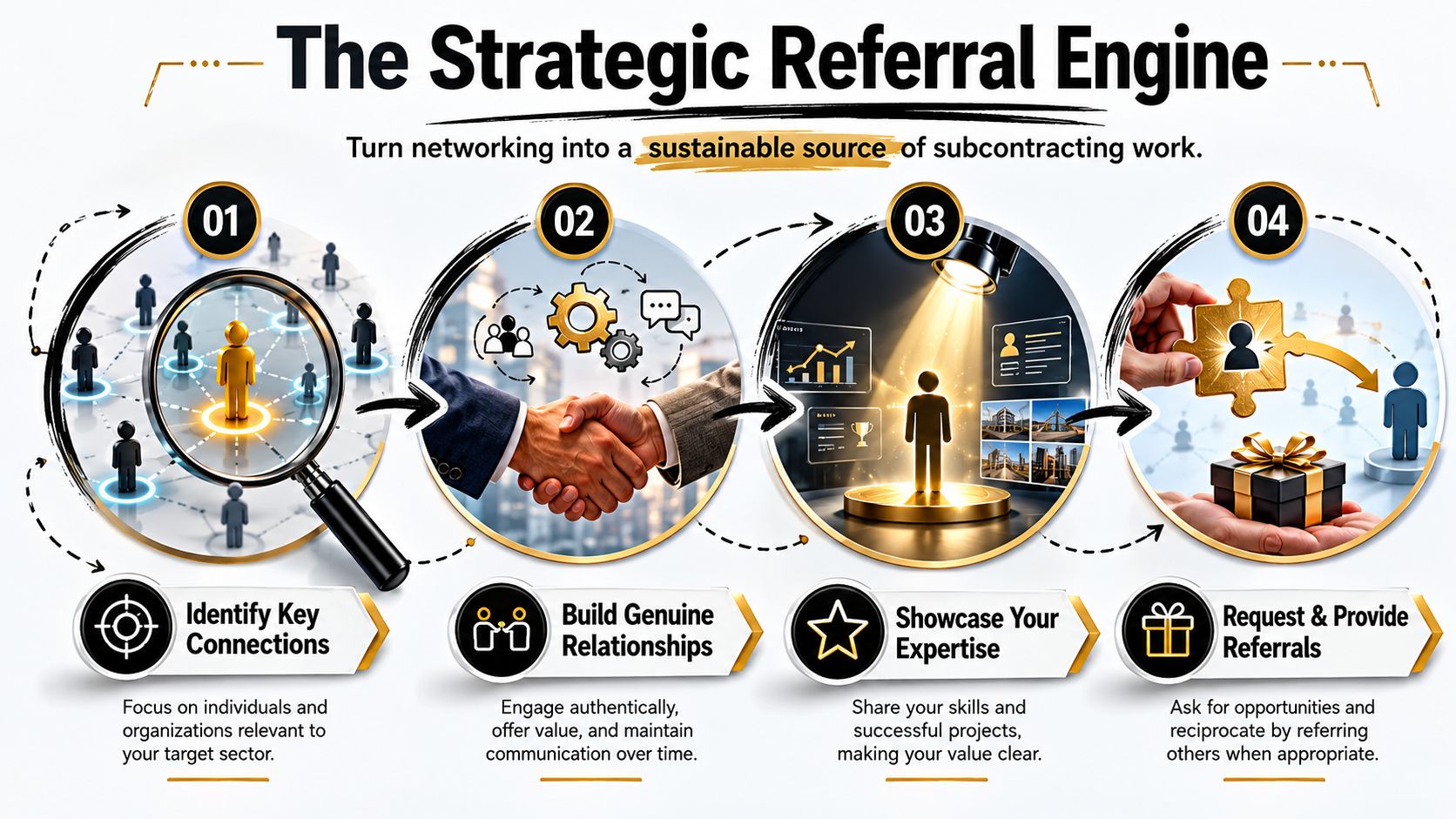
Subcontractors often hear “network more”, but that advice is too loose to be useful. Effective networking is not random coffee meetings or adding strangers online. It's a deliberate system for staying visible to people who already buy, influence, or hear about work.
Formal bidding routes don't solve everything. UK government construction research has shown that SMEs still face barriers such as tendering complexity and cash-flow pressure, and that knowing where demand is growing often depends on strong business networks rather than formal channels alone, as discussed in this guide on how subcontractors get found.
Who should hear from you regularly
The best referral networks are usually smaller than people think. Start with:
- Past clients who liked working with you
- Project managers and site leads who move between firms
- Recruiters who understand your niche
- Peers with adjacent skills, not identical ones
- Suppliers and consultants who hear about upcoming work early
You're not trying to ask all of them for work every month. You're trying to stay credible, current, and easy to recommend.
What a referral engine looks like in practice
A working referral engine has rhythm. Keep in touch, share relevant updates, and make it simple for contacts to place you.
Try this pattern:
| Activity | What it achieves |
|---|---|
| Reconnect after each project | Keeps the relationship warm while your work is fresh in their mind |
| Share a concise capability update | Reminds contacts what you do now, not what you did years ago |
| Comment intelligently on industry changes | Shows judgement, not just availability |
| Ask targeted questions about pipelines | Surfaces demand signals without sounding desperate |
| Refer other people when appropriate | Builds trust and makes reciprocity more likely |
A helpful primer on the basics is this explanation of what professional networking involves, especially if networking still feels vague or overly corporate.
Field insight: The easiest referral to win is from someone who already knows your work quality and knows exactly where to place you.
Ask in a way that gets useful answers
“Let me know if you hear of anything” is too passive. Ask narrower questions.
For example:
- Scope-based ask: Are you seeing more retrofit work, migration support, fit-out packages, or overflow design?
- Buyer-based ask: Is a particular contractor winning more work in your region?
- Timing-based ask: Are teams building for a start next month, or is it still pre-award?
That level of specificity helps contacts think commercially. It also tells them you understand how projects move.
Negotiating Terms and Managing IR35 Compliance
Winning the work is only half the job. The terms decide whether the contract is workable.
A subcontractor should review the full commercial picture before saying yes. Rate matters, but so do payment timing, retention clauses, notice period, insurance expectations, scope creep risk, and who carries responsibility if the brief changes.
Negotiate the whole contract, not just the number
A lower rate with reliable payment terms can be a better deal than a headline rate tied to long payment cycles and vague deliverables.
Check these points before you commit:
- Scope of work: Is the brief specific enough to avoid constant unpaid extras?
- Payment terms: When will invoices be approved and paid?
- Notice period: Can either side end the contract immediately?
- Liability and rework: Are you accepting risk that should sit with the main contractor?
- Status and payroll route: Will you be paid as a genuine business-to-business supplier, or through PAYE?
Keep IR35 in view from the start
If a role falls inside IR35, the engagement is taxed more like employment for tax purposes. That affects take-home pay and the way you're paid. It's much easier to deal with this before you accept the assignment than after onboarding has started.
If a contract is expected to operate outside the off-payroll rules, review the working practices as well as the written terms. A clause saying one thing while the day-to-day reality says another can create obvious problems. Our guide to outside IR35 contracts is a useful reference point when you're checking how the arrangement should work.
Set up compliant payment before day one
For inside IR35 assignments, many contractors use an umbrella company so PAYE, tax deductions, and payslips are handled through an employed payroll model. The key is to choose carefully and understand the margin, employment arrangement, and compliance position before signing anything.
Umbrella Company provides a way to compare umbrella providers for contractors who need that route, particularly when an assignment requires a compliant PAYE setup. That can save time when you want to line up payroll quickly without treating compliance as an afterthought.
Good subcontractor work should still look good once the paperwork, tax position, and payment method are clear.
If you're lining up your next contract and need a compliant payment setup for an inside IR35 role, Umbrella Company lets you compare umbrella providers based on your circumstances and move forward with clearer payroll options.


