


Finishing one contract and realising the next one isn't lined up is a familiar moment for most subcontractors. The work might be solid, your references might be good, and yet there's still that gap between “I can do the job” and “I can keep winning the right jobs”.
That gap is where many individuals get stuck.
The usual advice on how to find subcontracting work stops too early. It tells you where to look, maybe how to network, and then leaves you to sort out rates, contracts, IR35 status, payroll, and getting paid without trouble. In practice, those pieces belong together. A decent contract with poor compliance can still damage your income. A strong lead with weak paperwork can still turn into a slow payer.
If you're moving into contracting or tightening up how you operate, Umbrella Company has also published guidance on how to become a contractor that helps with the wider setup side. If you also work across borders or want a broader independent-contractor insurance perspective, this comprehensive guide for 1099 contractors is useful for comparing how other markets think about risk, cover, and self-employed responsibility.
Your Starting Point as a UK Subcontractor
You finish a job on Friday, send the last invoice, and spend Monday chasing the next one. That is how many newer subcontractors start. It keeps you busy, but it also pushes you into poor choices. You take work outside your lane, accept weak payment terms, or agree to an engagement setup you have not properly checked.
A better starting point is to treat work-finding and compliance as one job. If a contract pays well but leaves you exposed on tax status, payroll deductions, or late payment, it is not a good contract. It is a cash-flow problem waiting to happen.
In the UK, subcontracting usually follows larger project pipelines, especially in construction, fit-out, engineering, and infrastructure. That matters because steady work often comes from getting in front of the right firms early, not from reacting to single jobs after everyone else has seen them. The most valuable opportunity often sits with the main contractors, specialist firms, and labour supply chains already attached to upcoming work.
That changes your starting position. Before you chase leads, get clear on four points:
- Your lane: trade, project type, travel radius, and the kind of client you want
- Your trading setup: limited company, sole trader, or umbrella route, depending on how the work will be engaged and paid
- Your commercial limits: minimum rate, payment terms you can live with, and paperwork you need before starting
- Your compliance position: whether the role is likely to raise IR35 questions and who is handling payroll, tax, and reporting
Newer freelancers often skip the second and fourth points because they feel like admin. They are not. They affect your take-home pay, your risk, and whether a seemingly good contract is worth accepting at all.
If you are still sorting out the basics, this guide on how to become a contractor in the UK is a useful reference for the setup side. If you also want a wider view of how self-employed risk, cover, and contractor responsibilities are handled in another market, this comprehensive guide for 1099 contractors gives a helpful comparison.
What good subcontracting looks like in practice
A solid subcontracting setup is simple, but it is deliberate. You need a clear offer, a short list of target firms, a rate that works after tax and costs, and a payment route that will not cause trouble later.
I have seen good tradespeople lose money in ordinary ways. They start quickly without checking who approves timesheets. They agree to long payment cycles without pricing for them. They accept an arrangement that sounds like self-employment, then find the payroll treatment says otherwise. None of that shows up in the headline day rate.
Good subcontractors build from the inside out:
- They know where they fit best. General availability is less useful than a clear specialism.
- They qualify the engagement early. Who is the end client, who signs the contract, and how will you be paid?
- They check the numbers properly. Rate, tax position, travel, materials, retention, and payment timing all affect margin.
- They keep documents ready. Insurance, right-to-work evidence, certifications, UTR or company details, and bank information.
- They avoid avoidable risk. If the contract structure looks wrong, they sort it before the first shift, not after the first deduction.
That is the starting point. Get your offer, structure, and compliance position straight first, and you give yourself a better chance of winning work that pays properly and does not unravel once onboarding begins.
Where to Find High-Quality Subcontracting Roles
A subcontractor can be fully booked on paper and still take the wrong work. The rate looks fine, the start date suits, then onboarding reveals a payroll setup you did not expect, a client you cannot verify, or payment terms that drag cash flow out for weeks. Good lead generation and compliance screening need to happen together, at the first conversation, not after you have said yes.
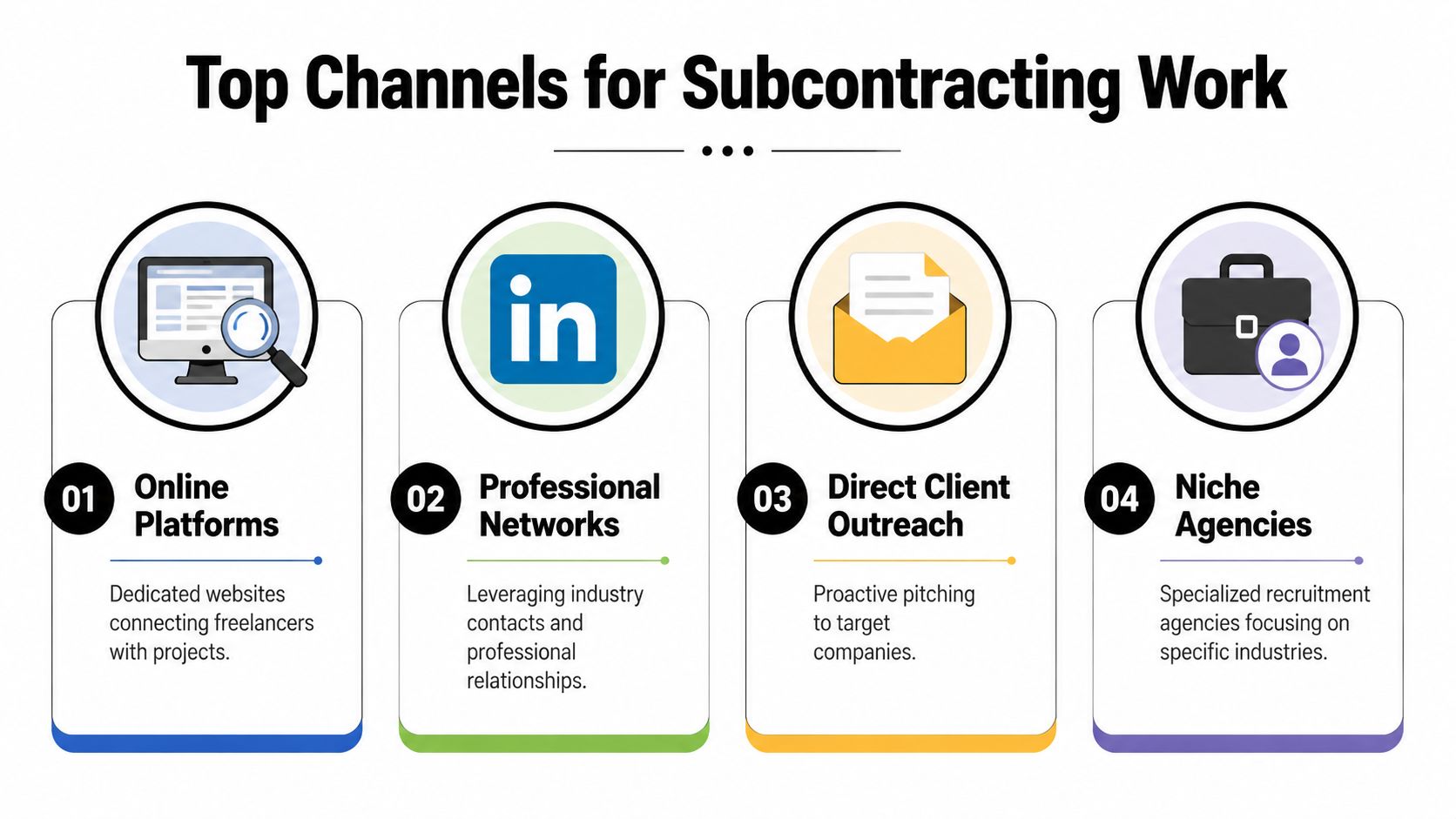
The strongest pipeline usually comes from four places: public procurement portals, direct approaches to main contractors, specialist recruiters, and existing trade relationships. Each one does a different job. Use public notices to see who is winning work, direct outreach to get in front of buyers, recruiters to fill short gaps or open new sectors, and your network to hear about work before it is widely circulated.
Public procurement platforms
For UK subcontractors, public procurement portals are useful because they show who is active, not just what is open today. Contracts Finder and Find a Tender can help you spot public sector projects, framework awards, and repeat winners. That matters because the package you want may not be live yet, but the notice often shows which principal contractor, consortium, or framework holder is likely to buy your trade later.
Use those portals in two passes.
First, search for live notices that match your sector, region, and project size. Second, build a list of the firms that keep appearing in awards and framework results. Those are the names worth contacting with a targeted capability note. Keep your own spreadsheet with contractor name, buyer contact, region, framework name, and expected mobilisation date. It sounds basic. It works.
Direct outreach to main contractors
Direct outreach pays when it is specific. A commercial manager does not need a life story. They need to know what package you cover, where you work, what capacity you have, and whether you are straightforward to onboard.
Good target firms include:
- Regional main contractors with repeat work in your patch
- Framework holders likely to release packages across the year
- Specialist package buyers in your trade
- Estimators, buyers, quantity surveyors, and commercial managers who influence tender lists
Send a short message with proof, not broad claims. Include recent comparable jobs, labour availability, key accreditations, and whether you can quote labour-only, supply-and-fix, or a defined package. Add one sentence on engagement setup if it matters, such as limited company only or umbrella-ready for PAYE contract roles. That saves time for both sides and filters out work that will not fit your tax position.
Agencies and niche recruiters
Recruiters are useful if you use them with discipline. Some know the market properly and can tell you exactly who the end client is, what the site needs, how long the contract is, what the payment cycle looks like, and whether the role is likely to fall inside IR35. Others cannot answer basic questions and still want a right-to-represent.
Treat that difference seriously.
Before you let an agency put you forward, ask for four points in plain English: who the client is, who pays you, whether the contract is PAYE, umbrella, or limited company, and what evidence they have on IR35 status. If they are vague on any of that, the lead is weaker than it looks. For broader search coverage, this page on jobs for subcontractors is a useful additional source.
If client-winning is a weaker area for you, some of the ideas in this piece on getting more clients for services can sharpen your outreach process.
Peer networks and trade relationships
A lot of solid subcontracting work never hits a jobs board. It gets passed between site managers, suppliers, former clients, package contractors, and other subcontractors who need cover fast and do not want risk.
The quality of those leads is often better because trust already exists. The downside is that informal referrals can also be vague. Before committing, check the same basics you would check anywhere else: who the actual client is, who signs off your work, how you will be paid, and what paperwork is needed to start.
A weekly routine helps, but it needs to be concrete:
| Channel | What to do weekly | What you're looking for |
|---|---|---|
| Former clients | Send a short update such as: "Hi [Name], I have capacity for [trade] work from [date]. I've just wrapped [project type] in [location]. Happy to send over details if you're pricing anything similar." | Repeat work, referrals, early pricing enquiries |
| Suppliers and merchants | Ask: "Which sites are opening locally in the next 4 to 8 weeks, and which contractors are buying heavily?" | Early signals on mobilisation and buyer names |
| Other subcontractors | Offer a clear swap: "We can take overflow on [specific scope] in [area]. Let me know if you need cover, and I'll do the same where I'm full." | Overflow work, specialist partnerships |
| Site contacts | Keep in touch with a reason. For example: "Are you still looking for an extra team for second fix in June, or has that package been placed?" | Live package gaps, short-notice starts |
This kind of contact works because it is easy to act on. It gives the other person dates, scope, and context they can forward internally.
High-quality roles usually come from being known for a specific trade, in a specific area, with paperwork and engagement options already thought through. That last part matters more than many newer subcontractors realise. A lead is only high-quality if the work, the contract, and the payment route all stand up once you look closely.
Crafting a Pitch and CV That Wins Work
Most subcontractor CVs read like employment histories. Clients don't buy histories. They buy outcomes, reliability, and fit.
Start by changing the frame. Your CV and pitch should show what you deliver, where you deliver it, and why you're low-risk to engage.

What clients actually look for
They usually want quick answers to practical questions:
- Can you do this exact scope
- Have you done similar work recently
- Can you start when needed
- Will you be easy to manage
- Are your paperwork and references in order
That means your CV should lean towards project evidence, not broad claims.
A stronger subcontractor CV includes:
- Trade and specialism: Be specific about your core work
- Project types: Commercial fit-out, housing, civils, data centres, public works, or similar
- Scope examples: What package or deliverable you handled
- Tools, systems, or site standards: Only where relevant
- Location and mobility: Where you'll work
- Commercial setup: Limited company, umbrella-ready for inside IR35 roles, or other valid arrangement
- References: Available and recent
If you want a useful outside perspective on presenting non-permanent work clearly, this guide to listing contract work on your resume is worth a read.
Weak pitch versus strong pitch
A weak pitch sounds like this:
“Hi, I'm currently available for subcontract work. I've got several years of experience and would be keen to discuss any roles you have.”
It isn't wrong. It just gives the buyer nothing useful.
A stronger version sounds like this:
“I'm available for drylining packages across the West Midlands and can start on short notice. Recent work includes commercial fit-out and education projects, with full site documentation and references available. If you're pricing upcoming packages, I can review drawings quickly and return a clear scope-based quote.”
The second version works because it answers practical buying questions. It gives trade, geography, recent relevance, readiness, and a next step.
Write for scope, not for ego
A common mistake is trying to sound impressive instead of useful. Buyers care more about clean scope alignment than grand language.
Keep your written material tight:
- Lead with relevance: Match your first lines to the client's project type
- Use plain trade language: Don't stuff your message with buzzwords
- Name recent comparable work: Similar jobs reduce perceived risk
- Show readiness: Mention availability, documents, and references
- End with a clear action: Ask for drawings, a call, or an invitation to price
If you want a quick refresher on tailoring your materials, this short video is a sensible primer before you rework your pitch.
Setting Your Rates and Negotiating Contracts
Pricing isn't just about picking a day rate that sounds acceptable. It's about making sure the work is commercially worth doing after tax treatment, downtime, admin, travel, materials risk, and payment timing are all considered.
A lot of subcontractors underprice because they focus on the headline number and ignore the contract around it.
Build your rate from the job backwards
Start with scope. If the scope is vague, the rate discussion will be vague too.
Expert guidance on subcontractor pricing is clear on this point. Better bidding comes from turning the process into a repeatable data loop: define scope in the same unit-price format subcontractors use, review plans and specifications with them, then track quote history, production rates, and variance across multiple jobs. Consistency only really appears after several projects, and poor scope definition is a common reason quotes become hard to compare (reference).
That's a useful lesson even if you're a solo freelancer. Keep records. Compare what you priced against what the work took. Tighten your assumptions over time.
A practical rate check should cover:
| Factor | What to ask |
|---|---|
| Scope clarity | Is this labour only, labour plus materials, or a fixed deliverable? |
| Programme pressure | Are you absorbing overtime, weekend work, or acceleration risk? |
| Travel and logistics | Will distance, parking, accommodation, or access reduce margin? |
| Payment mechanics | Are you being paid weekly, monthly, or on approval milestones? |
| Compliance route | Does the engagement structure change your take-home expectations? |
Negotiate more than the number
A strong subcontractor doesn't negotiate rate in isolation. They negotiate terms.
Important points to pin down include:
- Payment terms: When exactly are you paid, and what triggers payment
- Scope boundaries: What is included and what is not
- Variations: How changes are approved and priced
- Retention or holdbacks: If they apply, when they're released
- Notice and termination: How quickly the client can stop the engagement
- Liability wording: Whether you're taking on risk that doesn't match the fee
Commercial check: A slightly lower rate with clean terms can be better business than a higher rate tied to slow approval and disputed extras.
Use a simple statement of work mindset
Even where there isn't a formal Statement of Work document, think in that way. Define the deliverable, assumptions, exclusions, timeline, and approval process before you start.
That protects both sides.
It also stops the classic subcontractor problem where a “small addition” keeps appearing on site but never appears in writing. If it affects labour, time, materials, sequencing, or responsibility, it needs confirming.
If you want to test different pay assumptions before you agree terms, a contractor rate calculator can help you sense-check how a role may stack up commercially.
Navigating IR35 and Ensuring Tax Compliance
A subcontractor can do everything right on the work-winning side and still end up with trouble if the tax and payroll side is treated as an afterthought.
A common deficiency in guides is that they explain how to find subcontracting work, then go silent on what happens once the contract lands. That gap matters because the way you're engaged affects your pay, your deductions, your paperwork, and your risk.
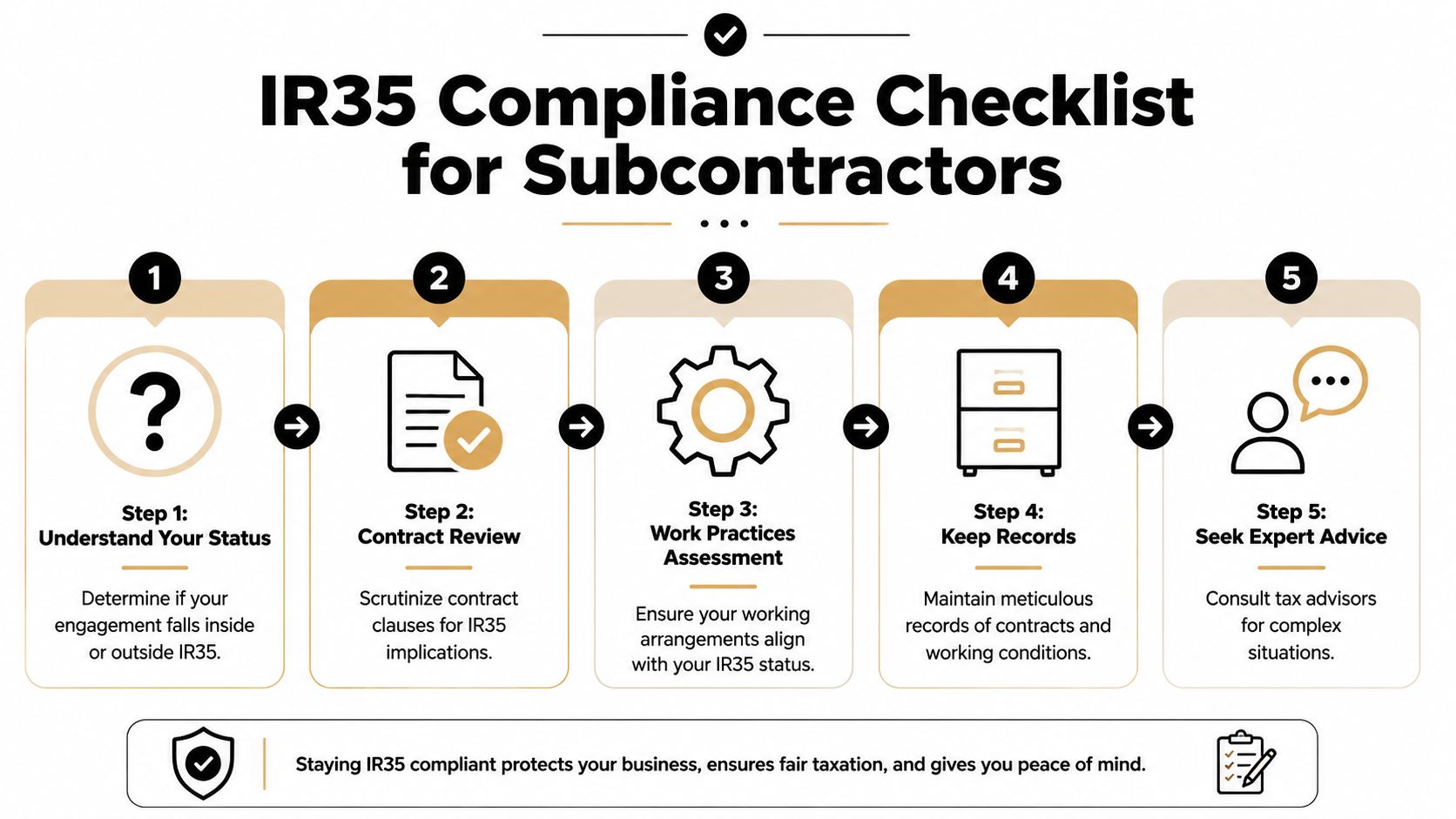
Why IR35 needs checking early
IR35 is about whether a contract looks, in substance, more like employment than genuine self-employed business-to-business work. The labels in the contract matter less than the actual working arrangement.
For subcontractors, the practical issue is simple:
- Inside IR35 usually means the income is treated more like employment income for tax purposes
- Outside IR35 means the arrangement is accepted as genuine self-employment for tax treatment, assuming the contract and working practices support that
You don't want to discover the engagement position after you've already agreed a rate. By then, the number may no longer make sense.
Review both the paperwork and the reality
A contract can look tidy on paper and still be risky in practice. Check both.
Focus on points such as:
- Control: Who decides how the work is done
- Substitution: Whether someone else could realistically perform the work
- Mutuality: Whether there is an ongoing expectation of work and acceptance
- Integration: Whether you're treated like part of the client's internal team
- Deliverables: Whether you're there to complete a defined piece of work or just fill a role
If the day-to-day reality clashes with the contract wording, the reality is what creates the problem.
This is also why “I'll sort the tax side later” is a bad habit. Compliance starts at contract review, not after the first payslip.
When an umbrella company makes sense
For inside IR35 roles, an umbrella company is often the straightforward route. The umbrella employs the contractor, processes pay through PAYE, handles tax and National Insurance deductions, and issues payslips.
That can simplify administration, but only if the provider is compliant and transparent.
Check for the basics:
- Clear payslip process: You should understand every deduction shown
- No vague take-home promises: If it sounds too aggressive, walk away
- Accreditation checks: Look for recognised compliance standards such as FCSA or Professional Passport
- Written answers: Ask how holiday pay, pension, margin, and expenses are handled
Umbrella Company provides a comparison portal for contractors who want to compare providers by role, pay rate, and inside-IR35 support, which can help when you need to narrow down compliant options without relying on sales claims alone.
Red flags that deserve a hard no
Some warning signs come up again and again:
- Upfront joining fees or “membership” payments tied to access to work
- Unclear tax explanations or reluctance to explain deductions
- Pressure to move quickly before you've seen proper paperwork
- Confusing contract chains where nobody owns the payment process
- Promises that focus on unusually high take-home pay rather than compliant treatment
The practical standard is simple. If the engager, recruiter, or payroll provider can't explain the setup in plain English, you shouldn't proceed until they can.
Keep records from day one
Even if the engagement seems straightforward, keep copies of the contract, status determination where relevant, key emails, timesheets, and any notes that show how the work was performed.
That record helps if there's a dispute over payment, deductions, or status later.
It also keeps you disciplined. Contractors who document the engagement properly tend to spot mismatches earlier, before they become expensive.
From Onboarding to Invoicing Your Final Steps
Once the contract is agreed, the last part is operational discipline. Operational discipline is what distinguishes good subcontractors from chaotic ones.
You'll usually move through a short chain of admin. Client onboarding, right-to-work or identity checks, contract issue, timesheet or milestone process, and then payment setup. If an umbrella is involved, you'll also complete employment paperwork before the first payroll run.
A clean finish looks like this:
- Confirm onboarding documents early: Don't let missing IDs, bank details, or signed terms delay your first payment.
- Follow the agreed submission process: If timesheets or milestones need approval, know who signs them and by when.
- Check every payslip or remittance: Make sure the numbers match the contract and approved time.
- Keep your own records: Save contracts, approvals, invoices, and payment confirmations in one place.
If you manage your own billing on relevant engagements, using reliable invoicing software for contractors helps keep dates, approvals, and follow-up organised.
The bigger point is this. Finding subcontracting work isn't just about getting a yes from a client. It's about building a repeatable way to find suitable roles, present yourself well, agree workable terms, and get paid through a structure that doesn't create unnecessary tax risk.
If you've got work lined up and need to compare compliant payroll options for an inside-IR35 contract, Umbrella Company gives you a straightforward way to review umbrella providers against your role and pay setup before you commit.


