


You've got gaps in the diary, a few old contacts who've gone quiet, and job boards full of vague listings that don't tell you who's buying your trade. That's the point where many subcontractors drift into reactive mode, sending the same details to everyone and hoping something lands.
That rarely works for long.
How to find subcontracting work is less about hunting random leads and more about building a repeatable system. In the UK, competition is heavy. There are approximately 2.1 million self-employed workers as of 2024, which is why niche specialisation and stronger relationships usually beat broad cold outreach (Indeed career advice on finding subcontracting work).
The contractors who stay busy tend to do a few simple things well. They define their scope clearly, target firms that regularly buy that scope, present themselves properly, and follow up like professionals. Then they protect the margin by checking the contract, the status decision, and the payment route before they start.
Laying the Groundwork for Success
Most subcontractors start too wide.
They describe themselves as “general building”, “IT support”, or “available for all works”. That sounds flexible, but buyers don't procure that way. They buy specific packages, in specific places, on specific timelines. If your offer is vague, you're harder to place and easier to ignore.

Define the package you actually sell
Start by writing down your offer as a work package, not a job title.
A better definition looks like this:
- Trade and scope: Drylining and suspended ceilings, 1st and 2nd fix electrical, structured cabling, reactive maintenance, snagging support
- Project type: Schools, fit-outs, housing, retail, healthcare, commercial refurb
- Geography: Counties, towns, or a practical travel radius
- Buying format: Day rate labour only, labour and small tools, fixed-price package, call-out support
- Capacity: Immediate start, next-month availability, evenings, weekends, shutdowns
That level of clarity helps buyers decide quickly whether you fit their live work.
If you operate in construction, your admin setup matters as much as your availability. CIS deductions, verification, and payment handling often affect how smoothly a subcontract starts, so it's worth understanding the Construction Industry Scheme rules before you begin outreach.
Replace the generic CV
A CV has its place, but it's not enough on its own.
A subcontractor needs a capability statement. Keep it to one page. Include your scope, sectors, recent relevant work, accreditations, insurances, service area, and contact details. Add a short list of the jobs you want more of.
Practical rule: If a buyer can't tell what you do, where you work, and when you're free within 30 seconds, your profile needs tightening.
Your online presence matters too. UK government-backed data says firms with a digital presence had a 40% higher success rate in securing contracts, and firms active in local trade associations or industry events secured subcontracting opportunities 3.5 times more frequently than those relying only on online platforms. Those findings were reported in the 2023 Small Business Survey summary published in March 2024.
That doesn't mean you need a flashy site. A simple website or a clean LinkedIn profile is enough if it shows the right information. In technical sectors, specialist staffing partners can also help you understand how buyers describe requirements. For example, pages that explain how firms find contract IT professionals can give you a useful view of what hiring managers want to see before they engage.
Build a re-contact list first
Before chasing strangers, go back to people who already know your work.
Create a short list of:
- Previous clients who paid on time and gave clear instructions
- Site managers or project managers who moved companies
- Suppliers and merchants who hear about upcoming jobs early
- Other subcontractors in adjacent trades who can refer overflow work
Past relationships usually produce better work than cold messages because there's already trust. In a crowded market, that trust is a commercial advantage.
Where to Find High-Quality Subcontracting Opportunities
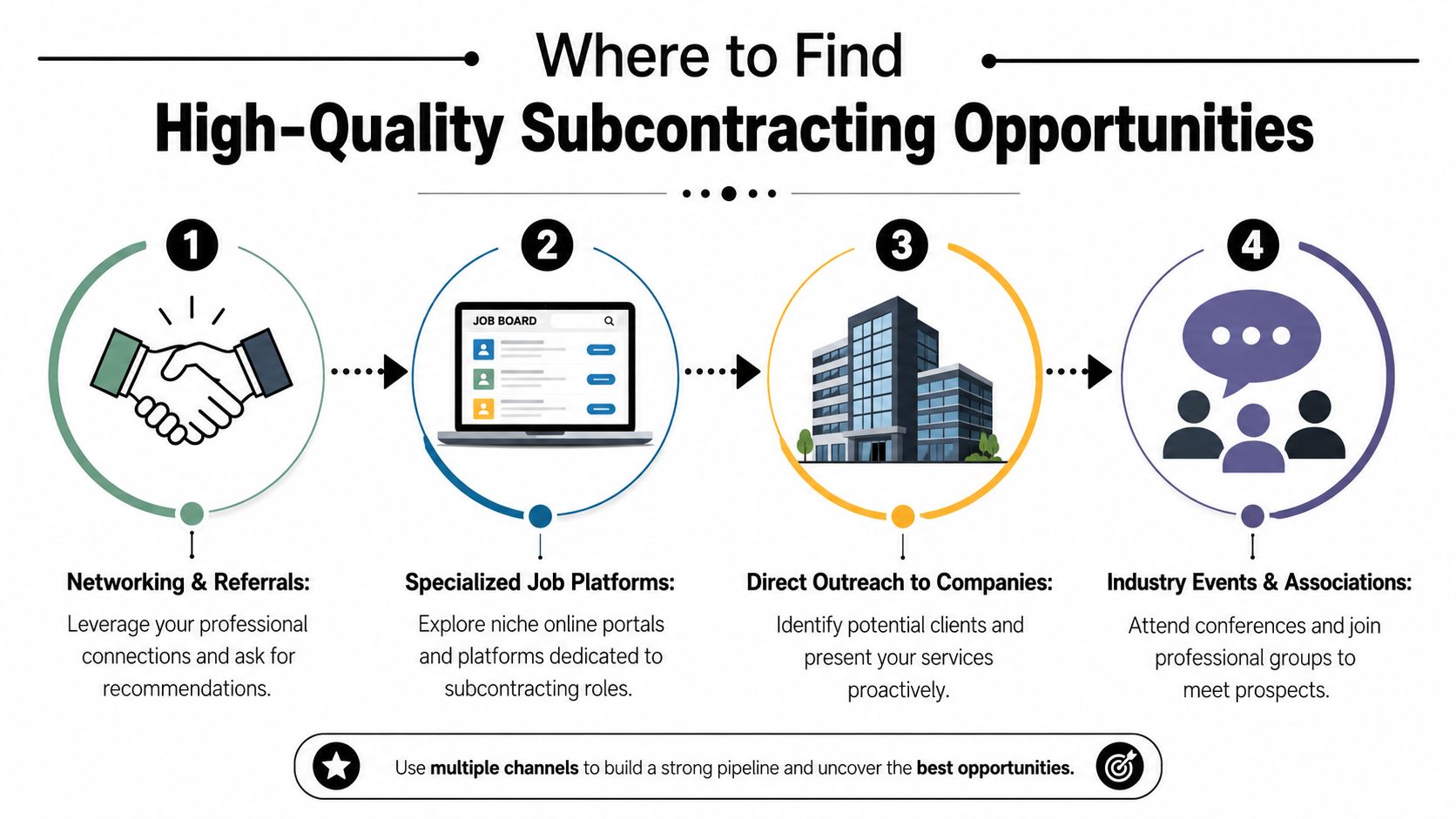
Good subcontracting work usually comes from a mix of channels, not one magic source. If you rely only on online listings, you'll see a lot of competition and not much context. If you rely only on networking, your pipeline can go quiet when a few contacts dry up.
The better approach is to build four parallel routes.
Direct contact still wins more often than people think
The strongest route is often the least glamorous. A 2022 Federation of Master Builders report found that 73% of UK construction subcontractors secured their first major contract through direct contact with general contractors, rather than online bidding platforms. The same report found 58% attended at least one local trade event or networking session in the prior year, and 67% of those attendees reported securing new work within six months. It also found that subcontractors in professional organisations gained access to 2.3 times more job opportunities annually than non-members (Federation of Master Builders report summary).
That tells you something important. Buyers often choose from people they know, have met, or have been introduced to.
When you contact a contractor directly, don't ask, “Do you have any work?” Ask something tighter:
- Reference the package: “We cover fire stopping on commercial refurb projects.”
- Reference the place: “We're active across Leeds and surrounding areas.”
- Reference the timing: “We've got labour available from the second week of next month.”
- Reference the fit: “Happy to price small packages or support existing site teams.”
Use public procurement tools to identify primes
A lot of subcontractors ignore public-sector systems because they assume they're only for main contractors.
That's a mistake.
The useful angle isn't always bidding as the prime. It's using Contracts Finder and Find a Tender to identify who won or is bidding for work in your region and sector. Once you know the likely main contractor, framework holder, or delivery partner, you can approach them with a relevant package.
Public procurement systems are often better used as intelligence tools than as direct lead lists for small subcontractors.
Look for patterns in awarded contracts, repeat buyers, and framework names. If one contractor keeps appearing on school refurbishments in your area, and that's your trade, they belong on your target list.
You can also keep an eye on active demand through specialist listings and sector pages such as these jobs for subcontractors, but treat listings as one stream, not the whole strategy.
A useful walkthrough sits below if you want a visual overview of the process.
Build a channel mix
Different channels do different jobs. Here's the trade-off.
| Channel | Best use | Common mistake |
|---|---|---|
| Direct outreach | Reaching buyers with active package needs | Sending generic emails with no scope |
| Recruitment agencies | Filling urgent gaps, especially in specialist labour markets | Registering with too many and building no relationship |
| Trade associations and events | Building trust and local visibility | Turning up once, then disappearing |
| Public portals and job boards | Market intelligence and live opportunities | Applying passively without follow-up |
A healthy pipeline usually combines all four. The key is consistency. A smaller list of relevant firms, contacted properly and followed up, beats mass applications every time.
Crafting Pitches That Win Contracts
Once you've found a likely buyer, the next job is reducing their risk.
That's what a strong pitch does. It doesn't just say you're available. It shows that you understand the package, know where your responsibility starts and ends, and can slot into a project without creating confusion.
Use the mini-tender approach
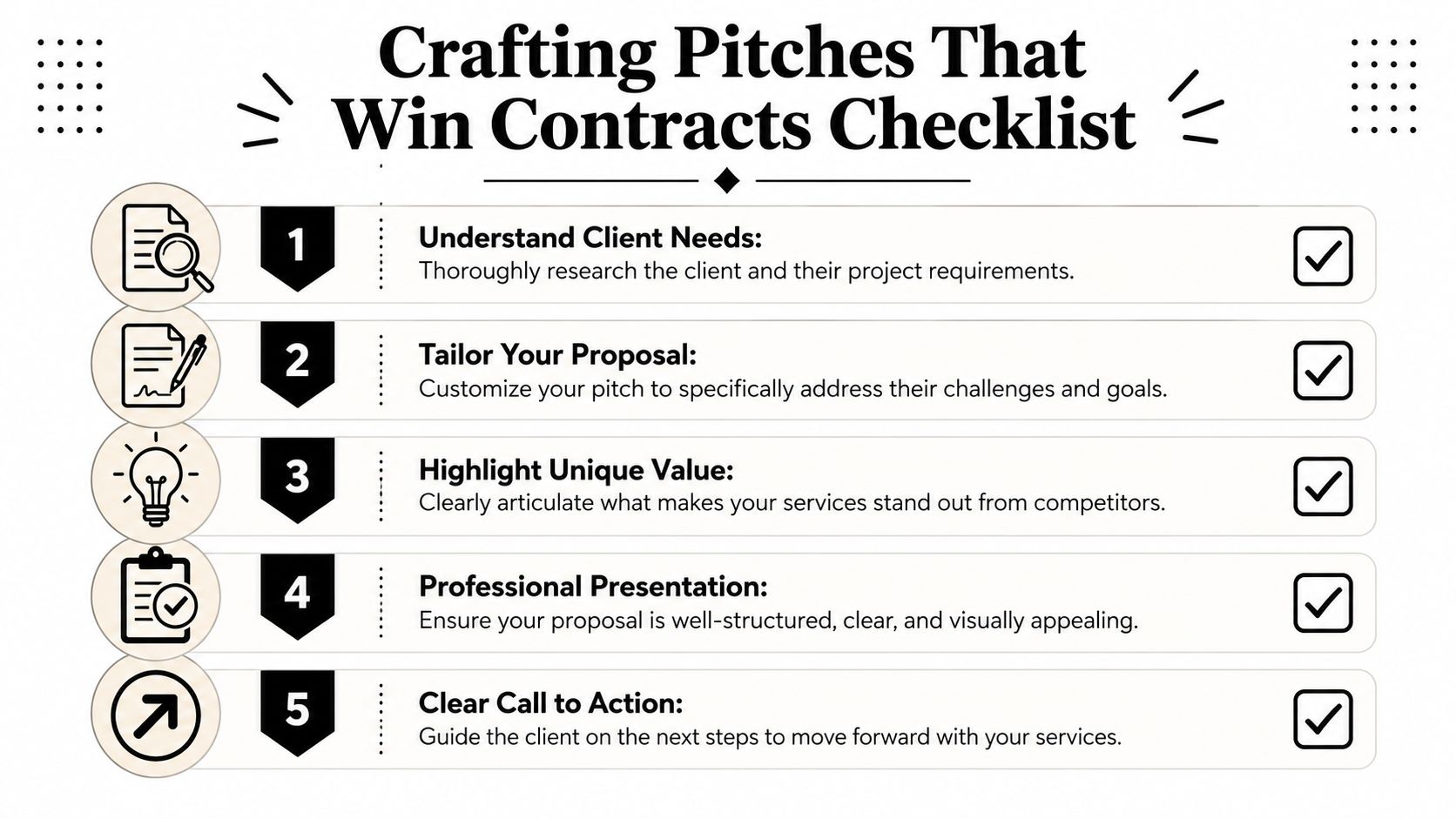
In construction procurement, best practice is often to invite three to five qualified subcontractors to quote on a package. To be in that group, your outreach needs to look like a serious bid, not a casual enquiry. Guidance on packaging and subcontractor selection also stresses that packages should be complete and mutually exclusive, with clearly marked interfaces and battery-limit drawings, because scope ambiguity causes disputes later (construction procurement checklist guidance).
That's why the most reliable approach is to treat every first contact like a mini tender.
Include:
- A one-page capability statement with your trade, sectors, locations, and current capacity
- Clear scope wording so the buyer knows exactly what you do
- Exclusions so there's less room for assumption
- Proof of insurance because buyers want compliance checked early
- A fixed response window such as “available to discuss this week” or “quote valid until Friday”
What a buyer needs to see quickly
A project manager or estimator scanning your email is usually looking for five things.
- Relevance: Does this subcontractor do this package?
- Availability: Can they start when needed?
- Competence: Have they done similar work before?
- Compliance: Are the basics covered?
- Commercial clarity: Is the scope clean enough to price?
If your pitch creates questions about what's included, the buyer will often move to someone easier to compare.
A simple structure works well:
- One sentence on the project type you handle
- One sentence on where you work
- One sentence on current availability
- Bullet list of recent comparable jobs
- Attached capability sheet and insurance details
Avoid the pitch mistakes that waste time
Most lost opportunities aren't lost on price alone.
They're lost because the buyer receives a message that is too broad, too long, or too unclear. Common errors include attaching only a CV, quoting without exclusions, using old insurance documents, and failing to mention when you're free.
If you're pricing a package, spell out interfaces. If you aren't including waste removal, access equipment, testing, or materials, say so. Clear exclusions don't weaken a pitch. They make it usable.
Navigating Rates Contracts and IR35
Winning the work is one part of the job. Protecting the deal is the other.
A subcontract that pays poorly, shifts too much risk onto you, or creates tax problems can turn a decent booking into a bad contract very quickly. Consequently, contractors need to slow down and read properly.
Set rates from the job backwards
Don't start with what you'd like to earn. Start with the work itself.
Look at:
- Scope complexity, especially if there are awkward interfaces or incomplete details
- Programme pressure, because short lead times often increase delivery risk
- Travel and site logistics, including parking, congestion, or night working
- Commercial exposure, especially if the client wants fixed-price work with loose scope
A day rate suits uncertain scope or short-term support. A fixed package can work well when drawings, access, and responsibility lines are clear. Problems start when contractors accept package pricing on half-defined information.
If the scope is blurred, qualify the quote or decline it.
Read the subcontract like someone who expects trouble
The important clauses are usually not the exciting ones. They're the practical ones that affect cash flow and liability.
Check these points carefully:
- Payment terms: When do invoices get approved, and what can delay payment?
- Notice provisions: How quickly can either side end the arrangement?
- Scope wording: Does the contract match what you priced?
- Variation process: How do changes get authorised?
- Liability wording: Are you taking on obligations that go beyond your fee or control?
If you want a plain-English explanation of one area that often catches contractors out, this guide on contractual liability is a useful reference. It helps when you're trying to understand whether the contract is making you responsible for losses that sit outside normal delivery risk.
A subcontractor usually gets into trouble through vague scope, weak variation control, or bad payment terms, not through the headline rate.
Keep IR35 simple
IR35, also called the off-payroll working rules, is about tax status. The question is whether the engagement looks like genuine self-employment for tax purposes, or more like employment.
In plain terms:
- Outside IR35 usually means the engagement is treated as a business-to-business arrangement for tax
- Inside IR35 usually means tax is handled more like employment income
Who makes the determination depends on the client and the structure of the engagement. That's why you need to know the status position before you agree the take-home expectations.
If you want a straightforward overview, this guide to IR35 for contractors breaks down the rules and what they mean in practice.
The key point is commercial as well as tax-related. A rate that looks fine outside IR35 may not look fine inside it. Always assess the status position before agreeing the final figure.
Streamlining Your Admin with an Umbrella Company
Once the contract is signed, most contractors want the same thing. They want to start quickly, get paid correctly, and avoid tax admin eating into their week.
That's where an umbrella company can make life easier, especially for roles that sit inside IR35 or for contractors who don't want the burden of running a limited company for a short-term assignment.
Why contractors use one
An umbrella company employs you and handles payroll through PAYE. That means tax and National Insurance are processed for you, and you receive payslips in a familiar employed format.
For many contractors, the practical benefits are straightforward:
- Less admin: No need to run payroll or manage company filings for that assignment
- Clear deductions: Tax is handled through PAYE
- Employment rights: Holiday pay and pension arrangements are generally part of the structure
- Quicker onboarding: Agencies and clients are often familiar with the process
That convenience matters most when speed matters. If a client wants someone on site or in role quickly, a clean payroll route can remove friction.
Check compliance before you sign up
Not all providers are equal. Contractors should look for transparency, proper documentation, and a clear explanation of deductions and margin. If the numbers or the wording look unusual, stop and ask questions.
A useful starting point is understanding how an umbrella company for contractors works in practice, including the payroll setup and compliance side.
The right arrangement should feel boring in the best possible way. Clear contract. Clear payslip. Clear responsibilities.
Conclusion Your Path to Consistent Work
The subcontractors who stay busy usually don't rely on luck. They build a system.
That system starts with a clear offer, not a vague promise to do a bit of everything. It gets stronger when you target buyers who already procure your trade, use public information to identify likely primes, and contact firms with a proper mini-tender pack instead of a casual message.
Then comes the discipline that protects the work. Read the subcontract properly. Check the scope. Understand the payment route. Don't agree a rate before you understand the IR35 position and the commercial risk.
If you keep doing those things, finding subcontracting work becomes more predictable. Not easy, but predictable.
When you've secured the contract and need a straightforward payroll solution, Umbrella Company helps you compare umbrella companies suited to your role, rate, and IR35 position, so you can choose a compliant option and get started with less admin.


