


Getting your head around Statutory Sick Pay (SSP) calculations can feel a bit daunting at first. It is not just a case of paying a flat rate; you need to figure out an employee's 'qualifying days' and factor in the three 'waiting days' before any payment is due.
Essentially, the process involves taking the weekly SSP rate, dividing it by the number of days the employee normally works, and then paying that daily rate for each day they are off sick after the waiting period. This can continue for up to 28 weeks. In this guide, we will walk you through each step.
Understanding Statutory Sick Pay in the UK
So, what is Statutory Sick Pay? Often just called SSP, it is the legal minimum that employers must pay to employees who are off work due to illness. Think of it as a crucial financial safety net, making sure people have at least some income when they cannot work.
Here at UmbrellaCompany.com, we live and breathe payroll. We know how important it is to get it right. This guide is designed to strip away the jargon and show you exactly how to handle SSP, step by step.
The Core Principles of SSP
Before you can start calculating, you need to be solid on the fundamentals. Nailing these core concepts is the only way to stay compliant and ensure your team gets paid correctly.
There are really three key things you need to grasp:
- The Minimum Earnings Threshold: To qualify for SSP, an employee's earnings must be above a specific level, known as the Lower Earnings Limit.
- The 'Waiting Day' Rule: You do not pay SSP for the first three days an employee is off sick. These are called 'waiting days', and they must be days the employee would normally have worked.
- The 'Qualifying Day' Concept: Payments are calculated based on an employee's usual working days. This could be Monday to Friday, but it could just as easily be a Tuesday to Saturday rota.
SSP has been around since 1983, introduced to formalise sick pay and help people stay formally connected to their jobs during illness. When it started, the rate was about 35% of average weekly earnings. That figure has since dropped to around 18%, which shows how the financial burden of sickness has shifted over the years.
While the rules might seem complicated, we are here to make them simple. Managing SSP correctly is a non-negotiable part of running a proper Pay As You Earn (PAYE) system. Follow these guidelines, and you will have the clarity you need to manage sick pay with total confidence.
Confirming an Employee is Eligible for SSP
Before you even touch a calculator, the first job is to check if the employee is actually entitled to Statutory Sick Pay. Getting this right from the start is a legal must-have, and it heads off any potential payment mix-ups or disputes later on. Think of it as laying the groundwork.
To get SSP, a person must be legally classed as an employee with a contract of employment. This net also catches agency workers and, in a lot of cases, contractors operating under specific setups. If you are a bit fuzzy on these employment structures, our guide explaining what an umbrella company is can clear things up.
The Minimum Earnings Threshold
A key hurdle for SSP eligibility is what the employee earns. Their average weekly pay must be at least the Lower Earnings Limit (LEL), a figure the government reviews and sets for each tax year. Right now, that is £123 per week.
This can feel a bit tricky for staff on zero-hours contracts or those whose pay fluctuates. The trick is to work out their average earnings over a "relevant period" (usually the eight weeks right before they went off sick). This gives a fair picture of their normal income for the eligibility check.
Getting the earnings calculation spot-on is non-negotiable. A mistake here could mean you either short-change a deserving employee or pay SSP to someone who is not eligible. Both scenarios create a compliance headache for your business.
Sickness Duration and Qualifying Days
SSP is not for a single day off here and there. An employee needs to be unwell for at least four days in a row to qualify. This block of time is known officially as a ‘Period of Incapacity for Work’ (PIW).
Those four days can include days they would not normally work, like weekends or bank holidays. So, if someone gets sick on a Friday and is still off on the following Monday, that counts as four consecutive days and triggers a PIW.
The days an employee is normally scheduled to work are called ‘qualifying days’. These are the only days you will actually pay SSP for (and only after the first three unpaid 'waiting days' have passed).
For a deeper dive into how this works for different work patterns, this guide on Statutory Sick Pay for part-time workers is a great resource. Pinpointing these days correctly is essential before you move on to the numbers.
Here is a quick checklist to help you run through the main eligibility points at a glance.
SSP Eligibility Checklist
| Eligibility Criterion | Requirement | Key Consideration |
|---|---|---|
| Employment Status | Must be classed as an employee with an employment contract. | Includes agency and some umbrella company workers. |
| Earnings | Average weekly earnings must be at least £123 (LEL for 23/24). | Calculate over the 8 weeks prior to sickness for variable pay. |
| Sickness Duration | Must be sick for 4 or more consecutive days (a PIW). | This period can include non-working days like weekends. |
| Notice Provided | Must have notified the employer of their sickness. | Should follow company policy, but SSP cannot be withheld if notice is late. |
Running through these checks for every case ensures you are on solid ground before calculating and processing any sick pay.
Calculating the Daily Rate of SSP
Right, so you have confirmed your employee is eligible for Statutory Sick Pay. Now it is time to crunch the numbers. Although SSP is always quoted as a weekly figure, you will almost always need to work out a daily rate. This is the only way to make sure the payment is spot on for that employee's specific working pattern, whether they are on a standard five-day week or a more flexible rota.
This infographic gives you a quick visual rundown of those essential eligibility checks you need to tick off before you even think about calculations, such as employment status, earnings, and how long they have been off.
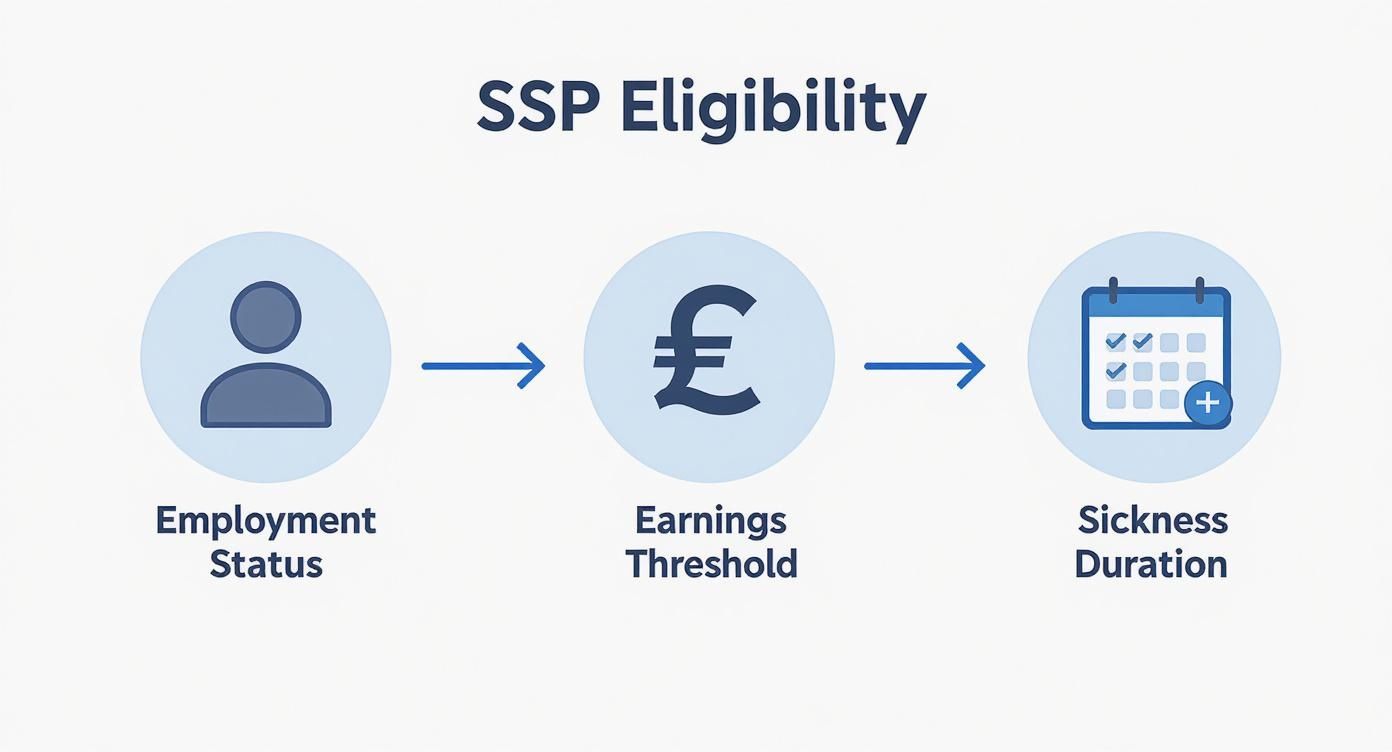
As you can see, getting these three things right from the start is the foundation of any SSP claim. It stops you from making mistakes before you have even picked up a calculator.
Understanding Waiting and Qualifying Days
Before you can get to the daily rate, you must get your head around two key ideas: waiting days and qualifying days. Honestly, they are the cornerstones of getting SSP right.
- Waiting Days: These are simply the first three qualifying days an employee is off sick. SSP is not paid for these days. Think of it as a small excess period.
- Qualifying Days: These are just the days the employee is contracted to work. For most people, that is Monday to Friday, but it could just as easily be a weekend shift or a Tuesday-to-Saturday pattern.
A simple way we remember it is that waiting days are unpaid, but qualifying days are the days SSP could be paid on, once that waiting period is over. Getting this distinction right is crucial, especially when you are dealing with part-time staff on varied schedules.
The Formula for the Daily SSP Rate
Once you have nailed down the qualifying days, the actual calculation is pretty straightforward. You just divide the weekly SSP rate by the number of qualifying days in that week.
The formula is: Weekly SSP Rate / Number of Qualifying Days = Daily SSP Rate
As of April 2024, the weekly SSP rate is set at £116.75, and it is payable for up to 28 weeks. So, an employee working a standard five-day week would get £23.35 for each sick day after their waiting period.
Let's walk through how this works with a couple of real-world examples.
Practical Calculation Examples
Imagine two different employees to see how their work patterns change the calculation.
Scenario 1: Standard Monday-Friday Worker
- An employee works five days a week, Monday to Friday.
- Their qualifying days are 5.
- The calculation is: £116.75 / 5 = £23.35 per day.
- After their three waiting days (Mon, Tue, Wed), they would be paid £23.35 for each subsequent qualifying day they are off sick.
Scenario 2: Tuesday-Saturday Worker
- Another employee works a Tuesday to Saturday shift pattern.
- Their qualifying days are also 5.
- The calculation is: £116.75 / 5 = £23.35 per day.
- The daily rate is identical, but their waiting days would be Tuesday, Wednesday, and Thursday. SSP would only become payable from Friday onwards.
If you are a contractor, getting a firm handle on your earnings is vital. You can use our handy contractor daily rate calculator to get a clear picture of your income, which is always a good move for financial planning.
Putting It All Together with Worked Examples

The theory is all well and good, but nothing makes the rules click like seeing the numbers in action. Let’s run through a couple of common scenarios so you can see exactly how to calculate statutory sick pay in the real world.
These examples will show you how to pull together the rules for waiting days and qualifying days to land on the final payment figure.
Full-Time Employee, Ten Days' Sickness
Let's kick off with a nice, straightforward case. A full-time employee works a standard Monday to Friday week. They are off sick for ten working days straight, from Monday the 1st to Friday the 12th of a given month.
First, the key figures:
- Weekly SSP Rate: £116.75
- Qualifying Days: 5 (Monday to Friday)
- Daily SSP Rate: £116.75 / 5 = £23.35
Now, the first three qualifying days are unpaid "waiting days." In this case, that is Monday 1st, Tuesday 2nd, and Wednesday 3rd. SSP only becomes payable from the fourth qualifying day, which is Thursday the 4th.
The employee is therefore paid for seven qualifying days. The total SSP due is 7 days x £23.35, which comes to £163.45.
Part-Time Contractor with Irregular Hours
Things can get a little more complicated with variable work patterns. Imagine a contractor who works Tuesdays, Wednesdays, and every other Saturday. They fall ill and are off for a full two weeks.
The first job here is to figure out their average qualifying days per week. Based on their pattern, it averages out to 3.5 days.
- Weekly SSP Rate: £116.75
- Daily SSP Rate: £116.75 / 3.5 = £33.36 (rounded)
Just like before, the first three qualifying days of their sickness period (Tuesday, Wednesday, and the next Saturday they were due to work) are the unpaid waiting days. They get paid SSP for the remaining sick days that fall on their normal workdays. This method ensures they receive a fair amount that is truly reflective of their specific schedule.
It is always a good idea to understand how your earnings stack up across different employment models. If you are weighing up your options, our PAYE vs Umbrella calculator is a brilliant tool for getting a clearer picture of your take-home pay.
Linked Periods of Sickness
One of the trickiest parts of SSP is the concept of 'linked' sickness. If an employee is off sick again within eight weeks of returning to work, the two periods are considered linked. What this means, crucially, is that they do not have to go through the three waiting days all over again.
A linked period means the clock on waiting days does not reset. If an employee was paid SSP for their first absence, any subsequent linked sickness period is payable from the very first qualifying day of that new absence.
Let's go back to our full-time employee from the first example. Say they return to work for four weeks and then have to go off sick again. Because this new absence is within eight weeks, it is linked to the first one. They would be entitled to SSP right from day one of this second sickness period.
Getting SSP Administration Right and Dodging Common Pitfalls
Nailing the SSP calculation is one thing, but it is only as good as the admin process behind it. Getting the numbers right is half the battle; having your internal processes running smoothly is the other. This is where sharp HR and payroll teams really make a difference, keeping everything compliant while supporting employees properly.
Solid record-keeping is simply non-negotiable. You must maintain meticulous logs of all employee sickness absences, noting the dates and every penny of SSP paid. This not only creates a clear audit trail but is essential for correctly managing linked periods of sickness.
Key Administrative Duties
One question we hear all the time is about medical evidence. For the first seven calendar days of an illness, an employee can self-certify. After that, they must provide a ‘fit note’ (officially a Statement of Fitness for Work) from a doctor or another qualified healthcare professional.
It is also crucial to know the procedure when someone does not qualify for SSP. If an employee is not eligible, you are legally required to give them form SSP1. You must do this within seven days of their sickness starting. This form clearly explains why they do not qualify and points them towards applying for state benefits instead.
Managing SSP is not just a payroll chore; it is a core part of your relationship with your team. Clear communication and efficient processes show your people you are organised and supportive when they are feeling vulnerable.
Avoiding Common Mistakes
A few common tripwires can catch out even the most seasoned payroll managers. A classic one is miscalculating average weekly earnings, especially for people on variable-hour contracts. To get this right, you must always use the correct eight-week reference period just before the sickness began.
Another frequent slip-up is getting the waiting day rule wrong for linked absences. Do not forget, if a second period of sickness kicks in within eight weeks of the first, the three-day waiting period does not apply a second time.
Of course, beyond the legal minimums of SSP, many businesses are looking for more proactive ways to help their staff. Exploring some practical employee wellness program ideas can help build a healthier, more resilient workforce and might even reduce sickness absence in the long run.
Your Key SSP Questions Answered
When it comes to Statutory Sick Pay, the same practical questions tend to crop up. We have tackled the most common queries we hear from contractors and employers to give you clear, straightforward answers.
Can You Claim SSP and Universal Credit at the Same Time?
Yes, in some circumstances you can receive both. The key thing to remember is that any SSP you get is classed as income.
This means it is factored into your Universal Credit calculation, which will likely reduce the amount of Universal Credit you are paid.
What Happens If You Are Self-Employed?
As a self-employed individual or freelancer, you are not an employee, so you cannot claim Statutory Sick Pay.
Instead, you might be eligible for Employment and Support Allowance (ESA). This is a government benefit specifically for people whose ability to work is limited by a health condition or disability.
Is the SSP Rate Really Enough to Live On?
While SSP provides a legal safety net, whether it is enough to cover living costs is a serious concern for many. The current weekly rate breaks down to an hourly figure well below the national minimum wage.
In fact, research shows that around 40% of British workers would fall into debt or struggle with bills if they had to get by on SSP alone. This starkly highlights the financial strain that falling ill can create, a reality explored in detail by the TUC. You can read more about the realities of sick pay on tuc.org.uk.
At UmbrellaCompany.com, we give you the clarity and tools to compare compliant umbrella companies, helping you manage your contracting finances with confidence. Find the right umbrella company for you.


