


Figuring out your PAYE for the first time can feel like a bit of a minefield, but it is much simpler than it looks. It boils down to a few key steps. You start with your gross pay, find your tax-free personal allowance using your tax code, and then work out the tax you owe based on the official UK tax bands. After that, it is just a case of calculating your employee National Insurance Contributions (NICs).
A Quick Guide to Your PAYE Calculation

Getting a handle on how PAYE is calculated is essential for any UK contractor. It allows you to check your payslips are accurate and plan your finances without any nasty surprises. Here at UmbrellaCompany.com, we believe understanding this process takes the mystery out of your earnings, so you know exactly where every penny is going.
This guide will walk you through the PAYE calculation step-by-step. We will skip the confusing jargon and stick to the practical side of things, making it easy to follow. Think of it as building your financial confidence, one calculation at a time.
Before we jump into a full example, it is useful to see all the moving parts in one place. These are the core elements that every PAYE calculation is built upon.
Key Elements in Your PAYE Calculation
| Component | What It Means for You | How It Affects Your Pay |
|---|---|---|
| Gross Pay | Your total earnings before any deductions. It is the starting line for everything. | The higher your gross pay, the more tax and NI you will likely pay. |
| Tax Code | A code from HMRC that tells your employer how much tax-free income you get. | A standard code like 1257L means you have the full personal allowance. Other codes can reduce or increase it. |
| Personal Allowance | The amount of income you can earn each year before you start paying tax. | Any earnings above this amount are subject to Income Tax. |
| Tax Bands | The different rates of tax you pay on your earnings (e.g., Basic, Higher, Additional). | As your income crosses into a new band, you pay a higher rate of tax only on the amount in that band. |
| National Insurance | Contributions you make to qualify for certain state benefits, like the State Pension. | Calculated separately from tax, with its own rates and thresholds. |
| Other Deductions | Things like pension contributions, student loan repayments, and umbrella company margins. | These are taken from your gross pay, often before tax, which can lower your taxable income. |
Understanding how these pieces interact is the key to accurately predicting your net pay. For contractors, especially those working inside IR35, this knowledge is absolutely crucial for compliance and financial clarity.
The Key Pillars of PAYE
At its heart, the entire calculation rests on three fundamental pillars. Once you get your head around these, you are most of the way there.
- Gross Pay: This is your total earnings before anything is taken off. It is the top-line figure that every other calculation is based on.
- Your Tax Code: This little code, usually 1257L for most people in the 2024/25 tax year, is HMRC’s instruction to your umbrella company on how much tax-free income you are allowed.
- National Insurance: This is a separate system from income tax. It pays for state benefits like the NHS and your state pension, and it is worked out using its own thresholds and rates.
A common tripwire for people is the difference between tax and National Insurance. They both come off your pay, but they are two completely separate systems. Tax funds general government spending, while NI is directly linked to your personal entitlement to state benefits down the line.
In the next sections, we will get stuck into each of these components. We will use a detailed, worked example to show you exactly how the numbers add up on a typical contractor payslip. This hands-on approach will turn the theory into something you can actually use.
Getting to Grips with Your Payslip
Before you can crunch any numbers, you need to speak the language of your payslip. Think of these terms as the essential building blocks for every single tax and National Insurance calculation. Once you know what is what, you can easily trace the journey from your gross earnings right down to your final take-home pay.
For contractors working through an umbrella company, this is not just good-to-know information, it is vital. It is how you verify that every penny is accounted for and every deduction is handled correctly, keeping you fully compliant with HMRC.
Gross Pay vs. Taxable Income
Your payslip journey always kicks off with Gross Pay. This is the big number, the total amount you have earned before anyone takes a slice. It is the starting line from which everything else is calculated.
But here is the good news: you do not pay tax on all of it. This is where Taxable Income comes into play. To figure this out, you simply take your gross pay and subtract any tax-free allowances, chief among them, your Personal Allowance. The figure you are left with is what HMRC actually applies its tax rates to.
Your Personal Allowance and Tax Code
For most people, the most important tax-free amount is the Personal Allowance. For the 2024/25 tax year, this stands at £12,570. It is the amount of money you can earn over the tax year without paying a single penny of Income Tax.
This allowance is communicated to your employer (or umbrella company) using your tax code. The most common one you will see is 1257L.
- The number (1257) tells your employer about your tax-free allowance. Just add a zero to the end to get the full amount: £12,570.
- The letter (L) simply confirms you are entitled to the standard Personal Allowance.
Think of it as your tax-free head start. You only start paying income tax on earnings above this threshold. That is why getting your tax code right is such a crucial first step in any PAYE calculation.
The PAYE system has come a long way since it started back in 1944. By 1984, the sheer volume of over 20 million taxpayer records prompted a major digital shift, computerising the entire system across 12 regional databases. This was a necessary upgrade, especially after National Insurance was integrated into PAYE in 1975, complicating calculations for employers. Today, the system manages payrolled employment for around 33 million people.
A Quick Word on National Insurance
While it is often lumped in with tax, National Insurance Contributions (NICs) are a separate system entirely. They are calculated independently, with their own thresholds and rates. Your employee NICs, known as Class 1, are deducted from your gross pay right alongside your income tax.
Getting these individual components straight is the key to it all. For a more detailed look, check out our guide on how to read a payslip in the UK, which breaks down every line. This knowledge gives you the confidence to check your umbrella company is processing your pay correctly and compliantly. In the next section, we will put this theory into practice with a proper worked example.
A Worked Example of a PAYE Calculation
Reading about tax bands is one thing, but seeing it all come together with a real-world example is where it really clicks. Let's walk through the numbers for a UK contractor to show you exactly how to calculate PAYE.
We will use a contractor named Alex who earns a day rate of £500 and works a standard five-day week. For this example, we will assume Alex is paid monthly and is on the standard 1257L tax code for the 2024/25 tax year.
The whole process starts by working out your gross pay, then figuring out how much of that is actually taxable after your Personal Allowance.
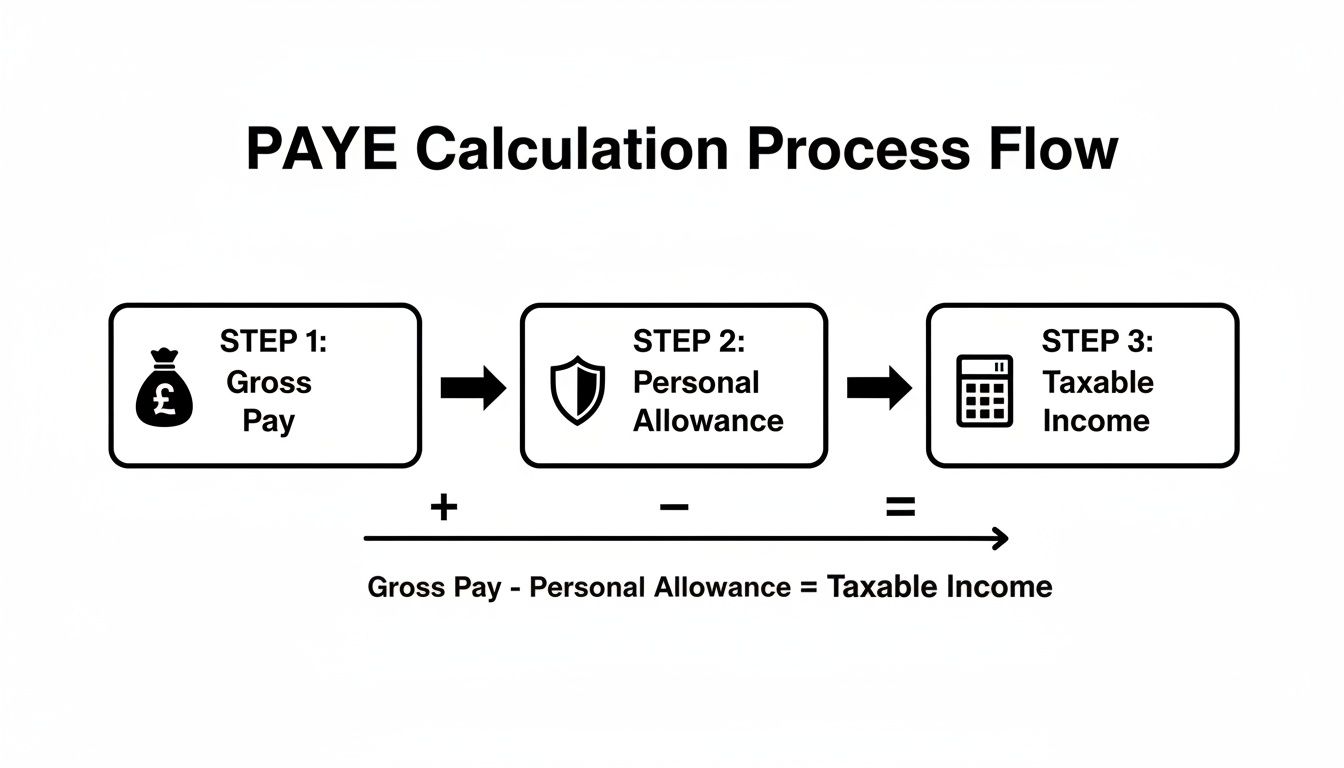
This visual just hammers home the point: your tax calculation always begins with your total earnings before any deductions.
Finding Gross and Taxable Income
First up, we need to calculate Alex's gross pay for the month. Working on an average of 4.33 weeks in a month, the maths is quite simple:
- Gross Pay: £500 (day rate) x 5 (days a week) x 4.33 (weeks in a month) = £10,833 per month.
Next, let's work out Alex's taxable income. With a standard £12,570 Personal Allowance for the year, we just need to find the monthly portion.
- Monthly Personal Allowance: £12,570 / 12 = £1,047.50.
Now we can subtract that tax-free allowance from the gross pay. What is left is the amount that HMRC will apply Income Tax to.
- Monthly Taxable Income: £10,833 – £1,047.50 = £9,785.50.
This is the key figure Alex will pay tax on for the month.
Applying the Income Tax Bands
With the taxable income sorted, it is time to apply the 2024/25 tax bands for England and Northern Ireland. Alex's income is high enough that it will span two different bands.
First, a chunk of that income falls into the Basic Rate band.
- Basic Rate Band: This covers annual earnings from £12,571 up to £50,270. The monthly slice of this band is (£50,270 – £12,570) / 12 = £3,141.67.
- Basic Rate Tax: 20% of £3,141.67 = £628.33.
The rest of Alex's taxable income gets pushed into the Higher Rate band.
- Remaining Taxable Income: £9,785.50 (Total Taxable) – £3,141.67 (Basic Rate portion) = £6,643.83.
- Higher Rate Tax: 40% of £6,643.83 = £2,657.53.
Add those two amounts together, and you get the total Income Tax deduction for the month.
- Total Monthly Income Tax: £628.33 + £2,657.53 = £3,285.86.
Calculating Employee National Insurance
The final piece of the core PAYE puzzle is the employee's National Insurance Contributions (NICs). This is a separate calculation based on gross earnings, not taxable income, and it has its own thresholds. For 2024/25, the main employee NI rate is 8% on earnings between £12,570 and £50,270 a year.
Let’s find the monthly NI-free threshold first.
- Monthly NI Threshold: £12,570 / 12 = £1,047.50.
Now we see how much of Alex's gross pay is subject to NI.
- Earnings Subject to NI: £10,833 (Gross Pay) – £1,047.50 (NI Threshold) = £9,785.50.
Apply the 8% rate to that figure, and we have our final NI deduction.
- Monthly Employee NICs: 8% of £9,785.50 = £782.84.
Putting It All Together: The Core Deductions
- Gross Pay: £10,833.00
- Income Tax: £3,285.86
- Employee NICs: £782.84
This gives you a clear picture of the main deductions. Just remember, this does not factor in things like student loans, pension contributions, or any umbrella company fees.
How Pay Frequency Changes Everything
It is crucial to understand that getting paid weekly versus monthly completely changes the numbers on each payslip, even if the annual outcome is the same. The allowances and thresholds are simply divided by 52 instead of 12.
Let's quickly compare Alex's monthly calculation with what would happen if they were paid £2,500 weekly.
Monthly vs Weekly PAYE Calculation Breakdown
| Calculation Stage | Monthly Calculation Example (£10,833 Gross) | Weekly Calculation Example (£2,500 Gross) |
|---|---|---|
| Personal Allowance | £12,570 / 12 = £1,047.50 | £12,570 / 52 = £241.73 |
| Taxable Income | £10,833 – £1,047.50 = £9,785.50 | £2,500 – £241.73 = £2,258.27 |
| NI Threshold | £12,570 / 12 = £1,047.50 | £12,570 / 52 = £241.73 |
| Income Subject to NI | £10,833 – £1,047.50 = £9,785.50 | £2,500 – £241.73 = £2,258.27 |
As you can see, the weekly thresholds are much smaller, which directly impacts how much tax and NI you pay on each individual payslip. This is why a contractor's take-home pay can feel very different depending on their pay cycle.
If you want a detailed estimate of your own potential earnings, playing around with a payroll calculator is the best way to get a feel for the numbers. It is a fantastic tool for getting a much clearer picture of what you will actually bank after all deductions are made.
Looking Beyond Tax and NI: Other Common Deductions
While Income Tax and National Insurance are the two big-hitters on your payslip, they are rarely the only things coming out. A few other common deductions can tweak your take-home pay, and getting your head around them is vital for seeing the full picture.
For contractors, particularly when using an umbrella company, understanding these extra deductions means no nasty surprises when your payslip lands. It gives you the power to accurately forecast your net pay and feel confident that every penny is accounted for correctly.
Student Loan Repayments
If you have a student loan, once you start earning over a certain amount, repayments are automatically taken through the PAYE system. The key thing to remember is that how much you repay is based on what you earn, not how much you owe.
For the 2024/25 tax year, it breaks down like this:
- Plan 1: You will repay 9% of anything you earn over £24,990 a year. This is for students from England and Wales who started their course before 1 September 2012.
- Plan 2: Repayments are 9% of your income above the £27,295 annual threshold. This applies to students from England and Wales who started their course between 1 September 2012 and 31 July 2023.
- Plan 4: This one is for Scottish students, who repay 9% on earnings over £31,395 per year.
- Plan 5: The newest plan for English students who started their course on or after 1 August 2023. You repay 9% on earnings over £25,000.
- Postgraduate Loan: Repayments are a bit different here, at 6% of your income over the £21,000 threshold.
Your umbrella company’s payroll software handles all this automatically, calculating the right deduction for each pay period.
Workplace Pension Contributions
Thanks to auto-enrolment, your umbrella company has a legal duty to sign you up for a workplace pension. You can opt out, of course, but staying in is a smart way to save for the future, especially as both you and your employer contribute.
Your contribution is usually taken from your pay before tax is worked out. This is a huge plus, as it gives you tax relief by lowering your taxable income. The standard minimums are 5% from you and 3% from your employer, making a total of 8% of your qualifying earnings.
Do not forget, pension contributions are taken from your gross pay before tax. This is a big win because it directly shrinks the amount of income HMRC can tax, trimming your overall tax bill for that period.
Deductions Specific to Umbrella Companies
When you work through an umbrella, your payslip will have a couple of deductions that are part of this model. It is important to know that these are legitimate costs of employment, not hidden fees from a shady provider.
The two main ones you will see are:
The Umbrella Margin: This is the flat fee the umbrella company charges for its services, such as running your payroll, handling all the admin, and making sure you get paid on time. It is a fixed amount taken each time you are paid (e.g., £25 per week) and is the only income the umbrella company earns from your contract.
Employer’s National Insurance: As your legal employer, the umbrella company must pay Employer's NICs on your earnings. This cost, along with others like the Apprenticeship Levy, is covered by the funds sent over from your client or agency. It is a completely standard practice for assignments that fall inside IR35.
It is crucial not to mix these up with your own employee tax and NI. For a more detailed breakdown, you can learn more about what Employer’s National Insurance contributions are in our detailed guide. Understanding this structure confirms why a compliant umbrella is the correct and standard way to manage your finances for inside IR35 contracts.
How Umbrella Companies Take the Pain Out of PAYE

While it is useful to know how to calculate PAYE, the real win for most contractors is not having to do it themselves. This is exactly where an umbrella company comes in. We lift the administrative weight off your shoulders, freeing you up to concentrate on what you do best: your client work.
The magic is simple: a compliant umbrella company becomes your legal employer. This one change unlocks a much smoother way of working, especially for assignments caught inside IR35. Instead of you wrestling with spreadsheets and worrying about HMRC deadlines, a good umbrella handles it all.
Your Own Payroll Department
Think of an umbrella company as your dedicated, professional payroll partner. Once you are set up with us, the process is incredibly straightforward. You submit your timesheets, and we handle everything else.
This means we calculate your Income Tax and National Insurance contributions with total accuracy, making sure the right deductions are paid to HMRC on time, every time. It completely removes the risk of miscalculation or late penalties, which is a huge weight off your mind.
This is particularly crucial now with the off-payroll working rules (IR35). For any contract deemed inside IR35, PAYE payroll is a legal requirement. An umbrella provides a compliant, ready-made framework to manage this without any fuss.
More Than Just Crunching Numbers
The support you get goes well beyond simple payroll processing. By becoming an employee of the umbrella company, you build a continuous record of employment. This is incredibly valuable when you need to apply for a mortgage, loan, or other forms of credit because it shows a stable, consistent income history.
You also get access to a whole raft of statutory employment rights that self-employed people often miss out on.
- Statutory Sick Pay (SSP): A crucial safety net if you are ever too ill to work.
- Holiday Pay: You accrue paid time off, just like a permanent employee, so you can take those well-earned breaks.
- Statutory Maternity/Paternity Pay: Financial support when you are starting or growing your family.
- Workplace Pension: You are automatically enrolled into a pension scheme to help you save for the future.
These benefits combine the flexibility of contracting with the security of traditional employment, giving you the best of both worlds.
A System Built for Simplicity
The PAYE system was designed from the ground up to make tax collection predictable and straightforward. It was actually introduced way back on 6 April 1944, during World War II, as a way to fund the war effort by deducting tax directly from wages. This new approach replaced confusing twice-yearly tax demands, and by January 1944, 15 million people had received their first tax code notices. It was so effective that it has remained the backbone of UK tax collection, now managing deductions for over 30.5 million workers.
An umbrella company simply harnesses this system's efficiency for you. We manage all the Real Time Information (RTI) submissions to HMRC, which have to be filed on or before each payday. This keeps your tax record accurate and up to date, saving you from any compliance headaches.
Outsourcing your PAYE to a trusted umbrella company is not just about saving time on admin. You are investing in your own productivity and professional focus, knowing the financial side is being handled by accredited experts.
Ultimately, using an umbrella company lets you enjoy the freedom of contracting without the administrative drag. To see how this works in practice, take a look at our detailed guide on the relationship between PAYE and umbrella companies. We are here to help you find a fully compliant, accredited provider that lets you get on with your work.
Frequently Asked Questions About PAYE
Even once you get your head around the mechanics, PAYE can still throw up a few curveballs. We have pulled together some of the most common questions we hear from contractors to give you clear, practical answers and help you manage your finances confidently.
Getting these things straight can save a lot of head-scratching later and means you will know exactly what to do if something on your payslip does not look quite right. Let's get into the specifics.
Why Does the Tax on My First Payslip Seem So High?
This is a classic query, and it almost always crops up when you start a new contract. The reason is usually that your new umbrella company has not received your correct tax code from HMRC yet. When this happens, they have no choice but to put you on an emergency tax code, like 0T or W1/M1.
An emergency tax code does not factor in your personal tax-free allowance. This means you are taxed on every penny you earn for that pay period, which is why the deduction can look painfully large. The good news is that it is almost always a temporary blip.
Once HMRC catches up and sends your correct tax code (usually 1257L), any tax you have overpaid will be automatically refunded in a future payslip. It typically sorts itself out within a month or two.
How Does a Bonus Payment Affect My Tax?
A bonus is always welcome, but it can make your payslip look a bit unusual for that month. Because a bonus bumps up your total gross pay, it can easily push some of your earnings into a higher tax band than you are used to.
For example, a decent bonus might mean a chunk of your income gets taxed at the 40% Higher Rate, even if you normally only ever pay the 20% Basic Rate. Your National Insurance and student loan deductions will also go up for that period, as they are calculated on your total earnings.
It is worth remembering that the higher tax rate only applies to the slice of your income that falls into that higher band. It does not change the tax rate on your regular earnings below that threshold.
So, while it is completely normal, it is worth bracing yourself for a bigger tax hit in the month the bonus lands.
What Should I Do If I Think My Tax Code Is Wrong?
If your tax code looks off, you need to act fast to avoid paying the wrong amount of tax. It could be wrong because of a change in circumstances, such as starting or stopping a second job, or it might just be a simple admin error.
Your first port of call should always be HMRC. Your umbrella company is legally bound to use the tax code HMRC provides, so we cannot change it for you, even if it is obviously incorrect. The easiest way to sort this is through your Personal Tax Account on the GOV.UK website.
- Log in to your Personal Tax Account to check your current tax code.
- Use the online service to report any changes that might affect it.
- If you cannot fix it online, you can always ring HMRC to talk it through.
Once HMRC updates your record, they will issue a new tax code directly to your employer, and your deductions will be adjusted. Taking ownership of this is the best way to make sure you are paying the right amount of tax throughout the year.
At UmbrellaCompany.com, our goal is to demystify the world of contracting. We provide the tools and information you need to compare and choose a compliant, accredited umbrella company that fits your specific needs, letting you focus on your work with complete peace of mind. Find your perfect match in minutes.


