


Thinking about becoming a contractor in the UK? It is a fantastic career move, but getting started can feel like a big leap. The journey boils down to three main things: choosing your business structure, getting the right insurance, and landing that all-important first project. This guide will walk you through everything you need to know.
For many, the simplest way to test the waters is by using a compliant umbrella company. At UmbrellaCompany.com, we find this is a popular choice because it removes the headache of taxes and payroll. This frees you up to focus on the work itself and ensures you are set up correctly from day one.
What Does It Really Mean to Be a Contractor?
Stepping into the world of contracting is more than just a new job; it is a complete shift in how you work. You are no longer just an employee. You become a business owner, a specialist service provider who clients hire for specific projects. This puts you firmly in the driver's seat of your career, giving you the power to choose what you work on and where you take your skills.
The biggest difference from a permanent role is that you are not on a company's payroll. You operate as your own business entity. This means you are responsible for managing your own taxes, National Insurance contributions, and all the administration that comes with it. This independence is what contracting is all about, and it is where many of the biggest perks come from.
To make this clearer, let us break down the key differences.
Contracting vs Permanent Employment: At a Glance
| Feature | Contractor | Permanent Employee |
|---|---|---|
| Employment Status | Self-employed or director of own company | Employee of the company |
| Pay & Benefits | Higher daily/hourly rate; no sick pay, holiday pay, or pension contributions | Lower base salary with benefits package (pension, sick pay, holiday) |
| Job Security | Project-based; security comes from skills and network | Greater job security with a notice period and employment rights |
| Flexibility & Control | High degree of autonomy over projects, hours, and location | Less control; works under direct management and set hours |
| Tax & Admin | Responsible for own tax, NI, and business administration | Tax and NI deducted automatically through PAYE |
| Career Path | Builds diverse experience across various industries and projects | Follows a structured career path within one organisation |
Ultimately, choosing to contract involves a trade-off. You swap the security and benefits of a permanent job for greater freedom and higher earning potential.
Why Do People Make the Switch?
The move to contracting is a popular one, and for good reason. Professionals are often drawn in by benefits that a typical nine-to-five simply cannot match.
- Higher Earning Potential: Let’s be honest, this is a big one. Contractors usually earn a significantly higher daily or hourly rate to compensate for the lack of employee benefits and the short-term nature of the work.
- Real Flexibility: You get to call the shots on when and where you work. This opens the door to a much better work-life balance and gives you the freedom to take proper breaks between contracts.
- Accelerated Skill Growth: Moving between different projects and clients means you are constantly learning. You get exposed to new challenges, different ways of working, and cutting-edge tech, which makes you a far more adaptable and valuable expert.
Contracting empowers you to become the architect of your own career. It’s a shift from being an employee to being a service provider, where your skills and reputation are your most valuable assets.
Of course, this journey comes with its own set of responsibilities. You will have to make some big decisions early on, like whether to use an umbrella company or set up your own limited company. You will also need to get your head around tax legislation like IR35.
Think of this guide as your roadmap. We will walk you through everything you need to know to get your contracting career off to a flying start.
Choosing Your Business Structure: Umbrella vs Limited
Right, let us get down to one of the biggest decisions you will make as a new contractor: how you are actually going to operate. This is not just a box-ticking exercise. It affects your take-home pay, the amount of admin on your plate, and your legal responsibilities.
For most UK contractors, it boils down to two main routes: working through an umbrella company or setting up your own limited company. Each has its own pros and cons, and what is right for one person might be a nightmare for another. Your best bet depends on your attitude to paperwork, your contract situation, and how long you see yourself doing this.
Getting this right from the start will save you a lot of headaches down the line.
What Is An Umbrella Company?
Think of an umbrella company as your ready-made employer. You find the contract work, but the umbrella company handles all the payroll logistics. You become their employee, and they sign a contract with your agency or client.
It is a simple setup. You submit your timesheets, the umbrella company invoices the client, and they pay you a salary through PAYE, deducting tax and National Insurance just like a permanent job. You get a proper payslip, and it is all above board.
For anyone just dipping their toes into contracting, this is often the perfect solution. It strips away the admin, ensures you are tax compliant, and even gives you statutory employment rights like holiday and sick pay. You get the freedom of contracting without the stress of running a business.
For many, an umbrella company is the lowest-risk entry into contracting. It lets you focus on the actual work you're paid to do, while someone else manages the nitty-gritty of payroll and compliance.
This flowchart can help you visualise where you fit in the bigger picture of becoming a contractor.
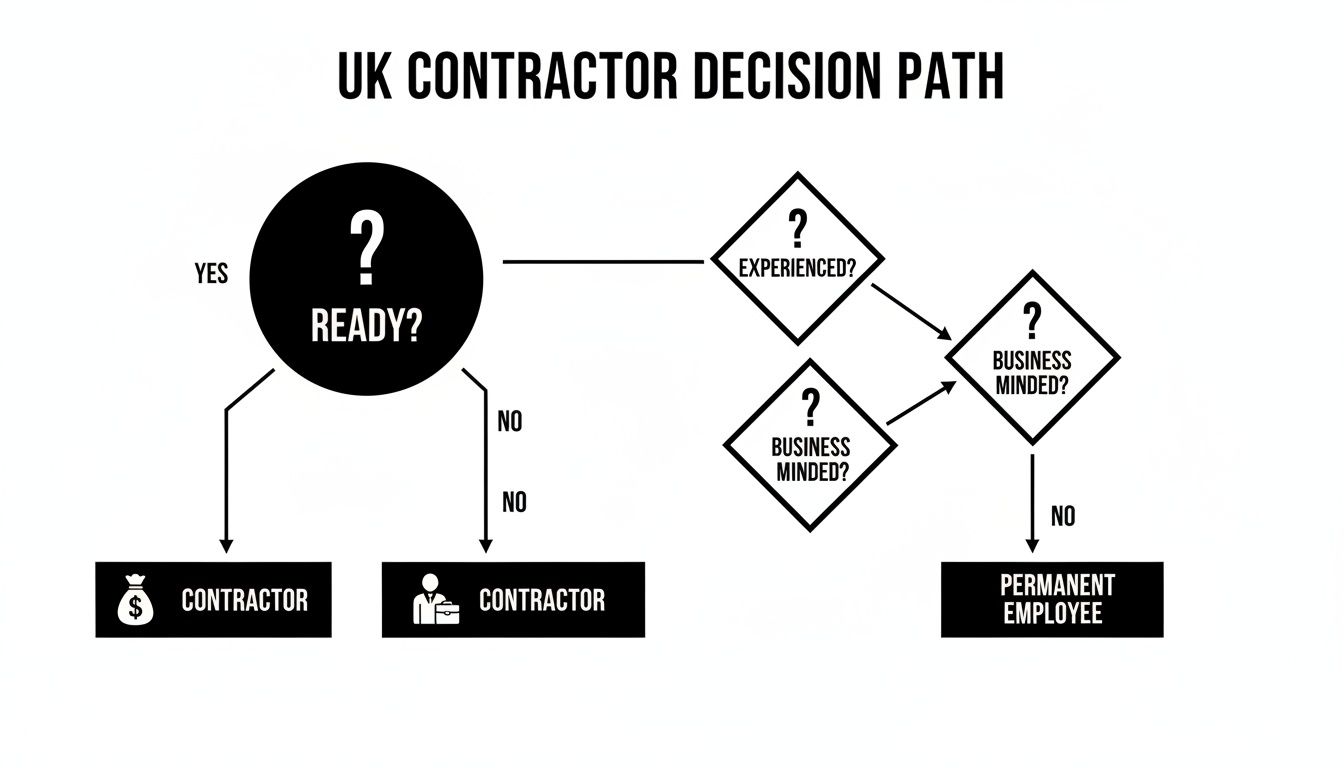
As the chart shows, a key part of the decision is whether you are ready for the financial autonomy that comes with being your own boss.
What Is A Limited Company?
Going down the limited company route means you are not just a contractor; you are a business owner. You become the director of your own company, which is a separate legal entity from you personally. This is a big deal because it protects your personal assets if things go wrong.
As the director, you are in the driver's seat. You are responsible for everything from filing annual accounts and paying Corporation Tax to managing your own payroll.
It is a lot more work, there is no denying it. But the trade-off can be significant. This structure is often more tax-efficient, as you can pay yourself a small salary combined with dividends, which can lead to higher take-home pay. This is usually the preferred path for seasoned contractors on higher day rates who are comfortable with the responsibilities of being a company director.
Official statistics show a clear trend towards more formal business structures. Even in sectors like construction, where the total number of businesses fell, registered companies grew by 35,000. Getting started is straightforward: you can register with Companies House online for just £12.
Making The Right Choice For You
To help you weigh your options, here is a breakdown of the key differences between an umbrella company and a limited company.
| Consideration | Umbrella Company | Limited Company |
|---|---|---|
| Admin Burden | Very low. Just submit timesheets. | High. You are responsible for accounts, tax returns, and compliance. |
| IR35 | Simple. All payments are PAYE, so IR35 is not a concern. | Complex. You must determine your IR35 status for each contract. |
| Tax Efficiency | Less tax-efficient; taxed as a standard employee (PAYE). | Potentially more tax-efficient through salary and dividend payments. |
| Setup & Costs | Quick and free to join. A weekly or monthly margin is deducted. | Requires company formation (from £12) and ongoing accountancy fees. |
| Control & Flexibility | Less control over finances; you are an employee. | Full control over company finances and business decisions. |
| Employment Rights | Yes. You get statutory sick pay, holiday pay, and a pension. | No. As a director, you have no statutory employment rights. |
| Exit Strategy | Simple. Just finish your contract and hand in your notice. | Requires formally closing the company, which can be complex. |
Ultimately, this decision is about balancing simplicity against financial control. There is no single "best" answer, and remember, it is not a permanent choice. Many contractors move between the two as their circumstances change.
A limited company is probably your best bet if:
- You are confident your contracts will be assessed as outside IR35.
- You plan to contract for the long haul and are on a good day rate.
- You are happy to manage the admin yourself or pay an accountant.
On the other hand, an umbrella company is likely the smarter move if:
- Your contracts are likely to be inside IR35.
- You are just starting out and want a hassle-free way to work.
- You value the security of employment benefits and straightforward tax.
If you are still weighing things up, our in-depth guide on umbrella company vs limited company breaks it all down even further to help you make the right call for your career.
Making Sense of the IR35 Off-Payroll Rules
The term IR35 can sound intimidating when you are just starting out, but it is something you need to get comfortable with pretty quickly. Think of it as HMRC’s way of making sure contractors who are effectively doing the same job as an employee pay a similar amount of tax and National Insurance.
Getting your head around IR35 is not just a box-ticking exercise. It is fundamental. The status of your contracts will have a huge impact on your take-home pay and, crucially, will help you decide whether to use an umbrella company or set up your own limited company.
Inside vs Outside IR35 Explained
Every contract you take on gets assessed and assigned an IR35 status. This label determines exactly how you will be taxed for that specific piece of work.
Inside IR35: This is when HMRC views your working arrangement as being similar to traditional employment. It is sometimes called 'disguised employment'. When a contract is inside IR35, your income is subject to PAYE tax and National Insurance, just like a permanent employee.
Outside IR35: This is the one most contractors aim for. It means you are considered genuinely self-employed and are providing a service to your client on a business-to-business basis. You can then be paid a gross rate and handle your own taxes, which usually means operating through your own limited company.
For the vast majority of contracts today, the decision-making power is not in your hands. It is your end client who has to assess your status. They must then provide you with a formal document called a Status Determination Statement (SDS) outlining their decision and the reasons for it.
Key Factors in an IR35 Assessment
So, what are clients looking at when they make this decision? HMRC considers several factors, but they all boil down to the reality of your day-to-day working relationship. It is not about what the contract says, but what actually happens on the ground.
The main tests usually come down to three core principles:
Control: How much control does the client have over your work? If they are dictating your hours, telling you how to do the job, and managing you like a regular team member, that points towards you being 'inside IR35'.
Substitution: Could you send someone else with the right skills to do the work instead of you? A genuine, unrestricted right to provide a substitute (that you would have to pay for yourself) is a very strong indicator of self-employment and points to an 'outside IR35' status.
Mutuality of Obligation (MOO): Does the client feel obliged to give you more work once the project is finished? And do you feel obliged to take it? In a true contractor-client relationship, once the agreed work is done, that is it. There is no expectation of more work on either side.
Understanding these principles is absolutely critical. They are the foundation of every IR35 decision and will directly affect how much you earn from each contract.
How IR35 Influences Your Choice of Business Structure
This is where it all comes together. The IR35 status of your contracts should be the single biggest factor in deciding how to set yourself up.
If your work is consistently inside IR35, then using an umbrella company is nearly always the simplest and most compliant path. The umbrella company acts as your employer, so they handle all the PAYE tax and NI contributions for you. This structure effectively takes IR35 out of the equation for you and the client, offering complete peace of mind.
On the other hand, if you are confident that your contracts will be firmly outside IR35, running your own limited company can be more tax-efficient. But remember, the burden of proof is on you to demonstrate your outside status if HMRC ever comes knocking. To get into the nitty-gritty of this, you can learn more about how IR35 affects contractors in our dedicated guide.
Choosing the right operating model from the start, based on your likely IR35 status, sets you up for a smooth and successful contracting career.
Getting Your Finances and Insurance Sorted
Okay, you have decided on your business structure. Now comes the really important part: getting your financial and legal house in order. Do not skip this bit! Setting up a solid foundation right now will save you countless headaches down the line, protect your hard-earned cash, and show clients you are a true professional.
Let us walk through exactly what you need to do.

Organising Your Business Finances
First things first: open a separate bank account for your business. We cannot stress this enough. Even if you are using an umbrella company, having a dedicated account for your contracting income makes life so much easier. If you have gone the limited company route, a business bank account is not just a good idea, it is a legal must.
Keeping your money separate helps you:
- See your cash flow at a glance and know exactly how your business is doing.
- Make tax returns a breeze, with all your business transactions neatly in one place.
- Look professional when you are sending invoices and paying for business expenses.
You will also need to get your head around VAT (Value Added Tax). It is mandatory to register for VAT once your taxable turnover hits £90,000 (as of April 2024). Interestingly, some contractors register voluntarily before they even get close to that figure. Why? It can make your business look bigger and more established, plus you get to claim back the VAT on your business purchases.
Nailing Your Contractor Insurance
In the world of contracting, insurance is not optional. Think of it as your professional safety net. Most clients and recruitment agencies will not even let you on-site without proof of cover. It is a deal-breaker, and trying to work without it leaves you massively exposed.
Here are the three essential policies every contractor needs to look at:
Professional Indemnity Insurance: This is the big one. It protects you if a client claims your work was negligent or had errors that caused them a financial loss. Essentially, if your advice goes wrong, this covers your legal defence and any compensation.
Public Liability Insurance: This covers claims for injury or property damage. Imagine you are working at a client’s office and accidentally trip someone with your laptop cable, or spill coffee on their server. This is the policy that would step in.
Employers' Liability Insurance: This one is a legal requirement if your limited company employs anyone, even if it is just your partner helping with admin. It covers claims if a staff member gets injured or sick because of the work they do for you.
Having the right insurance isn't just ticking a box for a client. It is a fundamental part of managing your risk and showing the world you're a serious professional who stands by their work.
We see how crucial this is for contractors every day. To really get into the nitty-gritty, have a look at our detailed guide on contractor indemnity insurance, which breaks down what each policy does in more detail.
Setting a Competitive Day Rate
This is the question every new contractor asks: "What should I charge?" Go too high, and you might scare clients away. Go too low, and you are not only undervaluing your expertise but you will also struggle to cover your costs.
Start by doing some research. Check job boards and chat with specialist recruiters in your field to get a realistic idea of the going market rates. Then, be honest with yourself about your experience. A seasoned expert with a rare skill set can, and should, charge a premium compared to someone just starting their contracting journey.
And do not forget, your day rate is not just your take-home pay. It needs to cover everything:
- Your salary and any company dividends.
- All your business running costs (insurance, software, accountant fees).
- Your "bench time" – those inevitable gaps between contracts.
- Money set aside for tax, National Insurance, sick days, and holidays.
Reviewing Your Contracts Like a Hawk
Before you sign anything, read that contract. And then read it again. This document is the rulebook for your relationship with the client or agency, so you need to know exactly what you are signing up for.
Pay special attention to these key clauses:
- Payment Terms: How often will you invoice, and how long will they take to pay you? Look for the schedule (weekly/monthly) and the payment window (14, 30, or even 60 days). Chasing late payments is a classic contractor problem.
- Notice Period: How much notice do you or the client need to give to end things? A shorter period gives you flexibility but less job security.
- Scope of Work: The contract should clearly spell out what you are being paid to deliver. A vague scope is a recipe for "scope creep", where the client keeps adding more and more work that you are not getting paid for.
Get these financial and legal basics sorted from day one, and you will be free to focus on what you actually love doing: delivering fantastic work and building a great reputation.
Finding Contracts and Nurturing Client Relationships
You have sorted out your business structure and got your finances in order. Great. Now for the exciting part: winning the work that will define your contracting career. This is not just about grabbing the first project that comes along; it is about finding the right contracts that build your reputation and keep the pipeline full.
Let us look at how to land those first few crucial roles and turn them into a sustainable, long-term business.

Work with Specialist Recruiters
For anyone just starting out, recruitment agencies are your fastest route to finding a contract. They have their finger on the pulse and hold the keys to roles that you will never see advertised publicly. Think of them as the essential matchmaker between your skills and the client's problem.
The trick is to build a real relationship with a handful of good recruiters who specialise in your field. Do not just fire off your CV and hope for the best. Call them. Keep them in the loop about your availability, what you are looking for, and any new skills you have picked up. A recruiter who knows and trusts you will fight your corner and negotiate a better deal on your behalf.
Your Professional Presence is Your Shop Window
As a contractor, you are your own brand. Your professional profiles, especially on platforms like LinkedIn, need to do the heavy lifting for you. It is not just a digital CV anymore; it is your storefront, open 24/7.
Take a good, hard look at your LinkedIn profile. Is it working for you?
- Your headline needs to be crystal clear. Forget vague job titles. "Contract Agile Project Manager" or "Freelance Java Developer specialising in FinTech" tells a recruiter exactly what you do.
- Your summary is your sales pitch. Showcase your biggest achievements and key skills right at the top.
- Get recommendations! A glowing review from a past client is worth more than any self-written summary. Actively ask for them once a project wraps up.
This is not vanity; it is about making sure you pop up when recruiters are searching for someone with your exact expertise.
Your CV Needs a Contractor-Focused Makeover
The CV that got you your permanent roles will not cut it here. Clients are not hiring a "team player"; they are hiring a specialist to deliver a specific outcome. Your CV needs to scream "problem-solver."
Stop listing job descriptions. Instead, frame your experience around the projects you have delivered. For each one, outline the challenge, your specific actions, and the tangible results you achieved.
Instead of: "Managed a software update."
Try: "Led the delivery of a critical software migration three weeks ahead of schedule, resulting in a 15% uplift in system performance."
See the difference? The second one immediately demonstrates your value and proves you deliver results.
Building Relationships That Last
Landing the contract is just the beginning. The real mark of a successful contractor is building relationships that lead to extensions and referrals. This is how you minimise your time "on the bench" and build a truly resilient career.
Delivering high-quality work is the absolute minimum. To really make your mark, you need to master the soft skills that build trust and make you the person they cannot do without.
The most successful contractors are not just technical wizards; they are masters of communication and managing expectations. Your ability to build genuine rapport is just as valuable as your coding or project management skills.
A few things that make all the difference:
- Communicate Proactively: Keep people updated. Flag potential problems before they become crises. It shows you are on top of things and builds massive trust.
- Manage Expectations: Be honest about what is achievable. It is always, always better to under-promise and over-deliver.
- Ask for Feedback: Regularly check in with your main client contact. A simple "How are things going from your perspective?" can uncover issues early and shows you care about their success.
This focus on reputation is vital, particularly in competitive sectors like construction. Recent figures show that 755,576 people in the industry are self-employed, a massive 37% of the entire workforce. With competition for roles getting stiffer, your reputation is your single most important asset. You can dig deeper into these trends in this construction industry analysis.
Combine a smart, proactive search for work with an absolute focus on delivering excellence, and you will create a powerful cycle of success that will keep you busy for years to come.
How to Choose the Right Umbrella Company for You
Diving into the world of umbrella companies can feel a bit overwhelming when you are just starting out. There are so many options, and they all seem to promise the earth. So, how do you find one that is not just compliant but is genuinely a good fit for you?
That is where we come in.
We built our service at UmbrellaCompany.com to cut through the noise. Rather than leaving you to spend hours sifting through reviews and checking accreditations, we bring the best, most reputable providers straight to your screen. It is all about making your move into contracting as smooth and straightforward as possible.
Using Our Comparison Service
Choosing your support system should not be a headache. Our comparison portal connects you with reliable, accredited umbrella companies that we have already vetted for compliance and quality. This simple step helps you completely sidestep the risk of getting tangled up in a non-compliant scheme.
The whole process is designed to be crystal clear. You can quickly narrow down the options based on what actually matters to your contracting career.
- Accreditation Matters: We heavily favour providers accredited by industry watchdogs like the FCSA (The Freelancer & Contractor Services Association) and Professional Passport. This is your guarantee of their ethical standards and compliance.
- Your Industry Focus: Whether you are in IT, construction, or healthcare, it helps to have an umbrella company that understands your sector. We will help you find them.
- Day Rate and Services: You can filter your search based on your earnings and the specific services you need, making sure the margin and support level are right for your situation.
Here is a quick look at how our clean, simple interface helps you get started.
As you can see, the layout is designed to get you the information you need, fast. No clutter, no confusion.
Choosing a compliant umbrella company is one of the most critical decisions you will make as a new contractor. It protects your finances, keeps you right with HMRC, and ultimately, gives you peace of mind.
Using a trusted comparison tool like ours is the perfect way to turn all the knowledge you have gathered into a simple, decisive action. We connect you with providers who will get you paid on time and ensure all your tax and National Insurance contributions are handled correctly from day one.
For a deeper dive into what to look for, check out our guide on choosing the right umbrella company for contractors. We are here to help make your transition into contracting a real success.
Your Contracting Questions, Answered
Stepping into the world of contracting is exciting, but it naturally comes with a lot of questions. We understand. Here are some of the most common queries we hear from professionals making the leap for the first time, along with some straight-talking answers.
How Much Money Do I Need to Start Contracting?
You might be surprised to hear that the initial setup costs can be quite low. If you go down the umbrella company route, you have zero business registration fees to worry about. Your main upfront cost will likely be business insurance, such as Professional Indemnity cover, which can be sorted for a few hundred pounds a year.
That said, it is always smart to have a financial cushion. We strongly recommend having one to three months' worth of living expenses saved up. This gives you a crucial safety net to see you through any quiet periods between contracts.
Can I Switch Between a Limited and Umbrella Company?
Absolutely, and many contractors do just that. It is incredibly common to move between operating structures depending on the IR35 status of your contracts.
You can simply make your limited company dormant while you take on an 'inside IR35' role through an umbrella, and then reactivate it when an 'outside IR35' project comes along. This kind of flexibility is one of the real perks of modern contracting.
What Is the Real Difference Between a Contractor and a Freelancer?
People often use these terms interchangeably, but there is a subtle difference in how they typically work.
A contractor tends to work for a single client at a time on a specific, long-term project. They are often on-site (or fully integrated with the team) and are usually paid a day or hourly rate.
A freelancer, on the other hand, often juggles multiple clients at once, working on smaller, distinct tasks and is frequently paid on a per-project basis. From HMRC's perspective, though, both are just different flavours of self-employment.
Do I Really Need an Accountant?
This completely depends on how you choose to operate. There is no single answer, so let us break it down:
- Working via an Umbrella Company? Nope, no accountant needed. Your umbrella company is your employer for tax purposes, so they handle all the PAYE tax and National Insurance calculations for you. It is all part of the service.
- Running your own Limited Company? Yes, you will almost certainly want one. A good contractor accountant is worth their weight in gold. They will manage your company accounts, corporation tax, VAT returns, and your director's payroll, making sure you stay compliant and tax-efficient.
Ready to get started? The expert team at UmbrellaCompany.com makes it simple to compare accredited providers and find the right one for you. Find your ideal umbrella company today.


