


Thinking about making the leap into contracting? It’s a move that can give you incredible control over your career, your money, and how you spend your time. But before you can get started, there are a few key things you need to sort out.
You’ll need to decide on a business structure, get to grips with tax rules like IR35, and then, of course, land that all-important first project. This guide will walk you through everything, step-by-step.
Starting Your Journey as a UK Contractor
Deciding to go from a permanent employee to a contractor is a pretty big deal. You're essentially shifting your mindset from being an employee to running your own business. A business of one, where your skills are the product you're selling.
This brings a whole new level of freedom but also a fair bit of responsibility. On the one hand, you get to pick your projects, set your own day rate, and work in a way that truly suits you. On the other, you're waving goodbye to the safety net of sick pay, paid holidays, and company pensions.
The Modern Contracting Landscape
The good news is that the UK contracting market is buzzing with opportunities, especially if you have in-demand skills. Sectors like IT, finance, and engineering are constantly on the lookout for specialist contractors to help deliver crucial projects.
Take the tech sector, for example. It's proven to be incredibly resilient. The Recruitment & Employment Confederation (REC) recently reported a noticeable jump in demand for IT contractors. Their index for temporary IT billings rose from 45.6 in April to 48.0 in May, the highest it’s been since last November and getting very close to the growth threshold. This shows that flexible, project-based work is as popular as ever.
Understanding Your Role
When you're a contractor, you're the CEO, the finance department, and the sales team all rolled into one. You need to start thinking commercially. If you're new to this world, brushing up on strategies for effective small business management can be a massive help.
Suddenly, a whole new set of responsibilities lands on your plate:
- Finding Clients: It’s down to you to market your skills and line up your next contract.
- Managing Finances: You'll be sending invoices, chasing payments, and making sure you put enough aside for the taxman.
- Legal Compliance: You've got to play by the rules, especially when it comes to UK tax law and your employment status (hello, IR35).
- Choosing How to Operate: This is a big one. You'll need to figure out whether to set up your own limited company or work through an umbrella company. If you're not sure what that even means, our guide on what an umbrella company is and how it works is a great place to start.
Choosing Your Business Structure: Umbrella vs Limited
Right, let's get down to one of the biggest decisions you'll make when you start contracting. How you structure your business will dictate everything from your daily admin workload to how much tax you pay and, ultimately, your take-home pay.
For most UK contractors, it boils down to two main routes: going with an umbrella company or setting up your own limited company. Each has its own set of pros and cons, and getting this choice right from the start is absolutely crucial.
The Umbrella Company Route
Think of an umbrella company as the 'plug-and-play' option for contracting. It's often the quickest and simplest way to get up and running.
Here’s how it works: the umbrella company becomes your official employer. They handle the contract with the agency or client, and you sign an employment contract with them. You're effectively their employee for the duration of the project.
This means you get all the usual employment rights like sick pay, holiday pay, and a pension. The umbrella company sorts out all your tax and National Insurance through PAYE, taking it off the top before paying you your salary. Easy.
- Simplicity: You just submit your timesheets and they handle the rest. No invoicing, no chasing payments, no tax returns.
- Compliance: A good, compliant umbrella company takes the headache of tax and NI completely off your plate.
- Speed: You can be set up and ready to work in just a few hours.
This path is a godsend for first-time contractors, people on short-term contracts, or those whose work is likely to be deemed 'inside IR35'. It's a genuinely hassle-free way to operate.
The Limited Company Route
Setting up your own limited company puts you firmly in the driver's seat. You become the director of your own business, creating a legal wall between your personal finances and the company's. This is what protects your personal assets if things go wrong.
As a director, you have total control over the company's money. This route is often the most tax-efficient way to work, allowing you to draw a small salary and take the rest of your income as dividends.
But, as they say, with great power comes great responsibility.
Key Director Responsibilities
Running your own limited company isn't just about the money; it comes with some serious legal duties. You're responsible for keeping proper company records, filing annual accounts with Companies House, and submitting a Corporation Tax return to HMRC.
It’s a lot to handle, which is why most contractors hire a specialist accountant to keep them on the straight and narrow. The legal side of things is not to be taken lightly.
This image gives you a clear snapshot of the formal responsibilities you’re taking on as a company director.
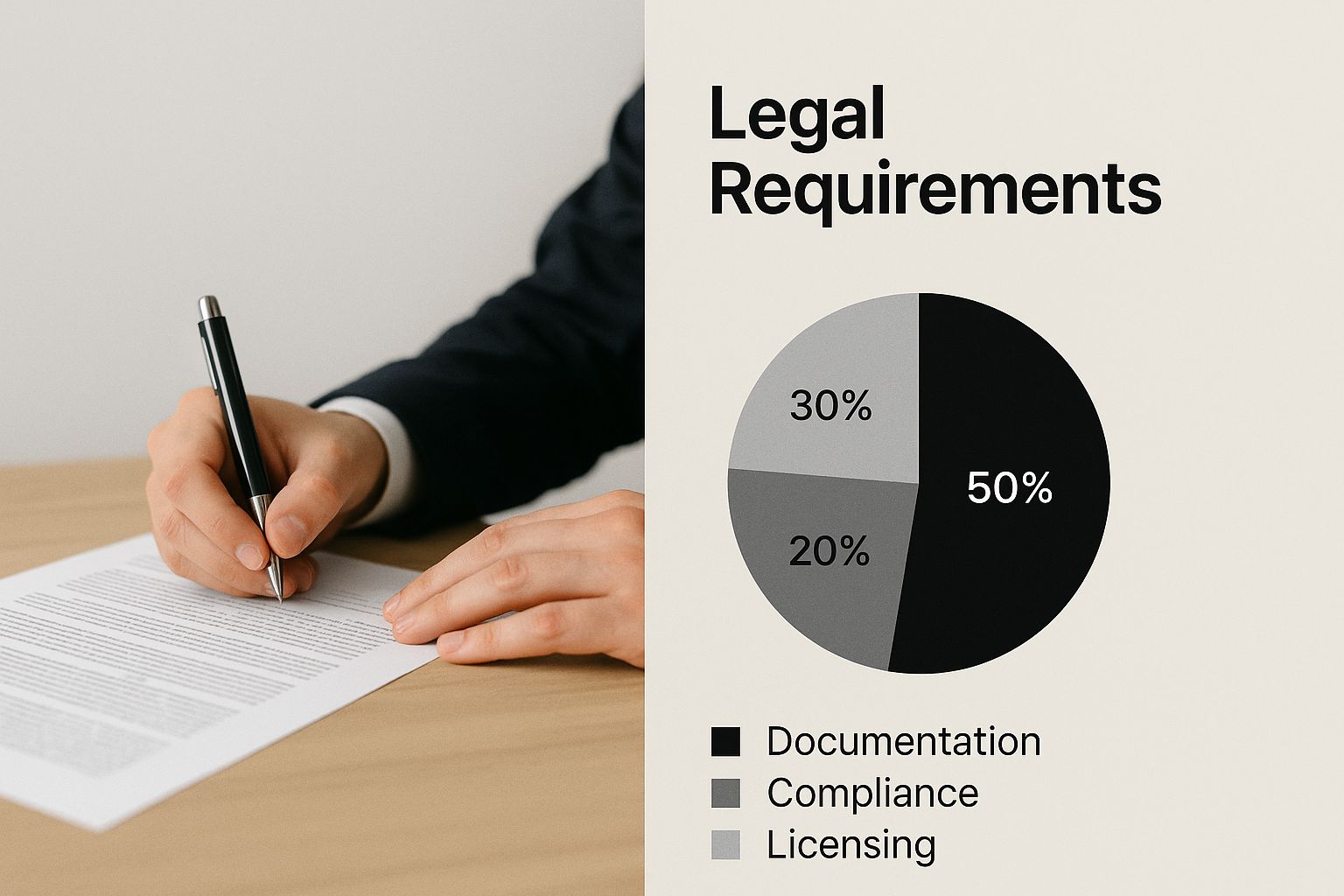
It’s a good reminder of the formal legal framework you’ll be operating within, from registering the company right through to ongoing compliance.
To help you weigh up the two main options, here’s a quick side-by-side comparison.
Limited Company vs Umbrella Company At a Glance
| Feature | Limited Company | Umbrella Company |
|---|---|---|
| Control | Full control over business and finances. You are the director. | No control. You are an employee of the umbrella company. |
| Admin | High. Responsible for accounts, tax returns, and compliance. | Very low. Submit timesheets, and they handle the rest. |
| Take-Home Pay | Potentially higher due to tax-efficient salary/dividend structure. | Lower due to all income being taxed via PAYE. |
| IR35 Status | Your responsibility to determine. Best for 'outside IR35' roles. | Ideal for 'inside IR35' roles. IR35 is not a concern for you. |
| Setup Speed | Can take days to set up bank accounts and registrations. | Can be set up in a few hours. |
| Costs | Accountant fees, business insurance, software subscriptions. | A weekly or monthly margin is deducted from your income. |
| Responsibilities | Director's legal duties to Companies House and HMRC. | Standard employee responsibilities. |
Choosing between these two paths is a major decision, and it really depends on your personal circumstances, your attitude to risk, and how much admin you're willing to take on.
For a much deeper dive, our complete guide on the differences between an umbrella company vs limited company breaks everything down in more detail to help you make the right call.
Navigating IR35 and Your Tax Status
If you're looking to become a contractor in the UK, getting your head around the off-payroll working rules, better known as IR35, is absolutely non-negotiable. This is the piece of legislation HMRC uses to figure out if a contractor is a genuine, independent business or a ‘disguised employee’ for tax reasons.
Getting this right is critical. Your IR35 status has a direct line to how you're taxed and, ultimately, how much of your day rate actually ends up in your bank account. It can feel like a minefield, but let's break it down into simple, practical terms.

Inside IR35 vs Outside IR35
Every single contract you take on will be assessed for IR35. The decision usually falls to the end-client you're working for (unless they're a small company), and the outcome will slot your contract into one of two buckets.
- Inside IR35: The contract is seen as 'employment' for tax purposes. This is the important bit, it means you’ll be taxed at source through PAYE, just like a permanent employee.
- Outside IR35: This means your contract is viewed as a legitimate business-to-business service. It’s the status that allows you to operate more tax-efficiently, usually through your own limited company.
For any role that’s been flagged as inside IR35, going through a compliant umbrella company is easily the most straightforward and risk-free path. We dive much deeper into this in our complete guide covering what IR35 is and how it affects contractors.
In short, an ‘inside IR35’ decision means HMRC considers your working relationship to be the same as employment, no matter what your business structure says on paper. Income tax and National Insurance will be deducted before the money ever hits your account.
Key Tests for Determining IR35 Status
So, how does a client or HMRC actually decide if a contract is inside or outside IR35? They look at the reality of your day-to-day working practices, not just the words written in the contract. There are a few key tests they use to get the full picture.
Control
This one is a big deal. The less control a client has over how, when, and where you get the work done, the stronger your case for being outside IR35.
Think about it this way: an IT contractor brought in to deliver a specific software upgrade (likely outside IR35) would typically decide on their own methods and working hours. But an IT contractor told to work 9-to-5 under the direct supervision of a line manager? That looks a lot more like an employee, pushing the role inside IR35.
Substitution
Here's a classic test: can you send a suitably qualified replacement to do the work in your place? A genuine business should have an unfettered right of substitution. This means you can provide a substitute, and the client can't just reject them without a valid reason.
If your client insists that only you can do the job, it strongly suggests a contract for personal service, which is a major red flag for an inside IR35 determination.
Mutuality of Obligation (MOO)
This test examines whether the client is obliged to keep offering you work and, just as importantly, whether you are obliged to accept it. In a true contractor relationship, there shouldn't be any such obligation.
When the project is done, the engagement is over. Simple. If there’s a lingering expectation of continuous work, it starts to drift into territory that looks more like an employment relationship. Understanding these tests is your first defence in confidently assessing any potential contracts that come your way.
Managing Your Finances as a Contractor
When you step into the world of contracting, you effectively become the chief financial officer of your own career. Getting a firm grip on your money right from the start isn’t just good practice, it’s absolutely essential for your long-term success and peace of mind.
This means you’ve got to get your head around your tax obligations, sort out the right insurance, and keep your books in good order. It's a different world from being a permanent employee, whether you're working through your own limited company or using an umbrella. Let's walk through the key things you need to manage to stay compliant and financially healthy.
Understanding Contractor Taxes
The UK tax system can feel like a maze at first, but for contractors, it really boils down to a few key areas, and what you pay depends entirely on your business structure.
Limited Company Taxes: As a company director, you’ll be dealing with Corporation Tax on your company’s profits. You also need to handle your personal tax through a Self-Assessment tax return, which covers your salary and any dividends you draw from the company. On top of that, if your turnover goes above the current threshold of £90,000, you’ll have to register for and charge Value Added Tax (VAT).
Umbrella Company Taxes: This route is a whole lot simpler. The umbrella company acts as your employer, so they handle all the tricky bits. They deduct Income Tax and National Insurance contributions directly from your pay through the PAYE (Pay As You Earn) system. You get a net salary, just like a regular employee, so there are no surprise tax bills down the line.
Keeping on top of all this is critical. We offer dedicated support and have some really useful guides on accounting for contractors that can make life much easier.
Essential Business Insurance
Business insurance isn't just a 'nice-to-have' for contractors; most clients and agencies will make it a contractual requirement. It’s there to protect you, your business, and your client from financial loss if something goes wrong.
Pretty much every client will insist that you have Professional Indemnity insurance. This covers you if a client claims your work was negligent or caused them to lose money. Other common policies you’ll come across are Public Liability and Employers' Liability, particularly if you're thinking of hiring anyone.
Having the right insurance in place is a hallmark of a professional contractor. It shows you take your responsibilities seriously and provides a vital safety net for your business.
Banking and Bookkeeping Basics
Here's a golden rule: always separate your business and personal finances. If you run a limited company, you’re legally required to have a dedicated business bank account. It makes tracking your income and outgoings so much simpler and is non-negotiable for accurate accounting.
Even if you go the umbrella route, having a separate current account for your contracting income can make budgeting a breeze. Good bookkeeping is the foundation of solid financial management. You can start with a simple spreadsheet or jump straight into dedicated accounting software to track every invoice and expense. This not only keeps you organised but ensures you claim every allowable expense you're entitled to.
As you plan for your long-term financial stability, you'll run into unique challenges, like getting a mortgage. It's well worth looking into specific home loan guidance for the self-employed, as having your financial records in perfect order will be vital.
There's a huge demand for skilled labour in many sectors right now. Take construction, for instance. The workforce stood at around 2.14 million in the last quarter, yet job vacancies remained high at about 35,000. With average earnings climbing by 4.7% year-on-year, it points to a strong market where organised, financially savvy contractors can really thrive.
How to Find and Secure Your First Contract
Alright, you've got your business structure sorted. Now for the exciting bit: landing that first contract. This is where the planning stops and the action starts. It's time to showcase your skills and win the work that'll get your contracting career off the ground.
Honestly, knowing where to look and how to sell yourself is half the battle.
A brilliant starting point is to connect with specialist recruitment agencies. These guys have their fingers on the pulse and hold established relationships with clients across your industry. They often have access to contracts you'll never see advertised publicly. Building a solid rapport with a couple of key recruiters can be a game-changer; they'll be the ones actively championing you for the best roles.

Crafting a Contractor-Focused CV
First things first: your old CV needs a complete overhaul. It’s no longer a chronological history of your employment. Think of it as a sales document, a powerful tool that screams about your skills, expertise, and the tangible value you bring to the table.
Here's how to get it right:
- Lead with a punchy summary: Kick off with a strong opening statement that nails down your specialism and highlights your biggest wins.
- Focus on outcomes, not duties: Forget listing responsibilities. It’s all about the results you delivered. "Implemented a new CRM system that increased sales leads by 15%" is infinitely more powerful than "Responsible for CRM system." See the difference?
- Keep it brief: Nobody has time to read a novel. Aim for a two-page maximum. Clients and recruiters need to grasp your value proposition in seconds.
Your contractor CV has one job: to sell your expertise as the solution to a client’s problem. Every project you list should demonstrate a clear return on investment, positioning you as a low-risk, high-value professional they can't afford to ignore.
Preparing for Interviews and Negotiating Your Rate
Contracting interviews are a different beast entirely. Clients aren't that interested in your five-year plan. They have an immediate, often business-critical problem, and they need to know if you have the specific skills to solve it. Fast.
Be ready to dive deep into your previous projects. Talk about the challenges you faced, the sticky situations, and exactly how you navigated them to get the job done.
Negotiating your day rate is another crucial skill you'll need to master. Before you even start looking, do your homework. Research the going market rate for your skillset and level of experience. When you state your rate, do it with confidence. Be prepared to justify it with a proven track record of delivering results.
Take the UK construction industry, for instance. Its output was valued at a massive £139 billion. Despite some slow patches, new orders recently surged by 26.6% in a single quarter, all thanks to major projects kicking off. This kind of growth creates a fiercely competitive market where top-tier contractors are in high demand. If you want to get a better handle on these trends, you can read the full analysis on the construction market.
Common Questions About Becoming a UK Contractor
Dipping your toe into the world of contracting is exciting, but it's natural to have a few questions swirling around. Let's tackle some of the most common ones we hear from people just starting out.
How Much Can I Earn as a Contractor in the UK?
This is the big one, isn't it? The honest answer is: it varies massively depending on your field, skills, and level of experience.
Contractors in sought-after sectors like IT, finance, and engineering can command some of the highest day rates. You might see anything from £250 for more junior positions right up to £1,000+ for highly specialised senior roles.
The key is to do your homework. Research the going market rate for your specific skillset to price yourself competitively. And don't forget, the final amount you take home will be affected by your business setup, whether you're a limited company or with an umbrella, and if your contract falls inside or outside IR35.
Do I Need an Accountant to Be a Contractor?
Another excellent question, and the answer really hinges on how you decide to work.
- Working through an umbrella company? Then no, you won't need your own accountant. The umbrella acts as your employer, handling all the tax and National Insurance calculations for you via PAYE. It keeps things simple.
- Running your own limited company? In this case, getting a specialist contractor accountant on board is a very smart move. In fact, most would say it's essential. They’ll manage your company accounts, Corporation Tax, and VAT, making sure you're fully compliant and as tax-efficient as possible.
What Is the Key Difference Between a Contract and a Permanent Role?
At its core, the difference comes down to your employment status. When you have a permanent job, you're an employee. You get all the statutory rights that come with it, for example sick pay, holiday leave, and pension contributions.
A contract, however, is a business-to-business agreement. You're not an employee; you're providing a specific service for an agreed-upon period. As a contractor, you're essentially trading the security blanket of traditional employment for the potential of higher earnings and far greater control over your work life.
This distinction is the absolute bedrock of a successful contracting career. You are not an employee; you are a service provider running a business. Getting your head around that mindset shift is vital for everything from how you negotiate rates to how you manage your finances.
At UmbrellaCompany.com, we specialise in helping contractors find the perfect, compliant umbrella company for their needs. Our comparison tool makes it simple to choose the right partner for your contracting journey. Find and compare trusted umbrella companies today at https://umbrellacompany.com.


