


Let’s be honest, you can’t simply “avoid” IR35. It’s not a tax you can sidestep. What you can do is make sure your contracts and the way you work put you squarely 'outside IR35'. This is the key. It means you are seen as a genuine business, not an employee in disguise, and you can keep operating tax-efficiently through your limited company.
Understanding IR35 and Its Tax Implications

Navigating the IR35 legislation can feel like wading through treacle, but getting your head around its purpose is the first real step to getting it right. At its core, IR35 (or the 'off-payroll working rules' as HMRC calls it) is all about sorting genuine independent contractors from 'disguised employees'. These are people who work just like permanent staff but invoice through their own limited company (a Personal Service Company, or PSC) to lower their tax bill.
First introduced way back in the Finance Act 2000 and shaken up by major reforms in 2021 for the private sector, IR35 has completely changed the game for UK contractors. The goal is simple: make sure contractors who do the work of an employee also pay similar tax and National Insurance.
Inside vs Outside IR35: The Critical Difference
This is the big one. Whether you are found 'inside' or 'outside' IR35 has a massive, direct impact on your tax bill and how much cash you actually take home.
Inside IR35: If your contract is deemed 'inside IR35', HMRC sees you as an employee for tax purposes. This means your client (or the agency paying you) has to deduct Income Tax and National Insurance Contributions (NICs) before the money even hits your company bank account, just like a regular employee. Your net pay takes a significant hit.
Outside IR35: Getting an 'outside IR35' determination confirms you are a proper, independent business. You get paid your gross day rate, and you manage your own tax affairs. This usually means taking a small salary and the rest in dividends, which is almost always more tax-efficient.
Understanding this is not just about ticking boxes for HMRC; it's about protecting your income and financial freedom. We dive much deeper into this in our full guide on what IR35 is and how it all works.
The Key Tests for IR35 Status
HMRC does not just pull your status out of a hat. They use a series of key tests, built from decades of employment law cases, to get a complete picture of your working relationship with a client.
The three pillars of any IR35 assessment are Control, the Right of Substitution, and Mutuality of Obligation (MOO). If you want a strong 'outside IR35' case, you need to show that these classic signs of employment just are not there in your contract.
So, what do these tests actually mean in the real world?
Control: This is all about who calls the shots. Who decides how, what, when, and where you do your work? A true contractor has a great deal of autonomy. An employee, on the other hand, is usually managed and supervised directly by the client.
Right of Substitution: This is a powerful one. Can you send someone else with the right skills to do the job for you? If you have a genuine right to provide a substitute (and you are responsible for paying them) it is a massive indicator that you are in business for yourself.
Mutuality of Obligation (MOO): This concept can be a bit slippery, but it boils down to this: an employer is generally obliged to provide work, and an employee is obliged to do it. For a contractor, once your project is done, the client has no obligation to offer you more work, and you have no obligation to accept it. It is a clean break.
By grasping these core principles, you can start building your contracts and working practices to accurately reflect your status as an independent expert. That is the foundation for managing your IR35 risk effectively.
Strengthening Your Contract for an Outside IR35 Status
When HMRC comes knocking to investigate your IR35 status, the first thing they will ask to see is your contract. This document is not just a formality; it's your primary piece of evidence. It needs to paint a clear, undeniable picture of a genuine business-to-business relationship, not a disguised employment one.
A strong contract is your best line of defence. But getting it right is not just about clever wording; the clauses must reflect the reality of how you work. Let's walk through the absolute must-have clauses to fortify your service agreement against scrutiny.
The Power of a Genuine Right of Substitution
A Right of Substitution clause is probably the single most powerful tool you have to demonstrate you are outside IR35. Why? Because it proves the client is paying for a specific service, not for you personally.
For this to hold up, the right has to be genuine and unfettered. That means you must be able to send a suitably qualified substitute to do the work in your place. Crucially, it is on you to find and pay that substitute. If the client gets the final say on who comes in, or if the clause is so restrictive it's impossible to actually use, HMRC will just dismiss it as a sham.
A strong substitution clause gives your company the right to provide a replacement of its choosing (as long as they are qualified), at your company’s own expense. A weak clause might say substitution is only possible with the client's express permission, which hands control back to them and looks a lot like employment.
Defining a Clear Statement of Work
Vagueness is a massive red flag for HMRC. A well-defined Statement of Work (SOW) is your best friend here, as it proves you have been engaged for a specific project, not just to fill a seat. It shifts the entire dynamic from personal service to a commercial engagement focused on deliverables.
Your SOW should clearly detail:
- Specific Deliverables: What exactly are you being paid to produce or achieve?
- Project Milestones: Key stages and deadlines for the work.
- Completion Criteria: How will everyone know the project is finished?
This document is brilliant for preventing 'scope creep', where a one-off project slowly morphs into what looks like an ongoing role. It reinforces that once the defined work is done, the engagement ends, which helps to dismantle any argument for Mutuality of Obligation (MOO).
This flow chart gives you a good idea of how HMRC assesses employment status.
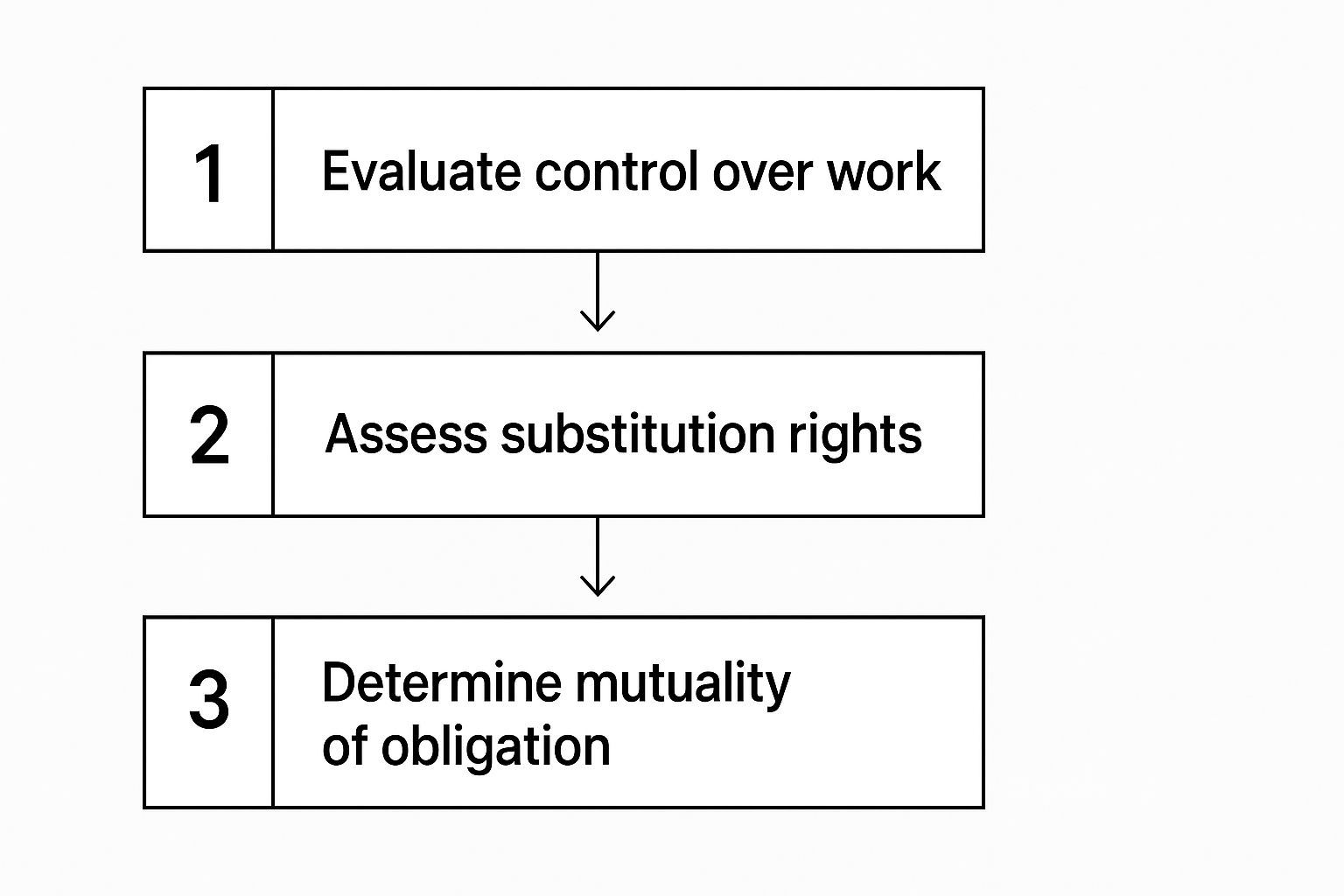
As you can see, the process logically moves through the key IR35 tests (Control, Substitution, and MOO) to build a complete picture of the working relationship.
To help you get your own contract right, here is a quick comparison of what to aim for versus what to avoid.
Key Contract Clauses for an Outside IR35 Position
| IR35 Factor | Weak Clause (High Risk) | Strong Clause (Low Risk) |
|---|---|---|
| Substitution | "Substitution is permitted only with the client's prior written consent." | "The contractor's company retains the right to provide a substitute of suitable skill at its own cost." |
| Control | "The contractor will work from 9 am to 5 pm at the client's office and report to the project manager daily." | "The contractor determines the method, means, and manner of performing the services to meet the agreed deliverables." |
| Mutuality of Obligation | "A notice period of three months is required from either party to terminate the contract." | "The contract terminates upon completion of the deliverables outlined in the Statement of Work." |
| Financial Risk | "The client will provide all necessary equipment and software." | "The contractor is responsible for rectifying errors at their own expense and provides their own primary equipment." |
Remember, your contract clauses must mirror your actual working practices. A perfectly worded contract is useless if what you do day-to-day tells a different story.
Other Vital Clauses to Include
Beyond the big three, a few other clauses add crucial layers of evidence that you are an independent business.
Financial Risk
One of the clearest signs of being in business is bearing financial risk. Your contract should make this obvious. For instance, a clause stating you are responsible for fixing mistakes at your own cost is incredibly powerful. Without it, the client is absorbing all the risk, just as they would for an employee.
Equipment and Premises
The contract should specify that you provide your own primary equipment. Of course, it is common to use client hardware for security or integration reasons, but your core tools (your laptop, for example) should be yours. This demonstrates you are not reliant on the client like a typical employee.
Notice Periods
Long notice periods are a trap. A 30-day notice period for both sides looks suspiciously like a standard employment contract. Shorter periods, or clauses allowing for immediate termination after the project is done, are much more reflective of a genuine business-to-business deal.
As you review these clauses, it is also smart to understand how your status affects your bottom line. A well-structured contract is the first step towards compliance and financial efficiency. For more on this, you can explore our guidance on IR35 and high take-home pay options.
Aligning Your Working Practices with Your Contract

A perfectly drafted, outside-IR35 contract is a brilliant start, but it is only half the battle. When HMRC decides to investigate, they do not just read the contract; they look at the reality of your day-to-day work. If your working practices scream 'employee', that carefully worded document will not be worth the paper it is written on.
This is a classic pitfall for many contractors. The key is to consistently act like the independent business your contract says you are. It is all about demonstrating genuine autonomy and maintaining a professional distance. You are there to deliver a service, not just fill a seat.
HMRC is piecing together a complete picture of your relationship with the client. Every action you take on-site, every email you send, and every meeting you attend is another brushstroke in that picture.
Demonstrating a Lack of Client Control
Control is one of the biggest red flags for an employment relationship. A genuine contractor controls how and when they complete their work to hit the agreed-upon deadlines. An employee, on the other hand, is told what to do and how to do it.
To actively show you are not under your client’s thumb, you need to:
- Set your own hours. Of course, you need to hit project deadlines and attend key meetings, but try to avoid rigidly sticking to a 9-to-5 schedule just because the permanent staff do.
- Decide on your own methods. You are the expert they hired to deliver a result. It is up to you to decide the best way to get there, rather than being spoon-fed a step-by-step process from the client.
- Work from your own location when possible. If the project allows for it, splitting your time between the client’s office and your own space is a powerful way to reinforce your independence.
Think of it like hiring a plumber. You show them the leak and tell them when you need it fixed; you do not stand over them dictating which wrench to use. Your relationship with your client should work on that same basis of professional trust and autonomy.
Avoiding Organisational Integration
One of the easiest traps to fall into is becoming too embedded in your client's organisation. When you start to look and feel like just another member of the team, it seriously weakens your outside-IR35 position.
This is all about maintaining a clear professional boundary. Blurring the lines between your business and the client’s can be seen by HMRC as a clear sign of employment, no matter what your contract says.
Maintaining a clear distinction between your business and your client’s is not about being unfriendly; it is about professional discipline. Actions like using a client email address or attending staff-only parties can inadvertently suggest you are 'part and parcel' of their organisation.
Here are a few practical ways to avoid this:
- Use your own kit. Always try to use your own laptop, phone, and software. Sometimes you will need to use client-provided tech for security or access reasons, but your core tools should always be your own.
- Politely decline employee perks. Say no to offers to join the company pension scheme, private healthcare, or subsidised gym memberships. These benefits are for employees, not external suppliers like your business.
- Steer clear of internal-only events. This means the staff Christmas party, team-building away days, and other social events intended for permanent employees.
- Maintain your own business identity. Always use your own company email address for correspondence and have your own business cards handy. You should not be listed on internal organisation charts or phone directories.
Working on a Clear Project Basis
At its core, contracting is about providing a service to complete a specific project, not just filling a role indefinitely. Your day-to-day actions have to reflect this finite, outcome-focused relationship.
For instance, once your part of the project is done, you should be moving on. If your contract ends and you just seamlessly roll onto the next "project" without a new agreement or a proper Statement of Work, it starts to look an awful lot like continuous employment.
Consider this real-world scenario:
An IT contractor is hired to deliver a new software system. Her contract clearly defines the project scope, milestones, and deliverables. Throughout the project, she works autonomously, uses her own laptop for coding, and politely turns down an invitation to the company’s summer BBQ. When the project is finished, she hands over the system, and her engagement ends. This is a textbook example of a strong outside-IR35 setup.
Now, contrast that with another contractor hired for the same project. He starts working 9-to-5, gets a company email address, and is managed daily by the client’s department head. After the project finishes, he is simply asked to stay on to "help with bug fixes and general IT support" without a new contract. This kind of behaviour is a huge risk to an outside-IR35 status.
Ultimately, your actions will always speak louder than your contract. By consciously making sure your working practices align with your status as an independent business, you build a powerful, consistent defence against any potential IR35 challenge.
Proving You Run a Genuine Business
While your contract and the way you work are the main pillars of an outside IR35 status, HMRC also looks at the bigger picture. Are you just a contractor, or are you the director of a genuine commercial enterprise? Proving the latter adds serious weight to your case, showing you are well and truly in business on your own account.
This really boils down to demonstrating that your Personal Service Company (PSC) is more than just a shell for invoicing a single client. It needs to have a real presence, take on financial risk, and actively chase new business. These are the classic hallmarks of a legitimate, independent business.
Building Your Commercial Presence
First impressions matter. That is true for potential clients, and it is certainly true for HMRC. Your business needs to look and feel like a professional operation. This is all about creating tangible evidence that you are an independent entity, completely separate from your clients.
Here are a few key steps to building that presence:
- A Professional Website: A simple, well-designed website that details your services, expertise, and contact information is a powerful asset. Think of it as your digital shopfront, showing you are open for business to the entire market.
- Branded Stationery: It might seem old-school, but investing in business cards, letterheads, and a proper email signature with your company's branding makes a difference. Consistency across all your communications reinforces your professional identity.
- A Dedicated Business Bank Account: This is non-negotiable. It is a legal requirement for a limited company and a fundamental part of running a business properly. It keeps your finances separate and professional.
These elements are not just for show. They create a clear, visible line between your business and the clients you serve, which is essential for proving your independence.
Taking on Genuine Financial Risk
One of the most compelling arguments for being outside IR35 is demonstrating that you bear a genuine financial risk. An employee is shielded from financial loss, but a real business always has skin in the game. This financial exposure is a clear indicator of self-employment.
HMRC considers financial risk a crucial test. If your business has the potential to make a loss, it strongly suggests a commercial relationship rather than employment.
So, how can you demonstrate this risk in practice?
- Holding Business Insurance: Having your own professional indemnity and public liability insurance is a must. It shows you are responsible for your own work and any potential mistakes that might occur.
- Investing in Your Own Assets: This means using your own laptop, software licences, and other essential equipment. You are investing your company's money to deliver the service, not relying on the client to provide everything.
- Paying for Your Own Training: A business invests in its own capabilities. Paying for your own professional development and certifications shows you are maintaining your marketability independently of any single client.
- Rectifying Errors at Your Own Cost: A strong contract should state that you are responsible for fixing any faulty work without additional payment. This is a direct financial risk that no employee would ever face.
Marketing Your Services to Multiple Clients
A business that relies solely on one client for all its income can look suspiciously like a disguised employee. Actively marketing your services and working for multiple clients is one of the strongest indicators that you run a legitimate enterprise.
This does not mean you have to juggle multiple projects at once. What it does mean is that you should be able to show evidence of seeking work from various sources. This might include having an active LinkedIn profile, being registered with multiple recruitment agencies, or networking within your industry.
To provide tangible evidence of your structured operations, consider how you can effectively use business process documentation templates to formalise your methods. These actions collectively build a compelling case that your PSC is an independent business, helping you to secure your outside IR35 status.
Using an Umbrella Company for IR35 Compliance

Let's face it: sometimes a contract is simply 'inside IR35', and there is no realistic way to challenge it. When that happens, working through an umbrella company is often the most practical and hassle-free way forward.
It is a solution that neatly sidesteps the IR35 headache, allowing you to get on with the job while keeping the flexibility that makes contracting so appealing.
Think of an umbrella company as a kind of intermediary that sits between you and your client or agency. They effectively become your employer for tax purposes. This means you can take on fixed-term projects without the administrative baggage or legal risks of running your own limited company for an inside-IR35 role.
So, How Does It Actually Work?
The process is refreshingly straightforward. Once you sign up with a compliant umbrella company, you officially become their employee. They handle the contract with your agency or end client, while you sign a contract of employment directly with them.
From that point on, the umbrella company manages all your invoicing and payments. They receive the money from the client for your hard work, and then they pay you through the PAYE (Pay As You Earn) system. All the right tax and National Insurance contributions are deducted at source, exactly like a permanent employee.
By becoming an employee of the umbrella company, your income is processed correctly under HMRC's rules. This effectively takes IR35 out of the equation for that specific contract, as the correct employment taxes are paid from the outset.
This route gives you complete peace of mind and ensures you are fully compliant. You will receive a clear, detailed payslip for every payment, so there are no nasty surprises or unexpected tax bills waiting for you down the line. To get a better feel for the mechanics, you can learn more about what an umbrella company is and how the model operates in our detailed guide.
The Key Benefits of Going Umbrella
Choosing an umbrella company is not just a box-ticking exercise for tax compliance. It brings some real, tangible benefits that can make a contractor's life a whole lot easier. You get the stability of employment without sacrificing the freedom to pick and choose your projects.
Here are the main advantages:
- Total IR35 Peace of Mind: For any role deemed inside IR35, this is the safest path. All your tax liabilities are handled correctly, which means zero risk of an HMRC investigation into your employment status for that contract.
- Access to Statutory Rights: As a formal employee, you are entitled to statutory benefits like sick pay, maternity or paternity pay, and a workplace pension. It is a safety net you just do not get when operating through your own PSC.
- Continuity of Employment: Hopping between contracts under a single umbrella company builds a continuous employment record. This is a massive help when you need to apply for a mortgage, loan, or credit, as it proves a stable income history.
- Less Admin, More Focus: Forget chasing invoices, wrestling with tax calculations, or managing company accounts. The umbrella company takes care of all the paperwork, leaving you free to focus on what you do best.
Finding a Provider You Can Trust
The shadow of the IR35 reforms has, unfortunately, led to a rise in dodgy, non-compliant schemes promising ridiculously high take-home pay. It is absolutely vital to choose a reputable, accredited umbrella company. Getting drawn into a tax avoidance scheme, even accidentally, could land you with a monumental and unexpected tax bill from HMRC.
Always look for providers accredited by recognised professional bodies like the FCSA (Freelance & Contractor Services Association) or Professional Passport. This accreditation is your proof that they have been independently audited and stick to the highest standards of compliance.
The disruption from the IR35 changes is undeniable. A 2025 IPSE survey revealed that a staggering 26% of UK contractors are currently out of work, with 56% pointing the finger directly at IR35. With fewer 'outside' roles on the market, compliant umbrella solutions have become more crucial than ever.
IR35 Tax: Your Questions Answered
Getting to grips with IR35 always throws up a few tricky questions. We have pulled together the most common ones we hear from contractors to give you clear, no-nonsense answers.
Can I Be Inside IR35 with One Client and Outside with Another?
Yes, you absolutely can. Your IR35 status is not a label that sticks to you personally; it is assessed contract-by-contract. Each project you take on is judged on its own terms and the reality of your working practices for that specific job.
It is perfectly normal for a contractor’s portfolio to have a mix of inside and outside IR35 contracts. This is just part of the flexibility of modern contracting, allowing you to adapt to what different clients need while staying compliant on every single engagement.
What Is a Statement of Work and Why Is It Important for IR35?
A Statement of Work (SOW) is a document that locks down the specific scope of a project. Think of it as the blueprint for the engagement, detailing the deliverables, timelines, milestones, and how you will get paid.
You really cannot overstate its importance for IR35. A solid SOW is your best evidence that a client is paying for a specific service or outcome, not just for your time to fill a seat. It frames the relationship as a professional, business-to-business one focused on results, which is a key pillar of an outside IR35 determination.
A strong SOW should always include:
- Clear Project Deliverables: What will you actually produce or achieve?
- Defined Timelines: Key milestones and a firm completion date.
- Acceptance Criteria: How the client will officially sign off on the finished work.
Does Having Multiple Clients Automatically Place Me Outside IR35?
Working with several clients is a massive indicator that you are running a proper business, but it does not give you a free pass to be outside IR35 on any single contract. HMRC will still look at each engagement individually, applying the usual status tests like Control and Substitution.
That said, having a diverse client base makes your overall case much, much stronger. It shows you are not financially tied to one client, you are actively out there marketing your services, and you operate as a genuine independent business. It helps build a convincing story that supports an outside IR35 status.
What Happens If HMRC Investigates and Disagrees with My Status?
If HMRC decides to investigate and successfully argues that you were wrongly classified as outside IR35, the financial hit can be serious. Your limited company would be on the hook for all the unpaid PAYE tax and National Insurance contributions for the whole contract.
And it does not stop there. HMRC can also tack on interest and penalties, which can quickly make the final bill much larger.
This is exactly why so many contractors get IR35 tax investigation insurance. It covers the costs of professional help during an enquiry and can even pay the tax bill if you lose the case. It is a small price for some serious peace of mind.
Your best line of defence, with or without insurance, is to keep detailed records of everything: contracts, emails, and any proof of how you actually worked.
Navigating IR35 means being prepared and understanding your responsibilities. At UmbrellaCompany.com, we take the guesswork and risk out of the equation by making it simple to find and compare compliant umbrella solutions. Find the right accredited partner for you today.
Compare trusted umbrella companies now at UmbrellaCompany.com


