


On the surface, setting up a limited company in the UK seems incredibly cheap. The mandatory online registration fee with Companies House is just £50. That is the baseline, the absolute minimum you will spend to get your company incorporated digitally. But as any seasoned contractor will tell you, that is rarely the final figure.
This guide breaks down all the costs you need to consider, from the initial setup to ongoing annual expenses, helping you build a realistic budget from day one.
The True Cost of Forming a Limited Company
To budget properly right from the start, you need to look beyond that headline number. While the government's fee is fixed, many new business owners have to decide whether to go it alone or bring in a professional to handle the paperwork.
Direct Registration vs. Using a Formation Agent
You essentially have two paths you can take to get your company registered, each with its own price tag and trade-offs.
Doing it yourself via Companies House: This is the most direct and cost-effective route. You simply go online and pay the flat £50 fee for a standard digital application. It is the cheapest way, no doubt. The catch? You are responsible for getting every single detail right, from share structures to articles of association, which can feel overwhelming if you have never done it before.
Using a Company Formation Agent: These services are the go-to for most contractors. They typically charge between £50 and £100 for their basic packages, which often include the Companies House fee. The real value here is that they take the entire process off your hands, massively cutting the risk of making a mistake that could hold up your registration. Many also throw in useful extras, like a registered office address or introductions to business bank accounts.
For many new contractors, paying that little bit extra for an agent makes perfect sense. It buys you peace of mind. Knowing all the legal boxes are ticked correctly lets you focus on what really matters (finding that first contract) instead of getting bogged down in administrative headaches.
It is amazing how much things have changed. Back in the 1970s, you would be looking at a bill of nearly £300 to set up a company. Now, thanks to everything moving online, it is accessible for around £50. The recent fee hike from £12 to £50, brought in under the Economic Crime and Corporate Transparency Act, has actually made formation agent packages look even more attractive, as many now bundle the official fee into their overall price. You can discover more about limited company setup costs on ITContracting.com to see how the numbers stack up.
One-Off Limited Company Formation Costs at a Glance
To help you decide, here is a quick summary of what you can expect to pay upfront.
| Formation Method | Typical Cost | Processing Time | Best For |
|---|---|---|---|
| Direct (Companies House) | £50 | Usually 24 hours | Confident individuals on a tight budget who are happy to handle paperwork. |
| Formation Agent | £50 – £100+ | Usually 24 hours | First-time directors, contractors seeking a hassle-free and guided setup. |
| Accountant Formation | Free – £150+ | Varies | Those who have already chosen an accountant and want an integrated service. |
Ultimately, the right choice boils down to how comfortable you are with official forms versus your budget. If you want the absolute minimum outlay, registering directly is the clear winner. But for a smooth, supportive, and streamlined start to your business, an agent is often worth every penny.
Budgeting for Essential First-Year Expenses

Once you have sorted the initial registration fee, a few other crucial costs pop up on the radar. These are not sneaky hidden fees; they are simply part of running a professional, legally sound business. Getting your head around them now will help you build a much more realistic financial picture for your first year of trading.
One of the first things you will need is a registered office address. This is the address that appears on the public record at Companies House, and for privacy reasons, using your home address is not always the best move. A virtual office service is a neat solution, providing a professional address for a small annual fee, usually somewhere between £25 and £100.
Setting Up Your Financial Foundations
Next up, every limited company is legally required to have its own business bank account. This is completely non-negotiable. It keeps your personal and company finances separate, which is absolutely vital for clean accounting and accurate tax reporting. The good news is that many high-street and digital-only banks offer free business banking for the first 12–24 months.
While it is not a mandatory upfront cost, getting advice from a professional accountant early on can be one of the smartest investments you make. A good accountant ensures your company is structured for tax efficiency right from the start, which can save you a serious amount of money down the line. They will be able to guide you on everything from share structure and salary vs. dividends to what expenses you can claim.
Getting the right financial structure in place from the beginning is like building a house on solid foundations. It prevents costly issues later and sets you up for sustainable growth and compliance.
Essential Registrations and Software
As your business gets going, other costs will come into play. You might not need them on day one, but it is wise to have them in your budget:
- Accounting Software: Tools like Xero, QuickBooks, or FreeAgent are brilliant for managing invoices, tracking expenses, and keeping an eye on your cash flow. Subscriptions typically run between £10 and £30 per month, although some accountants bundle this into their packages.
- VAT Registration: You are legally required to register for VAT once your turnover hits the £90,000 threshold in any rolling 12-month period. It is also possible to register voluntarily before you reach this point, which can be beneficial in certain situations.
- PAYE Scheme: As soon as you decide to pay yourself or an employee a salary, you will need to register for a PAYE (Pay As You Earn) scheme. Your accountant can usually handle this for you.
Choosing the right support is crucial because bad advice can be seriously expensive. To help you navigate this, we've put together a guide on finding the best accountant for limited company contractors, packed with practical tips. Thinking about these elements early on helps you create a solid budget and kick off your contracting career with confidence.
Understanding Ongoing Running Costs
So, you have got your limited company set up. The initial formation fee is just the starting line; now it is about understanding the regular costs that keep your business compliant and running smoothly. Think of these not as tedious expenses, but as essential investments in your company's health.
Beyond the one-off setup fees, there are annual obligations you simply cannot ignore. These are your legal duties to Companies House and HMRC, and failing to meet them can lead to penalties or even your company being struck off the register. Let us break down what you need to budget for.
The Annual Confirmation Statement
Every year, you need to file a Confirmation Statement with Companies House. It is a straightforward process that confirms the information they have on record for your company (things like your registered address, directors, and shareholders) is still correct.
The filing fee is currently £34 per year when you do it online. It is a small but non-negotiable part of your annual compliance. Most accountants will sort this for you as part of their service, but it is your responsibility as a director to make sure it gets done on time.
Why You Need an Accountant (And What It Costs)
For almost every contractor, your biggest ongoing expense will be your accountant. While you could technically do your own books, the maze of Corporation Tax, VAT, and payroll rules makes a specialist contractor accountant worth their weight in gold. They are not just a cost; they are your financial co-pilot.
A good monthly package from a contractor accountant should have you covered for all the essentials:
- Annual Accounts & Corporation Tax: They will prepare and file your statutory accounts and CT600 Corporation Tax return.
- Payroll (PAYE): They will run the payroll for you as the director, making sure your salary, tax, and National Insurance are all handled correctly.
- VAT Returns: If you are VAT registered, they will prepare and submit your quarterly returns.
- Director's Self-Assessment: Your personal tax return will also be taken care of.
- Proactive Advice: Crucially, they will offer ongoing advice to help you run your company in the most tax-efficient way possible.
You should budget somewhere in the region of £90 to £150+ per month for a comprehensive service. It might sound like a lot, but a good accountant will almost certainly save you more than their fee through smart tax planning. Knowing exactly how to balance your salary and dividends, for example, can have a massive impact on your take-home pay. We dive deeper into this in our guide on how to pay less tax as a limited company.
Do not just see your accountant as a number-cruncher. They are a strategic partner who can help you navigate the rules, legally minimise your tax bill, and free you up to do what you do best: your contract work.
To give you a clearer picture, here is a breakdown of what you can expect to pay annually to keep your limited company compliant and in good health.
Typical Annual Running Costs for a Contractor Limited Company
| Expense Item | Estimated Annual Cost Range | Notes |
|---|---|---|
| Accountancy Fees | £1,080 – £1,800+ | Covers year-end accounts, tax returns, payroll, VAT, and ongoing advice. This is your largest and most important recurring cost. |
| Confirmation Statement | £34 | A mandatory annual filing fee paid to Companies House. Often included in your accountancy package. |
| Business Bank Account | £0 – £120 | Many digital banks offer free accounts, but some traditional banks may have monthly fees. |
| Business Software | £0 – £300 | Free bookkeeping software is available (e.g., FreeAgent is often included with bank accounts), but you might opt for paid versions. |
| Professional Indemnity Insurance | £200 – £500+ | Not legally required but often a contractual necessity for contractors. Cost varies by profession and cover level. |
Keep in mind that costs are always subject to change. For example, the government recently increased the one-off company incorporation fee as part of the Economic Crime and Corporate Transparency Act. By staying aware of these ongoing financial commitments, you can budget effectively and ensure there are no nasty surprises down the road. You can read more analysis on UK company running costs on e-Accounts.co.uk for another perspective.
Real-World Budgets for Different Contractors
Theory is one thing, but what do these numbers actually look like in practice? To bring it all to life, we have put together a few budget scenarios for three common types of contractors.
These examples show how your industry and business model directly influence your total costs. It really proves that the initial, low formation fee is just the very beginning of the financial story. A bit of forward-thinking here will help you build a realistic budget for your own contracting journey.
The Remote IT Contractor
Let us kick off with a classic scenario: a new IT contractor working from their home office. Their needs are pretty straightforward, focusing on getting compliant and running efficiently without any major overheads.
For the first year, the budget is lean, prioritising the absolute essentials over any nice-to-haves. Here is a typical cost breakdown:
- Company Formation: £75 (Using a formation agent is a wise move for a smooth, error-free setup).
- Accountancy Package: £1,200 (This breaks down to £100 per month for payroll, annual accounts, VAT returns, and advice on tap).
- Professional Indemnity Insurance: £250 (A standard requirement for most IT contracts these days).
- Accounting Software: £0 (Good news – this is almost always included in your accountant's monthly fee).
- Confirmation Statement: £34 (The mandatory annual filing with Companies House).
This brings the total essential first-year cost to around £1,559. That is a realistic figure for a contractor who just needs to be fully compliant without any unnecessary bells and whistles.
The Creative Consultant
Now, let us picture a creative consultant, maybe a graphic designer or a marketing specialist. Their budget often needs to stretch a bit further to cover specific software and potentially higher insurance, given the nature of their client work.
Their spending really reflects the tools of their trade and the need to protect their intellectual property.
- Company Formation & Address: £125 (This covers the agent fee plus a virtual registered office, which is great for privacy).
- Accountancy Package: £1,440 (£120 a month is typical for a more comprehensive service).
- Specialist Software Subscriptions: £600 (Think things like Adobe Creative Cloud or specific project management tools).
- Professional Indemnity Insurance: £350 (It is often slightly higher to cover creative advice and services).
- Confirmation Statement: £34.
The total for a creative consultant's first year lands at around £2,549. This budget accounts for those specific operational needs that are absolutely vital for them to succeed in a competitive field.
The Growing, VAT-Registered Business
Finally, let us look at a more established limited company. Maybe they have just crossed the VAT threshold and have taken the plunge by hiring their first employee. Unsurprisingly, the costs here jump up due to the extra admin and compliance.
While the basic online registration fee for a company is a modest £50, research highlights that average UK startup costs can reach £22,756, covering everything from legal fees to marketing. This stark contrast shows why budgeting beyond the initial formation is so critical for long-term success. You can explore a detailed breakdown of these startup business costs on Money.co.uk.
A growing business simply requires more robust financial management.
- Company Formation: £100 (Often a premium package that includes a few extra services).
- Accountancy with Payroll for Two: £1,800 (£150 a month is a fair estimate to manage PAYE for the director and one employee).
- Enhanced Insurance: £450 (This will need to include Employers' Liability Insurance, which is a legal requirement).
- Confirmation Statement: £34.
This brings the estimated annual cost to £2,384, reflecting that greater compliance burden. To see how these costs might affect your earnings, it is well worth plugging some numbers into our limited company take home calculator to project your potential income.
Limited Company vs Umbrella Company Cost Comparison
For many UK contractors, the real debate is not about the one-off setup fee. It is about the bigger picture: which structure actually makes more financial sense in the long run? Is going limited genuinely cheaper than using an umbrella company? Let us put the numbers side-by-side.
An umbrella company offers one huge advantage: simplicity. You are effectively their employee, and they sort out all the admin (payroll, tax, and National Insurance) for a flat fee. This fee, often called the margin, is usually between £20 to £30 per week, or £80 to £120 per month. For that, you get proper payslips, statutory employment rights, and insurance cover bundled into a single, predictable cost.
The flowchart below gives a good sense of how your specific role and work type might shape your initial budget and choice.
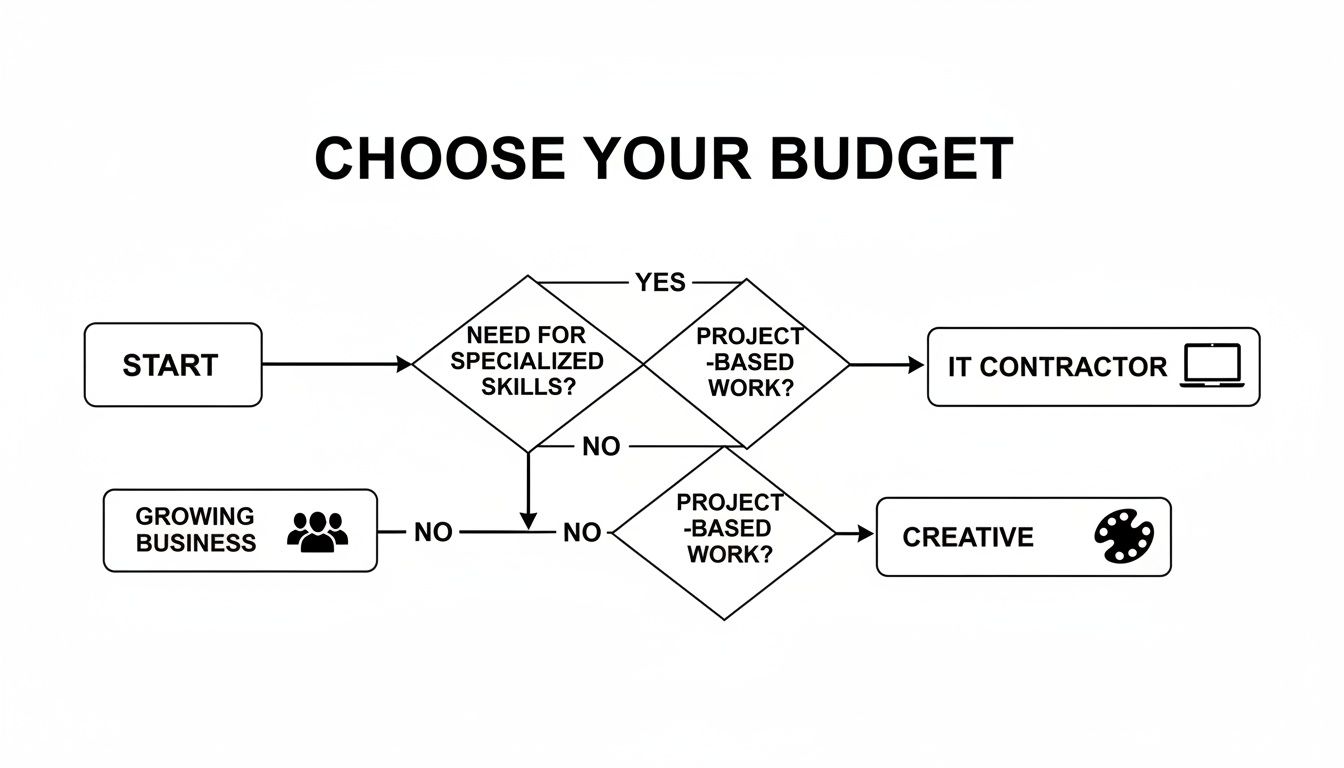
Whether you are an IT contractor or a creative professional, this helps visualise how your specialism influences the financial planning right from the start.
Weighing Up the Monthly Costs
Now, let us contrast that umbrella margin with the running costs of your own limited company. As we have already seen, you are looking at monthly accountant fees (typically £90 to £150+), accounting software subscriptions, and maybe other bits like a registered office address.
Here is the key difference: an umbrella company's margin is a straightforward cost to you. A limited company's expenses, however, are business costs. That means they can be offset against your Corporation Tax bill, reducing your overall tax liability.
The financial tipping point usually comes down to three things:
- Your Contract Rate: The higher you earn, the more tax-efficient a limited company tends to become, thanks to the flexibility of mixing a small salary with larger dividend payments.
- Your IR35 Status: If your contracts are deemed 'inside IR35', an umbrella company is often the most sensible, compliant route. Your tax treatment ends up being very similar to an employee's anyway.
- Your Appetite for Admin: Are you prepared to take on the legal responsibilities of being a company director? We are talking bookkeeping, filing deadlines, and staying compliant, all in exchange for potentially higher take-home pay.
A Direct Financial Scenario
Let us make it real. Imagine a contractor billing £400 per day.
Working through an umbrella company, their main outgoing is the fixed margin, let us say £100 per month. All their taxes are handled for them via PAYE. It is simple and predictable.
If they go the limited company route, their main cost is their accountant, perhaps £120 per month. While that is a higher figure, they now have access to tax planning opportunities that could significantly boost their take-home pay. The trade-off? They are now responsible for everything: tax compliance, business insurance, and all the annual filings.
The choice is not just about the raw numbers. It is a balance between simplicity and control. An umbrella company offers a hassle-free, 'plug-and-play' solution, while a limited company provides greater financial flexibility and potential for tax optimisation, but with added administrative duties.
Ultimately, the right answer depends entirely on your personal situation and what you want to achieve. For a much deeper dive into the pros and cons of each model, our detailed guide comparing an umbrella company vs a limited company is the perfect next step. Understanding this trade-off is absolutely crucial to figuring out what setting up a limited company will truly cost you, in both time and money.
Your Questions Answered: Company Setup Costs
Let us wrap up with a few of the most common questions we get from new directors. Knowing what to expect financially from the get-go helps you budget properly and kick off your contracting career on the right foot.
Can I Really Set Up a Limited Company for Free?
You will see plenty of adverts for 'free' company registration, but there is a small catch. While you cannot avoid the mandatory £50 Companies House fee, some accountants and formation agents will absorb this cost for you.
This is almost always part of a deal where you sign up for one of their monthly accountancy packages. The formation fee is simply rolled into what you pay them over the year. It is a convenient way to get started, but make sure you read the fine print and are happy with the long-term service before committing.
What Are the Hidden Costs I Should Look Out For?
Genuine 'hidden' costs are rare if you are working with a reputable professional, but there are definitely a few expenses that new directors forget to budget for.
Keep these on your radar to avoid any nasty surprises:
- A Virtual Registered Office: If you do not want your home address on the public record, this service will cost you somewhere between £25 and £100 a year.
- Late Filing Penalties: Missing your deadlines for the Confirmation Statement or your annual accounts is a costly mistake. Both Companies House and HMRC will issue fines.
- Professional Indemnity Insurance: It is not a legal must-have, but almost every client contract will require you to have it.
- Accountancy Extras: Check if your accountant charges extra for things like mortgage references or handling an unexpected tax investigation.
How Much Should I Expect to Pay an Accountant?
For a contractor's limited company, accountancy fees are one of those areas where you get what you pay for. A rock-bottom package covering just your year-end accounts might start around £70–£90 per month.
However, most contractors find that a more comprehensive service offers better value in the long run. For a budget of £100 to £150+ per month, you should be getting your VAT returns, director's payroll, and proactive tax advice all included. Always check exactly what is in the package before you sign.
Do I Need to Register for VAT and PAYE Straight Away?
No, you usually do not. You are only legally required to register for VAT once your turnover hits the £90,000 threshold in any rolling 12-month period. You can register voluntarily before then if it makes financial sense for your business, but it is not compulsory.
It is a similar story with PAYE (Pay As You Earn). You only need to register for a PAYE scheme once you actually start paying a salary. Many contractors get the company incorporated first and then tackle these registrations down the line, which can make the initial admin feel much more manageable.
Figuring out the costs and structures of contracting can feel overwhelming, but you are not on your own. UmbrellaCompany.com simplifies the process of comparing trusted, compliant umbrella companies, so you can find the perfect solution for your contracting journey.


