


Your first proper freelance payment feels great until the practical question lands. How much tax for self employed work should you set aside?
That uncertainty is normal. When tax no longer comes off your pay automatically, you have to work out what belongs to you, what belongs to HMRC, and what records you need to keep so the final bill doesn't become a nasty surprise.
Your Guide to Self Employed Tax in the UK
If you're new to freelancing, the biggest mistake is looking for one simple percentage and assuming that's your answer. In the UK, it doesn't work like that.
Your tax bill depends on your profit, not just your sales, and it's built from more than one part. HMRC also says you'll usually need to file a Self Assessment tax return if you earn over £1,000 from self-employment, as noted in this overview of self-employment tax rules.
What usually causes confusion
Four different ideas are often confused:
- Turnover. This is the money coming in from clients.
- Profit. This is what's left after allowable business expenses.
- Income Tax. This applies once profit goes above the tax-free allowance.
- National Insurance. Self-employed people can still have NICs to deal with, and that changes the actual cost.
That's why the answer to how much tax for self employed workers pay isn't a single number.
Practical rule: Always estimate tax from profit after expenses, never from total invoices sent.
What helps most in the early stages
A good starting habit is learning when HMRC expects you to register and file. If you haven't done that yet, our guide on when to register as self-employed is a useful first step.
It also helps to compare UK-focused guidance with broader small business thinking. If you want a plain-English resource on planning ahead and managing sole trader obligations, this piece on small business tax advice gives a practical owner's-eye view.
For most freelancers, the key is to think in layers:
- Work out your annual profit.
- See how much of that profit is tax-free.
- Apply Income Tax to the relevant band.
- Add the National Insurance that applies.
- Keep money aside as you go, rather than waiting for the deadline.
Once you understand those moving parts, self-employed tax becomes much less mysterious.
The Core Taxes You Need to Understand
The UK doesn't have one separate U.S.-style self-employment tax. For self-employed people, the bill is mainly made up of Income Tax and National Insurance contributions, as explained in this UK self-employment tax summary.
Income Tax in simple terms
Think of Income Tax as slices of profit being taxed at different rates.
For the 2024/25 tax year, the first £12,570 of profit is covered by the Personal Allowance. After that, profits in the £12,570 to £50,270 band are taxed at 20%, and profits above £50,270 are taxed at 40% in England, Wales and Northern Ireland.
That doesn't mean all your profit is taxed at one higher rate once you cross a threshold. Only the part inside each band is taxed at that band's rate. That's one of the most common misunderstandings.
National Insurance for the self-employed
National Insurance often causes more confusion than Income Tax.
For 2024/25, Class 4 NICs apply at 6% on profits between £12,570 and £50,270, and 2% on profits above £50,270. In April 2024, the requirement for most self-employed people to pay separate Class 2 NICs was abolished, which simplified the system while preserving access to contributory benefits for many people through credits.
You're not paying one flat self-employed tax. You're combining Income Tax with NICs that apply to different slices of profit.
If you're used to employment, this is the main mental shift. Under PAYE, deductions are handled for you. If you want a refresher on how that payroll system works in employed settings, our guide to Pay As You Earn explains the contrast clearly.
UK tax and National Insurance rates for self employed
| Tax/NIC Type | Profit/Income Band | Rate |
|---|---|---|
| Personal Allowance | First £12,570 | 0% |
| Income Tax basic rate | £12,570 to £50,270 | 20% |
| Income Tax higher rate | Above £50,270 | 40% |
| Class 4 NICs | £12,570 to £50,270 | 6% |
| Class 4 NICs | Above £50,270 | 2% |
| Class 2 NICs | Separate payment abolished for most from April 2024 | Qualitative change |
Why the combined view matters
What really affects your take-home pay is the combined marginal effect of Income Tax and NICs on each extra slice of profit.
That's why some online answers feel incomplete. They give you an Income Tax headline, but not the full picture of what leaves your bank account.
How to Estimate Your Annual Tax Bill
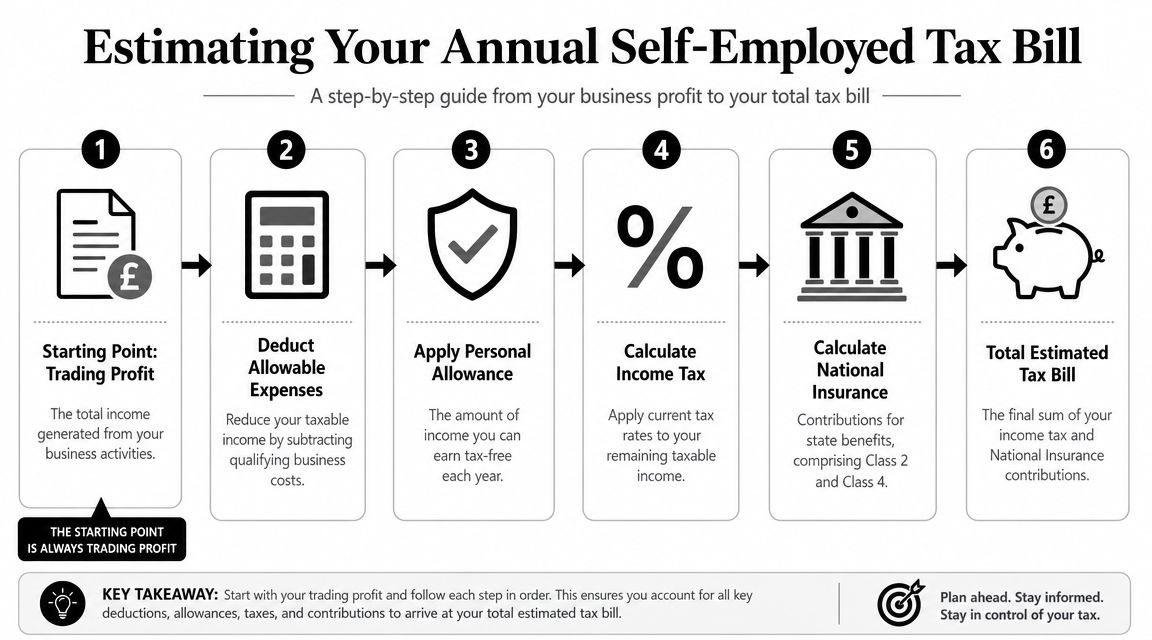
Once you stop looking for one magic percentage, estimating your bill becomes a practical exercise. The starting point is always your trading profit, which means your business income minus allowable business expenses.
A simple order to follow
Use this sequence each time you want a rough estimate:
- Add up your self-employed income for the tax year.
- Subtract allowable expenses to reach your trading profit.
- Remove the Personal Allowance if your circumstances allow it.
- Calculate Income Tax on the profit that falls into each band.
- Calculate Class 4 NICs on the profit bands that apply.
- Add those amounts together to get a working estimate.
If your income changes month to month, repeat this every few months instead of relying on one early guess.
Don't forget record keeping
Your estimate is only as good as your records. If receipts are scattered across email, notes apps and bank statements, it's easy to miss expenses and overestimate your taxable profit.
Some freelancers prefer to track spending as they go with a dedicated app rather than sorting it all later. If you're comparing tools, Rondre's expense app guide is a useful place to start.
The smoother your bookkeeping is, the easier it is to save the right amount and avoid guessing.
Two related issues that catch people out
There are two extra areas worth knowing about early.
- Payments on Account. HMRC may ask for advance payments towards your next bill based on your current tax position. Many first-year freelancers often feel blindsided by this, because the amount due can feel larger than expected.
- VAT registration. At some point, depending on how your business grows, VAT may become relevant. That's a separate system from Income Tax and NICs, so don't mix the two together when estimating your personal tax.
You don't need to panic about either point, but you do need to stay organised. A calm estimate made during the year is far easier to handle than a rushed calculation close to filing time.
A Worked Example of a Self Employed Tax Calculation
Examples make this much easier, so let's use a realistic freelance scenario.
Alex is a self-employed IT contractor with a trading profit of £60,000 for the tax year. That figure is after allowable business expenses have already been deducted.

Step one, work out the Income Tax
Alex's first £12,570 is covered by the Personal Allowance.
That leaves £47,430 of taxable profit.
Now split that taxable profit into bands:
- £37,700 falls into the basic-rate band, so that part is taxed at 20%
- The remaining £9,730 sits above £50,270, so that part is taxed at 40%
So Alex's Income Tax is:
- £37,700 × 20% = £7,540
- £9,730 × 40% = £3,892
Total Income Tax = £11,432
Step two, work out the Class 4 NICs
Now apply the NIC rules to the profit bands:
- £37,700 of profit falls between £12,570 and £50,270, so that slice is charged at 6%
- £9,730 is above £50,270, so that slice is charged at 2%
The calculation is:
- £37,700 × 6% = £2,262
- £9,730 × 2% = £194.60
Total Class 4 NICs = £2,456.60
Alex does not pay one rate on all £60,000. Different parts of the profit are taxed differently.
Step three, combine the figures
Add the two totals together:
- Income Tax = £11,432
- Class 4 NICs = £2,456.60
Estimated total bill = £13,888.60
That's the number Alex would use as a planning estimate for Income Tax and self-employed NICs on that level of profit.
A short video can also help if you prefer to see tax calculations explained visually.
What this example tells you about take-home pay
Freelancers often find clarity in understanding how tax is applied. Alex didn't lose the same rate on every pound earned. The first slice was tax-free, the next slice faced one combined set of deductions, and the top slice faced another.
That's why asking only “how much tax for self employed people pay?” can be misleading. The better question is, what happens to each extra slice of profit?
If you run your own estimate the same way, your numbers will make much more sense.
How to Legally Reduce Your Tax Bill
The cleanest way to reduce your tax bill is to make sure you claim the expenses you're entitled to claim.
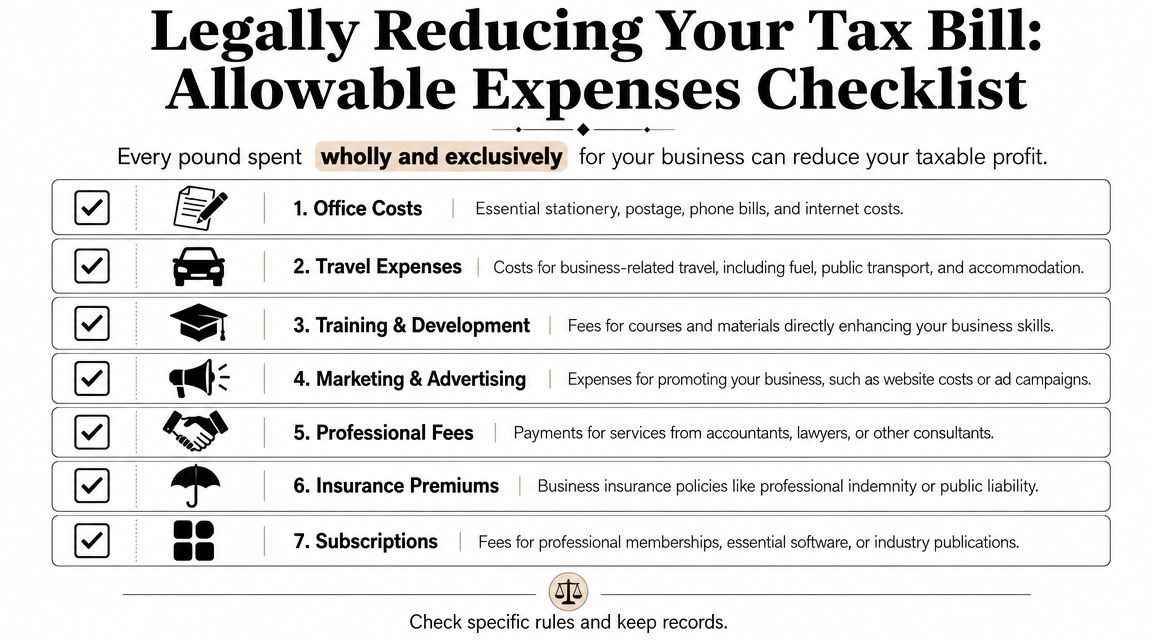
HMRC says expenses must be 'wholly and exclusively' for business purposes, and common allowable costs can include office supplies, travel costs, software, and a portion of home utility bills where you work from home, according to HMRC guidance on self-employed expenses.
What wholly and exclusively means in practice
This rule is stricter than many new freelancers expect.
If an expense is clearly for the business, it may be allowable. If it has a personal element, you need to be careful and only claim the business part where that's appropriate. Good records matter because they support your position if HMRC ever asks questions.
Common expense areas to review
- Office costs. Stationery, printer items, software subscriptions and other day-to-day tools used for work often sit here.
- Travel for business. Journeys made for client work or business tasks may count, but ordinary private travel doesn't.
- Working from home costs. If you use your home for business, some costs may be claimable. Our guide to working from home tax deductions explains the practical side.
- Professional services. Accountancy fees, legal support and other specialist help connected to the business can be relevant.
- Marketing. Website costs, design work, and promotional spending may be part of running and growing your trade.
- Insurance. Business-related policies can form part of your allowable costs.
Keep the evidence at the time you spend the money. Rebuilding records months later is possible, but it's harder and less reliable.
One area people often overlook
Mileage is a classic example. People remember the meeting, but forget to log the journey properly.
If driving is part of your work, a practical reference like this 2026 business mileage guide can help you build a better tracking habit. Even if your bookkeeping is simple, mileage tends to slip through the cracks unless you have a routine.
The real benefit of expense discipline
Claiming allowable expenses doesn't just lower your final bill. It also gives you a more honest picture of what your business is making.
That matters because freelancers often look at the bank balance and assume they're earning more than they really are. Once tax and business costs are stripped out properly, the true profit is usually lower than it first appears.
Is There an Easier Way? Considering Umbrella Companies
Some people are happy managing their own records, filing Self Assessment and setting money aside manually. Others would rather spend that time on billable work.
That's where an umbrella company arrangement can be worth considering for contract work. Instead of dealing with every tax calculation yourself, your income is processed through payroll under PAYE, so Income Tax and National Insurance are deducted before you're paid.
Why some contractors prefer this route
The appeal is mostly administrative.
- Less manual tax work. You don't have to calculate deductions on each payment yourself.
- More predictable pay. You receive net pay after payroll deductions have been processed.
- Employment-style payroll handling. This feels more familiar if you've moved from permanent work into contracting.
- Less year-end stress. There's usually less need to build your own tax forecast for that income.
For freelancers and contractors comparing options, umbrella company for freelancers outlines how that setup works in practice.
Self Assessment versus payroll simplicity
Self-employment gives you control, but it also gives you admin. You need to track income, keep receipts, estimate liabilities and stay on top of filing obligations.
An umbrella setup changes that experience. A provider processes the payroll side for you, which can suit contractors who want a simpler route, especially where assignments sit inside IR35 or where predictable deductions matter more than running as a sole trader.
The right route depends on how you work, how organised you are, and how much admin you're willing to carry.
If you'd rather compare compliant payroll options instead of handling every deduction yourself, Umbrella Company lets contractors and freelancers review umbrella companies based on their working setup.


