


Umbrella companies in the UK typically charge a fixed weekly margin of about £15 to £30 in 2026, and some still use percentage-based fees of about 3% to 5% of income. That fee is only one slice of what reduces your payslip, because statutory deductions such as employer National Insurance, the Apprenticeship Levy, and PAYE tax can sit alongside it.
If you're looking at an umbrella quote for the first time, it's easy to assume the headline fee is the whole cost. It isn't. Most confusion starts when a recruiter, agency, or provider shows one number, but your payslip later shows several deductions that weren't clearly separated at the start.
That confusion has become more common since the off-payroll working reform in April 2021 shifted responsibility for status decisions in the private sector to the end client, which pushed many contractors into umbrella arrangements inside IR35, as noted in this UK contractor guidance on umbrella company fees.
What You'll Learn About Umbrella Company Charges
A lot of contractors arrive here in the same position. You've taken on, or you're considering, an inside IR35 contract. You receive an assignment rate, then somebody mentions an umbrella, then a fee appears, and suddenly the numbers don't seem to line up with what you expected to take home.
The main problem isn't that umbrella charging is impossible to understand. It's that several different deductions get bundled together and described as if they were all the umbrella's own charge. They aren't.
The two questions most contractors ask
The first is simple. How much do umbrella companies charge?
The short answer is that the typical weekly umbrella margin is about £15 to £30 in 2026, and fixed charging is more common than percentage charging, according to this breakdown of umbrella company costs.
The second question is the one that matters more. How much of the reduction on the payslip is the umbrella's fee, and how much is tax or employment cost?
That distinction matters because an umbrella only controls part of the deduction stack. The umbrella chooses its own margin. It doesn't choose PAYE tax rules, employee National Insurance, or the employer-side costs that have to be processed before net pay is calculated.
What usually catches first-time users out
A quote can include, or leave out, several moving parts:
- The umbrella's own margin, which may be a fixed amount or a percentage.
- Employer costs, which can appear before taxable pay is worked out.
- Holiday pay handling, which changes how money shows on your payslip.
- Pension auto-enrolment, if you're enrolled in the workplace pension.
Practical rule: If a quote only shows one small headline number, ask for the full payslip calculation before you agree.
Later on, we'll work through two clear examples using simple numbers, including one with a fixed weekly fee and one with a percentage fee. That makes it much easier to see which pounds are the umbrella's choice, and which pounds are driven by the PAYE system.
How Umbrella Companies Work and Why They Charge a Fee
An umbrella company sits between the agency and the contractor. The agency pays the umbrella for the work completed, the umbrella becomes your employer for payroll purposes, and then the umbrella pays you through PAYE after processing the necessary deductions.
Think of it a bit like a letting agent handling rent collection and admin. The tenant pays the agent, the agent takes care of paperwork and payment handling, and the landlord receives the balance after the agreed administration steps. An umbrella does something similar with contract income, payroll, and employment administration.
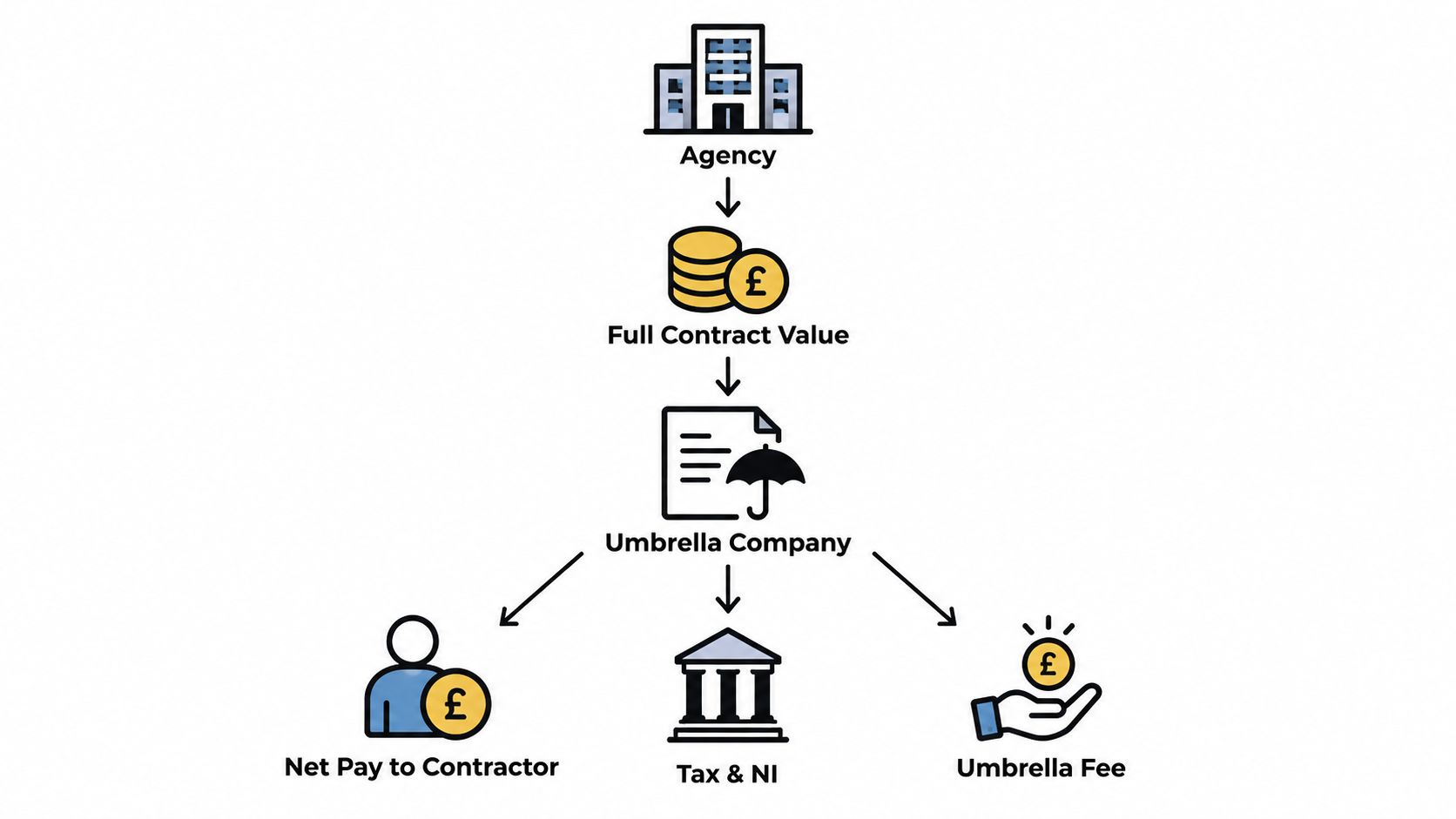
What the umbrella actually does
When you work through an umbrella, it usually handles:
- Payroll processing, including PAYE deductions and payslips.
- Employment administration, because you're treated as an employee for tax purposes.
- Holiday pay administration, whether accrued or paid out in line with the arrangement.
- Pension auto-enrolment, where applicable.
- Payment reconciliation, so the assignment income is translated into taxable pay and net pay.
HMRC says the umbrella fee should be disclosed when the worker signs the contract, and it also warns that high umbrella fees can be a sign of tax avoidance arrangements, so checking the payslip or reconciliation statement matters, as explained in HMRC guidance on checking your payslip when you work through an umbrella company.
For firms that manage large volumes of temporary workers or contractors, operational systems also matter. If you're interested in the payroll side from the business angle, contractor payroll with Pipeline On gives a useful overview of how payroll software fits into contractor payment workflows.
Why there's a fee at all
The umbrella fee isn't a random markup. It exists because the umbrella takes on administrative and employer responsibilities that would otherwise sit somewhere else in the chain.
In practice, contractors usually see four separate categories affecting the money flow:
- The umbrella's controllable fee, often called the margin.
- Employer National Insurance, which forms part of the employment cost structure.
- The Apprenticeship Levy, which can appear in the payroll calculation.
- Holiday pay administration, which affects how some earnings are set aside or shown.
A clean quote separates the umbrella's margin from every statutory deduction. A messy quote blends them together and leaves you guessing.
Fixed Weekly Margins Versus Percentage-Based Fees
Two umbrellas can offer the same basic service and still produce very different costs, because one charges a flat weekly margin and the other takes a percentage of your earnings.
UK contractor guidance commonly describes the market this way: fixed fees are often around £20 to £30 per week or £80 to £120 per month, while percentage-based margins are usually about 3% to 5% of income. The same guidance gives a simple comparison, showing that on £1,000 a week, a £25 fixed margin works out at about 2.5%, while a 5% fee would cost £50, which is why fixed charging is often easier to predict for higher earners, as explained in Contractor UK's guide to umbrella company costs and fees.
Why fixed fees are easier to compare
With a fixed fee, you know the umbrella margin in advance. If it's £25 per week, it's £25 per week whether your assignment rate is modest or high.
That makes comparisons straightforward. It also makes budgeting easier if your contract runs for several months.
With percentage pricing, the fee rises as your earnings rise. The service might not change, but the pounds deducted do.
A simple side-by-side example
Here is a basic comparison using a £25 fixed weekly fee against 3% and 5% percentage fees.
| Day Rate | Fixed £25/week | 3% Fee | 5% Fee |
|---|---|---|---|
| £200 | £25 | £30 | £50 |
| £300 | £25 | £45 | £75 |
| £400 | £25 | £60 | £100 |
| £500 | £25 | £75 | £125 |
This table uses a simple weekly assumption of five days worked, purely to compare charging styles. It isn't a payslip calculation.
Where percentage charging can become expensive
A percentage fee can look harmless at first because it feels small in percentage terms. But it scales up quickly on stronger day rates.
Some providers also complicate things by blending charges:
- A fixed margin plus a percentage, which makes headline comparison harder.
- Set-up or sign-up fees, added outside the main margin.
- Exit or leaver fees, which matter more on short assignments.
- Fast payment charges, which can inflate the total cost.
There's no statutory cap on what an umbrella can charge, and some providers still use percentage pricing while adding extra fees, as noted in this umbrella company directory guidance on fee structures. If you want a closer look at fee structures for inside IR35 work, IR35 umbrella company fees is a useful comparison point.
Statutory Deductions That Sit Alongside the Umbrella Fee
A first umbrella payslip often creates the same reaction. The contract rate looks healthy, the umbrella fee looks small, and the gap between those two figures still feels larger than expected.
The missing piece is the deduction stack. Some pounds are the umbrella's own charge for employing you and processing payroll. Other pounds are part of PAYE employment and would exist whichever compliant umbrella you used.
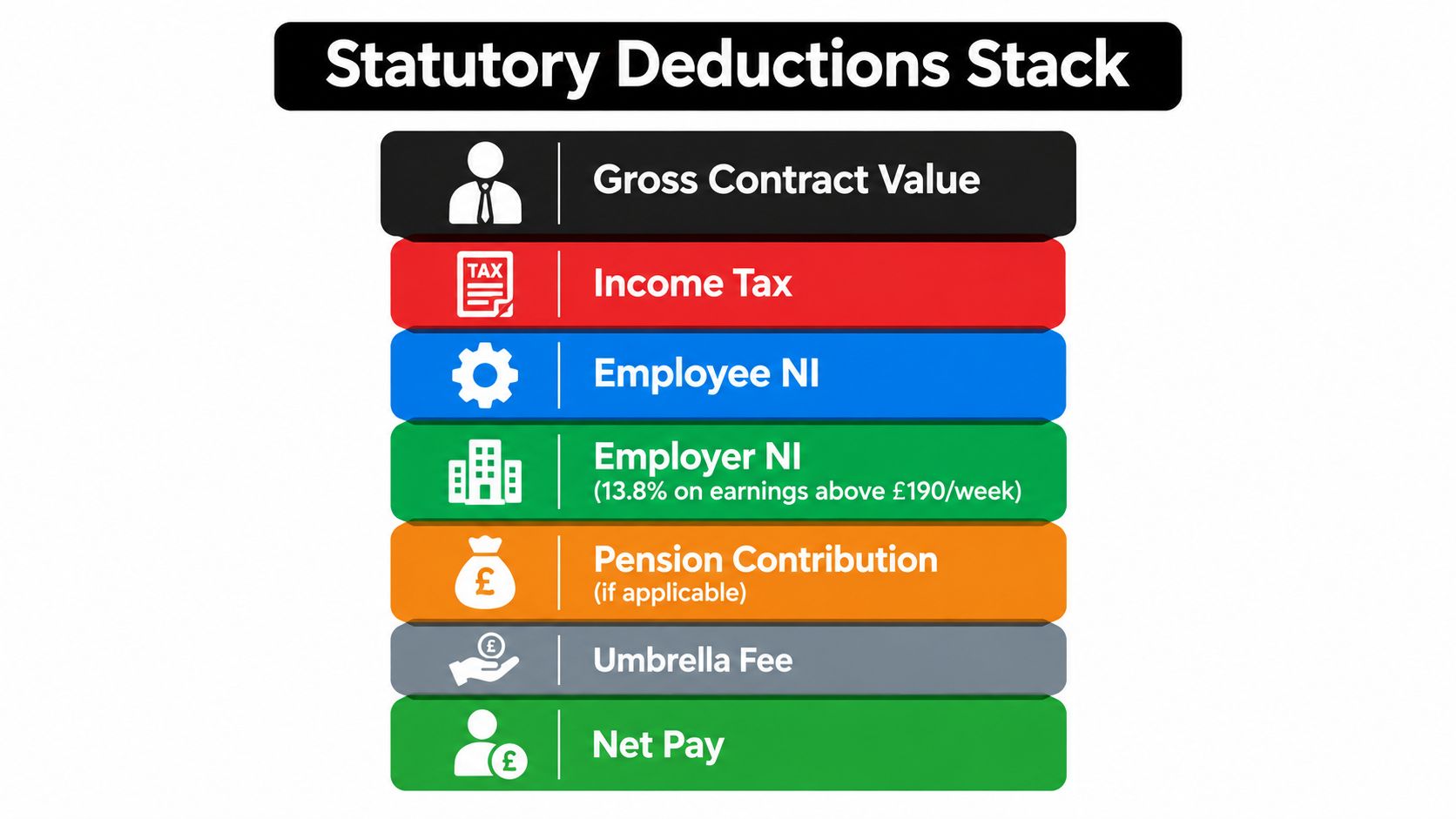
A simple way to read it is to picture three layers.
First comes the assignment income paid in by the agency or client.
Then come the amounts linked to employing you through the umbrella, such as the umbrella's margin and employer-side payroll costs. HMRC's internal guidance describes umbrella companies as retaining items from the funds they receive, including their fee, employer National Insurance, holiday pay, allowable expenses where relevant, and other costs such as the Apprenticeship Levy, as reflected in this guide quoting HMRC's internal umbrella company treatment.
Last comes your own employee payroll position, which is where PAYE Income Tax, employee National Insurance, pension deductions if you are auto-enrolled, and any student loan deductions are handled.
That distinction matters because only part of the stack is the umbrella's choice.
What the umbrella controls
The umbrella usually controls:
- Its margin, often shown as a fixed weekly amount
- Any clearly stated extra service charges, if your contract allows them
- How clearly it explains the payslip and calculation
If one umbrella charges £20 a week and another charges £35 a week, that £15 difference is a real comparison point because it is part of the umbrella's own pricing.
What the umbrella does not set
The umbrella does not set:
- PAYE Income Tax
- Employee National Insurance
- Employer National Insurance
- The Apprenticeship Levy
- Auto-enrolment pension deductions
- Holiday pay entitlement, although it does control how that entitlement is administered and shown
Employer National Insurance and the Apprenticeship Levy often confuse first-time umbrella users because they sit higher up the calculation than employee tax deductions. They are employment costs linked to the payroll model, not extra profit kept by the umbrella.
A short example makes this easier to see. If an agency pays the umbrella £1,000 for your week, the umbrella does not subtract a £25 margin and send the other £975 to payroll as taxable salary. The £1,000 first has to cover the full cost of employing you through that umbrella arrangement. Only after those employer-side costs and the umbrella margin are accounted for do PAYE tax and employee National Insurance apply to your taxable pay.
HMRC explains that umbrella workers are employees for tax purposes, so tax and National Insurance are handled through PAYE. For a line-by-line example of how those entries usually appear, see this guide to an umbrella company payslip explained. HMRC's published guidance on working through an umbrella company also sets out the basic PAYE treatment for umbrella workers: https://www.gov.uk/guidance/working-through-an-umbrella-company.
One warning sign is a provider that bundles everything together and talks as if every deduction is its fee. A clear umbrella separates its own margin from statutory deductions, so you can see which pounds are commercial charges and which pounds are part of the tax and employment rules.
Sample Calculations at Common Contractor Day Rates
Worked examples help more than theory, but they also need care. A full net pay calculation depends on tax code, pension status, holiday pay treatment, student loan position, and timing within the tax year. So the cleanest way to use examples is to separate the part we can measure clearly from the part that depends on your personal payroll settings.
Example A, £350 per day with a £25 fixed margin
Assume a contractor works 5 days a week for 46 weeks a year. At £350 per day, the gross assignment value for the year would be £80,500 based on those working assumptions.
The umbrella's own fee, at £25 per week, would total £1,150 over 46 weeks. That gives you a clear annual administration cost for the umbrella margin alone.
What happens next on the payslip is where many people get lost. Before net pay is reached, the umbrella payroll calculation may also reflect employer-side costs, then PAYE tax and employee National Insurance, along with holiday pay and pension treatment depending on the arrangement.
Example B, £500 per day with a percentage fee
Now assume the same 5 days a week for 46 weeks a year. At £500 per day, the gross assignment value would be £115,000.
If the umbrella charges 4%, the weekly fee would be £100 on a £2,500 week, and the annual fee across 46 weeks would be £4,600.
That comparison is the whole point. The service may be broadly similar, but the fee rises sharply because it scales with earnings.
A market benchmark that helps frame this
One practical benchmark often used in the market is a contractor on £400 per day, where an umbrella margin of about £25 to £30 per week is described as small relative to the full deduction stack, but still meaningful over a year. At roughly £27 per week, the margin alone is about £1,404 annually, while employer National Insurance, the Apprenticeship Levy, and pension costs are deducted first and reduce the amount on which PAYE tax and employee National Insurance are applied, as shown in this umbrella payslip checker benchmark.
| Day Rate | Fee Model | Weekly Fee | Annual Fee | Net Take-Home |
|---|---|---|---|---|
| £350 | Fixed margin | £25 | £1,150 | Varies by tax code, pension, holiday pay treatment, and payroll settings |
| £500 | 4% percentage fee | £100 | £4,600 | Varies by tax code, pension, holiday pay treatment, and payroll settings |
Because personal payroll variables matter so much, the best way to compare quotes is to model your own rate under each provider's method. A proper umbrella company take home pay calculator is the safest way to compare actual outcomes rather than advertised margins.
Practical Ways to Reduce What You Pay Your Umbrella
Once you understand the fee stack, you can reduce costs without chasing risky schemes. The biggest savings usually come from choosing the right charging model and spotting extras that don't need to be there.
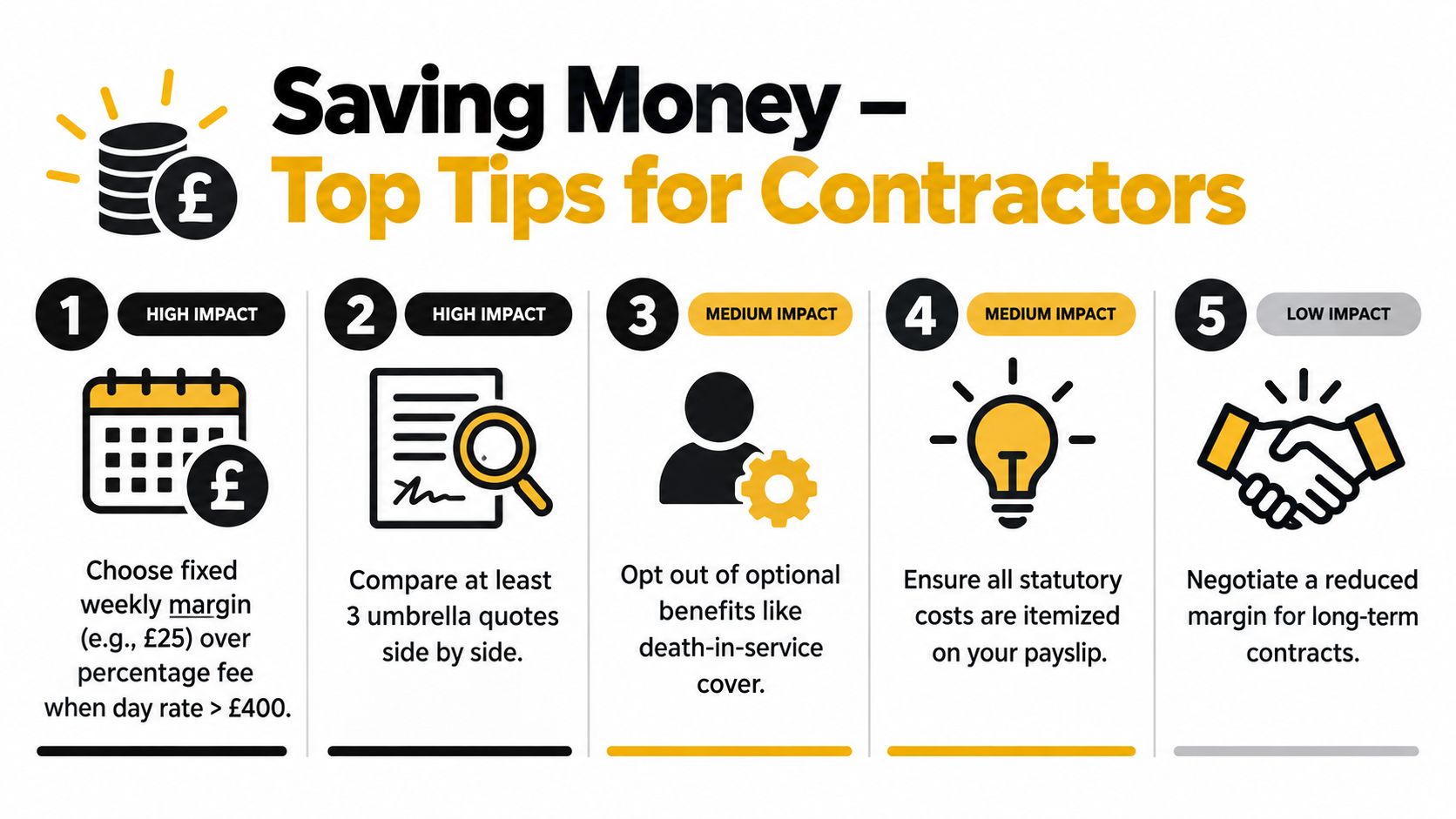
Start with the charging model
If your day rate is healthy, a fixed weekly margin is often easier to live with than a percentage fee. Percentage charging grows with your assignment rate, while the umbrella's core admin work doesn't necessarily change in the same way.
That doesn't mean fixed is always cheaper for every worker. On lower earnings or irregular part-time contracts, a percentage model can sometimes look competitive. But you should still compare the actual pounds, not just the label.
Check the quote for extras
A low headline margin doesn't always mean a low total cost. Look for charges such as:
- Same-day payment fees, which can be optional but expensive over time.
- Joining or leaving charges, especially on shorter contracts.
- Transfer fees, if you move between umbrellas.
- Pension-related surcharges, if they apply.
- Insurance or expense processing add-ons, which some providers charge separately.
Ask for a full reconciliation statement before your first payment. That's often where hidden extras show up.
Use compliance as a filter, not an afterthought
Comparing several providers is sensible. So is checking recognised standards such as FCSA or Professional Passport when you're narrowing the list.
A compliant umbrella won't always be the cheapest on paper, and the cheapest quote isn't always the safest option. That's especially important with tax avoidance warning signs already highlighted by HMRC in its umbrella guidance.
Holiday pay method also deserves attention. Some umbrellas show it as accrued, others roll it up or pay it out differently, and the timing changes what looks visible on your weekly payslip even when the entitlement is still yours.
If you're reviewing ways to improve overall efficiency, not just the margin itself, tax efficient umbrella company UK gives a practical starting point for what to compare.
Key Takeaways and What to Check Before You Sign Up
By the time most contractors ask how much do umbrella companies charge, they're really asking a better question. Which deductions are the umbrella's fee, and which are just part of PAYE employment? Once you separate those two, quotes become far easier to judge.
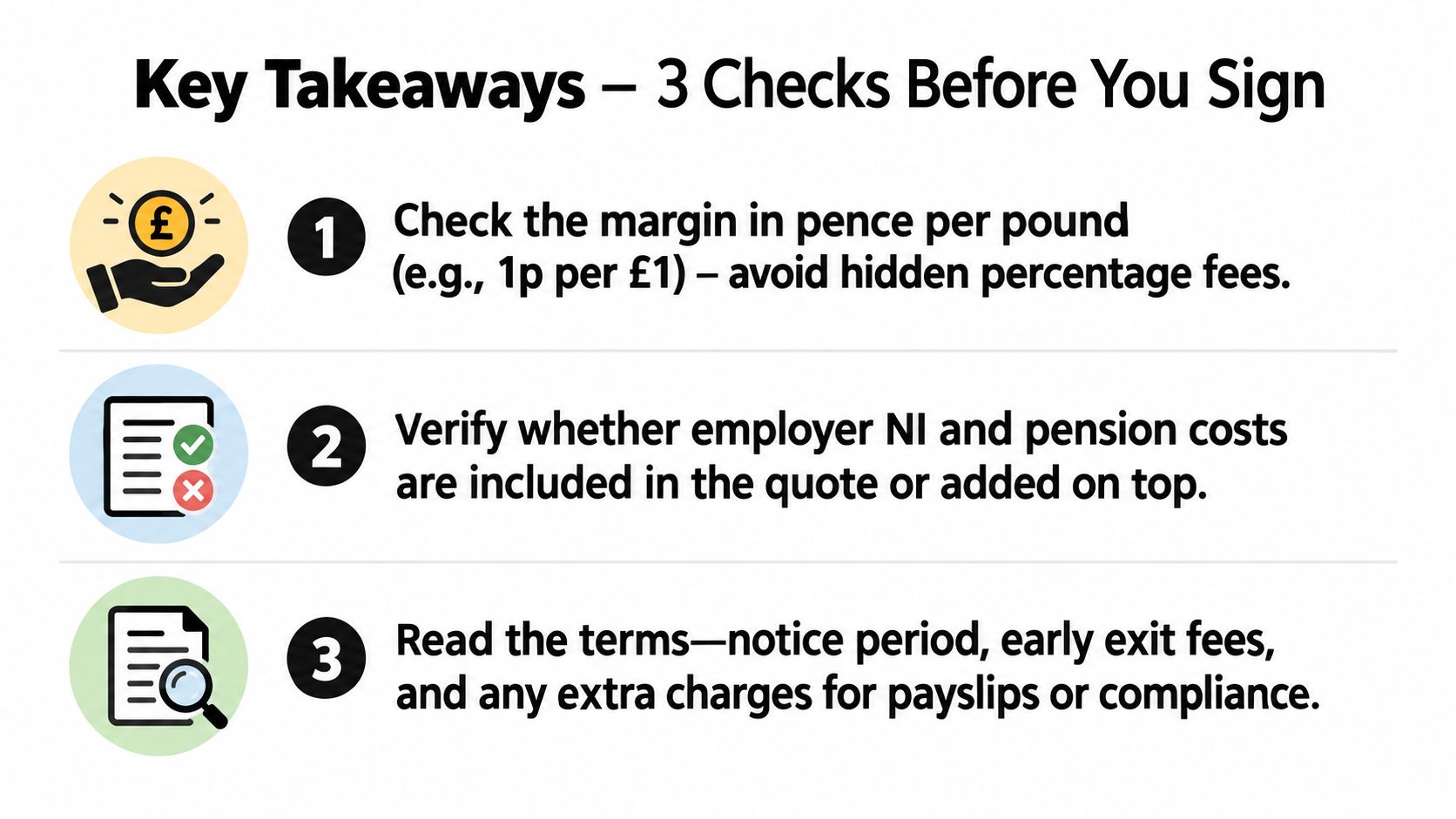
The three checks that matter most
- Check the margin in pounds, not marketing language. A weekly figure is usually easier to compare than a percentage, especially on stronger day rates.
- Confirm which statutory costs are separate from the margin. Employer National Insurance, PAYE deductions, and other payroll items shouldn't be blurred into one vague total.
- Read the extra charges carefully. Faster payments, notice periods, leaver fees, and pension handling can all change the cost.
Another point is worth keeping in view. Future rule changes can affect how the chain operates. Neutral UK sources note that from 6 April 2026 the government will shift PAYE responsibility in umbrella supply chains to agencies, or end clients if no agency exists, which could make fee comparisons harder to interpret, according to the Budget 2025 overview of tax legislation and rates.
The cheapest advertised margin can still produce the most expensive result if the quote hides add-on fees or clouds the statutory deductions.
Gather a few quotes. Run the same day rate through each one. Then compare the take-home, the fee model, and the contract terms before you sign.
If you're comparing umbrella options and want a clearer route through the numbers, Umbrella Company helps contractors and freelancers compare providers based on their rate, role, and IR35 position. We make it easier to separate the umbrella's own margin from the wider deduction stack, so you can choose with more confidence and less guesswork.


