


Ever glanced at your payslip and felt baffled by where the money goes between your gross and net pay? The system behind those deductions is called Pay As You Earn, or PAYE. This guide explains how it all works, what it means for you, and how we manage it for our contractors.
Think of it as HMRC’s pay-as-you-go plan for your taxes. It’s a clever way to keep your tax payments manageable and ensure you are always compliant.
What Exactly Is PAYE?

Instead of you having to save up for one enormous tax bill at the end of the year, PAYE smooths the process out. Each time you get paid, your employer (or an umbrella company like us, if you are a contractor) calculates and deducts the correct amount of Income Tax and National Insurance directly from your wages.
We then send this money straight to HMRC on your behalf. This means your tax obligations are met consistently with every payment, without you having to do anything.
The amount deducted is worked out based on your personal tax code and how much you earn. The system also handles employer National Insurance contributions, which is a separate cost an employer covers on top of your salary.
Let's break down who does what in this process.
Key Players in the PAYE System
Here’s a quick look at who is involved in the PAYE process and their primary responsibilities.
| Player | Role in the PAYE System |
|---|---|
| HMRC | Sets the tax and National Insurance rates, issues tax codes, and receives the payments. |
| The Employer | Calculates and deducts tax and NI, reports payroll data, and pays the collected funds to HMRC. |
| The Employee | Your role is to provide correct personal details and check that the right tax code is being used. |
Essentially, it is a three-way partnership designed to make tax collection as seamless and straightforward as possible.
Why Do We Have PAYE? A Quick History Lesson
To fully understand how PAYE works, it helps to know why it was created. It was not just dreamt up out of thin air; it was a clever solution to a massive national problem.
Picture this: it's 1944, Britain is in the thick of World War II, and the workforce is expanding at an incredible rate to support the war effort. The old system of collecting income tax once a year in a lump sum was no longer effective. It was becoming a logistical nightmare for the government.
The government needed a reliable, steady flow of cash to fund public services, and fast. The PAYE system was the solution. This new approach required around one million employers to deduct tax directly from the wages of 16 million employees. You can dive deeper into the brief history of PAYE to see just how significant this change was.
This completely changed the game for tax collection. It made the process smoother for everyone and created a predictable revenue stream to keep the country running. While technology has moved on since the 1940s, the fundamental idea remains the same: tax is handled quietly in the background as part of every payday.
Decoding Your Payslip Step-by-Step
Ever looked at your payslip and wondered how the final number is worked out? Let's break it down. The whole process starts with your tax code, a crucial piece of information that tells your employer exactly how much you can earn before Income Tax kicks in.
First, your total gross pay for the pay period is calculated. From this figure, your tax-free personal allowance is taken into account, which leaves the portion of your earnings that is actually taxable. This taxable amount is then used to calculate your Income Tax based on the current UK tax bands, while National Insurance contributions are calculated separately.
It's a system that has come a long way since it was first introduced during the Second World War.
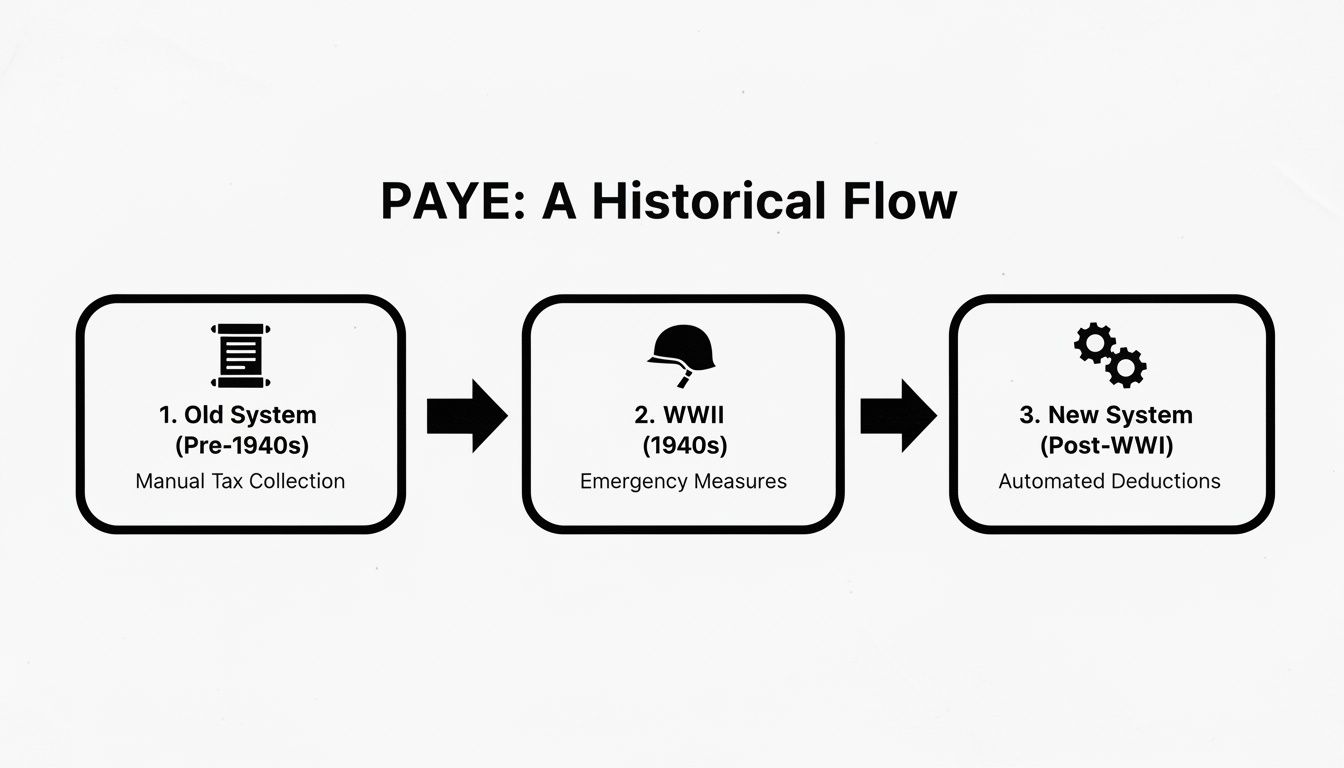
This shift from a manual, yearly collection process to the real-time, automated system we have today has made tax collection far more efficient.
After tax and National Insurance, any other deductions (like student loan repayments or pension contributions) are subtracted. What's left is your take-home pay. If you want to see these numbers in action, our UK payroll calculator is a great tool for getting a clear estimate.
How PAYE Works for Umbrella Company Contractors

As a contractor, you might be wondering where you fit into the PAYE system. It's actually quite simple: when you join UmbrellaCompany.com, you become our employee for tax purposes.
This setup means we take on all the employer responsibilities, including managing your tax and National Insurance deductions through PAYE.
The Process Step-by-Step
The whole thing works like a well-oiled machine. You complete your work and submit a timesheet to us. We then invoice your end client or agency on your behalf.
Once the client pays the invoice, we process those funds through our payroll system, treating it as your salary. Your payslip will detail all the standard deductions you'd expect, like Income Tax and your employee's National Insurance contributions.
You'll also see our margin and the employer's National Insurance clearly listed. This is an essential cost that, as your employer, we are legally required to pay to HMRC. It is deducted from the funds we receive from your client before your salary is calculated. For a deeper dive, check our guide on how an umbrella company works.
Ultimately, this approach gives you the freedom of contracting with the peace of mind that you are fully compliant with HMRC regulations.
How Real Time Information Powers Modern PAYE
The PAYE system we know today is driven by something called Real Time Information, or RTI. Think of it as a constant, live feed of payroll data to HMRC.
Gone are the days when employers would bundle up all their employee pay details and send them off in one big annual report. Now, thanks to RTI, your employer must report your pay and deductions to HMRC every single time they run payroll, whether that’s weekly, monthly, or on any other schedule.
This shift has been a game-changer. It gives HMRC a much clearer, up-to-the-minute picture of what people are earning across the country. For you, this means you are far less likely to end up on the wrong tax code, which was a common headache under the old system. It also makes the administration of benefits like Universal Credit much smoother.
Anonymised information from the RTI system, which covers around 30–31 million payrolled employees, gives organisations like the Office for National Statistics an invaluable, real-time pulse on the UK's labour market. This makes PAYE more than just a tax system; it's a vital source of economic insight. You can dig deeper into how PAYE data informs UK labour market statistics to see how powerful this information is.
Got Questions About PAYE? We've Got Answers
Understanding PAYE is key to managing your finances as an employee or contractor. We hope this guide has clarified how the system works and how your payslip deductions are calculated.
If you have more questions about how we handle PAYE at UmbrellaCompany.com or want to know more about our services, please get in touch. We are always happy to help you navigate your contracting journey with confidence. For a detailed comparison, see our guide on PAYE vs umbrella company setups.


