


Ever felt like contractor admin is a full-time job in itself? That’s where an umbrella company comes in. Think of us as your personal HR and payroll team, all rolled into one. We slot in between you, your agency, and your end client, handling all the tricky paperwork so you get paid correctly and on time, every single time.
This guide explains exactly how an umbrella company works, what the payment process looks like, and how it provides a simple, compliant solution for UK contractors.
What an Umbrella Company Is and How It Works

When you team up with an umbrella company, the first thing you will do is sign a contract of employment with us. This is a crucial step. It officially makes you our employee for the duration of your contract, not an employee of the agency or the client you're working for.
This employee status is a game-changer. It unlocks all the statutory rights and protections that freelancers often have to go without. The whole setup is designed to give you the freedom of contracting with the stability and security of being properly employed.
Your Role as an Employee
As our employee, your job is simple: do what you do best for the client. All you need to worry about is getting your timesheets approved and sent over to us. We take care of the rest.
- Invoicing: We will raise the invoices to your recruitment agency based on the work you have logged.
- Payroll Processing: As soon as the agency pays us, we process your salary through the PAYE (Pay As You Earn) system, just like any other employer.
- Statutory Deductions: We sort out all the tax calculations, deducting the right amount of Income Tax and National Insurance Contributions (NICs).
- Payslip Provision: You get a clear, detailed payslip showing exactly what you have earned and what has been deducted.
The popularity of umbrella companies has shot up in recent years. In the 2022/23 tax year alone, the government estimated that around 700,000 temporary workers in the UK were paid this way. It just goes to show how vital they have become in giving contractors a compliant, straightforward way to work while getting full employment rights.
An umbrella company is essentially an intermediary employer. It bridges the gap between you and your client, creating a simple, compliant payroll channel that works for everyone in the supply chain.
By letting us handle the financial admin, you can get back to focusing on your actual contract work. We make sure your tax obligations are met down to the penny, giving you complete peace of mind without the hassle of running your own limited company. For a deeper dive, check out our guide on what an umbrella company is.
To make it even clearer, let's break down who does what in this arrangement.
Key Roles in the Umbrella Company Supply Chain
The entire process relies on each party fulfilling their specific role. Here is a quick summary of who is responsible for what.
| Party | Primary Role and Responsibility |
|---|---|
| The Contractor (You) | Perform the work for the end client and submit approved timesheets to the umbrella company. |
| The Umbrella Company | Acts as your legal employer, processes your payroll, handles all tax deductions, and ensures compliance. |
| The Recruitment Agency | Finds the contract role, liaises between you and the client, and pays the umbrella company for your work. |
| The End Client | The business where you carry out your work. They approve your timesheets and pay the recruitment agency. |
Ultimately, this structure creates a clear, transparent chain of payment and responsibility, which benefits everyone involved.
Your Payment Journey from Timesheet to Bank Account
Ever wondered how your money actually gets from the client who hired you into your bank account? It is one of the first things contractors ask, and getting your head around it is key to feeling confident and in control.
The whole process is actually pretty simple and designed to be completely reliable. Once you are on board with us, we get everything set up so you are paid correctly and on time. Every single time.
The first step is a simple one: you officially become our employee by signing a contract of employment. This is not just a bit of paper; it establishes a proper legal relationship and gives you full employment rights. From that moment on, your job is just to focus on the assignment, do your brilliant work, and send us and your agency an approved timesheet.
From Timesheet Submission to Payroll
Once we have your timesheet, the ball is in our court. We immediately raise an invoice and fire it off to your recruitment agency for the hours or days you have worked.
The agency then gets this processed and sends the funds over to us. This lump sum is what is known in the industry as the assignment rate.
As soon as that money hits our account, our payroll pros jump into action. We run your salary through our fully compliant PAYE system, exactly like any permanent employee in the UK. This is the nuts and bolts of how a good umbrella company works, making sure every penny of tax is handled correctly.
This quick visual guide breaks down the simple three-step journey your payment takes.
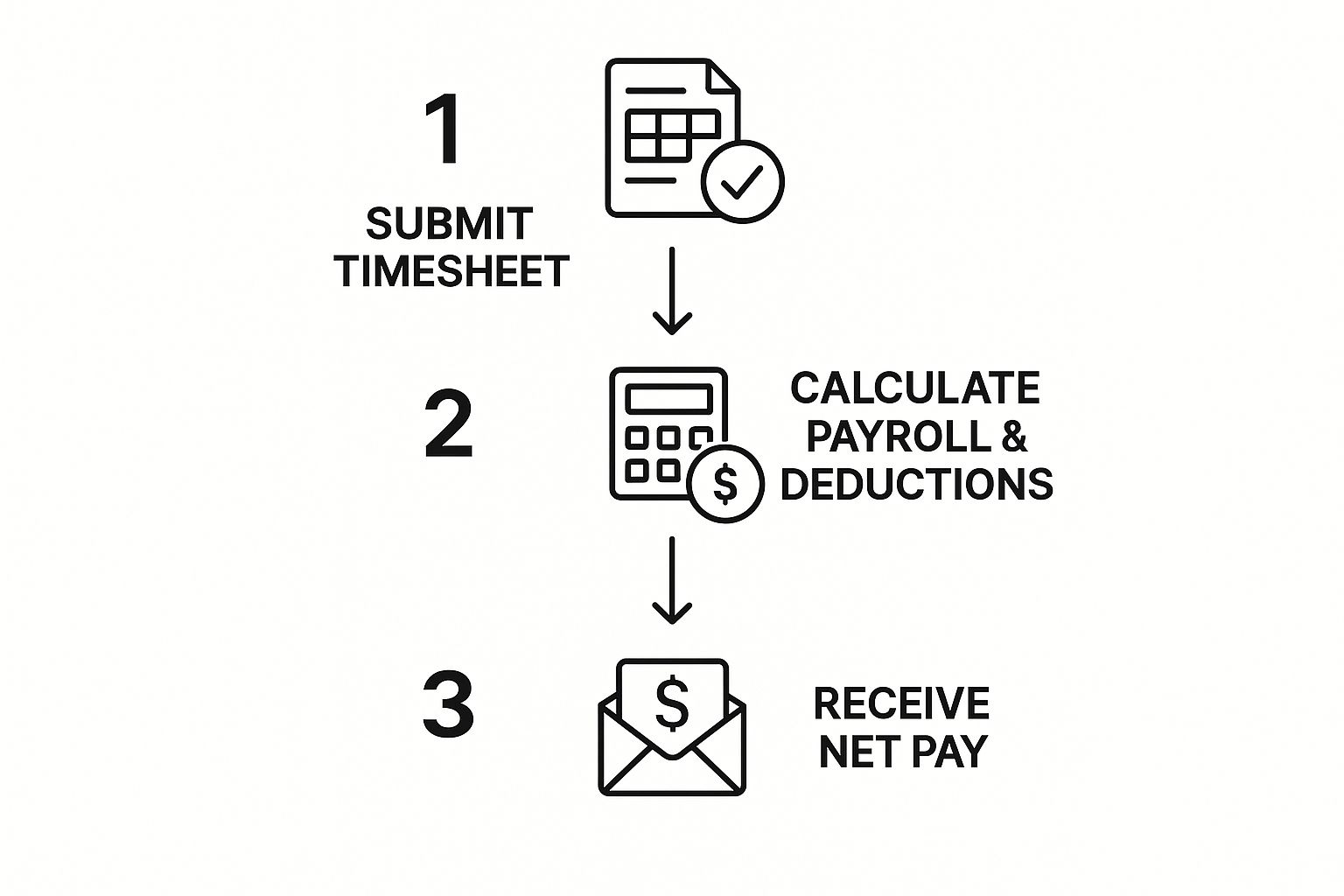
This whole flow is designed to take the admin headaches away. You can just get on with your contract work, without ever having to think about chasing invoices or wrestling with spreadsheets.
Calculating Your Pay and Deductions
The final piece of the puzzle is working out your net pay, the money you actually take home. From the assignment rate we get from the agency, we make all the necessary statutory deductions required by HMRC. Here is what that looks like:
- Our Margin: This is our fee for running the service. It is a small, flat amount that is completely transparent.
- Employment Costs: This covers things like Employer’s National Insurance Contributions and the Apprenticeship Levy. As your employer, we're legally required to pay these on your behalf from the assignment rate.
- Your Deductions: This is your personal Income Tax and employee National Insurance, calculated based on your tax code.
What is left after these deductions is your net pay, and we transfer it straight into your personal bank account. You will also get a detailed payslip that breaks down every single calculation, so you can see exactly where your money has gone.
Loads of contractors want to know how to maximise their earnings. If that is on your mind, you might want to check out our guide on which payroll solution gives the highest take-home pay for a few more insights.
The bottom line is that this entire process keeps you 100% compliant with UK tax law. It gives you a totally hassle-free way to get paid and completely removes the admin burden that comes with going it alone.
Decoding Your Umbrella Company Payslip

Getting to grips with your payslip is a huge part of feeling in control of your contracting career. It can look a bit confusing at first glance, but every single line item has a purpose. We believe in being completely upfront, so let’s pull back the curtain and walk through exactly how your pay is calculated.
The journey from the client's payment to what lands in your bank account has a few key stages. It all kicks off with the assignment rate. Think of this as the master figure, it is the full amount your recruitment agency pays to us for the work you have done. It is crucial to remember this is not your salary; it is an all-inclusive rate designed to cover every single cost associated with your employment.
From this assignment rate, we handle all the necessary employment costs and statutory deductions. Only then do we arrive at your personal gross pay. This is the standard, compliant process for any legitimate umbrella company.
From Assignment Rate to Your Gross Pay
The first things to come off the top of the assignment rate are the costs of employing you. As your legal employer, we are required by HMRC to make these payments on your behalf. It is not a choice; it is the law.
Here is what that includes:
- Our Margin: This is the only bit we take for running the service. It is a fixed, flat fee on each payslip, so you will never see any nasty surprises or hidden charges.
- Employer’s National Insurance: A mandatory contribution paid by every UK employer. It is calculated based on your earnings and paid directly to HMRC.
- Apprenticeship Levy: This is a UK tax on employers that helps fund apprenticeship schemes across the country. It is calculated at 0.5% of the annual pay bill.
- Employer’s Pension Contributions: If you are opted into our workplace pension scheme, the employer's slice of the contribution is also handled here.
Once these employment costs are taken care of, the amount left over becomes your gross pay. This is the figure that your personal tax and National Insurance will be calculated from.
From Your Gross Pay to Net Pay
At this stage, your gross pay is treated exactly like the salary of any other employee in the UK. We apply your personal tax code and calculate the deductions required under the PAYE system.
It's absolutely vital to grasp that your assignment rate and your gross pay are two separate things. The assignment rate covers all employment overheads, while your gross pay is what’s subject to your personal tax and employee NICs. This is not just how we do it; it is standard practice for all compliant umbrella companies.
To give you a clearer picture, let's break down a typical calculation.
Sample Payslip Calculation From Assignment Rate to Net Pay
This table shows how the money flows from the agency's payment down to the net amount you take home.
| Item | Description | Example Amount (£) |
|---|---|---|
| Assignment Rate | Total paid by the agency for your work. | £2,000.00 |
| Umbrella Margin | Our fixed fee for processing your payroll. | -£25.00 |
| Employer's NI | Statutory contribution paid by us as your employer. | -£200.58 |
| Apprenticeship Levy | 0.5% levy paid by us as your employer. | -£8.82 |
| Your Gross Pay | The amount left after employment costs. | £1,765.60 |
| Income Tax (PAYE) | Your personal tax deduction based on your tax code. | -£320.40 |
| Employee's NI | Your personal National Insurance contribution. | -£127.87 |
| Your Net Pay | The final amount transferred to your bank account. | £1,317.33 |
As you can see, every step is accounted for.
Finally, we deduct your personal Income Tax and employee National Insurance Contributions. The figure that remains is your net pay, the money that gets transferred directly into your bank account.
Every single one of these calculations is clearly itemised on your payslip, giving you a complete, transparent breakdown of your earnings. This clarity is your best defence against non-compliant schemes that promise unrealistic returns and ensures you are paid both fairly and, most importantly, legally.
Navigating IR35 with an Umbrella Company
The off-payroll working rules, which most of us know as IR35, have completely changed the game for UK contractors. Getting your head around these rules is non-negotiable, and this is exactly where an umbrella company offers a clear, secure way forward.
In a nutshell, IR35 legislation is designed to spot contractors who are essentially employees of their end client, just without the official title. This is often called ‘disguised employment’. If a contract is judged to be ‘inside IR35’, it means the contractor has to pay tax and National Insurance just like a regular employee.
This is why working through an umbrella company is such a popular and effective solution. When you join us, you become our employee. It is that simple. Your status is no longer ambiguous because we pay you through a standard PAYE system, meaning your tax and National Insurance are sorted correctly right from the start.
Your Simple Solution to IR35 Complexity
This structure neatly takes your assignment out of the IR35 firing line. Why? Because you are already being taxed as an employee. The whole question of whether you are a ‘disguised employee’ of the client becomes irrelevant. You are a genuine, legally-recognised employee of UmbrellaCompany.com.
For the clients and recruitment agencies you work with, this is a huge relief. It removes the risk and the administrative nightmare of trying to figure out your IR35 status for every contract. For you, it means total peace of mind, knowing you are fully compliant with HMRC while still enjoying the freedom of contracting.
Working through a compliant umbrella company is one of the most straightforward ways to operate within the current rules. It eliminates IR35 worries and allows you to focus purely on your contract work.
The rapid growth of umbrella companies is directly tied to these legislative changes. When IR35 was rolled out to the private sector in April 2021, many businesses and agencies started looking for ways to avoid the liability of getting a status determination wrong. As a result, they began to favour engaging contractors who were employed by a PAYE umbrella company, which has really fuelled the growth in our industry. You can learn more about how IR35 applies when working through an umbrella company in our detailed guide.
This shift offers a compliant, simpler way for contractors to work flexibly, without the hassle and complexity of managing their own limited company. Ultimately, it is a secure and efficient way to thrive as a contractor in today's market.
The Real Perks of Working Through an Umbrella Company

Signing up with an umbrella company is about more than just getting your payroll sorted. It is a smart way to blend the stability and rights you get from traditional employment with the freedom and flexibility that drew you to contracting in the first place. This mix brings some very real advantages that make your working life simpler and a whole lot more secure.
One of the biggest wins is having a continuous record of employment. It does not matter if you are hopping between different projects or clients; as far as the paperwork is concerned, your employment with us is unbroken. This is a game-changer when you are trying to prove a steady income for big life events, like applying for a mortgage or getting a loan.
Statutory Employment Rights and Protections
Because you become our employee, you are legally entitled to a full suite of statutory benefits. This provides a crucial safety net that just is not there for sole traders. It is a core part of how we support you.
These protections include:
- Statutory Holiday Pay: You will accrue paid time off, so you can take those well-deserved breaks without watching your income disappear.
- Statutory Sick Pay (SSP): If you are too ill to work, you are covered. You will be entitled to receive SSP to tide you over.
- Workplace Pension Scheme: We automatically enrol you into a compliant workplace pension, helping you build a pot for the future without any fuss.
- Statutory Maternity and Paternity Pay: You are also covered for parental leave, giving you financial support when you decide to start or grow your family.
The bottom line is simple. You get the autonomy of being a contractor without having to give up the essential protections and rights that come with being an employee.
On top of all that, we take care of the admin grind. We pay you via PAYE, meaning we handle all your tax and National Insurance deductions right from the source. This completely removes the headache of filling out a self-assessment tax return for your contracting income, saving you a ton of time and stress.
By dealing with the complex paperwork, we free you up to focus on what you do best. These are not just abstract benefits; they are practical, real-world advantages designed to make your contracting career not just more rewarding, but also much more manageable and secure.
How to Choose a Safe and Compliant Umbrella Provider
Choosing your umbrella company is a big deal. It is a decision that has a direct impact on your financial health, so it is worth getting right. With so many providers out there, knowing how to spot a solid, trustworthy partner from a dodgy scheme is vital. A little due diligence now protects not just your money, but your professional reputation too.
The single most important check you can make is for official accreditation. Look for providers who are members of respected UK bodies like the FCSA (The Freelancer & Contractor Services Association) or Professional Passport. These organisations are not just badges; they carry out tough, independent audits to make sure an umbrella company is operating completely by the book.
Spotting the Red Flags
Sadly, the market has its fair share of dodgy operators using tempting promises to lure contractors in. The umbrella industry is currently going through major regulatory reform to clamp down on widespread non-compliance and tax fraud. It was previously estimated that of the 700,000 workers using umbrella companies, a staggering 275,000 were caught up in non-compliant schemes, leading to huge tax shortfalls. Keep your eyes peeled for these warning signs. You can find out more about HMRC's crackdown on non-compliant umbrella companies.
You should be extremely cautious of any provider that:
- Guarantees sky-high take-home pay: If a company claims you will keep 80-90% of your earnings, it is almost certainly a disguised remuneration scheme. Avoid it like the plague.
- Talks about payments via ‘loans’: Any payment setup involving non-taxable loans, annuities, or other complicated financial gymnastics is a massive red flag for tax avoidance.
- Is vague about its fees: A compliant provider will be crystal clear about their margin. It should be a simple, flat fee taken from your pay, never a percentage.
- Is not based in the UK: Some schemes use offshore accounts to try and sidestep UK tax law. Always work with a company that is based and registered right here in the UK.
A compliant umbrella company will always give you a clear, detailed payslip and a Key Information Document (KID) before you sign anything. If a provider gets cagey about explaining their numbers or will not show you a sample payslip, just walk away.
Why Compliance Matters More Than Ever
Picking a fully compliant partner is not just about covering your own back. Under current UK law, if a non-compliant scheme is discovered anywhere in the supply chain, HMRC can chase any party for the unpaid tax, which includes the recruitment agency and even the end client.
This means that agencies and clients are more careful than ever about who they work with. Partnering with a reputable, accredited provider shows you are serious about working compliantly, making you a much more attractive, lower-risk candidate for the best contract roles. For a deeper dive on your options, our complete guide on using an umbrella company for contractors is a great place to start.
Ultimately, taking a few simple steps to check a provider’s credentials ensures you get paid correctly, legally, and without any worries about a future HMRC investigation.
Got Questions About Umbrella Companies? We Have Got Answers.
Stepping into the world of contracting can feel like learning a new language, and it is completely normal to have a few questions. To make sure you feel totally clear and confident, we have tackled some of the most common queries we get from contractors starting out.
Let’s get straight to it.
So, Who Is My Actual Employer?
This is one of the most important things to get your head around. When you work with us, you are legally an employee of the umbrella company. You are not employed by the agency that found you the gig, or the end client whose office you are in.
This single, continuous employment relationship is what unlocks all your statutory rights, like holiday pay and sick pay. It gives you a stable employment history while you are free to take on projects with all sorts of different clients.
Why Do Employment Costs Get Taken From My Assignment Rate?
Think of the assignment rate from your agency as the total pot of money for your services. It is an all-inclusive figure that has been calculated to cover every cost associated with employing you for that contract, including things like Employer's National Insurance Contributions and the Apprenticeship Levy.
As your legal employer, we have to pay these contributions to HMRC for you. It is the law. So, those funds are handled from the assignment rate before we calculate your personal gross pay. This is not a surprise deduction; it is how every compliant, legitimate umbrella company in the UK operates.
It is a really common point of confusion, but these are not extra fees being taken from your wages. They are the standard costs of employment, which the assignment rate is specifically set up to cover right from the start.
Can I Claim My Daily Commute as an Expense?
The short answer is, unfortunately, no. Back in 2016, there were some big changes to the tax rules around Supervision, Direction, or Control (SDC). Since then, the vast majority of contractors simply cannot claim tax relief for regular travel to their main workplace.
Any compliant umbrella company (like us) will tell you the same thing and will not process these kinds of claims. Trying to do so would go directly against HMRC rules and could land you in hot water. Our job is to make sure your finances are always handled by the book, keeping everything transparent and protecting you from risk.


