


If you're asking how do you become a ltd company, you're probably at the point many contractors reach. You've landed work, you want to look more established, and you're wondering whether trading through your own company gives you more control than staying as a sole trader or using an umbrella.
The short answer is that you don't "become" a limited company as a person. You form a private limited company, then you run your contract income through that company. On paper, the setup is fairly straightforward. In practice, the actual question isn't only how to register it. It's whether you want the legal and admin duties that come with being a director.
A lot of contractors focus on incorporation day and not enough on month three, quarter end, or year end. That's where the difference between a limited company and an umbrella arrangement becomes obvious. One gives you control and responsibility. The other gives you simplicity and less hands-on admin.
Is Forming a Limited Company Right for You?
For some contractors, a limited company is the right fit. For others, it's an unnecessary layer of work.
A limited company is a separate legal entity from you personally. It can invoice clients, receive income, pay expenses, pay tax, and employ staff, including you. That separation is one reason many people choose it. It can also look more professional when you're dealing with agencies and end clients.

The route is common. In 2023-24, 890,500 new companies were registered in the UK, an 11.2% increase from the previous year, and the total number of active companies rose to over 4.8 million, according to UK business registration statistics. That tells you two things. First, the process is accessible. Second, there is already a mature system around formation, banking, accounting, payroll, and tax filing.
What a limited company changes
Once you incorporate, you stop acting only as a worker earning money directly. You also act as a director with legal duties.
That means you're responsible for things such as:
- Company decisions: You must act in the company's interests and keep proper oversight of how it runs.
- Records and filings: You need to keep company details up to date and file what Companies House and HMRC require.
- Separation of money: Company income isn't your personal income until it's paid to you properly.
Practical rule: If you want the benefits of a company structure, you have to be comfortable treating the business as separate from yourself.
When it usually makes sense
A limited company tends to suit contractors who want more control over how they run their affairs, don't mind admin, and are happy working with an accountant. It can also suit people building something wider than a single freelance income stream.
If you're at that stage, it can help to look at how other founders think about structure and growth. A practical example is this guide on how to build a successful software business, which shows how early business decisions affect later operations.
If you're still weighing up your options, our guide to types of business structure is a useful starting point.
Laying the Groundwork Your Pre-Registration Checklist
Contractors rarely get stuck because the online form is hard. They get stuck because they start the application before deciding how the company will be set up and run.
This stage matters more than people expect. A limited company can be quick to form, but the choices you make here affect your banking, bookkeeping, payroll, tax setup, and how much admin lands on your desk later. If you already know you want the simplest route, that is often the point where an umbrella arrangement starts to look more attractive.
Choose the practical basics first
Before you file anything, settle the core details.
You will need:
- At least one director: A UK limited company needs one director aged 16 or over, as explained in this guide to UK company formation requirements.
- A registered office address: This goes on the public record and must be suitable for official post.
- Formation documents: These are the legal documents used to create the company and set its rules.
None of that is difficult on its own. The main issue is getting the details right first time, so you do not end up correcting records, reopening applications, or explaining avoidable mistakes to your accountant.
Your company name needs to work in real life
A company name is not just a branding exercise. It has to pass Companies House checks, look credible on invoices and contracts, and still make sense if your work changes in a year or two.
Common problems are predictable:
- Too close to an existing company name
- Use of sensitive words that need approval
- A name that sounds clever but looks poor on formal paperwork
For most contractors, a plain, usable name is the better choice. It saves hassle.
Decide the ownership properly
Many contractor companies are simple on paper. One director, one shareholder, one ordinary share.
Even so, the ownership position should be clear before you incorporate. Decide:
- who the shareholders will be
- how many shares each person will hold
- who counts as a person with significant control
- whether there is any reason to use anything other than a straightforward share structure
This is one of those points where people overcomplicate matters. If you are the only person involved, keep it simple unless your accountant has given you a clear reason not to. If you want a sense of the likely setup costs around these decisions, our guide to how much it costs to set up a limited company explains the usual expenses.
Pick an address and business activity carefully
Your registered office is where official correspondence goes. If you use your home address, that address appears on the public record unless you have an alternative arrangement in place.
You also need to choose a SIC code to describe the company's business activity. Contractors often treat this as a formality, but it is still worth choosing a code that broadly matches the work you expect to do. It will not run the business for you, but sloppy setup usually signals a rushed incorporation.
A sensible pre-registration check looks like this:
- Settle the company name
- Confirm the director and shareholders
- Choose the registered office
- Decide the share structure
- Select the SIC code
- Have ID and personal details ready
The contractors who find limited company admin manageable usually make these decisions before they touch the application. The ones who do not are often the same people who later realise they wanted the tax and payment side handled for them, which is why an umbrella model can be the better fit if simplicity matters more than control.
The Official Registration Process Step-by-Step
Once the groundwork is done, the Companies House filing itself is usually straightforward. Most delays happen because the application is rushed, not because the system is difficult.
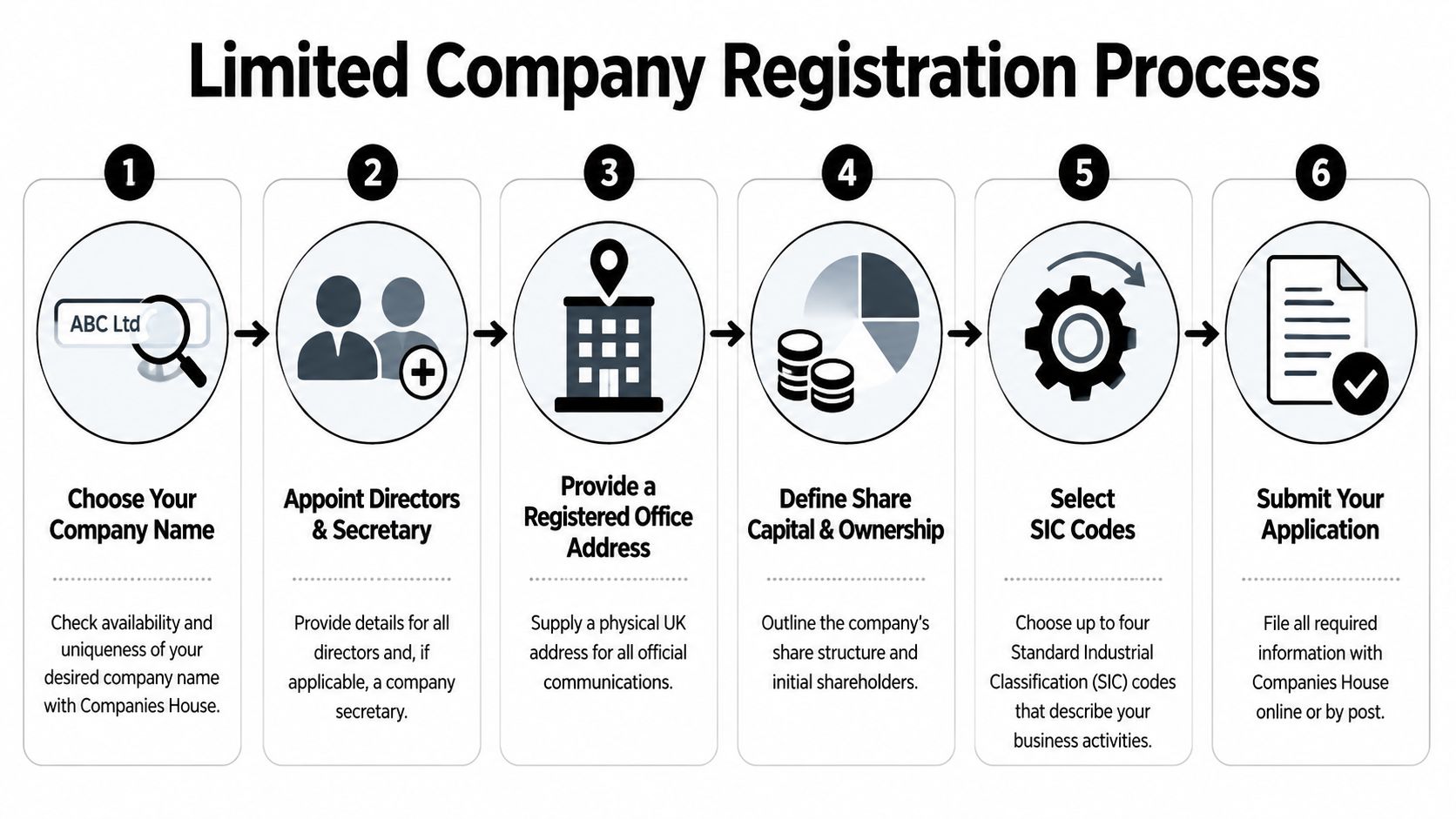
Step one to three
The official process starts with the company identity and the people behind it.
Choose the company name
Check that the name is available and acceptable. A surprising number of applications fail here because the name isn't sufficiently distinct or doesn't meet the rules.
Appoint the director
You need at least one director. You'll provide personal details as part of the incorporation filing.
Identify Persons with Significant Control
This is commonly shortened to PSC. In simple terms, it means the people who own or control the company in a significant way. If you're the sole shareholder and director, that's usually you.
Step four to six
After the people, you move to the company structure.
Prepare the Memorandum and Articles of Association
The Memorandum of Association records the intention to form the company. The Articles of Association set out the internal rules. Many contractors use standard model articles because they are sufficient for a simple one-person company.
Add the registered office and SIC code
This tells Companies House where the company is based for official purposes and what trade it carries on.
Submit the application
This is typically done online through Companies House.
What usually works, and what doesn't
Done properly, online incorporation is fast. Companies House says 98% of applications are approved within 24 hours, while 28% of rejections are due to name issues and 15% are caused by missing PSC information, according to the official setup process on GOV.UK.
That pattern matches what we see in practice. Most rejected filings are not complicated legal failures. They're simple omissions.
What helps:
- Checking the name properly before submission
- Making sure PSC details are complete
- Using consistent spellings and addresses
- Reading the final summary before you click submit
What causes trouble:
- Guessing the SIC code and moving on
- Rushing through ownership details
- Using an address you can't monitor reliably
- Assuming model documents remove the need to understand your role
A one-person company is still a company. The fact that you're the only person involved doesn't reduce the filing responsibilities.
DIY or use an agent
There isn't a single right answer. If your setup is basic, doing it yourself can be fine. If there are multiple shareholders, unusual share rights, or uncertainty around the structure, an accountant or formation agent can save time and avoid errors.
The important part isn't whether you click the button yourself. It's whether the information going in is right.
You're Incorporated What Happens Next?
Getting the Certificate of Incorporation feels like the finish line. It isn't. It's the point where the company starts to become real in operational terms.

Open the company bank account
Your first practical job is usually to open a dedicated business bank account. Keep company money separate from personal money from day one.
This matters for two reasons. It keeps the records cleaner, and it reduces the risk of treating company funds casually. That's one of the quickest ways new directors create avoidable accounting problems.
Tell HMRC and get the tax side organised
After incorporation, you need to register the company for Corporation Tax once it starts trading. If you're going to pay yourself a salary, you'll also need to set up PAYE. If VAT registration applies to your situation, that needs attention too.
For most contractors, this is also the point where payment strategy comes into focus. If you want a practical overview of extracting profits properly, our guide on how to pay yourself dividends covers the basics in plain English.
Important point: Incorporating a company without setting up the tax and banking side properly leaves you with a company on the register, but not a business that is ready to trade cleanly.
Get your admin habits in place early
The first few weeks shape the whole year. Set up a bookkeeping system, decide who will handle payroll, store invoices properly, and keep copies of contracts and expense records.
A simple operating routine helps:
- Issue invoices consistently
- Keep receipts and records organised
- Separate salary, dividends, and expenses properly
- Review the company account regularly
If you're new to the process, this short explainer is a useful companion:
Don't ignore the director side
A lot of new contractors still think of the company as a wrapper around their freelancing. Legally, it isn't just that. You're running a company, even if it's small, even if it's only you, and even if the work looks identical to what you did before.
That mindset shift is where some people settle in comfortably. Others realise they'd rather hand payroll, tax deductions, and routine compliance to an umbrella and focus on the contract work itself.
Managing Your Ongoing Legal and Financial Duties
At this point, a limited company stops being a registration exercise and becomes an ongoing responsibility.
The admin isn't impossible. But it is regular, and it doesn't care whether you're busy on client delivery, on site, travelling, or between contracts. Companies House and HMRC still expect the company to meet its obligations.
The tasks that keep coming back
A contractor limited company usually needs attention in several areas across the year:
- Confirmation Statement: This confirms the company details on record are still correct.
- Annual accounts: These must be prepared and filed on time.
- Company tax return: The company has to report its taxable position properly.
- Bookkeeping: Invoices, expenses, payroll entries, and bank transactions need to be recorded accurately.
- Director decision-making: Dividends, expenses, and changes to company details all need to be handled correctly.
None of that is glamorous. All of it matters.
The cost isn't only the fee
A lot of contractors ask about setup cost and almost none ask the better question, which is what the company will demand from them after month one.
That burden is often underestimated. An IPSE survey found 42% of new limited company contractors cited unexpected admin time as a major regret, and first-year compliance costs including accountant fees typically range from £800 to £1,500, according to this contractor company guide.
That doesn't mean a limited company is a bad choice. It means it isn't a light-touch choice.
Some contractors enjoy the control. Others discover that the recurring admin drains time and attention they would rather spend earning.
What tends to work in real life
The contractors who manage limited companies well usually do three things consistently.
First, they treat bookkeeping as part of the job, not as an afterthought for year end.
Second, they use an accountant for the parts where mistakes are expensive. That doesn't remove all director duties, but it reduces the chance of avoidable errors.
Third, they keep personal and company decisions separate. A company isn't a personal wallet.
If you want broader reading on how tax planning fits into business decision-making, this tax planning guide by IGNIITE offers useful context, even though the exact tax rules differ by jurisdiction.
Why this pushes some people towards umbrellas
An umbrella arrangement removes much of this hands-on admin from the contractor's plate. You work, submit your timesheets, and get paid through PAYE. You give up some control, but you also give up a large part of the filing and record-keeping burden.
That trade-off matters most when:
- You're inside IR35 and tax planning flexibility is reduced
- You don't want director responsibility
- You want predictable payroll administration
- You don't want to spend evenings dealing with company paperwork
For many contractors, the decision isn't "Can I form a company?" It is "Do I want to run one properly for the whole year?"
Decision Checklist Ltd Company vs Umbrella Company
Once you've looked beyond registration day, the choice becomes clearer. A limited company can work very well, but only if the structure matches the way you want to operate. If what you really want is to contract without carrying the admin yourself, an umbrella may fit better.
A useful way to think about it is not as a status choice, but as an operating model choice. If you've ever compared outsourced employment options more broadly, this guide on navigating PEO and HRO decisions is a good example of the same principle. The question is who handles what, and how much responsibility you want to retain.
Limited Company vs. Umbrella Company A Contractor's Checklist
| Factor | Limited Company | Umbrella Company |
|---|---|---|
| Admin burden | You handle company records, filings, and director duties, usually with accountant support | The umbrella handles payroll administration and routine employment processes |
| Set-up effort | You must form the company, choose the structure, and organise banking and tax registrations | Setup is usually simpler because you join an existing employment and payroll arrangement |
| Ongoing responsibility | You remain legally responsible as a director | The umbrella takes care of much of the ongoing admin linked to getting paid |
| Control | More control over how the company operates | Less control over the structure because you are using a provider's framework |
| IR35 practicality | Can be suitable in the right circumstances, but the structure needs to align with your engagements | Often simpler where contracts fall inside IR35 |
| Paperwork | More forms, more deadlines, more record-keeping | Less paperwork for the contractor personally |
| Professional image | Some clients and agencies like dealing with an incorporated business | Still widely used, especially where ease and compliance are priorities |
| Stress level | Fine if you are organised and comfortable managing compliance | Often lower for contractors who want a straightforward pay-and-work setup |
A quick decision filter
A limited company may suit you if:
- You want control over the business structure
- You're comfortable with admin and deadlines
- You understand that director obligations are ongoing
- You plan to work with an accountant and keep records properly
An umbrella may suit you if:
- You want to minimise admin
- You prefer PAYE simplicity
- You don't want responsibility for company filings
- Your main priority is getting paid correctly with less operational effort
For contractors comparing those routes, our guide to umbrella company vs limited company looks at the practical differences in more detail. If you want a comparison tool rather than a registration process, Umbrella Company provides a way to compare umbrella providers based on your role and working setup.
Bottom line: Forming a limited company is easy enough. Running one well is the part that tests whether it was the right choice.
If you're organised, comfortable with admin, and happy to take director responsibility seriously, a limited company can be a sensible structure. If you'd rather avoid the compliance burden and keep things simple, an umbrella arrangement is often the cleaner option.
If you're deciding between setting up your own company and using an umbrella, Umbrella Company can help you compare your options and choose a setup that fits the way you want to work.


