


Thinking about how umbrella companies work? Imagine having your own personal HR and payroll department, all rolled into one efficient service. While you focus on delivering fantastic work for your client, we manage all the administrative tasks in the background. As your official employer, we create a simple, compliant link between you, your recruitment agency, and the end client.
This guide will explain exactly what an umbrella company is, how the payment process works, and what you can expect. The main goal is to make your contracting life easier by managing your payments and tax through the familiar PAYE (Pay As You Earn) system, so you don't have to worry about complex tax returns.
What Is an Umbrella Company and How Does It Function?
At its core, an umbrella company is a business that employs contractors for their fixed-term assignments. When you sign up with us, you officially become our employee. One of the biggest benefits of this arrangement is that it provides you with a continuous record of employment, which is a great help even if you move between different projects and clients.
The day-to-day process is designed to be completely straightforward. You submit your timesheets to us, and we handle everything else. We invoice your agency or client for the hours you have worked. As soon as we receive that payment, we process your salary, ensuring all the correct tax and National Insurance deductions are made before the money reaches your bank account.
The Key Players in the Process
To get a clear understanding of how this works, it helps to know who is involved. The relationship is a partnership between four parties, all working together to ensure everything runs smoothly.
- You (The Contractor): You are the professional delivering the work for the end client. Your main responsibility, besides the contract itself, is to submit your timesheets on time.
- The Recruitment Agency: This organisation finds you the assignment. They connect you with the end client and are responsible for sending us the funds for your work.
- The End Client: This is the company you are actually working for on a day-to-day basis. They pay the agency for the value you provide.
- Us (The Umbrella Company): We are your legal employer. We are responsible for your payroll, managing your tax and National Insurance, and ensuring you receive all your statutory employment rights.
This is not a niche arrangement; it is a mainstream way of working in the UK. Estimates suggest that over 600,000 contractors rely on umbrella companies. It has become the go-to, compliant solution for managing temporary assignments, particularly for contracts that fall inside the IR35 rules.
By acting as the central employer, an umbrella company creates a stable and reliable foundation for your contracting career. You get the freedom and flexibility of being a contractor with the welcome simplicity of being an employee.
The Umbrella Process at a Glance
To break it down even further, here is a simple, step-by-step look at how the entire process flows from start to finish.
| Step | Action | Key Outcome |
|---|---|---|
| 1. Sign-Up | You sign an employment contract with the umbrella company. | You are now a legal employee of the umbrella. |
| 2. Work | You complete your contract work at the end client's site. | The project moves forward, and your hours are recorded. |
| 3. Timesheets | You submit your approved timesheets to the umbrella company. | Your billable hours are confirmed and ready for invoicing. |
| 4. Invoicing | We invoice the recruitment agency for the work you've done. | The payment process is officially started. |
| 5. Payment | The agency pays the invoice amount to us. | Funds are received and ready for your payroll. |
| 6. Payroll | We process your salary, deducting tax and NI via PAYE. | Your net pay is calculated, and a payslip is generated. |
| 7. You Get Paid | We transfer your net salary directly to your bank account. | You receive your take-home pay for the period. |
As you can see, the system is built for efficiency. Your main responsibility is simply to do your work and log your hours; we take care of the rest of the financial admin.
The Journey of Your Pay from Client to You
Have you ever wondered how the money you earn gets from your client into your bank account? While it might seem complex, the umbrella company process is designed to be transparent and easy to follow. Let's trace the path your earnings take.
It all begins when you finish your work and submit your timesheet. The end client pays the recruitment agency for the value you have delivered. The agency then passes this payment, known as the assignment income, over to us. This single figure covers everything related to your employment for that contract.
From Assignment Income to Your Gross Pay
Once we receive the assignment income from the agency, we act as your employer. Before we can calculate your personal gross pay, we must deduct the legitimate costs of employment, the same costs any UK employer has to cover.
These are not hidden charges; they are standard deductions required by law. They include:
- Our Margin: This is our fee for handling all the payroll administration and keeping you continuously employed.
- Employer’s National Insurance Contributions (NICs): A statutory payment every UK employer must make to HMRC.
- The Apprenticeship Levy: A UK-wide tax on employers which helps fund apprenticeship programmes.
- Employer Pension Contributions: Our legal contribution to your workplace pension.
After we have taken care of these employment costs, the amount left over is your gross pay. This is the figure we use to calculate your personal taxes, just like in any other job.
This infographic breaks down the flow from timesheet to payday.
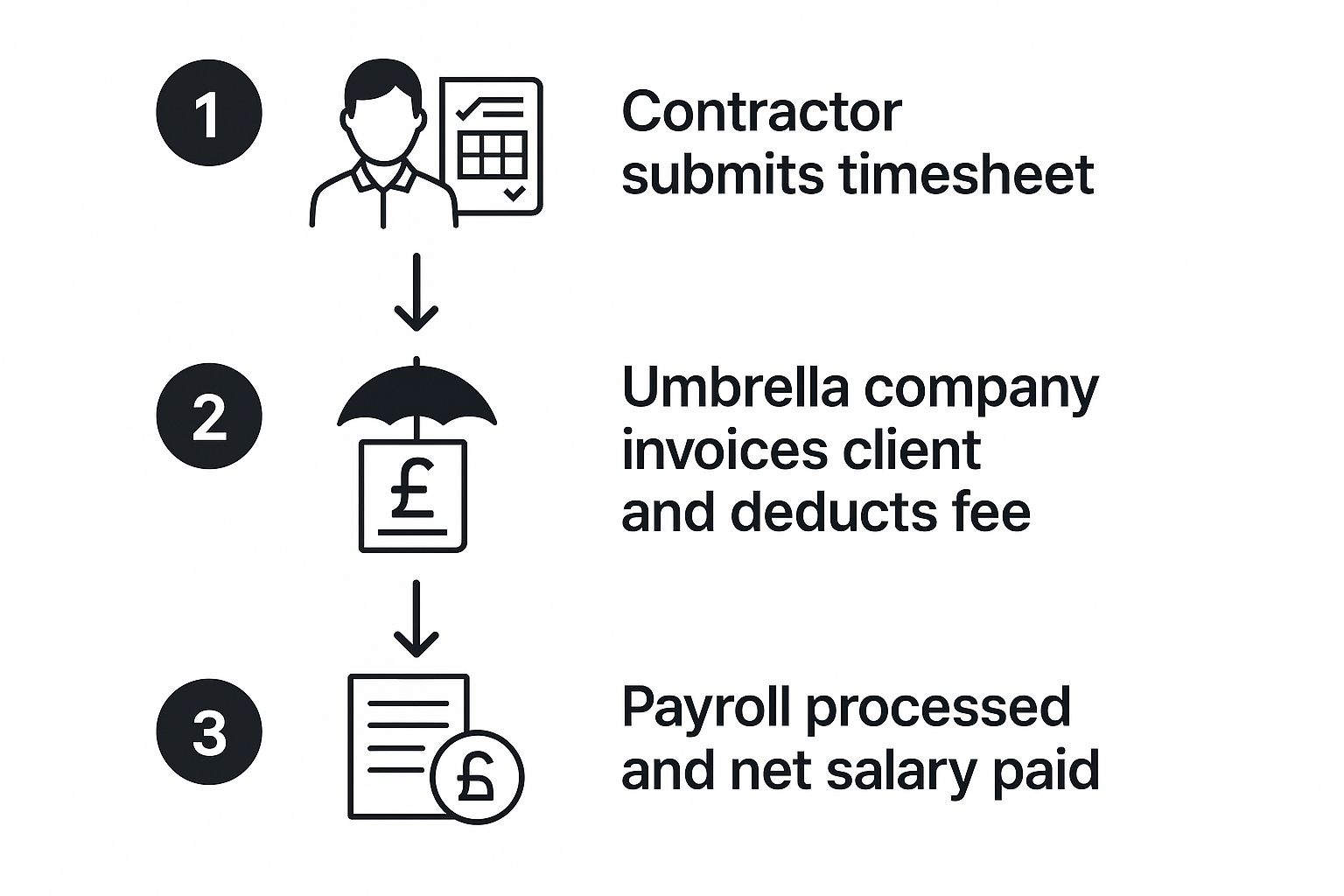
As you can see, the umbrella company sits in the middle, managing the money and the relationship between you and the agency.
Calculating Your Final Take-Home Pay
The final step is to process your gross pay through the PAYE (Pay As You Earn) system. At this point, we deduct your personal tax obligations, which are:
- Income Tax: Calculated using your personal tax code.
- Employee’s National Insurance Contributions: Your own contribution to the national insurance system.
What remains after that is your net pay, or what most people call take-home pay. This is the exact amount that arrives in your bank account on payday. Every one of these deductions is shown clearly on your payslip, so you have a complete, transparent record of where your money has gone.
Essentially, we act as an intermediary, employing you on behalf of the agency. This ensures you receive full employment rights while we handle all the statutory payments.
The real benefit of the umbrella structure is that it gives you the freedom of contracting with the security and protections of being an employee, such as statutory holiday and sick pay.
Our goal is to make getting paid predictable and hassle-free. While it involves a few steps, this process ensures full compliance with HMRC rules, giving you complete peace of mind. For a deeper look at how this impacts your earnings, you might find our guide on which payroll solution gives the highest take-home pay useful.
How to Read Your Umbrella Company Payslip
Understanding your first umbrella company payslip can feel a little daunting, with its many terms and numbers. However, it is crucial that you understand exactly where your money goes.
Think of it as a journey. The money starts as a single figure from your recruitment agency and ends up as the net pay in your bank account. Each line item on your payslip is just a step along that route.

Once you get used to it, you will feel much more in control. It also empowers you to spot a non-compliant provider a mile off, as those promising unrealistic take-home figures usually have something to hide. A legitimate payslip tells a clear, logical story.
Key Terms on Your Payslip Explained
Let's look at the common terms you will see. These first few items explain how the initial payment from your agency is handled before it becomes your personal taxable income.
Assignment Rate: This is the top-line figure, the full amount the umbrella company receives from your agency for the work you have completed. It is an all-inclusive rate designed to cover not just your pay, but all associated employment costs too.
Company Margin: This is simply the fee the umbrella company charges for its services. It covers the administration of running your payroll, managing your employment contract, and ensuring everything is HMRC-compliant.
Employer's NI: As your legal employer, the umbrella company has to pay Employer’s National Insurance Contributions. This is a standard, non-negotiable cost of employment in the UK, and it is deducted from the assignment rate.
Holiday Pay: You are entitled to paid leave, just like any other employee. This figure shows a portion of your earnings being set aside for when you take time off. It is your money, just accrued for later.
After these initial employment costs are taken from the assignment rate, we arrive at your gross pay. This is the figure that your personal taxes will be calculated on.
From Gross Pay to Net Pay
Once your gross pay is calculated, the rest is what any employee in the UK would expect to see on their payslip. The deductions are all processed through the standard PAYE (Pay As You Earn) system.
Understanding this part is the key to spotting a compliant umbrella company. Any organisation that claims it can magically skip these statutory deductions is almost certainly a tax avoidance scheme, which could land you in serious trouble with HMRC.
Here are the final deductions before the money reaches your account:
- Employee's NI: This is your own personal National Insurance Contribution, taken from your gross pay.
- PAYE Tax: This is the income tax you owe, calculated using the personal tax code HMRC has given you.
- Net Pay: The finish line! This is your take-home pay, the final amount that gets transferred into your bank account after all costs and taxes are correctly paid.
Sample Payslip Breakdown
To make this crystal clear, let's look at a simplified example. Imagine a weekly assignment rate of £1,000. Here’s how that might break down on a payslip.
| Item Description | Example Amount (£) | Explanation |
|---|---|---|
| Assignment Rate | £1,000.00 | The total invoice value received from the recruitment agency for the week's work. |
| Company Margin | £25.00 | The umbrella company's weekly fee for their administrative services. |
| Employer's NI | £107.50 | The statutory contribution the umbrella (as the employer) must pay to HMRC. |
| Holiday Pay Accrued | £94.20 | A percentage of earnings set aside for when the contractor takes paid leave. |
| Gross Pay (Taxable) | £773.30 | The amount remaining after employment costs are deducted. This is the figure subject to personal tax and NI. |
| Employee's NI | £64.00 | The contractor's personal National Insurance contribution, deducted from gross pay. |
| PAYE Income Tax | £114.80 | The income tax owed, based on a standard tax code. |
| Net Pay (Take-Home) | £594.50 | The final amount paid into the contractor's bank account. |
Note: These are illustrative figures. Actual deductions will vary based on your tax code, earnings, and the specific week of the tax year.
Seeing the numbers laid out like this really helps connect the dots from the initial rate to what you actually get paid.
Want to see how this works for your specific rate? The best way to get a personalised estimate is to use a reliable umbrella company calculator. It gives you a detailed projection so you know exactly what to expect before you even sign a contract.
Navigating IR35 with an Umbrella Company
The off-payroll working rules, better known as IR35, can feel like a minefield for contractors. When a contract is deemed 'inside IR35', using a compliant umbrella company offers a simple, safe path forward. In fact, it is one of the most straightforward options available.
This is because the moment you join us, you become our employee. We process all your earnings through PAYE, meaning the right amount of Income Tax and National Insurance is calculated and paid directly to HMRC on your behalf. This structure effectively lifts the administrative weight of IR35 right off your shoulders.
How an Umbrella Makes IR35 Simple
When a contract falls 'inside IR35', it simply means that for tax purposes, you are viewed as an employee of the end client. The rules then demand that tax and National Insurance are deducted at source, exactly as they are for a permanent employee. An umbrella company is purpose-built for this scenario.
By acting as your employer, we take on the full legal responsibility for handling these deductions correctly. This gives both the recruitment agency and the end client complete peace of mind, as they know all tax obligations are being met. You never have to worry about complex tax calculations or submitting payments yourself.
Working through an umbrella company when inside IR35 is not just a workaround; it is a fully compliant employment solution. It ensures you pay the right amount of tax while retaining the flexibility of contracting.
Peace of Mind for Everyone Involved
Under the IR35 rules, the end client is responsible for determining your employment status. If they get it wrong, they could be held liable for any unpaid tax. This has understandably made many businesses cautious about engaging contractors through their own limited companies for roles that are inside IR35.
Our role as your employer removes this risk for everyone in the supply chain.
- For you: There is no danger of a surprise tax bill from HMRC down the line related to IR35.
- For agencies and clients: They have solid assurance that your payroll is being managed correctly and compliantly.
This clean, straightforward approach lets you get on with your work, confident that all the tricky compliance is being handled professionally. It is crucial to understand how IR35 rules apply when working through an umbrella company, as it clarifies why this structure works so well. It means you can take on inside-IR35 contracts without any of the associated stress.
Pros and Cons of Using an Umbrella Company

Is an umbrella company the right move for you? Like any big decision in your contracting career, it is about weighing up the benefits and the drawbacks. You need to look at both sides to figure out if this model fits with what you want to achieve professionally and personally.
For many contractors, the biggest advantage is pure simplicity. We take care of all the administrative burdens, including invoicing, payroll, and tax paperwork, which frees you up to focus on the job you were hired to do. It’s a clean, compliant way to work, especially for any contract that falls inside IR35.
The Advantages for Contractors
The benefits of using an umbrella company often come down to stability and security. It brings a degree of traditional employment into the often-unpredictable world of contracting, which can make a real difference to your work-life balance and financial planning.
Here are the key advantages:
- Statutory Employment Rights: Because you are our employee, you get a full package of legal rights. This includes statutory sick pay, holiday pay, and maternity or paternity leave. It is a safety net you do not get as a sole trader.
- Continuous Employment Record: Moving between contracts no longer means having large gaps in your employment history. This continuous record is a massive help when you are applying for a mortgage, loan, or credit card, as lenders prefer to see that kind of stability.
- Workplace Pension: We will automatically enrol you into a workplace pension scheme. This means you will be saving for the future with contributions from both you and us as your employer.
- Simplified Administration: Say goodbye to chasing invoices or stressing about tax deadlines. You just send us your timesheets, and we handle the rest. It is as simple as that.
The Considerations and Drawbacks
Of course, the umbrella model is not a one-size-fits-all solution. It is important to be aware of the potential downsides so you can make a fully informed decision. The main things to consider usually relate to cost and having less direct control.
Here are the potential drawbacks:
- Associated Costs: The assignment rate you agree with your agency has to be high enough to cover all the employment costs. This includes things like Employer’s National Insurance and our margin for handling all the administration.
- Less Tax Efficiency: Unlike running your own limited company, the opportunities to claim business expenses for tax relief are very limited. This can mean your take-home pay is lower than if you were operating outside IR35.
- Perceived Lack of Control: Some experienced contractors value the autonomy that comes with running their own limited company. They prefer to manage their own finances and business strategy from start to finish.
The umbrella model has grown in popularity, especially since the major changes to tax legislation. The number of UK contractors using them has increased from around 100,000 in 2008 to an estimated 700,000 by 2024/25, a shift driven almost entirely by the IR35 reforms. You can read more about the reasons behind the increase in umbrella company workers in the UK.
Ultimately, the choice comes down to your personal priorities. Are you looking for the security and simplicity of being an employee, or the financial control and responsibility that comes with running your own business?
Choosing a Compliant Umbrella Company
Picking the right umbrella company is one of the most important decisions you will make as a contractor. It is not just about getting paid on time; it is about protecting your finances and professional reputation. In a market with hundreds of providers, knowing how to spot a trustworthy partner from a non-compliant operator is essential.
The single most important word to remember is compliance. A legitimate umbrella company is, at its core, an employer. They should operate a straightforward PAYE payroll, just like any other UK employer. Be immediately suspicious of any provider promising exceptionally high take-home pay, especially anything in the 85% or higher range. These offers almost always rely on disguised remuneration schemes, such as non-taxable 'loans' or complex offshore payment structures, which are aggressive forms of tax avoidance and will cause serious problems with HMRC.
Look for Signs of Trustworthiness
So, how do you cut through the noise and find a provider you can trust? The clearest indicators of a compliant company are accreditations from respected, independent professional bodies.
- FCSA (The Freelancer & Contractor Services Association): This is the gold standard in the UK. FCSA-accredited firms are not just members; they have been through rigorous annual audits of their entire operation to prove they adhere to UK tax law.
- Professional Passport: This is another highly regarded organisation that provides independent compliance checks. Seeing their approval means the provider has been thoroughly vetted against strict industry standards.
These accreditations are not just logos for a website. They are your proof that a company is serious about operating transparently and ethically.
Choosing an accredited provider is the single most effective step you can take to protect yourself. It is your best guarantee that your taxes are being paid correctly, shielding you from the risk of a future HMRC investigation.
Questions to Ask Any Potential Provider
Before you consider signing up, you need to ask a few direct questions. A compliant company will have no problem giving you clear, confident answers.
- Will all of my income be processed through PAYE? The only acceptable answer is a simple "yes".
- Can you show me a full pay calculation before I join? They should be able to provide a transparent, detailed breakdown of every deduction with no surprises.
- Are you accredited by the FCSA or Professional Passport? If they are, it will be easy to verify on the accrediting body's own website.
- What is your policy on data security? They will be handling a lot of sensitive information, so it’s vital to know how they protect personal information online.
The government is cracking down on non-compliant schemes. New legislation, part of the Finance Bill, may introduce a joint liability model where HMRC can pursue recruitment agencies or even end clients for unpaid taxes if an umbrella company fails to pay correctly. This is making everyone in the supply chain far more careful about who they work with, reinforcing why understanding how to find a tax-efficient and compliant umbrella company in the UK is more critical now than ever.
Common Questions from Contractors
Let's tackle a few of the questions that contractors frequently ask. Getting these cleared up will help you see the complete picture of how umbrella employment works.
Is My Holiday Pay an Extra Bonus?
Not exactly. Your holiday pay is not an extra amount on top of your earnings. Think of it as a portion of your own money that we, as your legal employer, are required to set aside for you.
The assignment rate you agree with your agency is an all-inclusive figure designed to cover all the costs of your employment, including your statutory holiday entitlement. We detail this clearly on every payslip, and you can then draw on this fund whenever you take time off.
Why Am I Paying Both Employee's and Employer's National Insurance?
This is a common point of confusion, but it is straightforward when broken down. As our employee, you are responsible for Employee’s NI, which is deducted from your gross pay just like in any other job.
The Employer’s NI is a separate, statutory cost that every UK employer has to pay. The assignment rate from the agency is set at a level that covers this cost. It is deducted from the funds we receive from the agency before we calculate your personal gross pay. So, while it is part of the overall cost of your contract, it is not an additional tax being taken from your salary.
Can I Still Claim Expenses?
For most contractors, the short answer is no. Since major legislative changes in 2016, claiming tax relief on general travel and subsistence expenses is no longer possible for most umbrella contractors.
This is because most contractors are considered to be working under ‘Supervision, Direction, or Control’ (SDC). If you see any umbrella provider promising that you can claim extensive expenses, treat it as a major red flag, it is one of the biggest warning signs of a non-compliant scheme.
Ready to find a payroll solution you can trust? UmbrellaCompany.com takes the guesswork out of choosing a compliant and reliable partner. You can compare accredited umbrella companies in just a few minutes. Get your personalised comparison at https://umbrellacompany.com.


