


You're probably in a familiar spot. One contract is ending, the pipeline looks thin, and every opportunity seems to come with small print that matters just as much as the rate. Getting subcontract work in the UK isn't only about finding a client who needs your skills. It's about choosing work you can deliver profitably, getting the paperwork right, and avoiding compliance mistakes that can follow you long after the invoice is paid.
That's where many contractors get caught out. They chase the role first, then look at IR35, payment terms, control clauses, and umbrella arrangements after the fact. By then, their bargaining power is gone.
A better approach is to treat job search and compliance as one process. The strongest contractors do both. They build a steady pipeline, pitch clearly, screen hard, and only accept work that makes commercial and tax sense.
Your Playbook for Winning Subcontract Work
If you want to get subcontract work consistently, think like a business owner rather than a job applicant. Skills still matter, of course, but clients also buy certainty. They want someone who understands scope, communicates clearly, starts smoothly, and doesn't create tax or contractual problems later.
That changes how you approach the market.
What strong subcontractors do differently
The contractors who win repeat work usually follow a practical pattern:
- They target the right buyers: They don't apply everywhere. They focus on clients, agencies, and frameworks that regularly use external specialists.
- They sell outcomes: They talk about delivery, deadlines, handovers, and risk reduction, not just years of experience.
- They screen before accepting: They check whether the contract matches the actual working arrangement.
- They protect cash flow: They care about payment terms, invoicing process, and who is responsible if status decisions go wrong.
Practical rule: A contract with a strong day rate can still be poor work if the client controls your day-to-day activity, the scope is vague, or the payment process is sloppy.
This matters in a labour market that relies heavily on independent talent. In 2023, 7.4% of total employment, or 11.9 million people, were classified as independent contractors across sectors including IT, construction, and professional services, according to the independent contractor labour market data referenced here.
The mindset that keeps your pipeline healthy
There isn't one perfect route to subcontract work. It typically requires a mix of agency relationships, direct outreach, and referrals. Some weeks you'll be pitching cold. Other weeks you'll be reviewing terms on an offer that came through someone you worked with two years ago.
What works is consistency. Keep your CV current, your LinkedIn profile usable, your references ready, and your contract review process tight. That combination gives you a better chance of winning the right work, not just any work.
Where to Find Quality Subcontract Opportunities
Finding leads isn't the hard part. Finding leads worth pursuing is harder. Good subcontract work usually comes through three channels, and each one suits a different stage of your career.
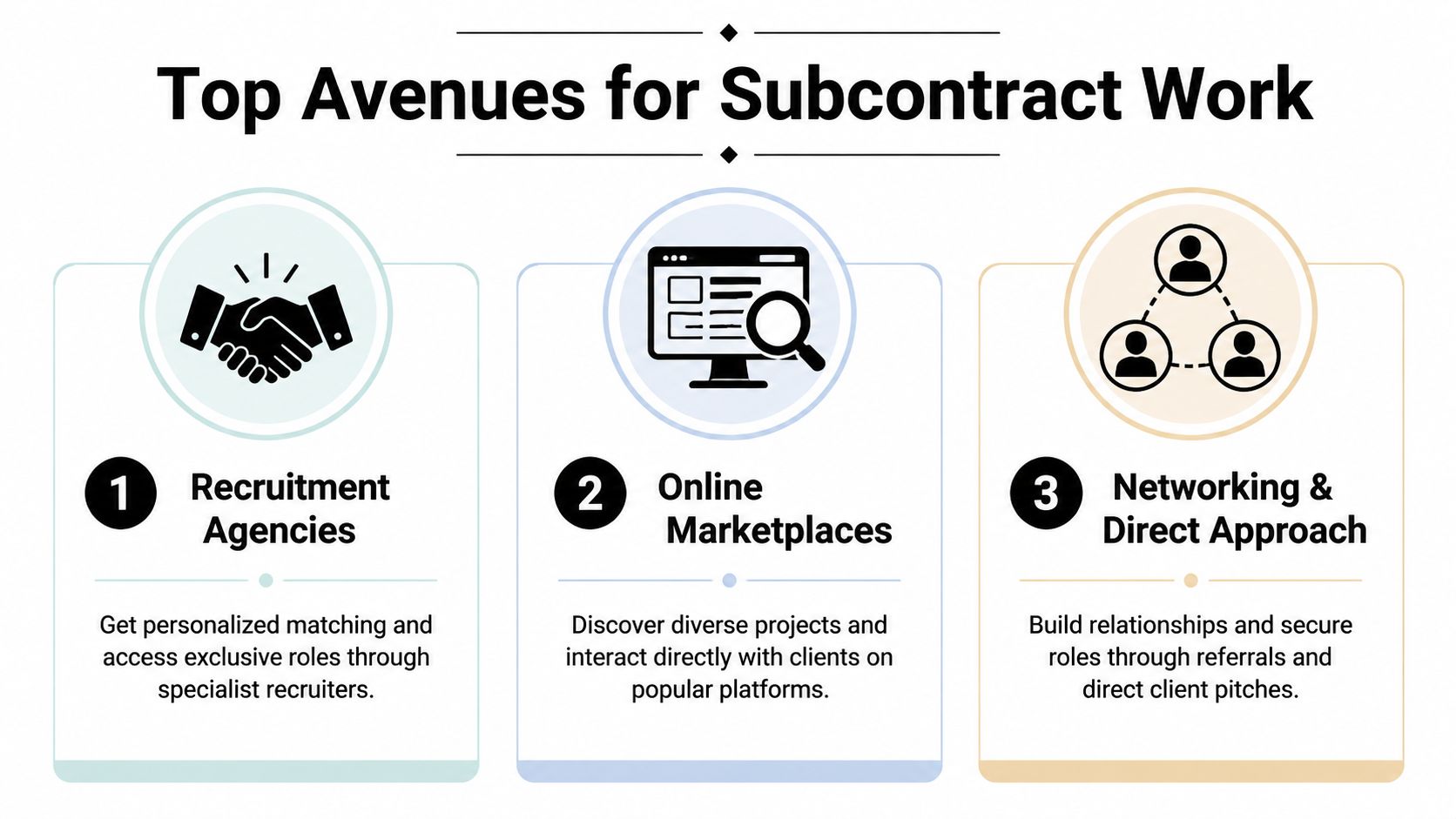
The three channels that matter
Agencies are often the fastest route in. They already have client relationships, they know which roles are live, and they can tell you quickly whether your profile fits. The downside is that some recruiters only understand the headline skillset and not the detail of how you work.
Online marketplaces widen your reach. They can be useful for specialist project work, shorter assignments, or building direct client relationships. The trade-off is noise. You'll spend more time filtering weak briefs and unrealistic budgets.
Networking and direct outreach are slower, but they often produce the best long-term clients. Referrals tend to come with more trust, fewer surprises, and less price pressure. If you're targeting public work, tools like public sector bidding tools can help you identify buying organisations and bidding activity more strategically.
Sourcing Channels for Subcontract Work
| Channel | Best For | Pros | Cons |
|---|---|---|---|
| Recruitment agencies | Contractors who want faster access to active vacancies | Existing client demand, quicker introductions, recruiter feedback | Less control over client relationship, variable role quality |
| Online marketplaces | Specialists offering defined project work | Broad reach, direct visibility, flexible pitching | Higher competition, more filtering, inconsistent briefs |
| Networking and direct approach | Experienced contractors building repeat business | Better margins, stronger relationships, more control | Slower to build, requires follow-up and sales discipline |
How to use them together
Don't rely on one source. A single channel can dry up quickly, or produce too many poor-fit roles in a row.
A balanced weekly routine usually works better:
- Agency maintenance: Speak to a small number of specialist recruiters who place your type of work.
- Marketplace scanning: Review live briefs and respond only where the scope is specific.
- Direct outreach: Contact former clients, delivery leads, or procurement contacts with a short capability update.
- Referral prompts: Ask trusted contacts what's coming up before it reaches the open market.
If you want a starting point for live roles, browse subcontractor job listings and use them to spot patterns in skills, sectors, and contract structures.
A healthy pipeline usually comes from layered activity, not one lucky lead.
Crafting Your Pitch to Win the Best Contracts
Once you've found an opening, the next job is to make the client feel safe buying from you. That's the core purpose of your pitch. Not to sound impressive, but to reduce doubt.

What clients actually want to see
Most subcontract pitches fail because they read like permanent job applications. Long employment histories. Generic profile statements. No clear picture of what the contractor can solve.
A better pitch shows four things quickly:
- Relevant delivery history: Similar projects, environments, or stakeholders.
- Commercial awareness: You understand deadlines, handover points, and dependencies.
- Autonomy: You can work without daily management.
- Low-friction onboarding: References, right to work, documentation, and availability are all clear.
A useful way to present yourself is through outcomes. Instead of writing “responsible for project support”, write what you delivered, how you worked, and what the client got at the end.
A simple structure that works
Try this format in outreach emails, LinkedIn messages, or proposal notes:
- Opening line: Mention the project type or business need.
- Fit statement: Explain why your experience matches this exact contract.
- Proof: Give two or three examples of similar work.
- Working style: Show that you can deliver independently and communicate clearly.
- Close: Suggest a short call or ask for the full brief.
For fixed-scope engagements, a clear statement of work guide can help you frame your offer around deliverables rather than a vague resource request.
Example outreach message
Here's a short version that feels commercial rather than needy:
I'm available for subcontract work in this area and have delivered similar projects where the brief required clear handover, stakeholder coordination, and independent execution. My background fits the technical scope, and I can provide recent client references and start documentation immediately. If useful, I'm happy to review the deliverables and confirm whether the work is best structured as project-based support or a broader contract engagement.
There's another reason to pitch this way. A 2023 UK industry report found that 71% of subcontractors are actively looking to grow their business, which means ambition is common, not unusual. The contractors who stand out show that ambition in a controlled, commercial way, as reflected in the 2023 subcontractor market report.
Small changes that improve response quality
You don't need a flashy proposal. You need a precise one.
- Lead with relevance: Put the matching sector, system, trade, or environment near the top.
- Cut biography: Clients don't need your life story. They need fit.
- Name practicalities: Mention notice period, availability, and whether you've worked through agency or direct models before.
- Make references easy: Say they're available. Don't wait to be asked.
Screening Opportunities and Negotiating Your Contract
Winning the call isn't the finish line. It's where true risk starts. A subcontract role can look attractive until you read the control language, payment wording, or scope definition properly.
Start with the checklist, then move into the detail.
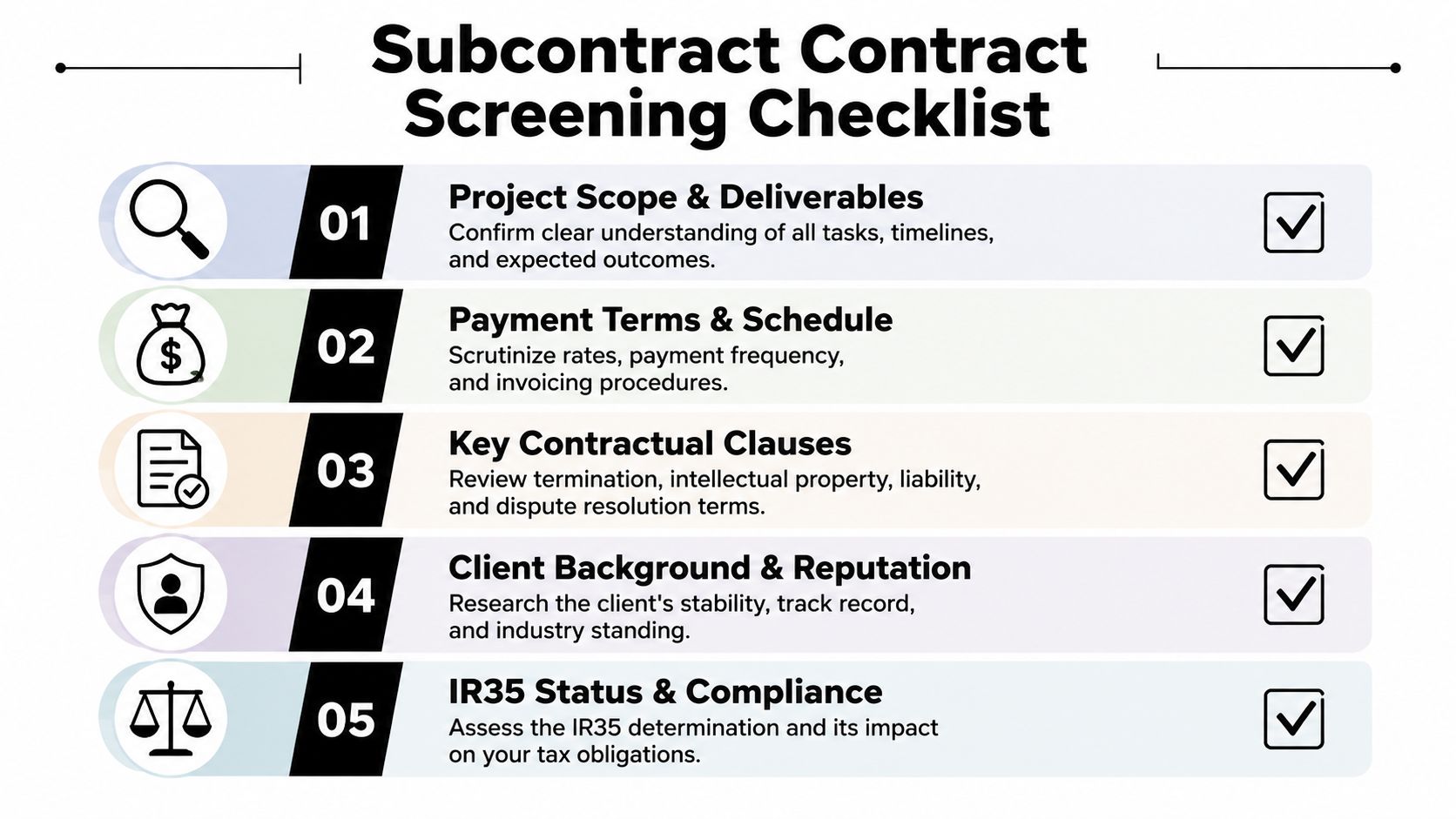
The first pass screening test
Before you negotiate anything, ask five blunt questions:
- Is the scope clear: Can you see defined deliverables, deadlines, and boundaries?
- Who controls the work: Are you being engaged for an outcome, or slotted into the team like staff?
- How do you get paid: Are invoice dates, approval steps, and payment terms written down?
- What liabilities are you taking on: Do the clauses reflect your actual role?
- Does the paperwork match reality: A contract can say one thing while the day-to-day arrangement says another.
That last point matters more than many contractors think.
The control clause is where many disputes start
UK case law statistics show that 70% of IR35 disputes arise from ambiguous contract terms regarding client control. If supervision, direction, and control aren't documented properly, you leave too much room for reinterpretation later.
If a client wants to dictate your hours, methods, approvals, and daily priorities like an employee relationship, treat that as a major status and contract signal.
Look carefully at phrases such as:
- “Report into line management”
- “Work under supervision of”
- “Follow client working practices as directed”
- “Integrated member of the team”
Some of that language may be normal in context, but if the contract relies on broad control without clear professional boundaries, push back. Clarify what you are responsible for, what the client approves, and what remains under your own judgement.
For background on wider contractual exposure, many contractors also find it useful to understand joint and several liability in contractor arrangements.
Here's a useful explainer on contract review and risk awareness before you sign:
What to negotiate beyond the rate
Too many contractors focus on the number and ignore the mechanics. A strong rate can be undermined by bad terms.
Review these points properly:
- Payment terms: Ask when invoices are approved, who signs them off, and what happens if the client disputes time or deliverables.
- Scope wording: If the work is loosely described, tighten it. Vague scope leads to unpaid extras and control creep.
- Exit terms: Check notice periods, termination rights, and whether the client can pause work without paying for committed time.
- Flow-down obligations: If you're downstream from a larger contract, understand which obligations are being passed to you.
- Delay and dependency language: Make sure you're not carrying responsibility for hold-ups caused by someone else.
Red flags worth acting on
Walk away, or at least slow the process down, if you see:
- Rushed paperwork: “We'll sort the contract later” is not a small admin issue.
- Unclear approvers: If nobody can explain who signs off your work or payment, expect friction.
- Employment-style control with contractor wording: This is one of the most common mismatches in the market.
- Resistance to clarification: A reasonable client should be willing to define scope and payment in writing.
A clean contract doesn't guarantee a perfect engagement, but it gives you something to enforce when memory and goodwill start to fade.
Navigating IR35 and Choosing Your Umbrella Company
IR35 is where many otherwise solid contracts become expensive. If you get subcontract work on terms that fall inside the off-payroll rules, the commercial picture changes fast. Your fee is no longer just your fee. Tax treatment, National Insurance, and payroll handling all come into play.
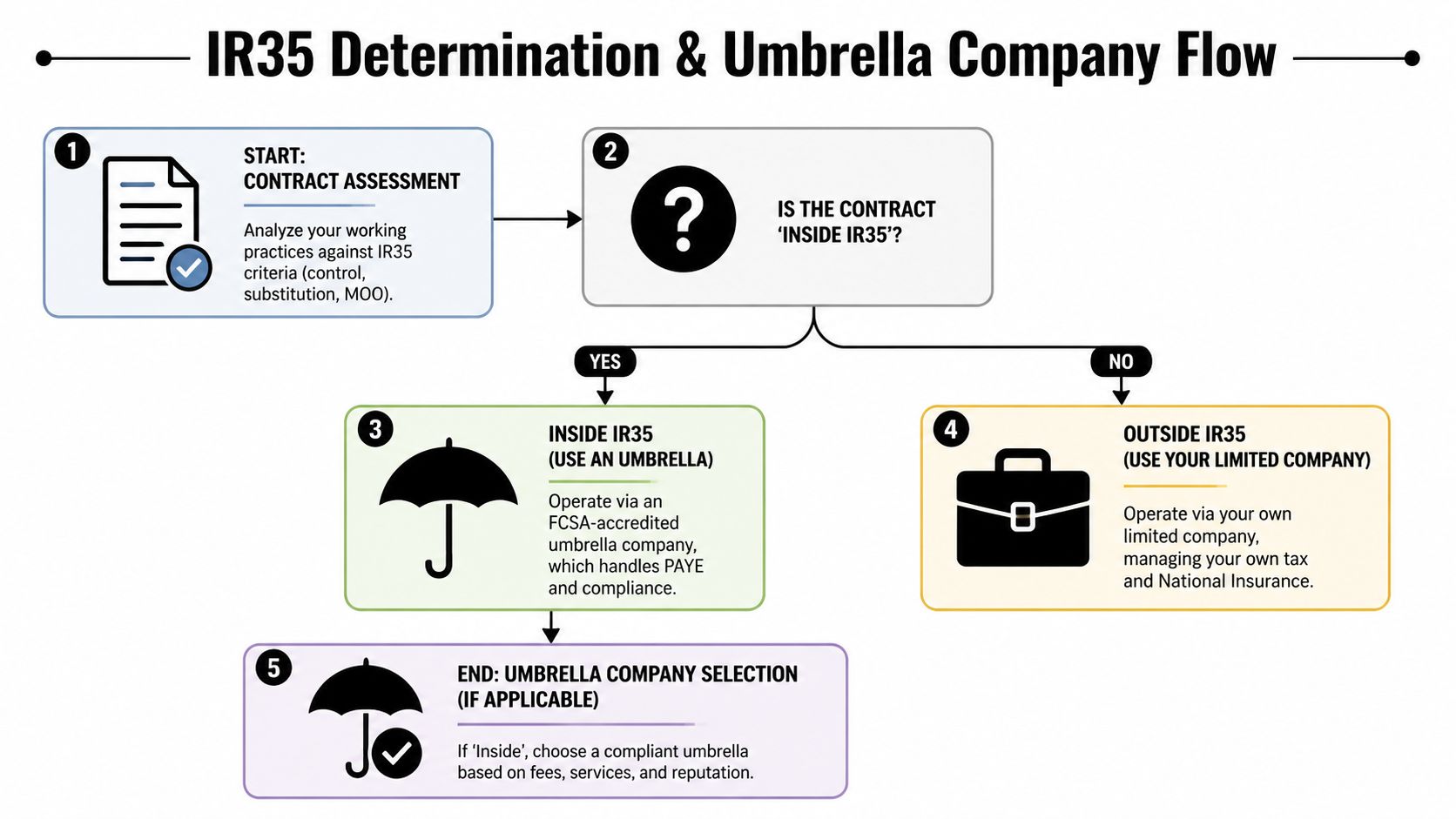
What inside IR35 means in practice
Inside IR35 means the engagement is treated like employment for tax purposes. That doesn't automatically mean the work is bad. It does mean you need to understand the deductions and the structure you're using.
For roles inside IR35, Employer's National Insurance contributions are 13.8% on earnings above the Secondary Threshold (£9,100 for 2024/25), and Employee's NIC is 8% on earnings between £12,570 and £50,270, as set out in this summary of contractor tax treatment and NIC thresholds. A compliant umbrella company manages these statutory deductions through PAYE.
The status tests you need to understand
The technical language can be dry, but the underlying questions are straightforward. Status usually turns on how the work is performed.
HMRC looks closely at three themes:
- Behavioural control: Does the client decide how, when, and where the work is carried out?
- Financial control: Do you carry business risk, cover your own expenses, or have scope for profit and loss?
- Relationship of the parties: Does the arrangement look and operate like employment?
In practical terms, if the client directs your daily activity closely and there is no meaningful right of substitution, the arrangement is more likely to be treated as inside IR35. If you operate with clear autonomy and genuine business risk, the picture is different.
Reality check: Many contractors don't lose money on the rate. They lose it by accepting a contract structure they didn't fully understand.
Why umbrella choice matters
For inside IR35 work, an umbrella company isn't just an admin layer. It becomes central to how your income is processed and how compliant the arrangement is. The right provider handles PAYE correctly, explains deductions clearly, and avoids gimmicks that promise unusually high take-home pay.
Things worth checking include:
- Margin clarity: Reputable providers state their fee upfront.
- Accreditation: FCSA and Professional Passport are useful markers when you're screening providers.
- Payslip transparency: You should be able to see how gross pay, employer costs, employee deductions, and net pay are calculated.
- Support quality: If there's a status question or payroll issue, you need answers quickly.
- Contract review approach: Strong providers understand the difference between headline wording and actual working practice.
If you're weighing options, a structured umbrella company comparison tool makes it easier to compare fee models, support levels, and compliance signals side by side.
The overlooked financial protection point
One issue contractors often miss is what happens if an IR35 assessment goes wrong. Some guides treat getting the role and choosing an umbrella as separate decisions. They aren't. If the status assessment later unravels, the tax consequences can be painful.
That's why it's worth reading the umbrella contract itself, not just the marketing page. Look for wording around compliance responsibility, indemnities, and what support the provider offers if HMRC challenges the arrangement. The practical question isn't just “what's your fee?” It's “what protection do I have if your initial check turns out to be wrong?”
A cheap umbrella can become very expensive if the paperwork behind it is weak.
Best Practices for Onboarding and Invoicing
A contract starts properly on day one, not when the first invoice is late. Smooth onboarding reduces friction with the client, the agency, and your payroll provider.
Get your admin in order early
Before work begins, confirm exactly what each party needs from you. That usually includes identity documents, right-to-work evidence, bank details, signed terms, purchase order information, and any site or system onboarding requirements.
If you want a useful external perspective on client setup, Pipeline On shares onboarding strategies that are worth adapting for contractor relationships too. The main lesson is simple. Clear expectations at the start prevent avoidable delays later.
Build an invoicing routine that protects cash flow
Don't treat invoicing as an afterthought. Treat it like part of delivery.
A good invoice process should include:
- Correct references: Add the purchase order number, project name, and client contact if required.
- Clear description: State the services or deliverables in language the approver will recognise.
- Agreed terms: Match the contract wording on dates, rates, and billing periods.
- Submission proof: Keep records of when and where the invoice was sent.
- Chasing discipline: Follow up professionally before the due date, not long after it.
Send invoices in the format the client's accounts team actually uses, not the format you prefer. Convenience speeds approval.
Keep records while the work is live
The ease or difficulty of resolving many disputes often hinges on proper record-keeping. Keep your timesheets, email approvals, change requests, milestone notes, and any revised scope documents in one place. If the client later questions what was agreed, your records become the difference between a quick resolution and a long argument.
For umbrella workers, check your payslips against submitted hours and approved payments. For direct contracts, reconcile every invoice against the contract and your own delivery notes. Good record-keeping isn't glamorous, but it protects your income.
Building Your Successful Contracting Career
The contractors who get subcontract work consistently don't rely on luck. They build a repeatable system. They source through more than one channel, pitch with clarity, vet every contract properly, and treat IR35 compliance as part of commercial decision-making, not separate from it.
That's the long-term advantage. Not just winning the next role, but building a contracting career that stays profitable, organised, and defensible when questions arise.
If you're moving into an inside IR35 contract, or you want to tighten up how your income is handled, take the time to compare your options carefully before you sign anything.
If you need help choosing a compliant provider for your next contract, Umbrella Company can help you compare umbrella companies based on your role, rate, and IR35 needs, so you can move forward with more confidence.


