


You've just landed a new contract. The rate looks good, the scope is clear, and then you reach the clause asking for proof of insurance. If you're unsure what you need, you're not alone.
Freelancer insurance can feel confusing because different rules sit on top of each other. Some cover is required by law in certain circumstances. Some is demanded by clients. Some isn't mandatory at all, but can still protect your income, savings, and reputation if something goes wrong.
This guide breaks it down in plain English. You'll see what the main insurance types mean, when cover is legally required, how contracts change the picture, what personal protection is worth considering, and how umbrella companies fit in for contractors who want a simpler route to compliant cover.
Why Freelancer Insurance Is More Than Just a Box to Tick
A lot of freelancers first think about insurance when a client asks for it. That's common, especially when you start working with larger organisations that want reassurance before they sign. But insurance isn't just paperwork for procurement teams. It's part of how you protect your business when a mistake, accident, dispute, or interruption threatens your finances.
That matters in a labour market where freelance work is already a major part of the UK economy. The UK workforce includes approximately 4.4 million self-employed individuals, with an estimated 2.046 million being highly skilled freelancers, according to UK freelancer statistics compiled by Mode Insurance. When so many people earn their living independently, suitable protection stops being a niche issue and becomes a basic business decision.
Three questions to answer first
Most confusion disappears when you separate insurance into three questions:
- Is it legally required: This is about rules you must follow.
- Is it contractually required: This depends on what your client has written into the agreement.
- Is it good risk management: This is about protecting yourself even when nobody forces you to buy cover.
A freelance designer, developer, consultant, or copywriter might answer those questions differently. Someone who works entirely remotely faces different risks from someone who visits client sites, hires subcontracted help, or advises on sensitive commercial decisions.
Practical rule: If losing a dispute would put your savings, future income, or client relationship under pressure, insurance deserves serious attention even where the law doesn't force it.
Why this matters in practice
Insurance often does two jobs at once. It can help you win work because clients see you as lower risk, and it can reduce the damage if something goes wrong after the work starts.
You can see how specialist providers position trust and protection in real-world insurance marketing through this Extra Mile Insurance case study, which is useful if you want to understand how insurers communicate value beyond price alone.
If you want a contractor-focused overview of the main options, our guide to insurance for contractors in the UK is a useful next read alongside this article.
Decoding the Main Types of Freelancer Insurance
The names sound technical, but the core products are easier to understand when you map them to everyday freelance risks. Most confusion comes from mixing up Professional Indemnity, Public Liability, and Employers' Liability.
That confusion is real. 70% of UK freelancers are confused about whether they need professional indemnity versus public liability insurance, and 45% have considered cancelling policies due to this uncertainty, despite 60% facing negligence claims annually, according to Livingstones Insurance.
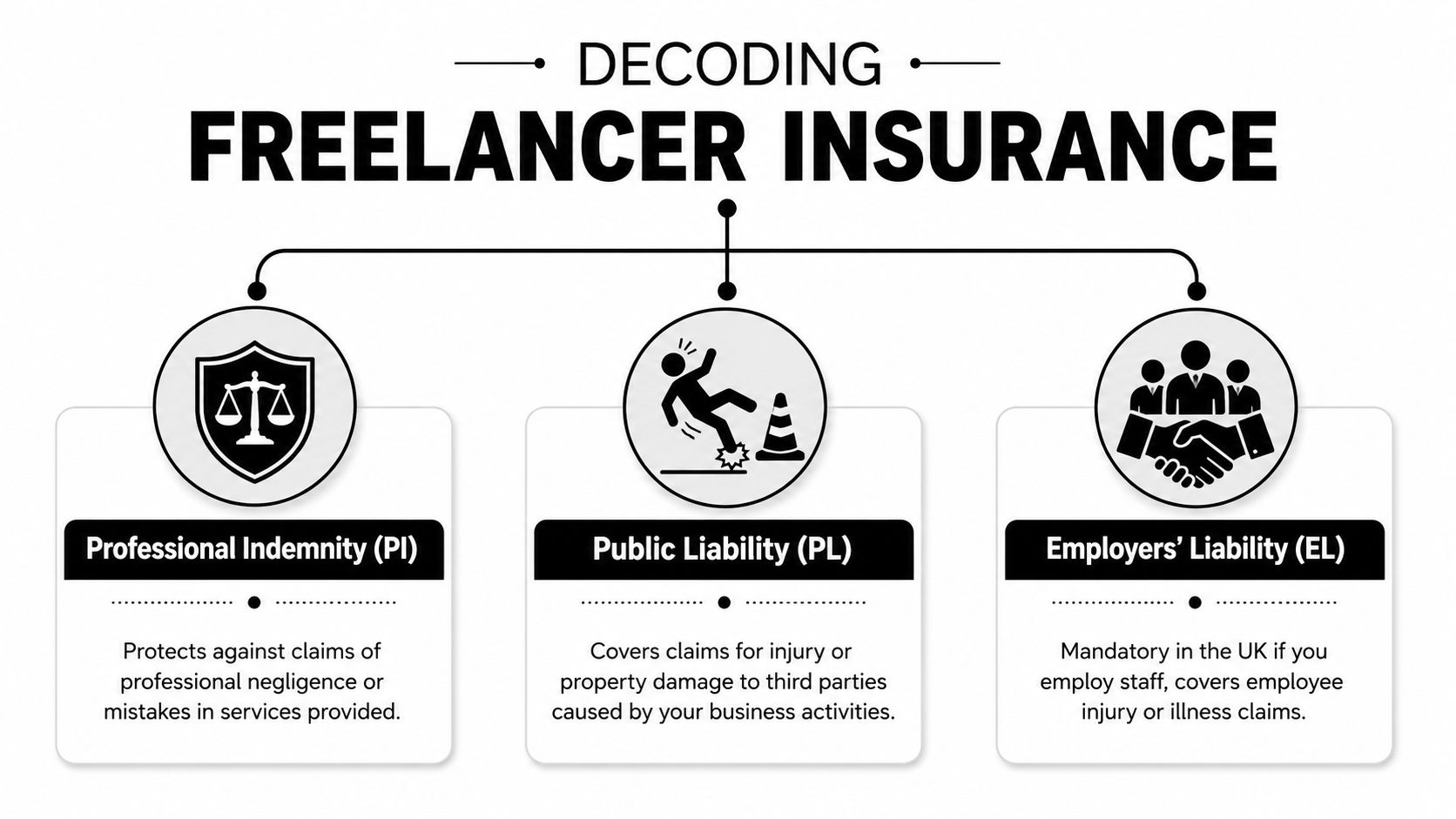
Professional Indemnity insurance
Think of Professional Indemnity insurance, often shortened to PI, as protection for your advice, judgement, and professional output.
If a client says your work caused them financial loss, PI is the cover they're usually talking about. That can include an allegation that you made an error, missed something important, gave unsuitable advice, or failed to deliver the service to the standard expected.
A simple example helps. Say you're a freelance marketing consultant and you recommend a campaign structure that breaches a platform rule or misses a legal approval step. The client says the mistake cost them money and they want compensation. PI is designed for that sort of claim.
Public Liability insurance
Public Liability insurance, or PL, deals with injury to other people or damage to their property caused by your business activities.
This isn't really about your professional advice. It's about physical incidents.
For example, if you visit a client's office, knock over expensive equipment, or a visitor trips over your cable during a workshop, PL is the type of policy that may respond. It's especially relevant if your work involves meetings, events, site visits, filming, installations, or any in-person activity.
Employers' Liability insurance
Employers' Liability insurance, or EL, is different again. It relates to claims from people who work for you.
If someone you employ becomes ill or is injured because of the work they do for your business, EL is the relevant category. This applies beyond traditional full-time staff. Depending on the arrangement, the question isn't just whether you think of yourself as an employer. It's whether the law treats you as one for insurance purposes.
PI covers your professional mistakes. PL covers accidents involving third parties. EL covers claims from workers you employ.
A quick comparison
| Cover type | Main risk | Typical example |
|---|---|---|
| Professional Indemnity | Financial loss caused by your service or advice | A client alleges your recommendation or deliverable caused them loss |
| Public Liability | Injury or property damage involving third parties | You damage a client's equipment during a site visit |
| Employers' Liability | Injury or illness claims from people working for you | An employee says they were harmed while carrying out work for your business |
For a deeper look at claims linked to advice and services, our page on freelance indemnity insurance covers the practical side in more detail.
When Is Freelancer Insurance a Legal Requirement
Most freelancer insurance isn't automatically required by law for a solo self-employed person. The key legal exception is Employers' Liability insurance.

The legal trigger
The rule is straightforward. If a freelancer employs staff, Employers' Liability Insurance is a strict legal requirement in the UK, with a minimum cover of £5 million. Failure to hold this insurance can result in fines of up to £2,500 for every day you are uninsured, according to Everywhen's guide to freelancer insurance.
That's the point many freelancers miss. They think insurance is optional because they're used to working alone. Then the business grows, they bring in support, and the risk position changes immediately.
Who counts as staff
This isn't limited to a formal employee on a long-term contract. The legal question can arise when you bring in help, including temporary or unpaid support. That's why growing freelancers need to check the arrangement before anyone starts work.
A common mistake is assuming, “They're only helping for a short period, so it doesn't count.” That assumption can be expensive.
Why the distinction matters
Professional Indemnity and Public Liability might still be very sensible depending on your work, but they usually sit in the category of contractual need or good practice. Employers' Liability is different. Once the legal trigger applies, this is not a judgement call.
A sensible compliance check looks like this:
- Working alone: Review contractual and operational risks.
- Hiring any help: Confirm whether EL is required before work begins.
- Scaling up: Keep insurance under review whenever your structure changes.
Don't wait until payroll is set up or a contract is signed. If someone starts working for your business and the legal test is met, the obligation already matters.
If you operate through a limited company, this point needs even more attention, because company structures and employment arrangements can create obligations that freelancers don't always expect.
Meeting Contractual Requirements and Sector Needs
Clients often shape your insurance needs more than the law does. A contract might ask for proof of cover before onboarding, before access to systems, or before any work starts on site. If you don't spot that early, you can end up negotiating rates and timelines only to stall at the paperwork stage.
Why clients insist on cover
From the client's perspective, insurance is part of supplier risk management. They want confidence that if your work causes loss, or if an incident happens while you're delivering the contract, there's a policy behind the business. It's also a sign that you operate in a structured, professional way.
This is especially common where freelancers work on commercially important projects, regulated processes, sensitive data, or in environments where third-party interactions happen regularly.
What to look for in the contract
Insurance clauses usually appear in one of four places:
- Supplier onboarding documents: Procurement or vendor forms may ask for certificates before approval.
- Master service agreements: The insurance wording may sit with indemnities, liability caps, or warranties.
- Statements of work: A client might apply different insurance expectations to a specific project.
- Site access rules: Physical attendance can trigger requests for Public Liability even if remote work didn't.
A practical example is a freelance IT specialist who usually works from home and assumes Public Liability isn't relevant. Then a client asks them to attend a data centre or office site for testing. The risk profile changes because the working environment changes.
Legal, contractual, and good practice are not the same
Here, freelancers save money and avoid overbuying.
| Requirement type | What it means | Typical response |
|---|---|---|
| Legal | Required by UK law in defined circumstances | You must comply |
| Contractual | Required by a client agreement | You decide whether to accept, negotiate, or walk away |
| Good practice | Not mandatory, but sensible for your risk level | You choose based on exposure |
A policy can be unnecessary in legal terms and still be necessary in commercial terms. That's why reading the contract matters as much as reading the policy.
Sectors such as IT, consultancy, marketing, and professional services often expect PI. Work involving in-person meetings, training, production, or site attendance may also create a stronger case for PL. The right answer depends less on generic checklists and more on how, where, and for whom you work.
Protecting Your Income and Health as a Freelancer
Liability insurance protects the business you run. It doesn't solve the problem of you being unable to work.
That's a different risk, and for many freelancers it's the more serious one. If illness or injury stops you from taking on projects, invoicing can stop immediately while household costs keep going. Employees may have sick pay or workplace benefits. Freelancers usually need to build that safety net themselves.
Income protection
Income Protection is designed to pay an ongoing benefit if illness or injury keeps you off work for a qualifying period. The exact policy terms vary, but the principle is simple. You insure your earning power because your labour is the engine of the business.
This is especially important if your business depends heavily on one person, which is the case for most freelancers. If you're the one delivering the work, winning the work, and managing the clients, your ability to function is a financial asset in its own right.
For a plain-language overview of how this kind of cover supports financial security with income protection, that resource gives a helpful consumer-level explanation of the thinking behind it.
Private health insurance
Private Health Insurance serves a different purpose. It doesn't replace income. Instead, it can help you access diagnosis and treatment more quickly, depending on the policy and medical issue.
For freelancers, faster treatment can have a direct business effect. The aim isn't luxury. It's reducing the length and impact of disruption.
A sensible way to weigh personal cover
Consider these questions:
- How long could you manage without invoices: Think in months, not days.
- Do you have dependants or fixed financial commitments: Mortgage, rent, childcare, and debt all raise the stakes.
- Would faster treatment help you return to work sooner: For many self-employed professionals, the answer is yes.
Our guide to the best income insurance looks at this in more detail if you're comparing protection options.
Important distinction: Business liability cover protects you from claims by others. Personal protection helps when the problem is your own health and ability to earn.
Freelancers sometimes spend a long time comparing PI and PL but never stop to insure the person doing the work. That can leave the biggest risk untreated.
Understanding Costs, Limits, and How to Get Covered
Cost is usually the point where interest turns into action. Once you know what insurance does, the next question is whether the premium is reasonable for the risk you carry.
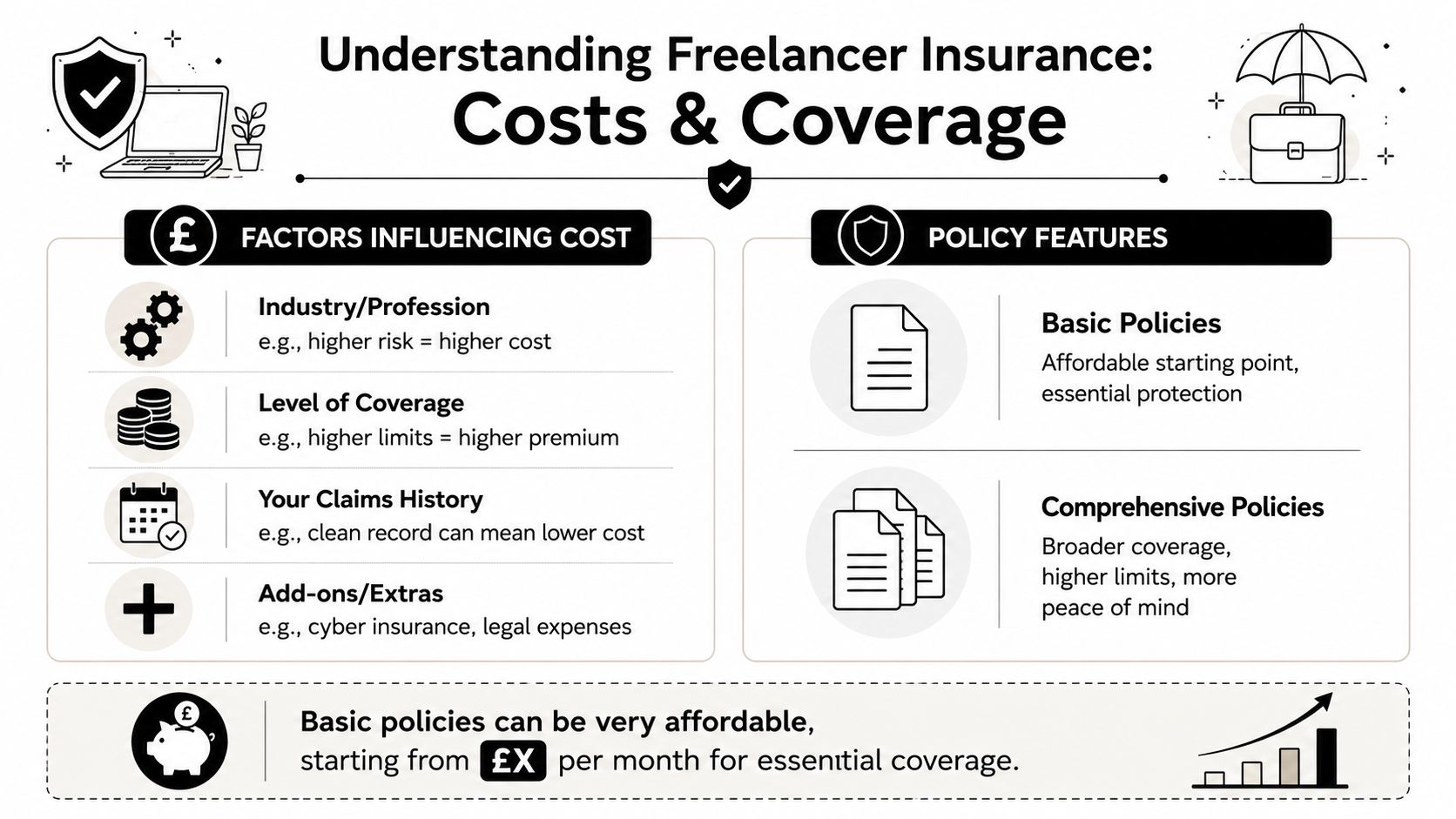
There is no universal price because policies are built around what you do, how you work, and the level of cover you choose. But there is a useful baseline. According to AXA UK, business insurance costs for freelancers can start from as little as £76 per year. However, the final price varies based on the level of cover, with most insurers offering a standard minimum of £10 million for Employers' Liability, as noted in PolicyBee's overview of insurance for freelancers.
What affects the price
Premiums usually move according to a handful of practical factors:
- Your profession: Advisory and technical roles may carry different risks from manual or public-facing work.
- Your cover level: Higher limits generally mean higher premiums.
- Your working pattern: Remote-only work can produce a different risk picture from on-site delivery.
- Extra cover options: Legal expenses, equipment cover, and similar additions can change the total.
A freelance management consultant and a freelance videographer might both be self-employed, but the exposures are different. One is more likely to focus on claims about advice and financial loss. The other may need to think harder about public interaction, location work, and equipment.
Two policy terms that matter
Many freelancers compare quotes without fully checking the structure of the policy. Two terms are worth understanding early.
| Term | What it means | Why it matters |
|---|---|---|
| Policy limit | The maximum amount the insurer will pay under the cover | A cheap premium may come with a limit too low for your contracts |
| Excess | The amount you pay yourself when making a claim | A higher excess can reduce premium cost but increase out-of-pocket exposure |
If a client requires a certain level of cover, the policy limit needs to match that requirement. If your excess is high, you need to be comfortable funding that first slice of a claim.
How freelancers usually get covered
You generally have three routes:
Direct from an insurer
This can be straightforward if your work is standard and you know exactly what you need.Through a broker
A broker can help when contract wording is complex or your work spans several risk areas.Through an umbrella company arrangement
For contractors working through an umbrella, relevant business insurance may already be built into the solution, depending on the provider and model.
That third route is often attractive because it reduces admin. Instead of sourcing, checking, and renewing separate policies yourself, the cover can form part of a broader compliant setup. It's also worth looking at related protection such as tax investigation insurance when you're thinking about the wider risk picture of self-employed and contract work.
Before you buy, check whether the policy is solving a legal issue, a client issue, or a business continuity issue. The answer should shape the cover, not the other way round.
Your Freelancer Insurance Checklist and Key Questions
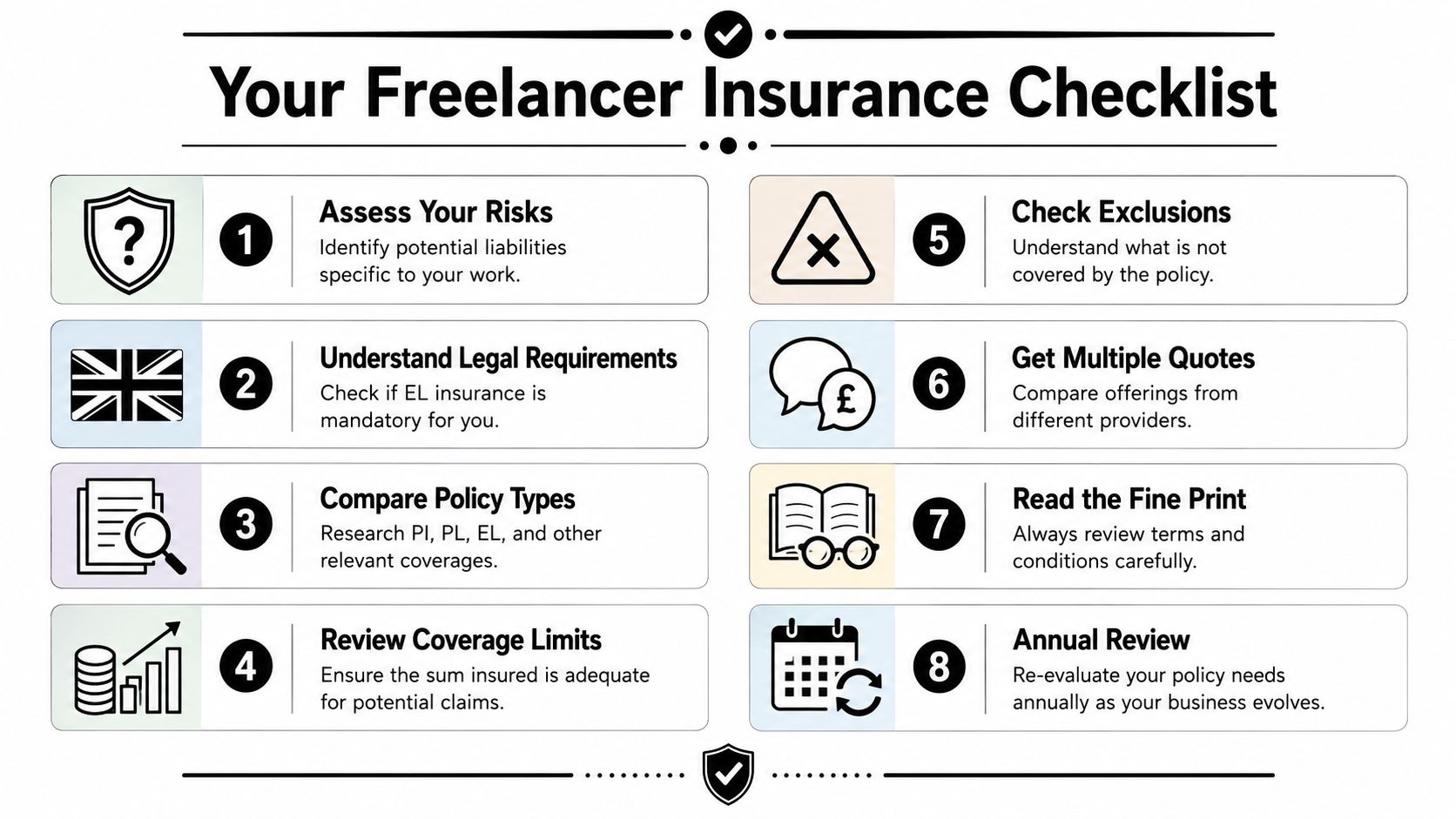
Once you strip away the jargon, choosing freelancer insurance becomes a process of asking the right questions in the right order.
A practical checklist
Use this before you compare quotes:
- Review your contracts: Check whether clients ask for PI, PL, specific limits, or proof before work starts.
- Map your real risks: List what could go wrong in the way you work, not just what generic articles mention.
- Check legal status: If anyone works for you, confirm whether Employers' Liability is required.
- Match cover to activity: Advice-led work points towards PI, physical interaction points towards PL, and staffing changes raise EL questions.
- Check policy limits carefully: Make sure the insured amount fits your contract and exposure.
- Read exclusions: A policy isn't useful if the situation you worry about is carved out.
- Confirm claim reporting rules: Late notification can create problems.
- Review annually: New clients, new services, and new working arrangements can change what you need.
Questions to ask an insurer or broker
The answers matter as much as the premium:
- Does this policy cover the specific services I provide
- Are subcontracted or temporary working arrangements included
- What exclusions should I pay attention to
- Does the policy cover work for clients outside the UK
- What documents would I need if I had to make a claim
- Can you provide a certificate that matches client onboarding requirements
- How does renewal work if my business model changes during the year
Ask the insurer to explain anything unclear in plain English. If they can't do that before a sale, don't expect clarity when a claim is on the line.
The goal isn't to buy the broadest policy on the market. It's to buy cover that matches the risks you carry.
Frequently Asked Questions about Freelancer Insurance
Do umbrella companies provide insurance
Sometimes, yes. Many umbrella company arrangements include relevant business insurance as part of the overall employment and payroll model for contractors. The details vary, so you should check exactly what is included, who is covered, and whether the scope matches the work you do. Don't assume all umbrellas offer the same protection.
Do I need cyber insurance as a tech freelancer
Not always. The answer depends on what data you hold, what systems you access, and the consequences if something goes wrong. While many guides give a blanket recommendation for cyber insurance, data from Hiscox UK shows that while 38% of UK solo tech freelancers report cyber attack attempts, their needs may differ from larger businesses, creating confusion about cost-benefit trade-offs, according to Hiscox UK's freelancer insurance guidance.
If you don't store sensitive client data and your exposure is limited, cyber insurance may not be the first policy to prioritise. If you manage systems, handle confidential information, or rely heavily on uninterrupted digital operations, the case becomes stronger.
Is Professional Indemnity legally required
For most solo freelancers, not automatically. It often becomes necessary because a client contract demands it or because your work creates a real risk of negligence claims. That's different from a legal obligation.
What is retroactive cover
Retroactive cover can matter when a claim is made later for work you completed earlier. Because professional disputes don't always appear immediately, freelancers should ask how the policy deals with past work and when cover begins.
Can I rely on one policy for every situation
Usually not. Different policies deal with different risks. A PI policy won't do the same job as PL, and neither replaces income protection if illness stops you working. Good insurance planning is about fit, not just ownership.
If you're comparing ways to stay compliant and reduce admin as a contractor, Umbrella Company helps you compare trusted umbrella companies suited for your role, pay rate, and IR35 position. It's a practical starting point if you want a simpler route to payroll support and contractor-focused protection.


