


A client sends over the contract. The rate looks fine, the scope is clear, and then procurement asks for your professional indemnity certificate before they will issue a purchase order.
If that's your first encounter with freelance professional indemnity insurance, the request can feel oddly loaded. You know it matters, but the policy wording is unfamiliar, the limits look arbitrary, and it's not obvious whether you need your own cover or whether someone else in the chain already has it.
That confusion is common because PI insurance sits at the point where freelance work becomes a real business. It affects whether you can start a contract, how much risk you personally carry, and how exposed your savings are if a client says your work caused them a financial loss.
Your Guide to Professional Indemnity Insurance
Freelancers usually meet PI insurance at the least convenient moment, just before a new contract starts. A recruiter is chasing documents, the end client wants proof of cover, and you're left trying to work out whether this is a sensible requirement or just standard procurement language.
That's happening more often because PI insurance is no longer a niche product for a small group of regulated professions. The UK professional indemnity insurance market is estimated at £3.3 billion in premium value, with around 1.5 million policyholders across more than 500 occupation types, a spread linked to the growth in self-employment and freelance work, according to UK professional indemnity market facts and figures.
For freelancers, that matters for one simple reason. Clients increasingly treat PI as part of basic supplier due diligence, especially where you provide advice, project delivery, design, software, or specialist expertise.
Where most freelancers get stuck
The practical questions are usually these:
- Do I need it: Some freelancers do. Some are being asked for it by habit rather than real risk.
- What does it protect me against: PI is about claims tied to your professional work, not every business problem.
- How much cover is enough: The right answer depends on your contracts and exposure, not on what looks cheapest.
- Who arranges it: That changes depending on whether you trade directly, use a limited company, or work via an umbrella.
A lot of generic guidance stops at “buy a policy”. That's not enough if you're contracting in the UK and dealing with IR35, agency terms, umbrella arrangements, and client indemnity clauses.
If you're reviewing your wider protection at the same time, our guide to contractor insurance in the UK helps place PI alongside the other covers contractors often get asked about.
Practical rule: If a client can claim your work caused them financial loss, PI isn't an abstract insurance product. It's part of how you stay in business.
What Is Professional Indemnity Insurance
Professional indemnity insurance is the cover that protects you if a client says your professional work caused them a financial loss and they pursue you for compensation or legal costs.
That usually means claims connected to things like bad advice, a mistake in deliverables, an omission, or a failure in professional service. In plain terms, it's a financial safety net for your expertise.

A UK insurer aimed at freelancers describes professional indemnity as the most important cover for freelancers because clients in advice-led and project-based roles often require it before work begins, making it a commercial necessity in practice, as noted in Hiscox guidance for freelancers.
What PI is really protecting
Think about the kinds of work many freelancers sell:
- Consulting: Recommendations that influence spending or operations
- Software and IT delivery: Builds, changes, integrations, support, migration work
- Design and marketing: Deliverables that affect launches, campaigns, brand use, or customer journeys
- Specialist advisory services: Work where a client relies on your judgement
If the client says that work was wrong, incomplete, or negligent, the claim usually isn't about a broken chair or a damaged office wall. It's about financial loss.
PI versus public liability
Freelancers often mix up two very different policies.
| Cover type | What it usually deals with | Typical example |
|---|---|---|
| Professional indemnity | Financial loss linked to your professional service | A client says your advice or deliverable caused them a business loss |
| Public liability | Injury to a third party or damage to property | Someone trips over your equipment during an on-site meeting |
If you're comparing options, our page on contractor indemnity insurance covers how this type of protection fits into contractor working arrangements.
PI insurance doesn't make a dispute disappear. It gives you a route to deal with legal defence costs and claims without carrying the whole burden personally.
Which Freelancers Need PI Insurance
The short answer is that not every freelancer legally needs PI insurance, but many freelancers either genuinely need it because of their risk profile or effectively need it because clients won't engage them without it.
That distinction matters.
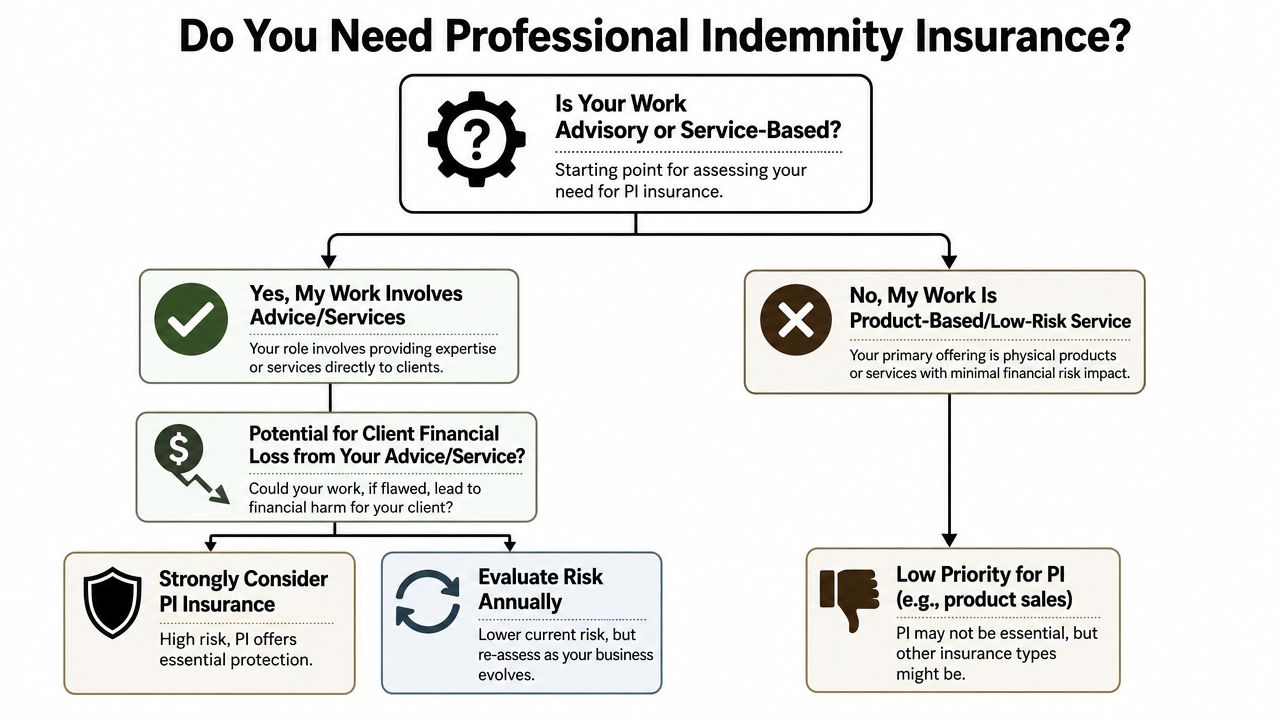
A useful way to assess freelance professional indemnity insurance is to stop asking “Is it compulsory?” and start asking “Could my work create a financial loss claim?”
Higher-risk freelance work
PI becomes far more relevant when your work influences business decisions, systems, revenue, compliance, or intellectual property.
Freelancers in these areas should take the issue seriously:
- IT contractors and software developers: If a system fails, data is mishandled, or a deliverable doesn't perform as promised, the client may say your work caused commercial loss.
- Management consultants: Advice that shapes hiring, operations, procurement, or strategy can be challenged if results go wrong.
- Designers and creative freelancers: Branding, packaging, campaigns, and assets can trigger disputes around rights, usage, or costly rework.
- Marketing specialists: If your service includes strategic advice, media decisions, or campaign implementation, a disappointed client may frame the issue as professional negligence.
- Regulated-adjacent specialists: Work close to finance, compliance, or formal advisory activity usually attracts stronger insurance expectations.
Lower-risk positions
PI may be a lower priority where your service is less advisory, less bespoke, and less likely to create measurable client loss.
That doesn't mean “never”. It means the business case may be weaker if:
- You sell straightforward productised services
- The client doesn't require cover
- Your contracts limit liability sensibly
- Your work has little realistic path to a financial-loss allegation
Contractual need versus real need
A useful contrarian point is that PI is often presented as though every UK freelancer must have it. That isn't right. For most freelancers, it isn't a legal requirement, and it's worth separating genuine risk from client overreach, as discussed in this analysis of whether freelancers really need PI insurance.
That means you should test the requirement, not just accept it blindly.
Ask:
- What exactly am I being asked to insure
- Is the requested limit proportionate to the contract
- Does the work create this risk
- Would another policy be more relevant
- Is the client using a boilerplate supplier clause
Freelancers building a stronger client pipeline often face this earlier because larger buyers usually have more formal onboarding. If you're trying to attract those buyers in the first place, a solid online presence strategy for creators can help you look more credible before procurement ever asks for paperwork.
Some clients ask for PI because their template says so. Others ask because your work could expose them to a real financial claim. Those are not the same thing.
Understanding Your Cover Limits and Exclusions
A PI policy only helps if the wording matches the work you do. This is a common pitfall for freelancers. They buy a policy to tick a contract box, assume they're protected, and only later realise the difficult parts of their work sit in the exclusions or in narrow definitions.
Guidance for freelancers warns that standard PI cover often doesn't fully address modern risks such as consequential loss claims or specific client demands around IP and data, which may need separate or specialized protection, as noted in RCI guidance on what PI may fail to cover.
What PI commonly covers
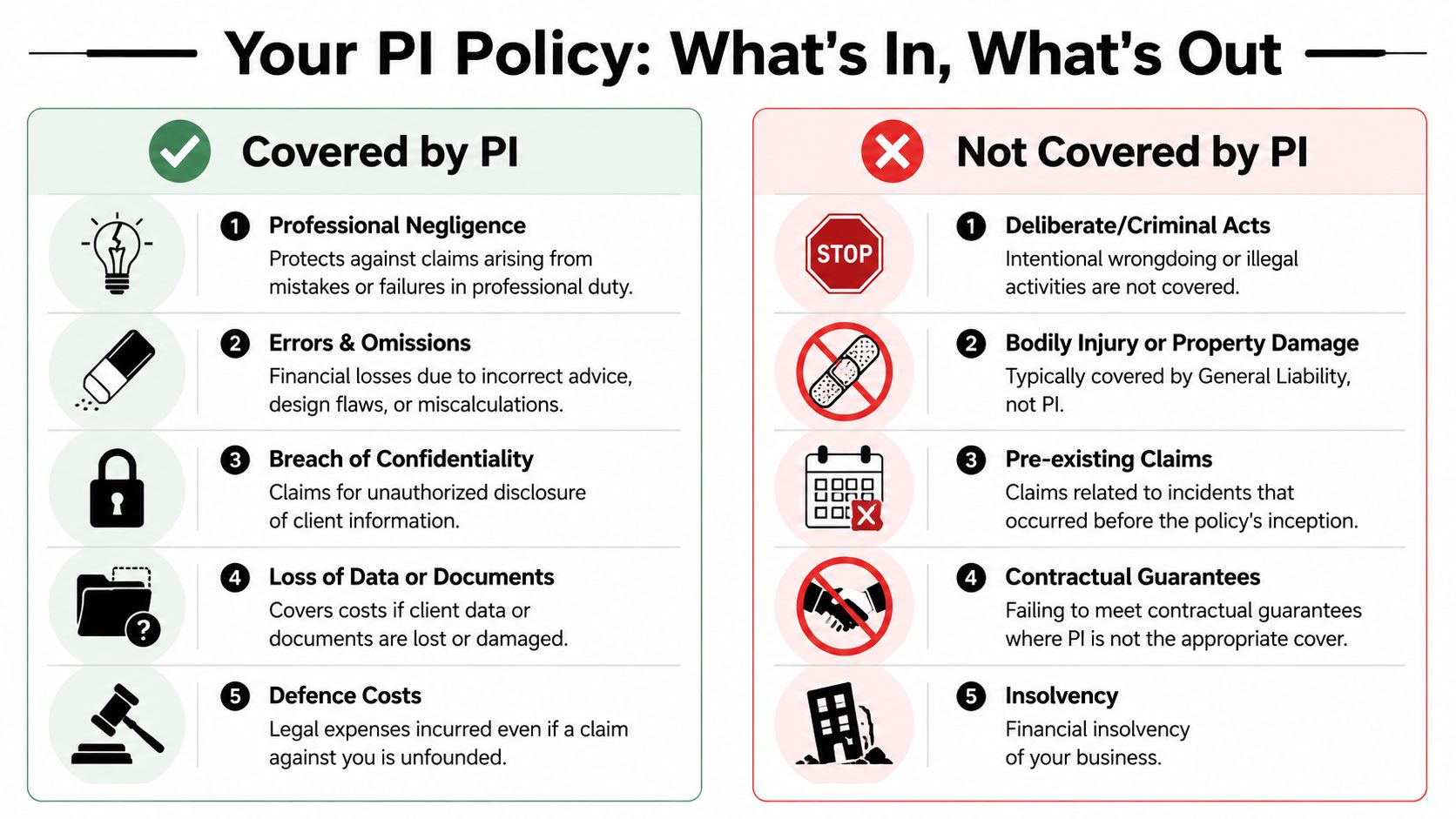
A typical policy often includes protection for claims linked to your professional service, such as:
- Negligence in your work: A client says you failed to meet the expected professional standard.
- Errors and omissions: Something was wrong, incomplete, or missed in what you delivered.
- Breach of confidentiality: Client information was handled improperly.
- Loss of documents or data: Relevant where your service depends on records, files, or digital material.
- Legal defence costs: One of the most practical parts of a policy, because even a weak claim can be expensive to defend.
What often falls outside standard cover
This is the part freelancers need to read slowly.
- Deliberate wrongdoing: PI is not there to protect intentional acts.
- Bodily injury or property damage: That usually sits under public liability, not PI.
- Contractual promises that go beyond professional duty: If you guarantee a result or accept liability wider than normal negligence, your insurer may not follow you there.
- Known issues from before the policy starts: Timing matters, especially with claims-made policies.
- Business risks dressed up as PI issues: A missed commercial target, client non-payment, or your own insolvency won't usually become a valid PI claim just because the contract mentions indemnities.
The digital work problem
Modern freelance work creates awkward grey areas. A web developer may face a complaint that mixes code quality, downtime, lost revenue, data handling, and contractual warranties. A designer may face an IP challenge tied to licensed assets, client instructions, or third-party materials. A consultant may have a client frame ordinary project disappointment as professional negligence.
That's why the cheapest policy often performs worst in real disputes. It may satisfy procurement at the start but fail where the facts become messy.
Questions worth asking before you buy
| Question | Why it matters |
|---|---|
| Does the policy match my actual services? | Broad labels like “consulting” can hide gaps if your work is technical or specialised |
| Are defence costs included within the limit or in addition? | That affects how much cover remains for any settlement |
| What does the policy say about IP, data, and consequential loss? | These are common flashpoints in digital freelance work |
| Have I accepted liabilities in my contract that the policy won't cover? | Contract wording can quietly widen your exposure |
| Does home working create any insurance gap elsewhere? | Some risks sit outside PI and need checking separately |
Watch the contract, not just the certificate: If your client's terms make you responsible for more than ordinary negligence, your policy may not respond the way you expect.
How Much Does Freelance PI Insurance Cost
The honest answer is that cost varies so much by profession and contract profile that a headline figure on its own is rarely useful. What matters more is understanding what drives the premium and why the cheapest quote can be the wrong decision.
The biggest pricing factors are usually the nature of your work, your turnover, your claims history, the territories you work in, and the level of cover your clients require. A freelance copywriter working on low-risk projects won't be assessed the same way as a software contractor delivering business-critical systems.
What usually pushes the cost up or down
- Your profession: Advice-led, technical, or regulated-adjacent work tends to attract closer scrutiny.
- Your turnover: Higher revenue can point to larger contracts and greater exposure.
- Your policy limit: More cover usually means a higher premium.
- Past claims or disputes: Insurers will want to know if you've had previous problems.
- Scope of work: Bespoke strategic work is usually viewed differently from routine delivery.
For many contractors, the more useful question isn't “What's the cheapest policy?” but “What limit will satisfy my client and still make sense for the work?”
Industry guidance often points to corporate buyers expecting PI limits in the range of £250,000 to £1,000,000+, depending on contract value and risk, and choosing a limit purely around a cheap premium can leave a freelancer underinsured, according to freelancermap's guide to freelancing insurance.
Budgeting in a practical way
A sensible approach is to build insurance into your rate rather than treating it as an annoying extra. If a client expects formal insurance, legal review, and compliance admin, those costs are part of delivering the engagement professionally.
That's also why rate setting matters. If you're still working out how to price your time against business overheads, Earlybird AI's hourly rate guide is a useful starting point for thinking through how insurance and admin fit into your freelance economics.
What works and what doesn't
What works:
- Matching cover to the contract
- Reviewing the client's insurance clause before buying
- Checking whether defence costs erode the limit
- Accepting that higher-risk work needs stronger cover
What doesn't:
- Buying the lowest limit available without reading procurement requirements
- Assuming one policy fits every client
- Ignoring how your services are described in the application
- Treating insurance as separate from commercial pricing
PI Insurance Umbrella Companies and IR35
Freelance professional indemnity insurance carries practical implications. Your insurance responsibility changes depending on how you're engaged.
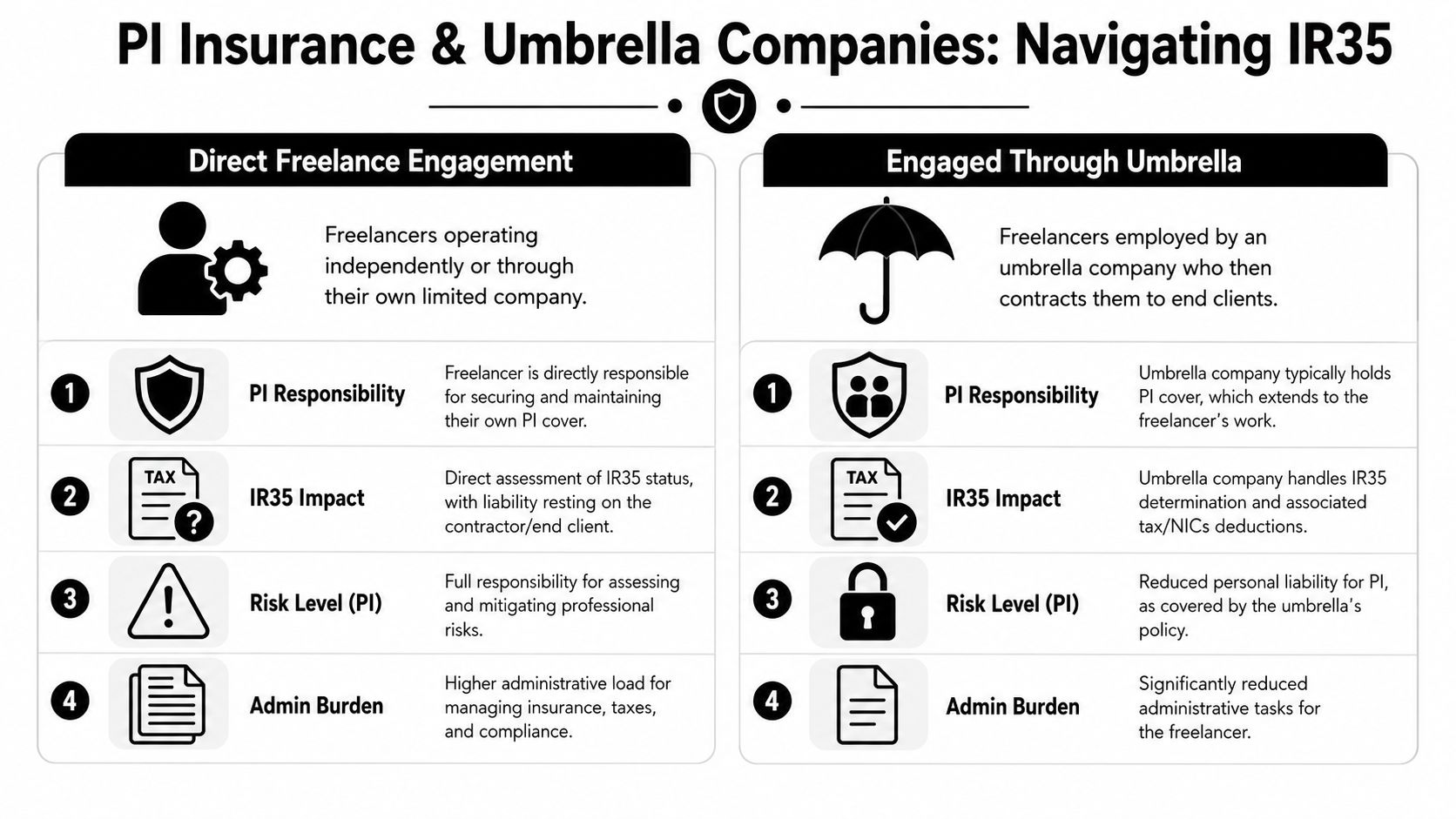
If you work directly as a sole trader or through your own limited company, you usually carry the responsibility for arranging appropriate cover yourself. If you work through an umbrella company, the position is often different because the umbrella is the employing entity and typically holds its own business insurances.
When you work through your own business
If you contract through a limited company, especially on assignments outside IR35, clients and agencies will often expect your company to carry its own PI cover.
That makes sense because:
- You are the supplier of record
- Your contract sits with the agency or client
- Any professional negligence allegation may be aimed at your business
- The client's onboarding team usually expects your company documents, including insurance
In that setup, failing to arrange your own policy is a real operational risk. You may be unable to start work, and you may also leave your company exposed if a dispute lands later.
When you work through an umbrella
With an umbrella arrangement, the umbrella company generally employs you and contracts in the supply chain. In many compliant setups, the umbrella carries PI, employer's liability, and public liability cover as part of its service.
That changes the practical question from “Do I need my own PI policy?” to “What does the umbrella's policy cover, and does it apply to my assignment?”
You still need to check the details. Some contractors assume “umbrella” automatically means every insurance issue disappears. It doesn't. You need clarity on whether the policy extends to your activities and whether the end client has any assignment-specific requirement.
The IR35 link
IR35 doesn't itself create a PI insurance rule, but it does affect your working model.
Inside IR35 engagements often push contractors towards umbrella working, and that can mean the insurance is arranged at umbrella level rather than by the individual contractor. Outside IR35 engagements usually leave more responsibility with your own business.
For a broader explanation of how these arrangements work, our guide to umbrella companies and IR35 breaks down the relationship between employment structure and tax status.
Before you buy a standalone PI policy, check who the contracting party is. If you're under an umbrella, the relevant insurance may already sit there. If you're using your own company, it usually won't.
How to Choose the Right PI Insurance Policy
Choosing freelance professional indemnity insurance is less about finding a polished website and more about matching policy wording to the way you earn money. A decent buying process is slow enough to catch gaps, but simple enough that you'll complete it before the contract start date.
Start with the work and the contract
Read your service description and your client terms side by side.
You want to know:
- What service are you promising
- What liabilities are you accepting
- Whether the client has set a minimum insurance limit
- Whether you've agreed to anything broader than ordinary professional responsibility
If you're comparing contractor cover more widely, our guide to insurance for contractors in the UK is a useful reference point.
Then compare policy wording, not just price
Many freelancers go wrong. They compare quotes line by line on premium and miss the parts that decide whether a claim is covered.
Review:
- The business activities description. It should reflect your real work.
- The exclusions. Pay special attention to IP, data, contractual liability, and consequential loss.
- The claims basis. Check how and when the policy responds.
- The defence costs position. Know whether costs sit inside the limit.
- The insurer or broker's track record for your type of work. Social proof isn't everything, but it can help when you're judging service quality. For example, collections like Alpha Insurance Agency testimonials can show the kind of questions buyers tend to ask and the problems they want help solving.
A short checklist before you buy
- Match the policy to your actual services
- Check the minimum limit in the client contract
- Read every exclusion that touches digital work, data, IP, or advisory services
- Confirm who is insured, especially if you work through different structures
- Keep the certificate and wording accessible for procurement and renewals
Where contractors need to compare working arrangements as well as insurance expectations, Umbrella Company provides a way to compare umbrella companies by role and circumstances, which can be useful if insurance responsibilities may sit differently depending on how you're engaged.
The right policy isn't the one with the lowest premium. It's the one that would still make sense after a client complaint lands in your inbox.
If you're weighing up PI requirements alongside IR35 status and umbrella options, Umbrella Company can help you compare suitable umbrella companies and understand how different working arrangements affect your insurance responsibilities.


