


A lot of freelancers meet professional indemnity insurance at the exact moment a good contract lands in their inbox.
The work looks right, the day rate works, and then the client procurement team asks for proof of cover before you can start. If you haven't arranged it before, that request can feel technical and slightly opaque. What are they asking for, how much do you need, and what happens if you already work through an umbrella arrangement?
In the UK, this isn't a niche issue. The professional indemnity insurance market is worth approximately £3.3 billion annually and supports an estimated 1.5 million policyholders, with 60 to 70% of corporate clients requiring it according to UK professional indemnity market figures. That tells you something important straight away. Freelance indemnity insurance is a normal business requirement, not a specialist extra for only high-risk consultants.
For most contractors and freelancers, the primary challenge isn't deciding whether PI matters. It's choosing cover that fits the work you perform, understanding the policy wording well enough to avoid gaps, and making sure your setup, whether that's a limited company or an umbrella, matches the contracts you're signing.
Introduction
Freelance indemnity insurance usually means Professional Indemnity insurance, often shortened to PI or PII. In plain English, it protects your business if a client says your professional work, advice, error, or omission caused them financial loss.
That matters because many claims don't start with dramatic misconduct. They start with ordinary project problems. A specification is misunderstood. A delivery goes live with a defect. Advice is followed and the outcome isn't what the client expected. Even if you dispute the allegation, dealing with the claim can still become expensive and disruptive.
The practical reason most freelancers buy PI is simple:
- Client contracts require it, especially when you're supplying larger organisations
- Legal and defence costs can escalate quickly
- Having cover reassures agencies and procurement teams
- It helps you trade like a business, not just as an individual selling time
What works is treating insurance as part of your contract review process, not as an afterthought once the start date is approaching. What doesn't work is buying the cheapest policy without checking whether the wording fits your actual work.
What Is Indemnity Insurance and Why You Need It
Professional Indemnity insurance covers claims that arise from the professional services you provide. If a client alleges negligence, a mistake, bad advice, or an omission that caused them financial loss, PI is the policy designed to respond.
That makes it different from insurance that covers physical accidents or employment obligations. Many freelancers mix these up, especially when a contract asks for several types of business cover in one schedule. It helps to separate them clearly.
Key insurance types for UK freelancers
| Insurance Type | What It Covers |
|---|---|
| Professional Indemnity | Claims linked to your professional work, advice, errors, omissions, and alleged financial loss suffered by a client |
| Public Liability | Claims involving injury to a third party or damage to their property arising from your business activities |
| Employer's Liability | Liability relating to employees, where applicable |
If you're comparing wider Business insurance policies, that distinction matters because a package can look extensive while still leaving your core professional exposure underinsured.
Why PI is often the one that matters most
For freelancers, PI tends to sit closest to the actual commercial risk. A developer can ship faulty code. A consultant can be accused of giving poor advice. A designer can deliver work that allegedly breaches rights or fails to meet a brief. None of those are public liability problems. They're professional service problems.
Practical rule: If the loss starts with your expertise, recommendation, output, or missed detail, PI is usually the policy you look at first.
This is also why clients ask for it so often. They aren't necessarily predicting failure. They're allocating risk before the project starts. If your work sits inside a wider programme, your mistake can affect deadlines, budgets, compliance, or customer outcomes far beyond your own fee.
Contract access and commercial credibility
PI isn't only about claims. It also opens doors. Some agencies and end clients will not onboard an uninsured freelancer, particularly where procurement teams work from standard supplier rules. If you can't evidence cover, you may lose the engagement before commercial discussions even begin.
That doesn't mean every freelancer needs the same policy or the same limit. A copywriter producing low-risk content for small businesses doesn't face the same exposure as an IT contractor handling data flows, system migrations, or business-critical integrations. The right decision depends on the work, not on generic internet advice.
A practical way to think about cover
When we advise contractors, the strongest starting point is this:
- Look at the client first, because larger organisations often impose mandatory insurance clauses
- Look at the project value next, because higher-value work tends to carry wider downstream consequences if something goes wrong
- Look at the sector risk last, because some professions create more serious financial exposure than others
A useful starting point is understanding what professional indemnity insurance covers in day-to-day contracting terms, not just insurer language. Once you frame it around the actual service you deliver, the buying decision becomes much clearer.
How to Choose the Right Level of Cover
The most common mistake freelancers make is choosing a limit because it sounds standard, not because it matches the contract in front of them.
Many corporate clients in the UK and Europe ask for minimum PI cover between €250,000 and €1 million, as noted in guidance on choosing cover based on client type, project value, and sector risk. The important part isn't memorising those figures. It's translating them into the reality of your own work.
A simple checklist helps.
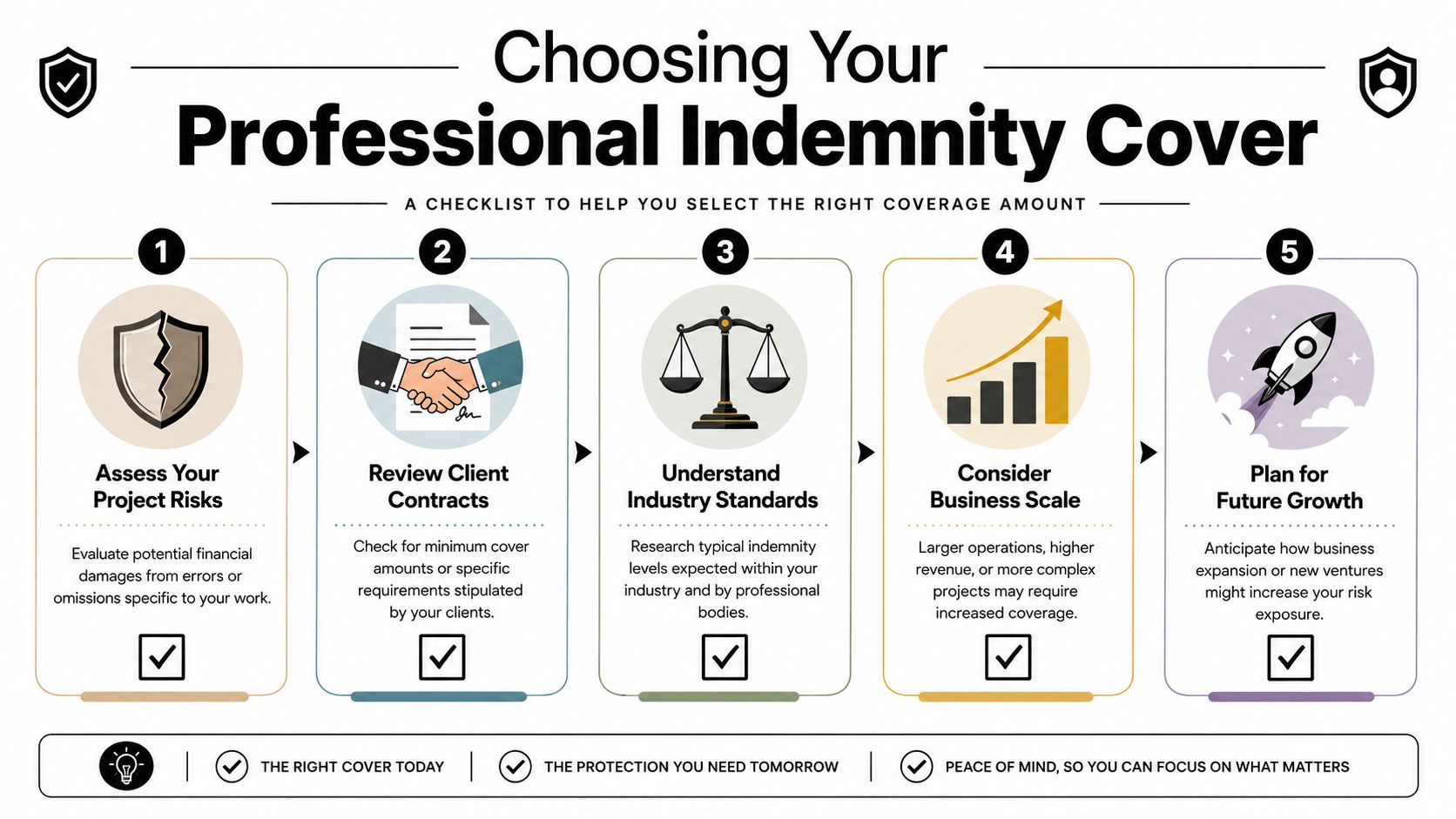
Start with the contract, not the premium
Some freelancers shop by price first. That's backwards. The contract tells you the minimum standard you need to satisfy before cost even becomes relevant.
Check these points before you compare quotes:
- Required limit of indemnity, because the client may specify a minimum level
- Any special wording, especially if the contract refers to data, media, intellectual property, or ongoing liability
- Who requires evidence, since agencies sometimes need documentation before the client does
- Whether the cover must remain in place after the work ends, which affects how you think about continuity
Match the limit to the real exposure
There isn't one universal answer, but there is a sensible way to judge it.
- Lower-limit cover often suits smaller projects where the work is contained, the client is smaller, and the financial fallout from an error is likely to be limited.
- Mid-range cover is often appropriate where you're supplying established businesses, advising on operations, or delivering specialist work that could create meaningful rework costs.
- Higher-limit cover becomes more relevant where your work touches revenue systems, regulated activity, sensitive data, or projects with multiple dependencies.
A useful test is this. If your work failed in the worst realistic way, what financial loss could the client argue flowed from that failure?
That question is more helpful than merely comparing your fee to the insurance limit. Clients don't only look at what they paid you. They look at the consequences.
Different work, different logic
An IT contractor supporting a migration project usually carries a different type of exposure from a freelance writer. The writer may still need PI, especially if the client requires it, but the practical risk profile isn't the same. The same applies to consultants whose recommendations influence hiring, pricing, systems, or compliance decisions.
This video gives a useful general overview of how professionals approach insurance decisions:
Don't ignore the claims-made issue
The cover level is only half the decision. How the policy responds over time matters just as much.
Professional indemnity is usually arranged on a claims-made basis. The easiest analogy is car insurance with one big twist. What matters isn't only when the work happened. What matters is whether you have the right policy in force when the claim is reported.
That affects freelancers who:
- Switch insurers to save money
- Pause trading between contracts
- Close a limited company
- Move from self-employed trading to an umbrella setup
If you only focus on the headline limit and ignore continuity, you can still leave a dangerous gap.
Understanding Your Policy Wording and Exclusions
Most freelancers read the schedule, check the limit, and stop there. The harder part, and the more important one in practice, is the wording behind the certificate.
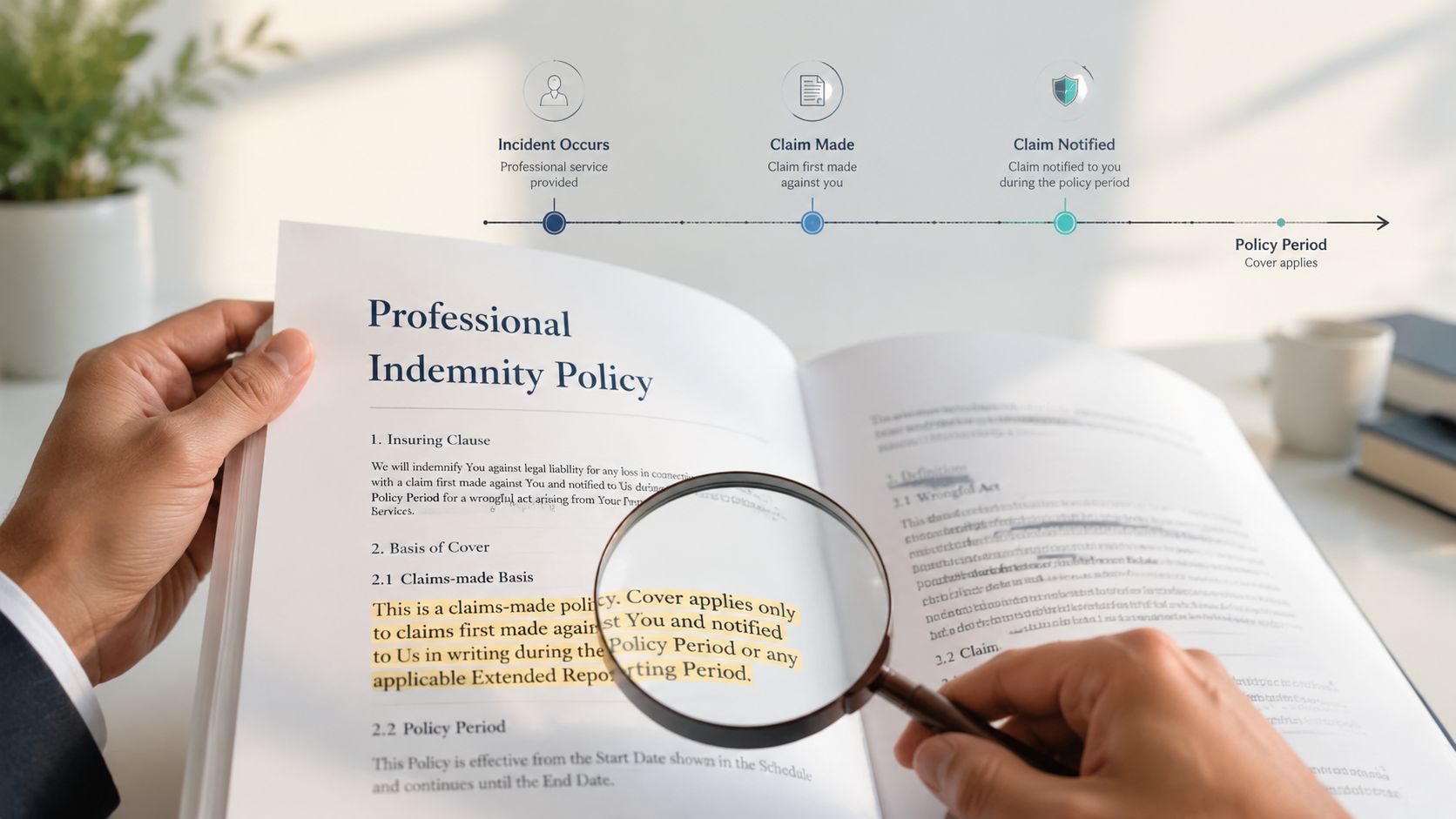
Claims-made is the clause you can't afford to skim
According to freelance insurance guidance covering claims-made policies and run-off cover, professional indemnity insurance is usually written on a claims-made basis. That means the policy in force when the claim is notified is the one that responds.
Claims-made means you need suitable cover active when the claim is reported, not only when the work was carried out.
This catches people out when they assume past work stays protected automatically. It doesn't always. If you cancel a policy, change insurer, or stop trading, a claim can still arise later from work you completed earlier.
Why run-off cover matters
Run-off cover, sometimes called extended reporting cover, matters whenever you stop trading or move between arrangements. If you've done work that could generate a later allegation, you need to think beyond the policy year in which you invoiced the client.
What works is asking clear questions before you switch or cancel:
- Will my new policy pick up prior work
- Is there any retroactive date limitation
- Do I need run-off cover after closing the company
- How are defence costs treated under the wording
That last point matters more than many people realise. Legal defence can become a major issue even if the underlying claim is weak. A policy that responds early and clearly is often worth more than a superficially cheap option with narrow wording.
Watch the exclusions carefully
Most disputes don't happen because someone forgot to buy PI. They happen because someone assumed a policy covered more than it did.
Common areas to review include:
- Deliberate acts, because intentional wrongdoing isn't what PI is there for
- Fines and penalties, which are often treated separately from compensatory loss
- Bodily injury or property damage, which usually sit under public liability rather than PI
- Copyright and media issues, especially if your work includes content creation, publishing, or brand assets
- Data-related exposures, where the line between PI and cyber-related issues can become blurred
Ask the insurer to explain exclusions against the exact service description you use in contracts and proposals. Generic policy language can hide a poor fit.
UK providers often include media liability within PI for freelancers, which can be especially relevant where accidental copyright infringement is a realistic exposure. That's worth checking if you work in design, content, marketing, video, or digital publishing.
If you want a broader view of how cover fits around freelance and contractor risks, our guide to contractor business insurance is a useful next read.
Typical Costs and Real Claim Examples
Cost matters, but it only becomes meaningful once you've checked that the policy matches the work.
In the UK, average annual premiums typically range from £180 to £250 for £250,000 of cover, according to freelancer insurance cost guidance. Higher cover levels, such as £1 million often required by corporate clients, come with higher premiums. That same guidance also notes that PI is generally tax-deductible as a business expense in the UK, which helps soften the cost.
What those premiums are really buying
The premium isn't just buying a certificate for procurement. It's buying a response mechanism when a client says your work caused loss.
Consider two common scenarios.
- A freelance developer pushes an update that breaks a checkout flow during a live campaign. The client alleges lost revenue, emergency repair costs, and the cost of bringing in another supplier.
- A management consultant gives advice that informs an operational decision. The client later says the recommendation was negligent and seeks to recover losses tied to that decision.
In both cases, the dispute can become expensive before anyone proves who was right. That's the point many freelancers miss. PI is often as much about handling the dispute as paying a final settlement.
Insurance, IR35, and administration
For contractors moving between outside IR35 and inside IR35 work, insurance can become administratively messy. If you operate through your own limited company, you usually arrange your own cover and keep it under review as contracts change.
If you move into umbrella working, the picture can simplify, because the umbrella may include core cover within its wider service package. That doesn't remove the need to check the detail. It does reduce the amount of insurance admin you handle yourself.
If cost is the question you're wrestling with first, our breakdown of indemnity insurance cost explains what tends to affect pricing in practice.
Indemnity Insurance, IR35, and Umbrella Companies
The insurance answer depends heavily on how you work.
If you trade through your own limited company, arranging PI is your responsibility. You choose the insurer, you check the wording, and you maintain continuity. That gives you control, but it also means you need to stay on top of renewal dates, changes in service scope, and any client-specific insurance clauses.
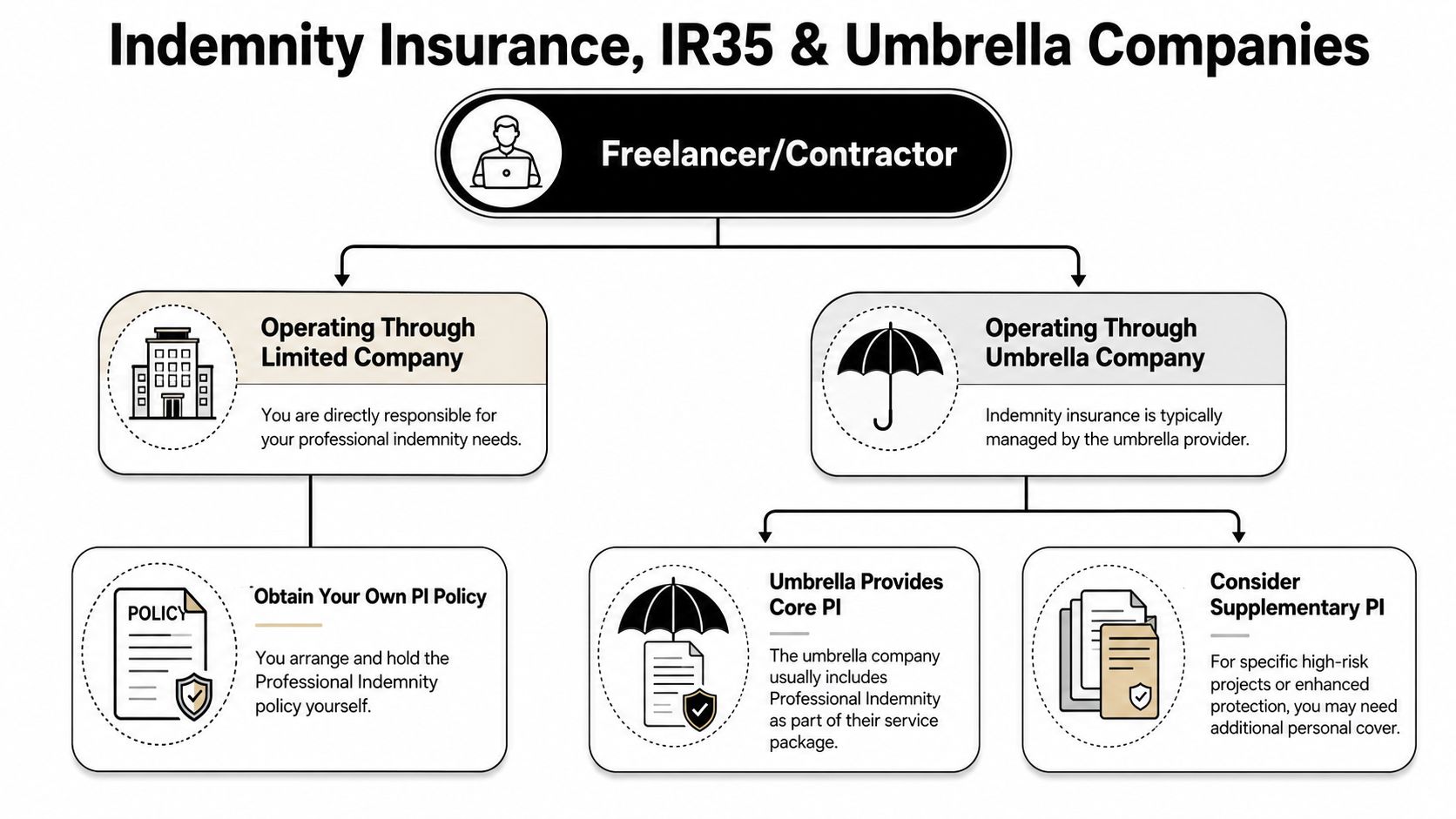
Limited company versus umbrella route
The umbrella route is different. In many compliant arrangements, the umbrella provides a package of core insurances as part of the employment model. For contractors working on assignments that sit inside the off-payroll rules, that can remove a fair amount of friction.
That doesn't mean you should assume every umbrella arrangement solves every insurance issue automatically. You still need to verify:
- What level of Professional Indemnity is included
- Whether Public Liability is also included
- Whether the cover fits the assignment type
- Whether any higher-risk work needs supplementary personal cover
Checklist point: Always ask for confirmation of the level and type of cover provided before relying on an umbrella's insurance package for a client contract.
Where IR35 changes the conversation
IR35 doesn't change what PI is. It changes how many contractors choose to engage with clients and payroll structures. A contractor moving into inside IR35 work may decide that an umbrella arrangement is simpler than maintaining a limited company for that assignment.
For that group, comparing providers becomes less about accountancy mechanics and more about practical employment support, compliance, and included protections. Umbrella Company offers a comparison route for contractors reviewing umbrella options in that context.
The key point is straightforward. If you're under an umbrella, don't ignore insurance just because someone else arranges it. If you're under your own company, don't assume a basic policy bought years ago still matches your current work.
Conclusion: Next Steps to Get Insured
Freelance indemnity insurance does two jobs at once. It helps you meet client requirements, and it protects your business if professional work leads to a dispute. Both matter.
The practical decisions are where freelancers usually need the most clarity. Choose a cover level that matches the client, contract value, and sector risk. Read the policy wording, especially the claims-made clause. Check exclusions before you rely on the certificate. If you're changing setup, particularly from a limited company to an umbrella or vice versa, think carefully about continuity and run-off cover.
A sensible next step depends on how you work:
- Limited company contractors should gather quotes, compare wording, and review prior work exposure before switching insurer
- Umbrella workers should confirm what cover is already included and whether it satisfies the assignment contract
- Anyone building wider protection around self-employment may also want to look at personal planning, such as Life Cover Plans self-employed insurance, alongside business risk protection
Getting insured properly isn't about buying the broadest policy on the market. It's about buying the right protection for the work you do.
If you're looking for a compliant Umbrella Company option with insurance included as part of the service, our comparison tool can help you review suitable providers quickly and choose a setup that fits your contract and working style.


