


You're usually looking for a subcontractor online when something has already gone live.
A project has expanded, a specialist trade has dropped out, or the client wants a faster programme than your current team can cover. Your usual contacts have either priced high, gone quiet, or aren't available. At that point, speed matters, but so does judgement. A quick hire that creates rework, payment disputes, or an IR35 problem is rarely a bargain.
That's why finding subcontractors online needs a proper process. It's not just about locating someone who says they can do the work. It's about verifying their capability to deliver, whether their engagement model is right for the job, and whether your paperwork will stand up if HMRC or a client asks questions later.
Why Finding Good Subcontractors Online is a Skill
Most contractors start with the same assumption. If the work is urgent, the answer is to search wider.
That part is true, but it's only half the job. The primary difficulty is filtering. The UK market is large, busy, and scattered across small operators, sole traders, specialist firms, labour suppliers, and trade-specific outfits that may be excellent in one region and weak in another.
In construction particularly, that fragmentation is structural, not temporary. Around 99% of UK construction businesses are SMEs, which is why online search tools and directories have become such a practical way to identify niche specialists across regions, rather than relying only on a local black book, according to this UK subcontractor sourcing overview. The same source notes that UK construction output was £18.2 billion in June 2024, after a 1.2% monthly increase, which underlines the scale of work being coordinated across a broad supplier base.
Why online search is no longer optional
If your network is strong, online sourcing can still feel like a second-best option. In practice, it isn't. It's often the only realistic way to find:
- Niche trade coverage for a specific package or short-term gap
- Regional availability when local firms are already committed
- Comparable options so you can assess rate, responsiveness, and capability side by side
- Specialist labour models that fit the way the work needs to be delivered
Practical rule: Online sourcing works best when you treat it as market mapping first, recruitment second.
A rushed search usually produces the same poor outcomes. You get a vague profile, a polished website with no useful detail, or a promising quote from someone who can't produce the right documents when you ask.
What separates a good search from a bad one
The contractors who consistently find subcontractors online well don't rely on a single platform. They build a repeatable process:
| What works | What doesn't |
|---|---|
| Starting with a clear scope | Posting a vague brief and hoping the right person appears |
| Checking credentials early | Leaving compliance checks until after rate discussions |
| Comparing several candidates | Hiring the first person who replies |
| Testing communication speed | Ignoring slow or evasive replies |
| Formalising onboarding quickly | Letting “we'll sort paperwork later” become the plan |
That's the difference between filling a gap and building a dependable supply chain.
Where to Find Subcontractors Online in the UK
A lot of bad hiring starts with bad sourcing. If you search in the wrong places, you either get too much noise or too few relevant options.
The fix is to separate platforms by purpose. Some are good for trade-specific searches. Some are useful for white-collar and project-based work. Others are only worth your time when you already know exactly what niche skill you need.
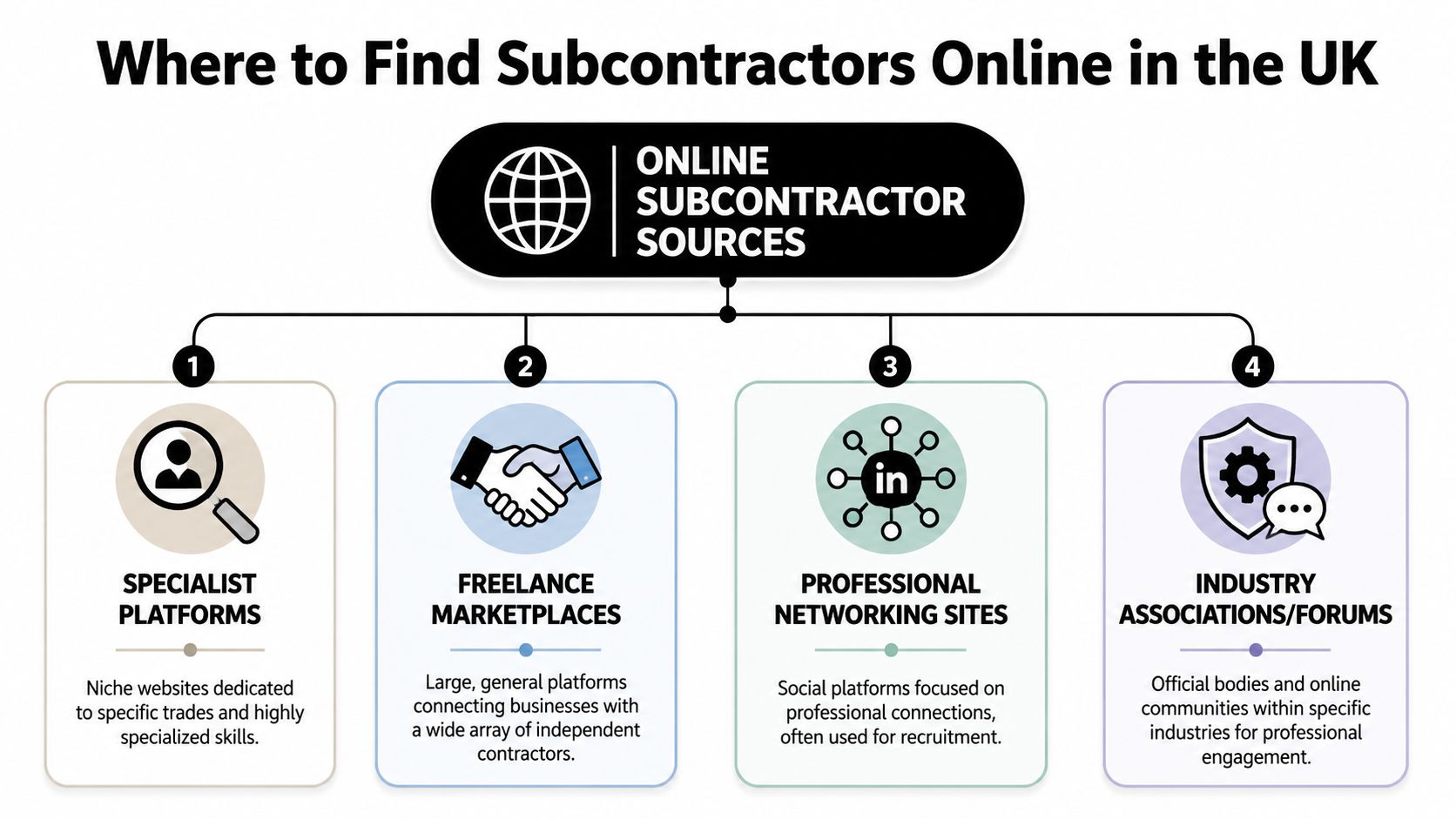
Specialist platforms and trade directories
For construction and site-based trades, specialist directories are usually the fastest starting point. They help when you need someone tied to a region, a trade category, or a project type.
Use them properly:
- Search by trade and location together. “Dryliner Birmingham” is better than “subcontractor Midlands”.
- Look for proof of recent activity. A profile that hasn't been updated in ages often leads to dead ends.
- Check whether the profile shows business detail, not just a mobile number and a list of services.
- Save promising firms into a shortlist before you start calling, so you can compare properly.
These platforms are good for breadth, but they often reward firms that market themselves well. That doesn't always mean they run jobs well.
Professional networking sites
LinkedIn is useful when the subcontractor role is commercial, technical, design-led, compliance-related, or management-heavy. It's less useful for purely local labour-only searches.
What tends to work:
- Search by job title plus sector
- Add regional terms
- Review whether the person posts or comments like someone active in the trade
- Check whether their work history matches the sort of package you need delivered
A profile with a polished headline but no project substance is a warning sign. A quieter profile with consistent experience, credible endorsements, and a clear specialist niche is often better.
If you're actively looking at open opportunities as well as available talent, it helps to keep an eye on jobs for subcontractors in the UK, because that gives useful context on how firms position roles and packages in the wider market.
Freelance marketplaces and niche communities
For digital, marketing, admin, creative, and back-office subcontracted support, freelance marketplaces can be effective. They're strongest when the work is clearly scoped and easy to deliver remotely.
They're weakest when the role depends on messy real-world coordination, site access, or ambiguous responsibilities.
Search terms matter. “Estimator residential refurb” will usually produce better results than “construction help”.
Industry forums and association-led communities are different again. They're slower, but often better for specialist referrals and peer recommendations. If you need a difficult niche filled, that's often where the better conversations happen.
Vetting Subcontractors Thoroughly Before You Engage
A decent online profile proves almost nothing on its own.
Before you discuss final rates or start dates, you need evidence that the subcontractor can perform, communicate, and turn up consistently. Vetting is where weak options usually fall away. That's useful, because it's far cheaper to reject someone now than halfway through delivery.
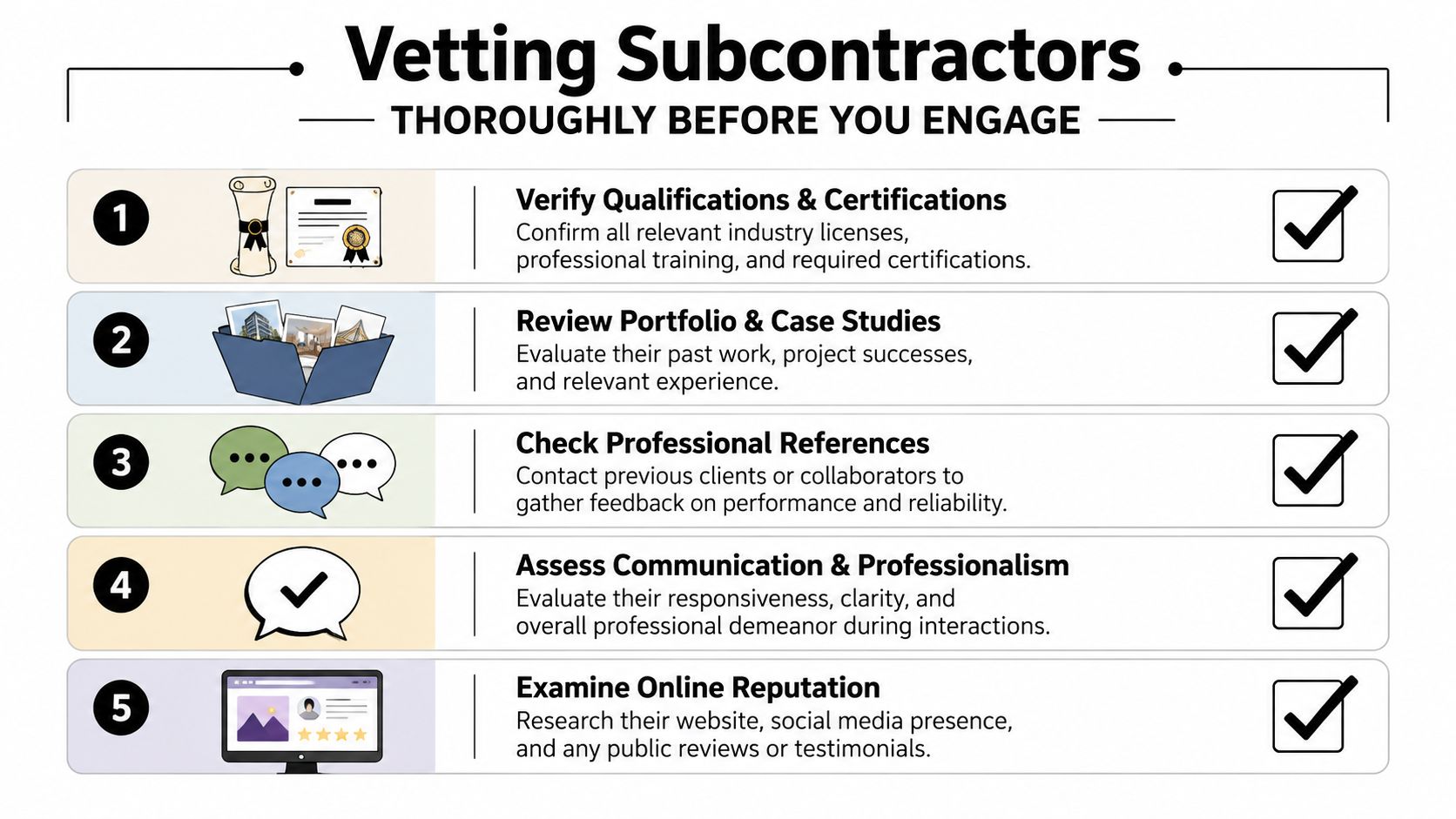
Start with work evidence, not promises
Ask for relevant examples, not a generic sales deck. You want to see work that resembles your requirement in scope, complexity, and environment.
Useful checks include:
- Portfolio relevance. Is the work genuinely comparable, or just loosely related?
- Named responsibilities. What did they personally handle?
- Delivery context. Was it direct for the client, through an agency, or as part of a wider team?
- Problem handling. Ask what changed during the job and how they responded.
A strong subcontractor usually answers these questions clearly. Weak ones often stay vague, overstate ownership, or lean on brand names instead of specifics.
For broader screening, especially where identity and business legitimacy checks matter, teams often combine references with modern vendor due diligence tools. That won't replace judgement, but it can help you spot inconsistencies early.
Check references like a contracts manager
A reference check shouldn't be “Were they good?” and then move on.
Ask questions that expose how the person works:
- Would you use them again?
- What were they reliable at?
- Where did you need to manage them closely?
- How did they handle changes, delays, or disagreements?
- Were invoices, timesheets, or paperwork straightforward?
Ask the previous client what happened when something went wrong. That answer is usually more useful than hearing what went well.
If the referee avoids specifics, that tells you something. If the subcontractor won't provide a credible reference at all, that tells you even more.
Here's a useful explainer to keep in mind while checking commercial protections and cover:
Review their professional footprint
Online presence isn't everything, but it can help confirm whether the business is coherent.
Check for:
- A basic website or service page that matches what they say they do
- Consistent business details across listings and profiles
- Evidence of insurance awareness if the work clearly requires it
- Professional communication in email, messaging, and calls
For many engagements, you'll also want to confirm what cover is in place and whether additional protection is needed. This guide to contractor insurance in the UK is a practical reference point when you're checking what should be in place before work starts.
Navigating Rates Availability and IR35 Compliance
Rate discussions often derail because the parties are talking about different things.
One side is pricing a deliverable. The other is pricing time. One assumes independence. The other expects day-to-day control. That mismatch creates most of the trouble, and it's why IR35 shouldn't be left until the end.

How to judge rates without buying trouble
The cheapest quote can be expensive if it comes with weak delivery, poor communication, or a setup that doesn't fit the engagement. Equally, the highest quote isn't automatically the safest.
When comparing rates, check four things together:
| Question | Why it matters |
|---|---|
| Is the scope clearly defined? | You can't compare quotes fairly if each bidder has assumed different work. |
| Is the subcontractor pricing output or attendance? | That affects both cost control and status risk. |
| Are materials, travel, revisions, or extras included? | Missing assumptions create disputes later. |
| Can they start when you need them? | A fair rate with no real availability may still stall the job. |
A practical habit is to ask each shortlisted subcontractor to price against the same written brief. If one quote is far lower than the others, don't treat that as a win. Treat it as a question.
Why IR35 belongs at the start, not the finish
The April 2021 off-payroll working reforms shifted responsibility for determining employment status to clients in many cases. With 4.2 million self-employed workers in the UK, online vetting now needs to cover compliance as well as capability, as noted in this IR35 and subcontractor sourcing overview.
That matters because a subcontractor found online may look commercially independent while the actual working arrangement points the other way.
Key warning signs include:
- You control how the work is done, not just what needs delivering
- They must provide the service personally, with no practical substitution
- They're folded into your team structure like an employee
- The engagement is open-ended, with no real project boundary
- You're paying for general availability, not a defined outcome
Compliance view: If the day-to-day reality looks like employment, a contract label won't rescue it.
That's why we prefer to frame the engagement before selection is final. Decide whether you need a genuine outsourced service, a fixed package, specialist consultancy, labour support under a particular model, or PAYE-style engagement. Then source accordingly.
For readers working in and around the capital, this round-up of 2026 IR35 advice for London contractors is a useful companion when local market pressure is pushing businesses towards quicker, less tidy hiring decisions.
Use documents that match the reality
A good Statement of Work helps because it pushes the discussion towards outputs, milestones, acceptance criteria, and responsibilities. If the engagement is project-based, the paperwork should say so clearly.
You should also pin down:
- Who provides equipment or materials
- Who decides working methods
- Whether substitution is possible
- How changes are approved
- What evidence supports completion
If you're operating in construction, it also helps to review how the labour and payment setup interacts with tax handling. This guide to the Construction Industry Scheme is worth keeping to hand when you're structuring the arrangement correctly from the outset.
Formalising the Agreement and Onboarding Process
Once you've chosen your subcontractor, move quickly.
Good hires, too, can still go wrong. A capable subcontractor who waits too long for documents, purchase order detail, access information, or payment terms may take another job. Industry guidance cited by ConstructConnect puts hard-bid win rates at 10 to 20%, which is a useful reminder that most leads won't convert and the chosen candidate needs a clean route into the job, as explained in this bid win rate tracking article.
What the agreement needs to cover
Your subcontractor agreement or Statement of Work should be specific enough that a third party could understand the arrangement without guesswork.
Include:
- Scope of work. Define exactly what is included, and what isn't.
- Deliverables and milestones. Tie progress to clear outputs where possible.
- Payment terms. Set rates, invoice rules, approval steps, and timing.
- Start and end points. Avoid vague open-ended wording if the work is project-based.
- Change control. Explain how variations are requested and priced.
- Termination rights. Cover notice, breach, and handover requirements.
- Confidentiality and data handling. Particularly for commercial or client-sensitive work.
If you need a starting point, a UK freelance contract template can help you organise the basics before legal review.
Onboarding that prevents avoidable delays
A short, disciplined onboarding process saves time later. Don't treat it as admin for admin's sake. It's how you avoid missed starts, duplicated questions, and payment friction.
A workable checklist looks like this:
- Confirm contacts. Name the project lead, commercial contact, and escalation route.
- Share the brief pack. Include drawings, specs, programme, and site or system rules.
- Set communication norms. Decide where day-to-day updates happen.
- Check compliance documents. Insurance, right certifications, and any trade-specific paperwork.
- Book a kick-off call. Walk through assumptions before work begins.
Some firms prefer to map this inside a broader contingent workforce framework, especially where they regularly engage multiple freelancers, subcontractors, and specialist suppliers. That approach helps when ad hoc hiring has started to become a recurring operational issue.
Fast onboarding doesn't mean loose onboarding. It means removing friction while keeping the record straight.
Conclusion Building a Reliable Subcontractor Network
If you need to find subcontractors online, speed matters, but structure matters more.
The best results usually come from the same sequence. Search in the right places. Vet properly. Compare rates against a clear brief. Check the engagement model before you agree terms. Then formalise the paperwork and onboard the person without delay.
Done well, this stops online sourcing from becoming a scramble every time a gap appears. It turns it into a repeatable system. Over time, that system becomes a network, and that network becomes one of the most useful assets in your business.
It also improves judgement. You start spotting the profiles that only look good online. You get quicker at filtering weak communication. You learn which subcontractors price clearly, document properly, and deliver without needing constant chasing.
That's the payoff. You're not just filling the next requirement. You're building a bench of people you'd trust on the next project, and the one after that.
If you need help navigating payroll options, IR35 concerns, or choosing a compliant setup for your contractor engagements, Umbrella Company offers practical guidance for UK contractors and freelancers who want to work with more confidence.


