


The last invoice has gone out. The handover is done. Then the same question lands again, usually faster than you'd like: where is the next piece of work coming from?
That gap between contracts is where a lot of subcontractors lose momentum. Not because the market is empty, but because they rely on one channel, send the same pitch to everyone, or take weak terms just to keep cash moving. A better approach is to treat business development like part of the job.
Good subcontractors rarely depend on luck. They build a repeatable process for how they find subcontractor work, how they qualify leads, how they negotiate, and how they handle the admin once the contract starts. That process matters in a market that keeps moving. The UK's contractor workforce has expanded by 36% since 2008 to reach 1.88 million, which shows a large and active market for skilled specialists, according to Contractor Calculator's review of the UK contracting landscape.
Your Guide to Securing Consistent Subcontractor Work
Most dry spells start earlier than people think. They start when a subcontractor waits until the current job is nearly over before looking again. By that point, you're under pressure, and pressure leads to poor decisions, weak rates, and clients you'd normally avoid.
A steadier way to work is to keep four things running at the same time:
- Positioning: Know what you do, who you help, and what type of project suits you.
- Lead flow: Use more than one source of work, including routes many subcontractors ignore.
- Conversion: Pitch properly, qualify the client, and negotiate from a position of strength.
- Operations: Get the contract, payment, and compliance side right so the job pays off.
That matters whether you work in construction, IT, engineering, media, or specialist business services. The principles don't change much. Clients still buy clarity, low risk, responsiveness, and proof that you can deliver without drama.
One thing worth noticing is that good subcontractors often borrow ideas from outside their own trade. A venue business, for example, still needs enquiries, positioning, and credibility to win work. That's why practical guides like local SEO for wedding venues are useful reading even if you never work near that sector. The lesson is simple: the firms that get found and look trustworthy get more conversations.
Practical rule: Start looking for the next contract while the current one is still running.
The rest comes down to execution. Build a profile that makes sense. Use the right channels. Write better bids. Check the contract before you sign it. Then make sure the payment and tax side is tidy enough that admin doesn't eat your time.
Laying the Groundwork for Success
A weak search usually comes from weak positioning. If your CV, LinkedIn profile, and outreach all say slightly different things, clients can't place you. When they can't place you, they move on.

Pick a lane, then leave room to move
You don't need to be boxed into one niche forever, but you do need a clear commercial story. Clients hire the person who sounds like they've solved this exact problem before.
The UK contractor market already shows where demand clusters. Media & Communications, Corporate Services, and Software & IT are major contractor sectors, and 67% of contractors who changed jobs in the past year also moved into a different industry, which is a strong reminder that transferable skills matter when they're presented properly, as noted in LinkedIn's UK contractor hiring data.
That means your profile should do two jobs at once. It should make your main specialism obvious, and it should show how your skills carry across sectors.
Build a contractor profile that sells outcomes
Start with your CV. Strip out filler and long task lists. A hiring manager wants to know what changed because you were there.
Use this test on every role you list:
- Problem: What was broken, delayed, missing, or under pressure?
- Action: What did you do?
- Result: What improved for the client or project?
- Fit: Which future client would care about that example?
A better summary line is specific. "Project controls subcontractor for infrastructure delivery" beats "motivated professional with varied experience" every time.
Your LinkedIn profile should match that story. Headline, About section, featured work, and recent activity should all point in the same direction. If you need a starting point before refining your market position, this guide on how to become a contractor is a useful checklist.
The fastest way to look inexperienced is to describe duties instead of outcomes.
Recommendations also help, but only if they're specific. Ask former clients or managers to mention reliability, communication, speed, documentation quality, or a project problem you solved. Vague praise doesn't travel far.
A similar principle shows up in content-led marketing for firms that sell expertise. If you want a smart example of how to frame specialist services clearly, look at this professional services SEO strategy. The trade is different, but the positioning logic is the same.
Make it easy for recruiters and clients to assess you
Clients don't want to guess. Give them a simple file set and keep it current.
Include:
- A focused CV: Adapted for the type of role you're targeting now, not every job you've ever had.
- A short capability summary: One page is enough for many trades and project roles.
- Relevant credentials: Tickets, certifications, software tools, memberships, and insurances where appropriate.
- Availability details: Current notice period, preferred locations, remote or site-based preference, and working pattern.
A short explainer is often more powerful than a long profile. If someone asks what you do, you should be able to answer in under 20 seconds without sounding rehearsed.
A practical walkthrough can help if you're reworking your profile from scratch.
Where to Source High-Quality Subcontractor Roles
The mistake here is relying on a single pipeline. Agencies can work. Job boards can work. LinkedIn can work. Referrals can work. Public tender portals can work. None of them is enough on its own.
The better approach is to treat each channel differently. Some are for speed. Some are for relationship building. Some are for finding subcontractor work before everyone else piles in.
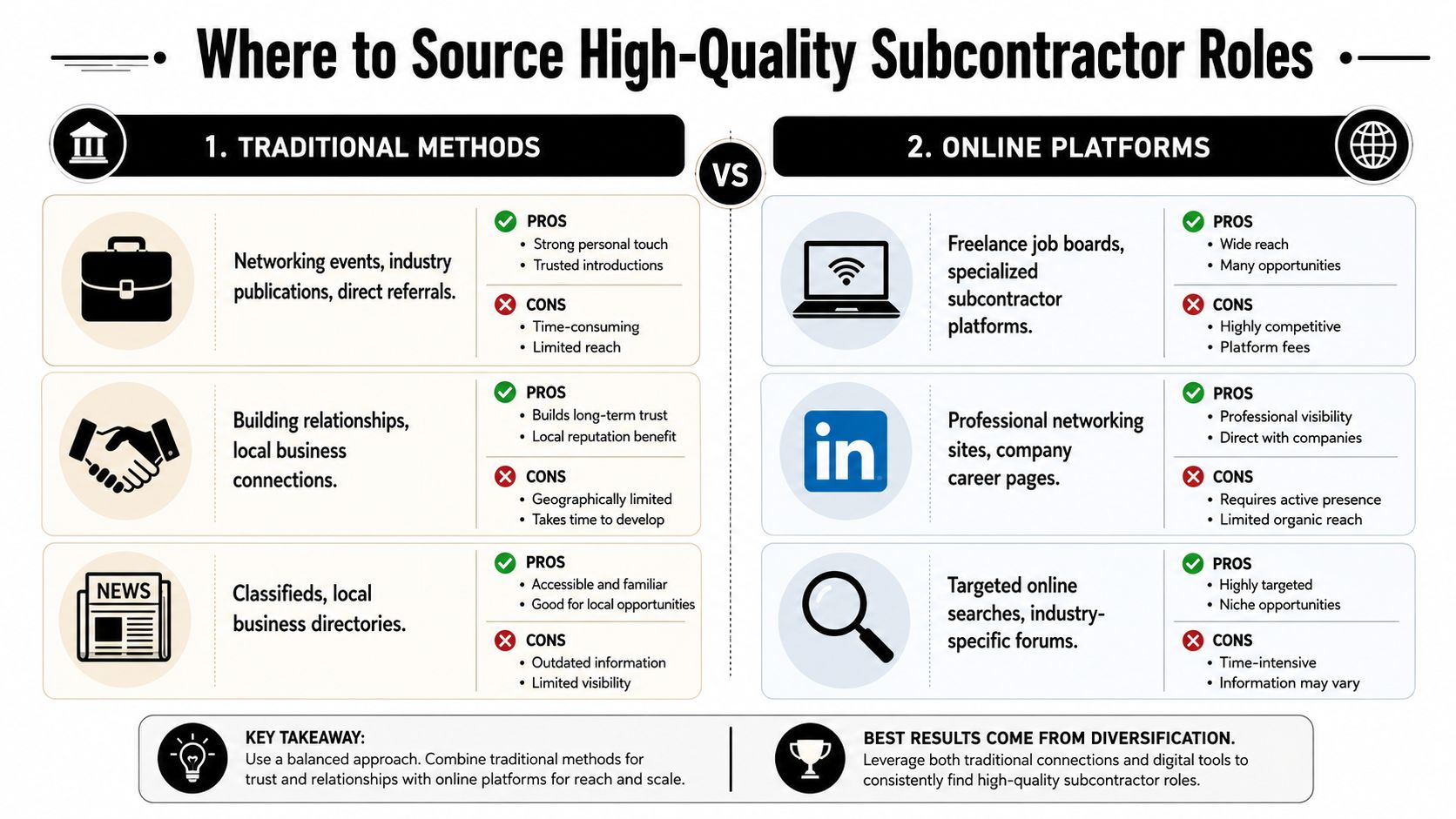
Compare the main channels properly
| Channel | Works well for | Weak point | Best use |
|---|---|---|---|
| Specialist agencies | Fast access to live roles | You may be screened before reaching the decision-maker | Keep a small list of recruiters who actually understand your trade |
| Job boards | Volume and visibility | High competition, lots of generic adverts | Set alerts and apply selectively, not blindly |
| Direct outreach and warm visibility | Takes consistency | Post proof of work and contact hiring managers sensibly | |
| Existing network | Trusted introductions | Can dry up if you don't maintain it | Stay in touch before you need help |
| Public tender portals | Early visibility into larger supply chains | Many subcontractors don't use them well | Track projects and identify prime contractors early |
That last route gets missed far too often. A significant share of subcontractors don't know how to use free public portals effectively. Approximately 68% are unaware of how to filter and find subcontracting opportunities on portals like Contracts Finder, while public sector procurement has grown by 14%, according to Umbrella Company's guide to jobs for subcontractors.
Use Contracts Finder and Find a Tender as lead intelligence tools
A lot of people search these portals the wrong way. They look for an advert that says "subcontractor wanted", don't find one, and leave. That's not the point.
Value is seeing which organisations have won, are tendering for, or are planning larger public contracts. Once you know that, you can work backwards to the likely prime contractors and supply chain.
Use a simple process:
Search by trade, service line, and region
Try both broad and specific terms. If you're too narrow, you'll miss framework-style opportunities.Read the contract notice carefully
Look for the buyer, the contract scope, likely delivery model, and whether specialist packages may be outsourced.Identify likely main contractors or delivery partners
Large public work often involves a lead supplier with specialist subcontract packages underneath.Build a target list
Save the contractor name, buyer name, estimated start timing, and any contact details you can verify.Send a relevant capability note
Don't ask if they have work. Show where you fit into that project or package.
Public portals don't just show available work. They show who is likely to need help next.
Keep your agency and direct channels tight
Agencies still matter, especially in sectors where hiring moves quickly. The trick is to work with fewer recruiters, not more. A recruiter who knows your rate expectations, preferred project type, and firm requirements is more useful than ten people who blast irrelevant roles at you.
For direct outreach, keep it short. A good message usually includes:
- Why you're contacting them: Reference a live contract, growth area, or project type.
- Where you fit: Your trade, specialism, or delivery capability.
- Proof: One or two examples of relevant work.
- Next step: A call, vendor registration, or capability review.
LinkedIn supports this well when used properly. Follow target firms, comment intelligently when relevant, and make sure your profile backs up your message. If your outreach says "specialist", but your profile looks generic, clients notice.
Don't ignore the local market
Some subcontractor work never appears on national boards. It moves through regional contractors, framework suppliers, commercial contacts, and previous site relationships. Keep a local list of contractors, consultants, and buyers. Review it every month.
That list becomes even more useful when paired with what you find on public tender portals. One source gives you visibility. The other gives you access.
Crafting Pitches That Win and Nailing Negotiations
Generic outreach gets ignored because it creates work for the client. They have to figure out whether you're relevant. Most won't bother.
A strong pitch does the opposite. It reduces effort. It tells the client where you fit, why you're credible, and what to do next.

Tailor the pitch to the work in front of you
Start with the job, not your biography. Read the advert, scope, or tender notice and identify the pressure points. Is the client trying to hit a deadline, cover a skills gap, stabilise delivery, or satisfy a compliance requirement?
Then answer those points directly.
A workable pitch often has four parts:
- A relevant opening: Mention the exact project type, package, or business need.
- A fit statement: Show that your background matches the work, not just the job title.
- Evidence: Give one or two examples that sound similar to the client's problem.
- A commercial close: State availability, working model, and how to continue the conversation.
Many subcontractors undersell themselves. They describe their background generally when they should be matching it to the risk the client wants removed.
Use BATNA before you discuss rate
Negotiation starts before the call. If you don't know your alternatives, you're negotiating from anxiety.
BATNA means Best Alternative to a Negotiated Agreement. In simple terms, it's your next best option if this deal doesn't come together. Contractors who calculate and present a clear BATNA achieve a 67% higher success rate in securing above-market rates, and speaking directly to decision-makers can increase earnings by 22%, according to IT Contracting's analysis of contract rate factors.
That doesn't mean being aggressive. It means being prepared.
Before any rate discussion, know:
- Your floor: The minimum rate or margin that makes the contract worthwhile.
- Your walk-away points: Bad payment terms, unclear scope, no decision-maker access, or unrealistic availability demands.
- Your alternatives: Other live conversations, likely incoming work, or existing clients you can revisit.
- Your value case: Why your rate saves the client time, risk, or rework.
If you want help pressure-testing contract income and deductions before you quote, a contractor rate calculator can help you assess the numbers.
Ask yourself one question before every negotiation: "If this client says no, what do I do next?" If you can't answer that, you're too exposed.
Speak to the person who can actually say yes
When possible, get beyond the middle layer. Agents and coordinators matter, but the strongest rate conversations usually happen with the person who owns the budget, the team, or the delivery problem.
That doesn't mean bypassing people rudely. It means understanding where the decision sits. A project lead who feels the cost of delay will often judge your value differently from someone screening CVs against a template.
Calm, direct language works best. No bluffing. No long defence of your rate. State it, tie it to the work, and stop talking.
Vetting Clients and Understanding Your Contract
Winning work is only half the job. A poor client, vague scope, or messy payment term can turn a decent rate into a bad engagement very quickly.
This is the part many subcontractors rush because they're relieved to have work lined up. That's exactly when problems creep in.
Vet the client before you commit
You don't need a forensic investigation. You do need a basic commercial check.
Look at how the client operates in practice:
- Communication quality: Are replies clear, timely, and consistent?
- Role clarity: Can they explain what success looks like?
- Approval path: Do you know who signs off work, timesheets, change requests, or invoices?
- Reputation: Ask trusted contacts whether the client is organised and fair to work with.
- Paperwork readiness: Serious clients can usually produce terms, scope, and onboarding steps without confusion.
If the early conversations are vague, chaotic, or full of last-minute changes, that usually doesn't improve after you start.
Review payment terms like they matter, because they do
A day rate can distract people from the line that really matters: when and how you'll be paid.
In construction especially, payment discipline is critical. Build UK notes that delayed payment notices are a major issue, and 45% of construction subcontractors experience payment delays exceeding 30 days in the UK market, based on Build UK's payment performance information.
That doesn't mean every client is a risk. It means you should check the mechanism, not just the headline rate.
Read for:
- Invoice trigger: What starts the payment clock, invoice receipt, timesheet approval, milestone sign-off, or something else?
- Payment window: Is the due date clear and written plainly?
- Notice requirements: Are there strict timelines for raising disputes or issuing notices?
- Retention or holdbacks: If they exist, are they clearly defined?
- Dispute route: Is there a practical path if payment is challenged?
Red flag: If a client is fuzzy about the payment process before you start, expect admin friction once money is due.
Make the scope specific enough to defend
A weak scope invites scope creep. Then you end up doing extra work that nobody wants to pay for because it was never described properly.
A clear statement of work should define deliverables, assumptions, dependencies, acceptance criteria, timeline, and who approves what. If you're unsure what that should look like in practice, this guide to a statement of work is worth keeping to hand.
Use a simple contract review lens:
| Clause area | What you want | What causes trouble |
|---|---|---|
| Scope | Defined outputs and responsibilities | Broad wording like "other duties as required" |
| Payment | Clear dates and approval process | Ambiguous triggers and long approval chains |
| Changes | Written change control | Informal verbal additions |
| Notice | Fair and workable notice terms | One-sided termination rights |
| IP and confidentiality | Reasonable and role-specific | Overreach unrelated to the assignment |
Treat uncertainty as a cost
Subcontractors often focus on rate and start date because those are the easiest points to compare. But uncertainty has a cost as well. If scope is loose, approvals are unclear, and the client won't commit to a payment process, you may spend far more time managing friction than delivering work.
Sometimes the right move is to ask for changes. Sometimes it's to walk away. Turning down a messy engagement is often what protects your availability for a better one.
Managing Payments and Compliance The Smart Way
Work often goes wrong after the job starts, not because the trade work is poor, but because timesheets are late, invoices are missing detail, or the payment setup was never pinned down properly.
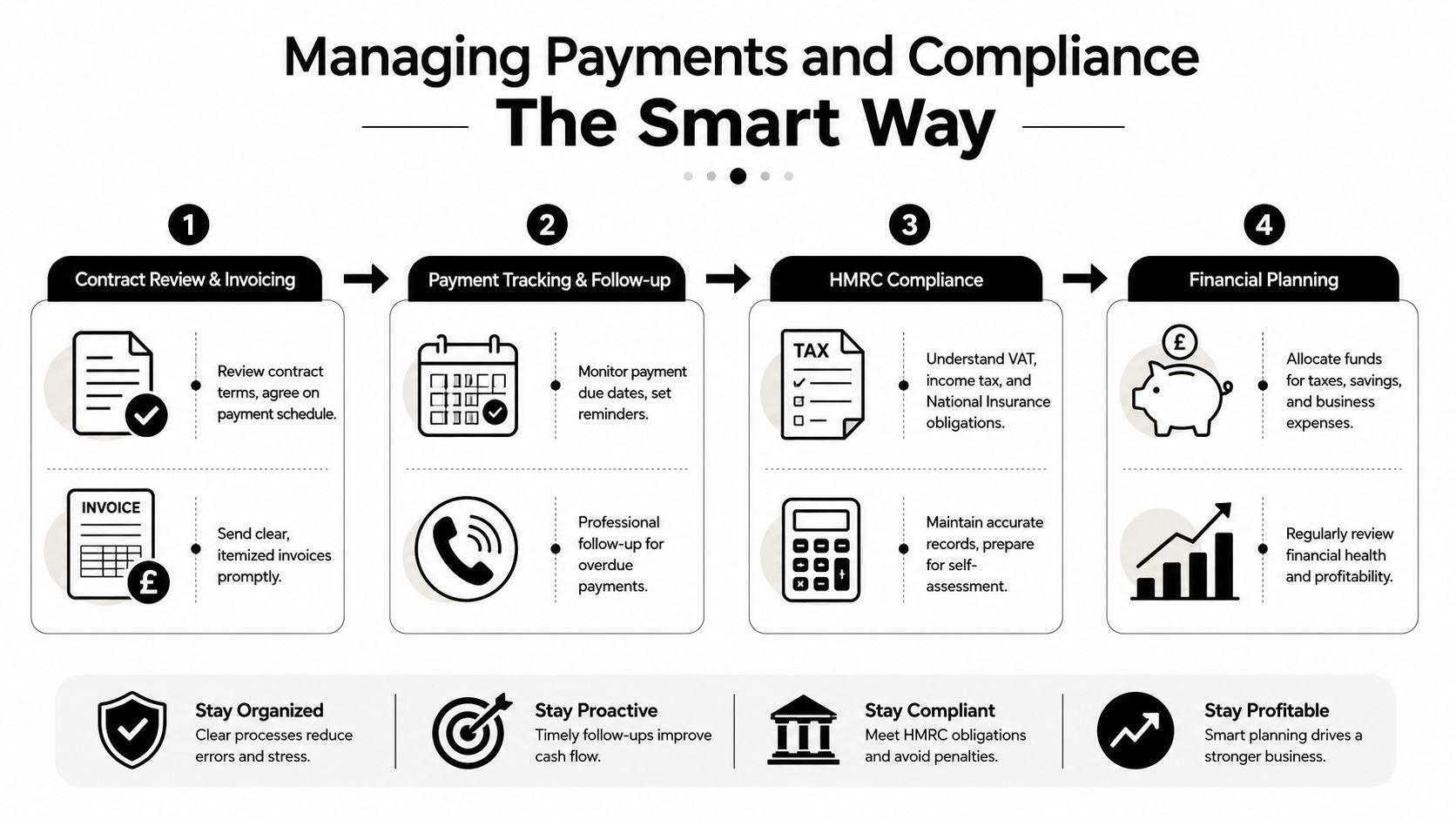
Get your admin right from day one. Confirm who signs off your hours, what reference must appear on the invoice, the billing date, and the expected payment date. Public sector work sourced through Contracts Finder or Find a Tender usually has a clearer approval chain than smaller private jobs, but you still need to check who releases payment. A well-run client pays on process, not goodwill.
If you're working inside IR35, the tax position is usually more straightforward than many subcontractors expect. IR35 was brought in by HMRC to stop temporary workers avoiding tax through an intermediary, and where a contractor works through an umbrella company, they are normally paid as an employee through PAYE, as explained in Churchill Knight's guide to umbrella companies.
That setup suits plenty of subcontractors because it cuts down the admin. You get taxed at source, payslips are easier to track, and the risk of getting the setup wrong is lower. The trade-off is cost. You pay for the convenience, so it only makes sense if the time saved and the reduced compliance risk are worth more than the margin you give up.
HMRC is clear about what to check. Avoid umbrella companies promising unusually high take-home pay, and make sure deductions for Income Tax, National Insurance, pension contributions, and student loan repayments match your records, according to HMRC's guidance on working through an umbrella company.
From 6 April 2026, draft legislation introduces Joint and Several Liability (JSL). That means agencies or end clients may be liable if an umbrella company fails to pay PAYE, which puts more pressure on everyone in the chain to choose compliant providers, as covered by Contractor Calculator's report on upcoming umbrella legislation.
A comparison route, rather than researching providers one by one, allows you to compare umbrella companies using your contract details and IR35 status.
If you've got work lined up and want the financial side to be simpler, use Umbrella Company to compare compliant umbrella providers, check your options for inside IR35 work, and choose a setup that fits the way you contract.


