


You've won the work, the programme is tight, and your in-house team can't cover every trade. That's when most small contractors start searching fast and hoping for the best.
That approach usually causes the problems you're trying to avoid. Late starts, weak workmanship, payment disputes, and HMRC issues nearly always begin before the first operative arrives on site. They start when a subcontractor is chosen without enough checking.
If you need to find sub contractors in the UK, treat it as a commercial and compliance process at the same time. You need people who can do the work, turn up when they say they will, carry the right insurance, and fit the engagement model you're using. That matters even more where short-term labour, off-payroll arrangements, and tax status all affect how the job is delivered.
Building Your Project Team with the Right Partners
The pressure point is familiar. A project lands, the client wants dates confirmed, and suddenly you need a groundworker, electrician, dryliner, roofer, or finishing trade at short notice. The mistake is thinking the job is to fill labour gaps.
It isn't. The subcontractors you bring in affect quality, margin, programme certainty, and compliance. In UK construction, that challenge is constant because the sector is huge. The Office for National Statistics reported 2.34 million jobs in construction in Q2 2024, and the sector accounted for 6.9% of total UK employment, according to this UK construction labour overview.
That scale explains why so many firms need flexible subcontract labour. It also explains why availability changes quickly by trade and region.
Start with the job, not the names
Before you try to find sub contractors, pin down what you need.
Write out:
- The exact scope. Labour only, labour and materials, or a package with design input.
- The trade boundary. What they are doing, and equally, what they are not doing.
- The programme window. Start date, access dates, sequencing, and finish expectations.
- The site conditions. Working hours, permits, logistics, restricted access, and supervision needs.
- The compliance route. CIS treatment, insurance checks, and whether off-payroll rules may need a status review.
If you skip this step, you'll get prices that look comparable but aren't. One sub has included plant. Another hasn't. One has priced waste removal. Another assumes you're handling it. That's how cheap quotes become expensive jobs.
Practical rule: If two subcontractors are pricing two different assumptions, you are not comparing quotes. You are comparing misunderstandings.
Build for reliability, not just speed
Small firms often focus on immediate availability. That matters, but it shouldn't outweigh fit. The subcontractor who can start tomorrow may still be the wrong appointment if they can't resource the middle of the package or don't work well with your site team.
Where you're using contingent labour or project-based contract arrangements, it also helps to understand how status and engagement models interact. This guide on IR35 rules for contingent workers gives useful background if your project setup includes short-term specialist support.
A good appointment process follows a simple order. Define the package. Source candidates. Vet them properly. Put the terms in writing. Then onboard them so they can start cleanly.
Where to Source Your Subcontractors
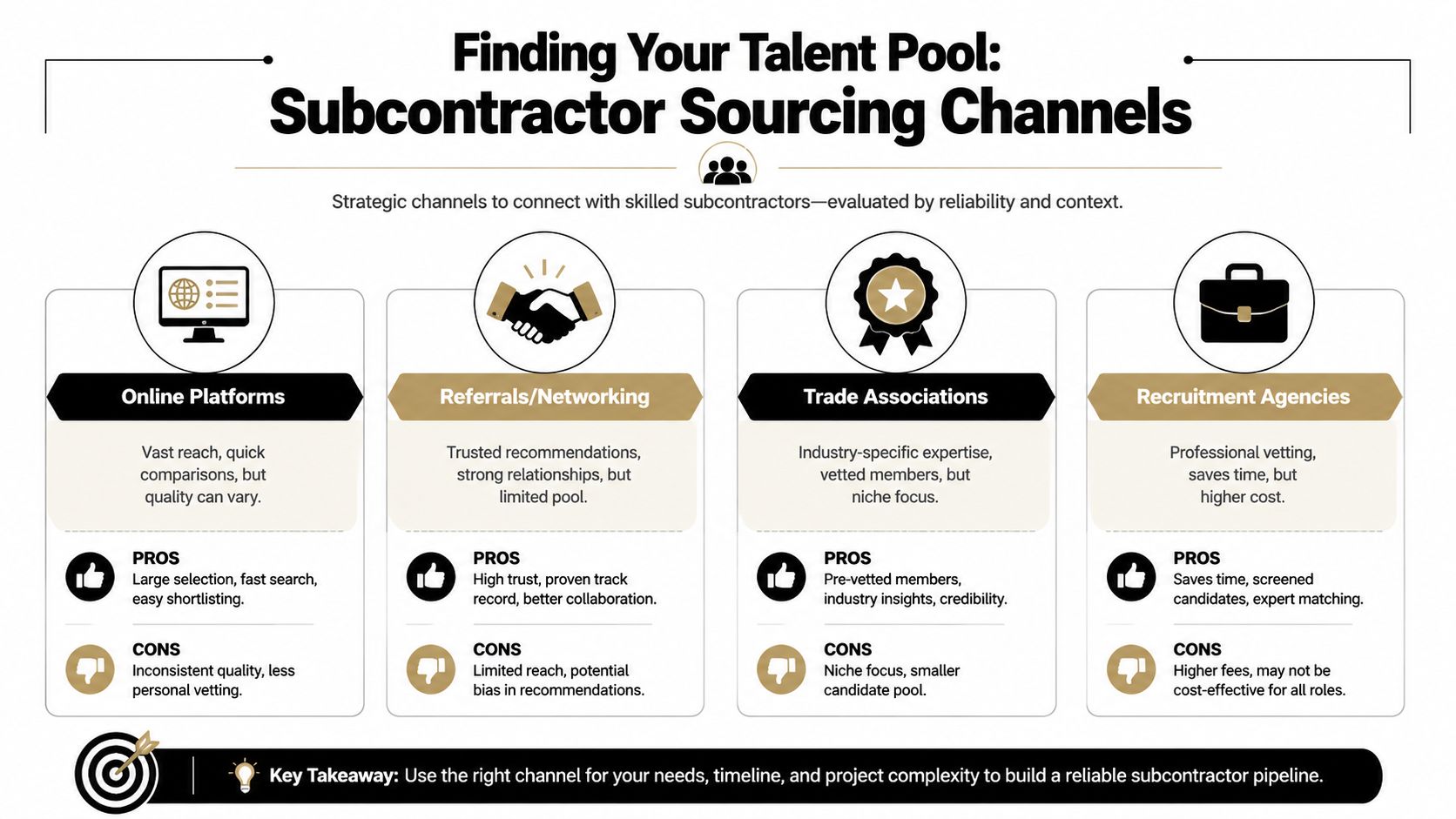
The best place to find sub contractors depends on the type of work, how fast you need cover, and how much risk you can tolerate. Not all sourcing channels carry the same level of trust.
In the UK market, labour supply is tight in many trades. The sector is dealing with persistent vacancies and retention pressures, which means the challenge isn't just finding names. It's finding subcontractors who are available, vetted, and prepared to take the work on sensible terms, as noted in this summary of construction hiring pressures in the UK market.
Referrals and existing trade networks
This is usually the strongest route.
When a trusted site manager, quantity surveyor, supplier, or another subcontractor recommends someone, you start with useful context. You often know whether that firm can run a package, communicate properly, and solve problems without drama.
Pros
- Higher trust because the recommendation comes with lived experience
- Faster filtering because poor performers rarely get recommended twice
- Better fit if the referrer understands your standards and job type
Cons
- Limited pool in a busy market
- Local bias because you may keep seeing the same names
- Availability risk because the best subs are often already committed
This route works especially well for repeat domestic work, small commercial jobs, refurbishments, and regional projects where reputation travels quickly.
Trade bodies, merchant contacts, and local industry circles
Builders' merchants, specialist suppliers, and trade associations often know who is active and who is overloaded. They also know who pays on time, who buys regularly, and who appears organised.
That doesn't replace vetting, but it helps you find realistic leads. If you're looking for specialist trades, this route can be more useful than broad online searches.
A few practical sources include:
- Merchants and distributors who supply the trade you need
- Professional contacts from prior tenders and completed jobs
- Local contractor forums where firms discuss availability and practical issues, including the UK Contractors Forum
Online platforms and bid boards
Online platforms widen your reach. They're useful when you're moving into a new area, trying a new project type, or need additional names to avoid relying on one supplier.
The trade-off is quality variation. Some profiles are complete and serious. Others are little more than a phone number and a list of claims.
Use platforms to create a longlist, not to make a final decision.
| Channel | Best use case | Main risk |
|---|---|---|
| Online directories | Expanding your longlist by trade or area | Thin vetting |
| Bid boards | Getting multiple expressions of interest quickly | Low-effort responses |
| Company websites | Checking project type and capability | Marketing can overstate capacity |
| Social platforms | Spotting active local firms | Informal signals can mislead |
If your work includes public contracts or supply chain opportunities tied to frameworks, it also helps to understand where tenders and subcontract packages appear. This guide to finding 2025 public sector bids is useful for seeing how firms track those opportunities.
Recruitment agencies and labour suppliers
Agencies are worth using when speed matters more than building a broad shortlist yourself, especially for short-term cover or niche labour. A decent specialist recruiter can save time, but you need clarity on who is vetting what.
Ask direct questions. Are they only introducing the subcontractor, or are they checking experience, references, insurance, and right-to-work documentation too?
A recruiter can shorten the search. They can't outsource your judgement.
What usually doesn't work
The weakest sourcing pattern is posting a vague requirement and choosing the first cheap response.
That often brings:
- Unclear package assumptions
- No evidence of comparable work
- Hidden availability problems
- Weak paperwork
- A race to the bottom on price
Good subcontractors don't always market themselves aggressively. Many are already working through repeat relationships. That means the best route is often a blended one. Start with referrals, widen the search through trade channels, and only then use broader platforms to fill the gaps.
Vetting and Interviewing Your Shortlist
Once you've got a list of possible firms, the job changes. You're no longer trying to find sub contractors. You're trying to remove the wrong ones quickly and choose the one most likely to deliver.
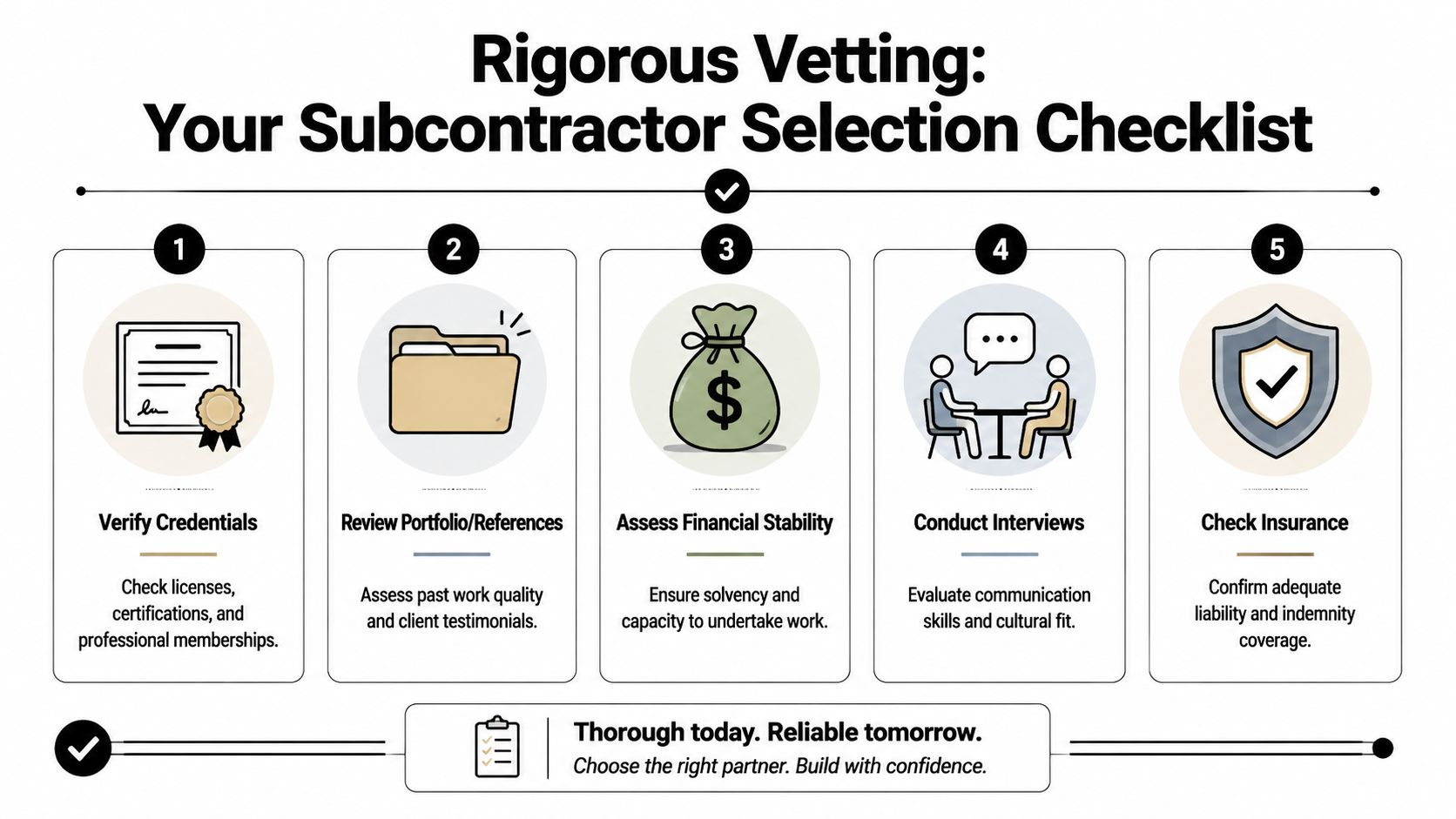
The most reliable approach is a prequalification funnel. Define the package first, identify candidates second, then verify insurance, references, and comparable work before inviting bids. That structured method is outlined in this guide to prequalifying subcontractors before appointment.
First screen the basics
Your first pass should be quick and unsentimental. If a subcontractor can't clear the basics, don't spend another hour on them.
Check for:
- Insurance evidence with current documents and sensible cover levels for the package
- Relevant trade experience on jobs similar in size and type
- Current workload so you know whether they can resource your dates
- Commercial clarity on whether they are labour only, labour and materials, or package-based
- Basic professionalism in how they respond, submit information, and answer questions
If you need a refresher on what different cover types do in practice, this guide to indemnity insurance is worth keeping handy when reviewing documents.
Then go deeper on capability
Paperwork matters, but site delivery matters more. Ask for evidence of recent comparable work. Not old flagship jobs from years ago. Recent jobs with similar constraints.
A proper review should cover:
- Recent project examples that match your package
- References from contractors, not only end clients
- Manpower and supervision so you know who will run the work
- Plant, tools, and access to equipment
- Safety culture as shown through practical behaviour, not polished language alone
Here's a useful explainer before you build your interview pack:
Ask interview questions that expose real working habits
A weak interview asks, “Can you do this package?”
A useful interview asks questions that reveal how the subcontractor works under pressure.
Try questions like these:
Tell us about a recent job similar to this one
Ask what went wrong, how they dealt with change, and who supervised it.What other live projects are you carrying during our programme window
This reveals stretch risk and whether your job will be staffed properly.How do you handle snags and returns to site
Good firms answer clearly. Weak ones become vague very quickly.Who will price the job, and who will run it on site
If those are different people, make sure both are aligned.What do you need from us to start cleanly
This tells you whether they think ahead or react.
Visit a live or recently completed job if you can. Site behaviour tells you more than polished PDFs ever will.
Check references properly
Reference checks are often rushed, and that's a mistake. Don't ask, “Were they any good?” No one learns much from that.
Ask:
- Did they start and finish when expected
- How did they deal with defects and snagging
- Did they need close supervision
- Were variations and payment claims handled fairly
- Would you use them again on the same kind of package
Listen for hesitation. People rarely criticise directly, but pauses, half-answers, and qualified praise tell you plenty.
Compare bids without being fooled by price
Once your shortlist is strong, ask for priced submissions on the same scope. Low price alone is a poor signal if one subcontractor has missed access costs, prelims, or materials assumptions.
Use a simple comparison sheet:
| Check area | What to compare |
|---|---|
| Scope | What is included and excluded |
| Resource | Labour numbers, supervision, plant |
| Programme | Start date, duration, sequencing |
| Commercials | Price basis, variation approach, payment terms |
| Risk | Insurance, references, recent performance |
The right subcontractor is rarely the cheapest line on the page. They're the one whose quote, capability, and behaviour all line up.
Contracts Payments and UK Compliance
A lot of small firms still treat subcontractor appointments too casually. A verbal agreement, a text message, a price by email, and everyone gets on with it. That might feel quicker, but it stores up problems around scope, payments, defects, and tax treatment.
In practice, the contract, payment process, and compliance checks all connect. If one part is loose, the others usually become messy as well.

Put the deal in writing properly
Your subcontract agreement doesn't need to be bloated to be useful. It does need to be clear.
At minimum, include:
- Defined scope with drawings, specifications, and exclusions
- Programme obligations including start, sequence, and completion expectations
- Payment terms covering application dates, due dates, and valuation basis
- Variation process so changes are priced and approved properly
- Defects and rectification responsibilities
- Insurance requirements and document obligations
- Termination and suspension rights
- Site rules and health and safety obligations
If your team is moving paperwork around by email and waiting on signatures, digital signing can speed up the admin side. While it's written for another commercial context, this article on e-signature solutions for sales teams is still a useful prompt for tightening document turnaround.
Understand CIS before work starts
In UK construction, subcontractor engagement is not only a buying decision. It's also a regulated payment process under the Construction Industry Scheme, or CIS.
HMRC introduced CIS in 1971, and contractors must verify subcontractors before paying them. The usual deduction is 20% for registered subcontractors, or 30% if they are not registered. Some verified subcontractors may qualify for gross payment status. This overview of how CIS affects subcontractor verification and payment treatment summarises the core rules.
That means you should settle these points before the first invoice lands:
- Is the work within CIS
- Has the subcontractor been verified
- What deduction rate applies
- Who is keeping the records and payment statements
For a broader practical explainer, we'd also suggest reviewing what the Construction Industry Scheme means in practice.
If you verify late, deduct wrongly, or keep weak records, the payment issue can become a tax issue very quickly.
Don't ignore IR35 where it may apply
CIS and IR35 are not the same thing. Small businesses sometimes confuse them because both sit around contractor payments and HMRC compliance.
CIS deals with how certain payments to subcontractors in construction are handled. IR35 deals with whether an individual working through an intermediary is, in substance, more like an employee for tax purposes. If you engage a limited company contractor or a specialist through an off-payroll setup, status still needs thought.
The key point is practical. Don't assume that calling someone a subcontractor settles the tax position. Review how the work is performed, who controls it, whether substitution exists in reality, and how integrated the person is into your business.
Set payment discipline early
Most payment disputes don't begin with bad intent. They begin with unclear paperwork, weak valuation routines, and silence when things change on site.
Set a simple discipline:
- Agree the price basis before start
- Confirm application and payment dates in writing
- Record variations as they happen
- Keep allocation of labour, materials, and extras visible
- Issue remittances and CIS statements correctly
This protects both sides. A reliable subcontractor wants a clean payment process just as much as you do.
Onboarding Subcontractors for Project Success
The subcontract is signed, the rate is agreed, and the labour is booked. That still doesn't mean the package will start well.
Poor onboarding causes avoidable waste in the first days on site. People arrive without the right drawings, don't know the reporting line, miss induction requirements, or start work on assumptions that should have been settled earlier.
Give a proper start, not a rushed one
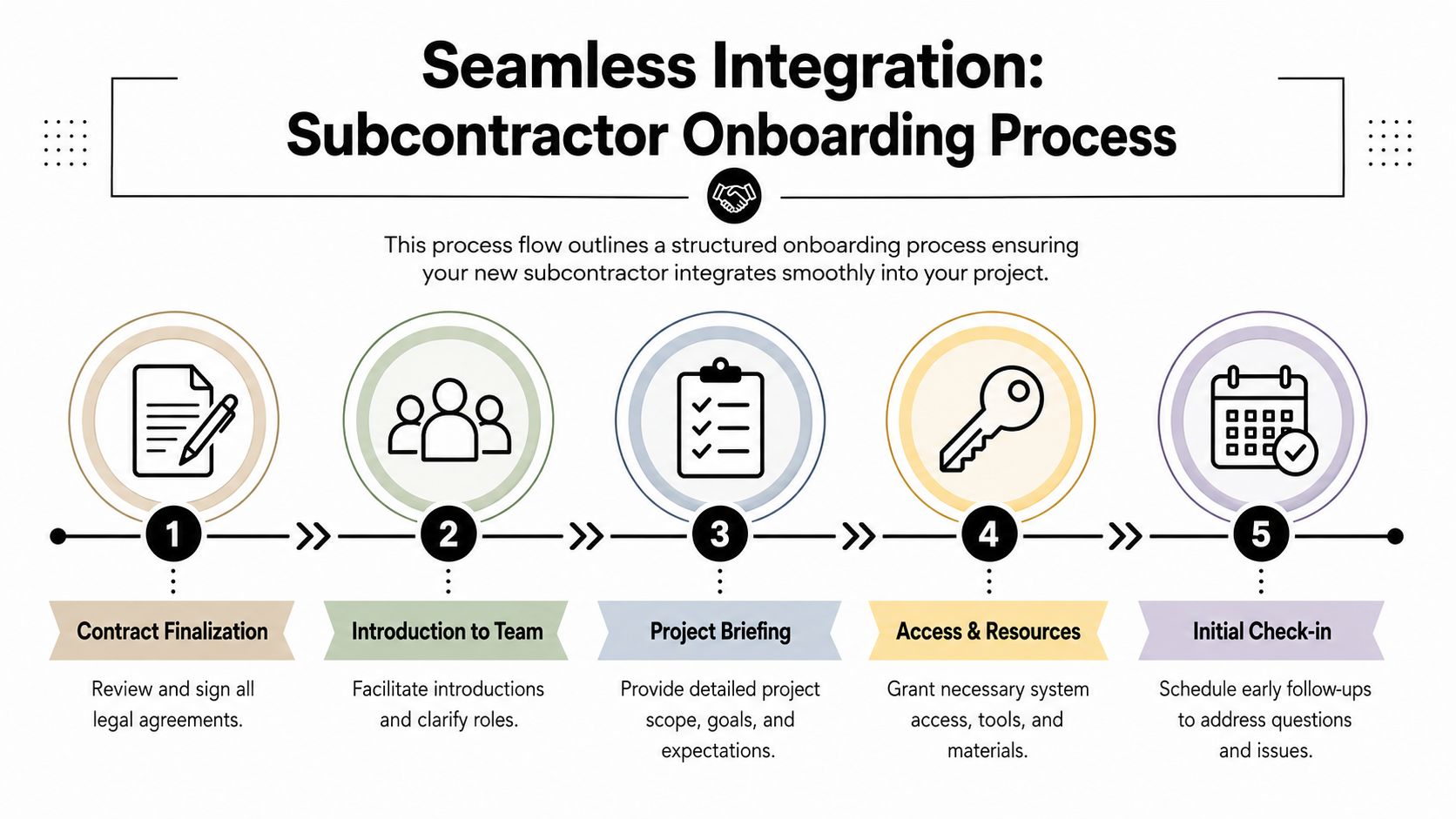
A clean onboarding process should cover the practical basics straight away:
- Site induction with health and safety rules, welfare, permits, and emergency procedures
- Project briefing covering drawings, specifications, sequence, and quality standards
- Team introductions so the subcontractor knows who gives instructions and who signs things off
- Access arrangements for plant, materials, keys, zones, and deliveries
- Commercial administration including invoice route, paperwork expectations, and variation approval
If you want a simple admin aid for the payment side, this construction invoice template in Word can help standardise what you expect from subcontractors.
Make responsibilities visible
A good subcontractor shouldn't have to guess who is running the job from your side. They need one clear route for technical queries, one route for commercial queries, and one route for day-to-day site coordination.
That avoids common problems such as:
- Conflicting instructions
- Unpriced changes
- Missed inspections
- Delays in material release
- Arguments over who approved what
Check in early
Don't wait until the first progress meeting to find out the start has gone wrong. The first few shifts tell you a lot.
Look for:
| Early signal | What it often means |
|---|---|
| Missing labour on day one | Overbooking or weak planning |
| Repeated drawing queries | Briefing gap or poor preparation |
| Unauthorised scope changes | Weak supervision |
| Slow paperwork return | Admin problems later |
| Friction with other trades | Coordination risk |
The first week usually confirms whether you appointed a delivery partner or bought yourself a management problem.
A firm but fair onboarding process also helps you keep the better subcontractors. Good firms notice when a site is organised, instructions are clear, and payments are handled properly. That reputation matters when labour is tight.
Building a Reliable and Compliant Team
The firms that consistently find sub contractors well don't rely on luck. They follow a repeatable process and stick to it when the programme gets tight.
That process is straightforward. Define the package properly. Source through trusted channels first. Vet on evidence, not promises. Put the agreement in writing. Check CIS and any off-payroll risk before payment starts. Then onboard the subcontractor so they can work productively from day one.
The shift is mindset. Subcontractor sourcing is not just buying labour. It is building a supply chain around your business. Every good appointment strengthens delivery, protects margin, and makes the next project easier to staff. Every weak appointment does the opposite.
For small business owners, that means discipline matters more than volume. You don't need a huge database of names. You need a smaller group of trades and specialists who are proven, contactable, insurable, and commercially straightforward.
Umbrella Company can also be a useful reference point where your project model includes contingent workers or you need support comparing umbrella payroll arrangements tied to contract-based engagements.
Treat subcontractors professionally, and the stronger ones will usually work with you again. That is how you move from scrambling to find cover on each new job to building a dependable network that supports growth.
If you need help understanding contractor compliance, off-payroll working, or how different engagement models affect your admin and risk, Umbrella Company offers practical resources to help you compare options and make informed decisions.


