


You've won the work, the programme is tightening, and the team you have today won't carry the next phase on its own. That's usually the point where firms start trying to find a subcontractor quickly, and that's also where avoidable mistakes creep in.
Most hiring problems at this stage aren't caused by a lack of skilled people. They come from weak checks, vague contracts, poor onboarding, and payroll assumptions that don't survive HMRC scrutiny. In the current UK market, a subcontractor who looks perfect on paper can still create real tax, payment, and delivery risk if their status and working arrangement aren't properly verified.
A safe appointment process needs two tests. First, can they do the work to the standard and pace you need. Second, are they legally and commercially ready to work on your project without creating downstream liability.
Your Guide to Finding Compliant Subcontractors
If your business is scaling, subcontracting isn't a side issue. It's part of how projects get delivered in the UK. The reliance on subcontracting is a structural feature of many UK markets. In construction, for example, approximately 70% of all workers are employed as subcontractors, with over 2.1 million of the 3.1 million total workforce classified as such, according to the Construction Industry Training Board and ONS.
That matters because the search process can't be casual. When subcontracting is the norm, the differentiator isn't whether you use subcontractors. It's whether you select and manage them properly.
What a good search really involves
A lot of firms still treat this as a simple sourcing exercise. They ask around, collect a few names, compare rates, and move. That approach can work on a small, low-risk package. It breaks down on bigger jobs, regulated work, or any engagement where tax status and labour compliance sit close to the client risk.
A proper process usually covers:
- Sourcing channels: finding people through trusted referrals, trade bodies, specialist directories, and targeted outreach
- Commercial checks: reviewing insurance, references, capacity, and financial resilience
- Status checks: confirming whether their engagement model fits the role you're offering
- Contract controls: making sure the paperwork matches the actual working practices
- Onboarding discipline: setting expectations before the first day on site or in programme delivery
Practical rule: If you only know a subcontractor's rate, trade, and availability, you don't know enough to appoint them.
What separates a safe hire from a risky one
The strongest subcontractors aren't just technically capable. They're organised, documented, and easy to assess. They can show how they work, who they've worked for, how they're insured, and how they're paid. That saves time and reduces disputes later.
When people ask how to find a subcontractor, the better question is usually this: how do you find one who is project-ready. In practice, that means someone who can start without confusion over scope, payment terms, right-to-work position, payroll treatment, or IR35 exposure.
Where to Find Skilled and Reliable Subcontractors
The best place to start is still your existing network. Good subcontractors are hard won, and most experienced contract managers won't recommend someone lightly. A referral from a supplier, site manager, quantity surveyor, or another contractor usually tells you more than an online profile ever will.

Start with the channels that carry reputation
Referrals work because reputation travels faster than advertising. If a trusted contact says a drylining gang turns up prepared, closes snagging properly, and doesn't create payment noise every week, that's useful intelligence. It's still only a starting point, but it's a strong one.
Trade bodies and curated directories also help narrow the field. Membership doesn't replace due diligence, but it does give you a more credible starting pool than random marketplace listings. If you're exploring digital routes, a specialist list of subcontractor websites can help you organise the search and compare channels more efficiently.
If your business is moving from owner-led delivery into a more structured hiring model, it can also help to read wider guidance on hiring your first employee. Even though subcontracting and employment aren't the same, the advice around role clarity, process, and compliance is relevant when your labour model starts to grow.
Use broader channels carefully
Online platforms and LinkedIn can be useful, especially when you need a specialist trade or short-term project support in a specific region. The mistake is treating visibility as proof. A polished profile, a strong headline, or a fast reply doesn't tell you whether someone can deliver under your site rules and commercial terms.
Use broader channels for discovery, not for decision-making.
A practical sourcing order usually looks like this:
- Trusted network first: ask clients, consultants, suppliers, supervisors, and peer contractors
- Trade associations next: use member directories and sector bodies to build a shortlist
- Specialist recruiters where needed: useful for niche trades or fast mobilisation
- Professional platforms last: LinkedIn and online directories can widen the net, but they need heavier vetting
The fastest route to a bad subcontractor is choosing the person who was easiest to find.
Match the source to the package
Not every package needs the same search route. If you're procuring repeat civils support, local reputation may matter most. If you need a compliance-heavy labour supply arrangement, the person's operating model matters just as much as their trade background.
That's why the strongest hirers don't just ask where to find a subcontractor. They ask where to find one whose experience, paperwork, and payroll setup fit the job they're being brought in to do.
A Vetting Process That Protects Your Business
Once you've got a shortlist, the real work starts. This is the point where many firms rely on instinct, one decent reference, and a quick rate check. That's not vetting. That's hope.
The safer approach is a formal prequalification process with a written scorecard. According to the UK Department for Business and Trade's 2024 construction sector report, a formal prequalification process can reduce rework by 40% and improve bid-hit ratios by 25%. The same guidance points to a Score and Categorize Risk system that assesses candidates on financial capacity, safety metrics, and trade experience.
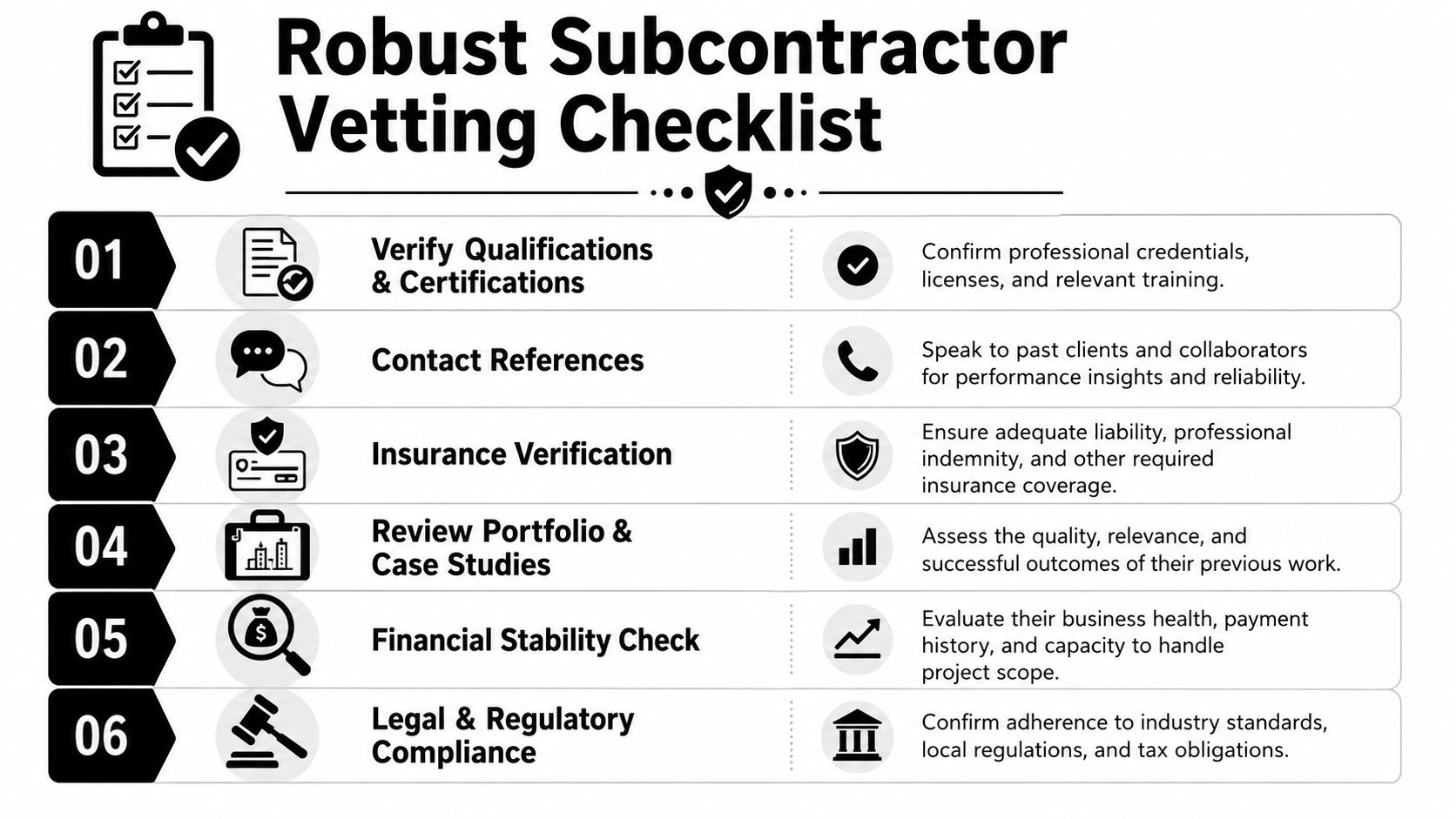
Build a scorecard before you start calling people
A scorecard keeps your process consistent, especially when several people in the business are involved in selection. It also stops the common problem where a subcontractor looks good because they're known personally, even though their paperwork or capacity is weak.
A workable scorecard should cover:
- Trade capability: relevant experience, qualifications, and similar completed work
- Safety record: site behaviour, incident history, and documented procedures
- Financial stability: ability to carry labour, materials, and cashflow demands
- Insurance position: public liability, professional indemnity where relevant, and expiry dates
- Operational capacity: real availability, not just claimed availability
- Compliance readiness: right paperwork, tax position, and willingness to work within your controls
You don't need an elaborate procurement portal to do this well. A disciplined spreadsheet and a standard evidence pack can be enough if people use it.
What to verify, not just ask about
Start with documents, then test them in conversation. Anyone can say they've delivered similar works. Fewer can talk through sequencing, handovers, variation handling, design queries, and site coordination in a way that shows they were in control of the package.
Check these points directly:
- Insurance evidence: ask for current certificates, not assurances
- Recent references: speak to them, don't just collect names
- Portfolio relevance: look for similar scope, scale, and environment
- Current workload: ask what else they've committed to and when
- Business health: review whether they look stable enough to stay solvent through your programme
If the work is sensitive, complex, or high value, enhanced checks can be sensible. In some cases, external pre-employment screening services can help verify background issues that a standard commercial review may miss.
A subcontractor doesn't fail only when workmanship drops. They also fail when cashflow, paperwork, or labour planning collapses halfway through a live package.
Add a compliance lens, not just an operations lens
Standard vetting often stops at competency and insurance. That's incomplete. You also need to know whether the subcontractor's operating model will stand up to scrutiny, especially if they're being engaged in a way that blurs the line between outsourced services and labour supply.
That's one reason accredited payroll structures matter when you're assessing risk. If a candidate already works through an established compliant model, you can often verify part of the administrative and tax picture more cleanly. For hirers reviewing that angle, it helps to understand what FCSA-accredited umbrella companies are expected to provide and why that affects risk.
Navigating Contracts Payments and IR35 Rules
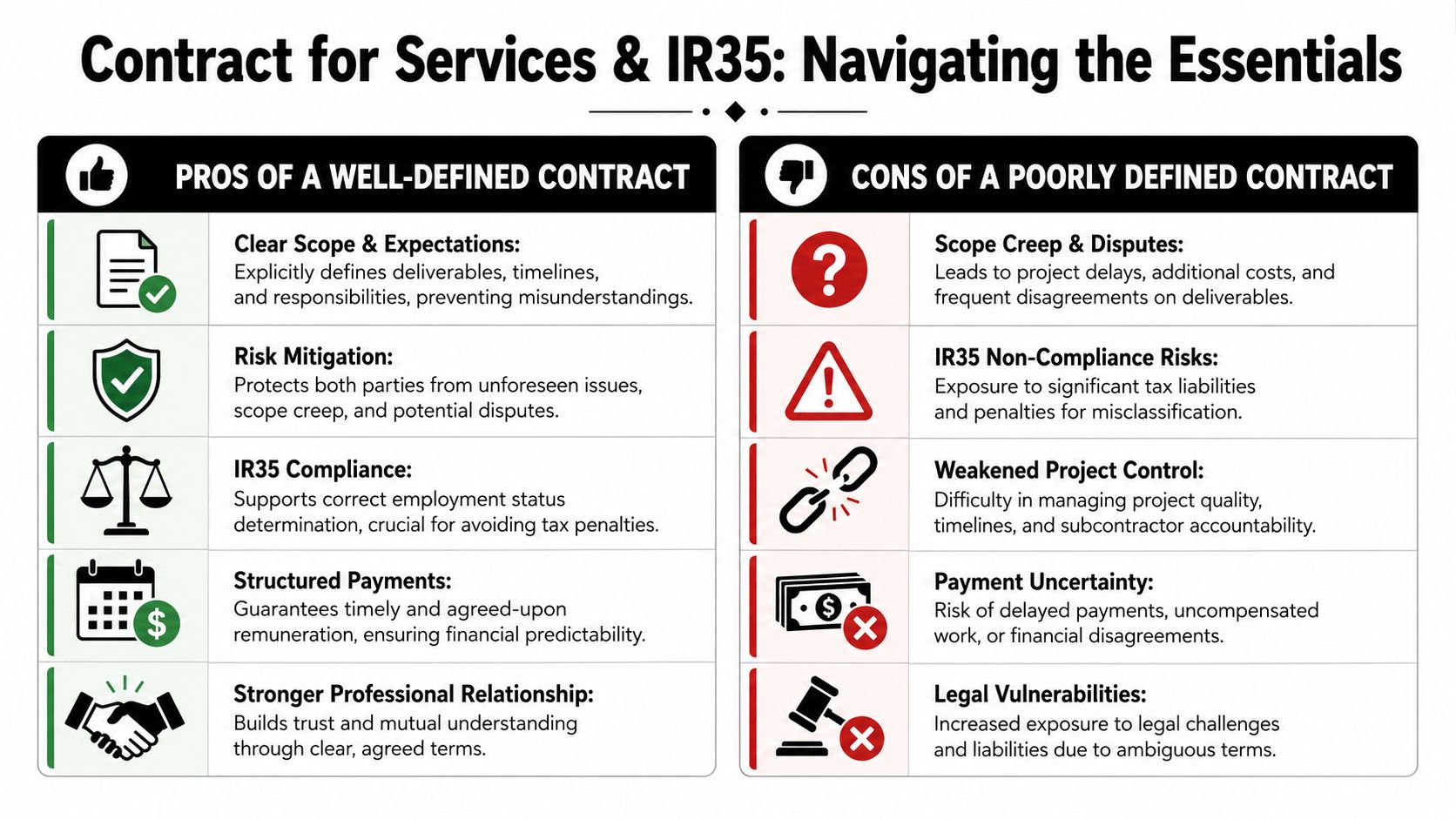
A subcontractor appointment goes wrong most often when the contract says one thing and the working arrangement does another. You may issue a tidy contract for services, but if the day-to-day reality looks like supervision, control, fixed hours, and integrated labour, that paperwork won't rescue you.
That's why contract drafting and IR35 status can't be treated separately. In the current market, they are part of the same risk conversation.
A useful visual summary sits below.
What the contract must do
Your agreement should define the package clearly enough that both sides know what success looks like. It should also make payment and accountability boring. Boring is good. Ambiguity leads to arguments about extras, timing, defects, and who was supposed to provide what.
At a minimum, cover:
- Scope of services: what is included, excluded, and assumed
- Programme obligations: start dates, milestones, handovers, and notice requirements
- Quality expectations: specifications, sign-off rules, and defect obligations
- Payment mechanics: rates, applications, supporting records, and payment timing
- Change control: how variations are instructed, priced, and approved
- Compliance clauses: tax status, right-to-work checks, insurance, and record keeping
Why IR35 changes the hiring decision
Plenty of firms still look at subcontractors as if it were enough to ask, “Do they have a UTR or a limited company?” It isn't. The harder question is whether the role you're offering would be treated as employment for tax purposes under the off-payroll rules.
That's where many disputes start. A 2024 report by the Chartered Institute of Payroll Professionals found that 68% of UK construction contractors face delays or disputes because they can't verify whether a subcontractor's payroll status complies with IR35, which is why hidden liability often slips past ordinary vetting lists, as noted in the CIPP report.
If you haven't reviewed the rules in detail recently, a practical explainer on IR35 for contractors is worth keeping to hand when you're assessing how a role should be structured.
Poor IR35 handling usually isn't caused by bad intent. It's caused by firms appointing quickly and checking status too late.
Match working practices to the paperwork
For experienced managers, avoiding trouble hinges on careful practice. Don't just issue terms and move on. Test the working arrangement in plain English.
Ask questions like:
- Who controls the day-to-day work: are they delivering a defined service, or acting like managed labour
- Can they provide a substitute: and would that be realistic in practice
- Are they exposed to genuine commercial risk: or paid like staff under another label
- How embedded are they: do they operate independently, or as part of your permanent structure
A short contract review meeting before appointment can flush out inconsistencies early. If the subcontractor expects set hours, direct supervision, and no autonomy over delivery, that tells you something important before the first invoice lands.
This short video gives a helpful overview of the compliance issues hirers and contractors need to think about.
Payment terms need the same discipline
Payment causes friction when the hiring business leaves too much open to interpretation. If you're paying against milestones, define them. If you need timesheets, specify who approves them and by when. If applications must include backup, say what counts as backup.
A strong subcontractor usually welcomes this clarity. The weak ones often resist it.
De-Risking Your Choice with Compliant Umbrella Companies
For many hirers, the cleanest route through the IR35 problem is to engage subcontractors who operate through a compliant umbrella company. That doesn't replace commercial vetting or project control, but it does reduce one of the most expensive areas of uncertainty.
The value isn't theoretical. According to the FCSA Annual Compliance Report 2024, 95% of contractors using FCSA-accredited umbrella companies pass all IR35 risk assessments without penalty, compared to 60% of those using non-accredited providers. That gap is exactly why third-party accreditation matters.
Why umbrellas can make the engagement safer
When a subcontractor is employed by a compliant umbrella company, PAYE, National Insurance, and payroll administration are handled through a formal employment model. That helps remove the grey area that often appears when hirers try to engage individuals through ad hoc arrangements that don't fit the working practices.
This doesn't mean every umbrella is good. Some are transparent and well controlled. Others create confusion around deductions, status, and documentation. The point is not to insist on any umbrella. It's to insist on a credible, accredited one.
A sensible checklist includes:
- Accreditation status: look for recognised independent standards
- Payslip transparency: deductions should be clear and explainable
- Contract documentation: terms should line up with the engagement model
- Support quality: someone should be able to answer compliance questions clearly
- Reputation: check how long they've been operating and how they handle issues
What this changes for the hirer
If you're trying to find a subcontractor for a role that is likely to sit inside the off-payroll rules, an accredited umbrella arrangement can turn a messy engagement into a manageable one. The subcontractor still needs the right skills, availability, and attitude. But the payroll side is less likely to unravel under scrutiny.
That matters because tax risk rarely appears at the start of the job. It appears later, when records are reviewed, deductions are questioned, or an engagement has drifted far away from what the original paperwork described.
The right umbrella company won't make a poor subcontractor good, but it can stop a good subcontractor becoming a compliance problem.
For hirers who want to understand the model in more detail, a practical overview of an umbrella company is useful when comparing engagement routes.
Onboarding Your Subcontractor for a Smooth Start
A strong appointment can still underperform if the start is loose. Most early project friction comes from assumptions. The subcontractor assumes they're covering one scope, the site team assumes another, and the commercial team expects records nobody has explained properly.
A structured onboarding process fixes that before it becomes delay, rework, or payment noise.
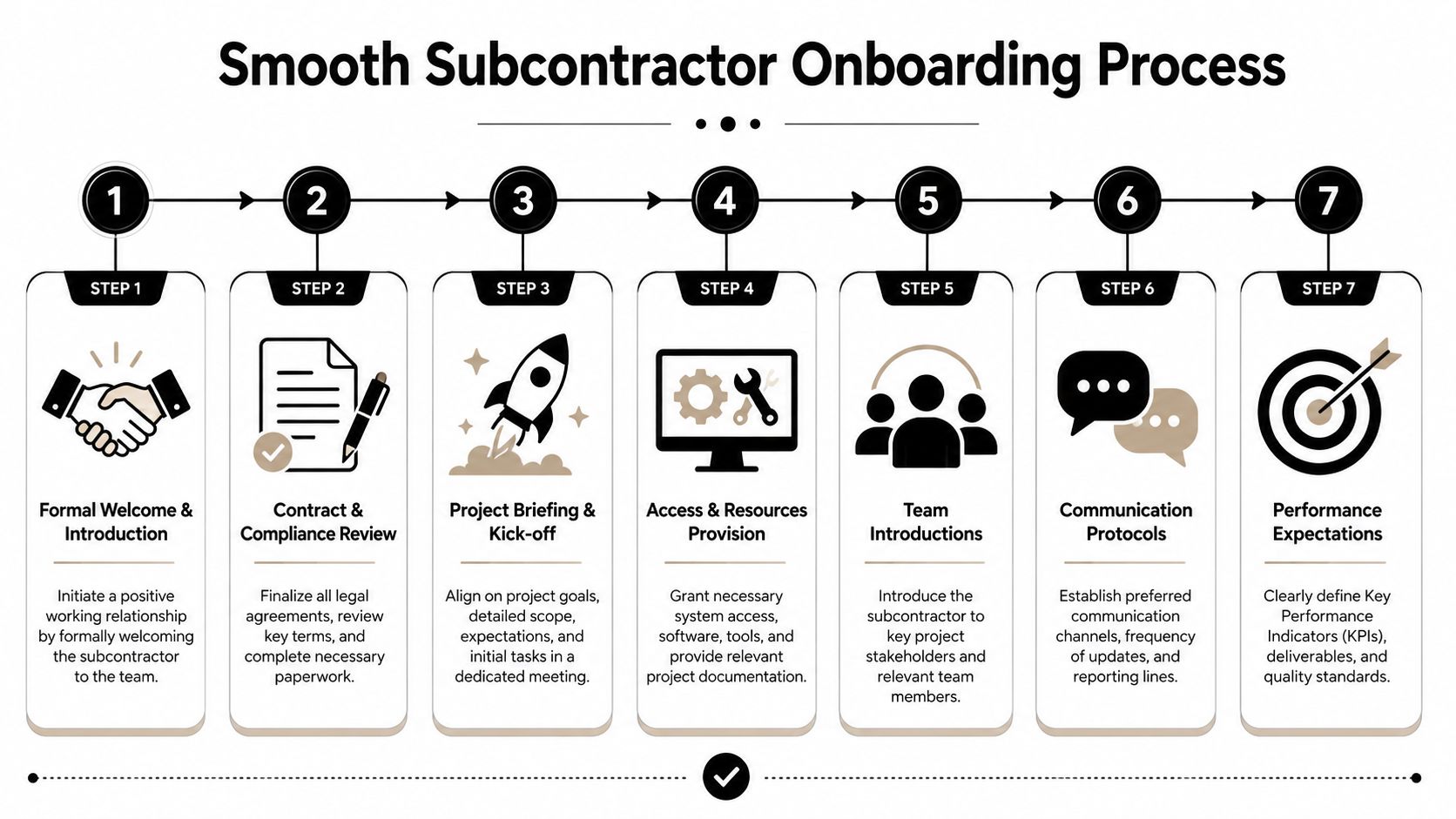
Set the tone on day one
The opening meeting should cover more than a welcome and a start date. Walk through the package, constraints, reporting line, access arrangements, site rules, and document flow. If you use project software, show them exactly where information sits and what they're expected to update.
This is also the right point to confirm practical matters that often get skipped:
- Site or system access: passes, logins, induction records, and permissions
- Document control: latest drawings, revisions, specifications, and forms
- Communication route: who they report to, who signs off work, and who handles changes
- Commercial admin: applications, timesheets, notices, and backup requirements
Don't leave standards implied
Good subcontractors want clarity. They don't want to discover two weeks in that your quality expectations, sequencing assumptions, or reporting routines were different from theirs.
Spell out what matters most. That may include workmanship standards, photographic records, test evidence, permit rules, client-facing behaviour, or attendance at coordination meetings. If performance will be reviewed against KPIs or periodic scorecards, say so upfront.
For teams looking at the wider process side of mobilisation and coordination, there's useful practical advice in this piece on managing residential construction effectively, especially around keeping communication and documentation under control.
Start-up meetings save arguments. They also reveal very quickly whether the subcontractor is as organised as they seemed during selection.
Use onboarding to confirm, not discover
The best onboarding process confirms what you already checked during vetting. It shouldn't be the first time you ask for critical documents or the first time they hear how payment works.
A simple onboarding checklist usually includes the following:
- Contract review completed
- Compliance documents received and filed
- Project brief issued
- Key contacts introduced
- Health and safety induction completed
- Reporting and payment process confirmed
- First review date agreed
That last point matters. Put an early review in the diary. Small issues are easier to correct in week one than in month two.
Summary and Next Steps
To find a subcontractor well in the UK, you need more than a name, a trade, and a day rate. The safest appointments come from a disciplined process that covers sourcing, vetting, contract control, payroll status, and structured onboarding.
Skill still matters, of course. But in the post-IR35 market, compliance readiness is part of competence. If a subcontractor can't be engaged cleanly, they aren't fully ready for your project, no matter how good their work looks on paper.
Choose carefully, document properly, and treat status checks as part of procurement, not an afterthought.
If you want to check whether a subcontractor is working with a credible provider, compare options through Umbrella Company. It's a practical way to review trusted umbrella companies and help confirm that the people you bring in are set up for compliant engagement.


