


If you used to be a permanent employee, there’s a fair chance an old final salary pension is still sitting in the background of your finances. It may belong to a former employer you left years ago, long before contracting, umbrella working, or IR35 became part of your day-to-day reality.
That old pension can feel oddly out of place in a contractor’s life. You’re now used to variable income, project-based work, and making decisions with flexibility in mind. A pension that promises a set income later can be reassuring, but it can also feel rigid when the rest of your financial life is anything but.
That’s why final salary pension transfers attract attention. For some contractors, the appeal is control. For others, it’s access, flexibility, or family planning. But this is one of the biggest irreversible financial decisions you can make. Once a transfer happens, you usually give up guarantees for good.
Practical rule: Treat a final salary transfer as a retirement planning decision first, and a cash-access decision second.
If you’re weighing your options alongside wider questions about working structure and tax efficiency, it also helps to understand your current setup, especially if you’re deciding between umbrella and limited company routes. This guide on the most tax efficient contractor setup in the UK is useful background.
Is Your Old Final Salary Pension Right for Your Contractor Career?
Contractors often look at money differently from permanent employees. You may think in terms of cash flow, reserve funds, tax timing, contract gaps, and how to keep your long-term plans stable while your short-term income moves around.
That changes how an old workplace pension feels.
A final salary pension was designed for a more traditional career path. You worked for one employer for years, built up benefits steadily, and later received a predictable income for life. Contracting rarely follows that pattern. You may switch assignments often, work through an umbrella company, pause between roles, or adjust your plans as IR35 rules affect your take-home pay.
Why contractors pause over these pensions
The tension is simple. A defined benefit pension gives security. A transfer may offer flexibility.
Security matters because contractor income can be uneven. Flexibility matters for exactly the same reason.
You might be asking questions like these:
- Can this pension fit a modern freelance life better if I transfer it?
- Would a personal pension or SIPP be easier to manage alongside other pots?
- Do I need access options that a final salary scheme doesn’t offer?
- Would giving up the guarantee create too much risk later on?
Those are sensible questions. They’re also the right questions.
A final salary pension isn’t automatically right or wrong for a contractor. The issue is whether its guarantees solve your future problem better than flexibility solves your current and future ones.
The rest of the decision only becomes clearer once you understand what you own, how a transfer value is worked out, where the risks sit, and which rules you must follow before anything can move forward.
What Is a Final Salary Pension?
A final salary pension, also called a defined benefit pension, is a workplace pension that promises you an income in retirement. Instead of building a pot that rises and falls with investments, the scheme uses a formula to work out what it will pay you.
The key point is this. The benefit is defined in advance. The pension scheme takes on the job of funding that promise.

A simple way to think about it
A final salary pension is like a guaranteed meal ticket for retirement. You know a meal should be there when the time comes.
A defined contribution pension, by contrast, is more like being given a grocery budget. You still have choices, but you also carry more responsibility. You decide how the money is invested, how much to draw, and how long it needs to last.
That difference matters because many contractors are used to the second model. Personal pensions and SIPPs fit self-directed financial planning. Final salary schemes don’t work like that.
How the pension promise is built
Most final salary pensions depend on a few core building blocks:
- Pensionable service. This means the years you were building benefits in the scheme.
- Salary measure. Some schemes use your final salary, while others use a career average.
- Accrual rate. This is the fraction that determines how much pension you earn for each year of service.
If the term accrual rate sounds technical, keep it simple. It’s the pace at which pension income builds up. A lower fraction means benefits build more slowly, a higher one means they build faster.
Why people value them so highly
These pensions are often described as valuable because they can include features many modern pensions don’t naturally provide in the same way:
- A known income for life
- Less direct investment risk for you
- Potential increases under scheme rules
- Benefits for a spouse or dependant in some cases
That doesn’t mean every final salary pension should be kept. It means you should understand that you’re not comparing one pension pot with another. You’re comparing a promise with a pot of money.
Recent transfer activity shows how important that trade-off has become. Over the past two years leading up to recent analyses, an estimated 210,000 individuals transferred out of UK employer final salary schemes, moving £50 billion into their own pension arrangements. But activity later dropped sharply, with an annualised rate of 18 members per 1,000 by the end of 2023, then 15 per 1,000 in January 2025, according to analysis of UK final salary pension transfer activity.
For contractors comparing old scheme benefits with more flexible retirement planning, that context matters. If you’re already reviewing your wider finances, this guide on how to pay less tax as a contractor can help you look at the bigger picture.
How Your Pension Transfer Value Is Calculated
A contractor leaves a permanent role, keeps an old final salary pension in the background, then asks for a transfer quote years later. The number can look far higher, or far lower, than expected.
That quote is called a Cash Equivalent Transfer Value, or CETV. It is the lump sum your scheme offers if you give up the future benefits you have built up and move them into another pension, such as a personal pension or SIPP.
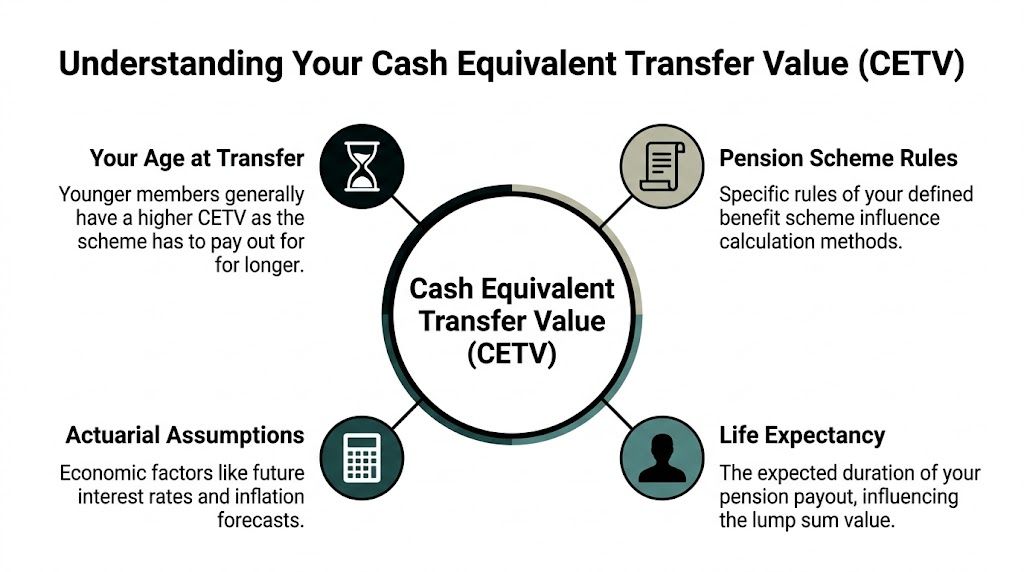
The easiest way to understand a CETV is to picture the scheme asking: how much money would we need to set aside today so we no longer carry this pension promise in future? That is why the figure can feel detached from what you remember paying in. It is based on the value of the promised benefits, not just your own contributions.
What goes into the calculation
Actuaries work through several ingredients at once. They usually include:
- The pension you have built up so far. A larger promised income usually leads to a higher transfer value.
- Your scheme's rules. Retirement age, inflation increases, and spouse or dependant benefits all affect the cost of that promise.
- Your age and life expectancy assumptions. A scheme estimates how long benefits may need to be paid.
- Interest rates and market conditions. These can change the value sharply, even if nothing about your own employment history has changed.
A useful comparison is a mortgage quote. The house has not changed, but the monthly cost can move a lot when interest rates move. CETVs work in a similar way. The promise may be the same, while the transfer value shifts because the financial assumptions behind it have changed.
Why transfer values can rise or fall quickly
One of the biggest drivers is the level of gilt yields, which are the yields on UK government bonds.
When gilt yields rise, CETVs often fall. When gilt yields fall, CETVs often rise.
The reason is practical rather than mysterious. If the pension scheme expects stronger returns from low-risk assets, it may need less money today to meet future pension payments. That lowers the transfer value it offers now. 2020 Financial's update on DB pension transfer values gives examples of how higher gilt yields have pushed transfer values down materially in recent years.
This matters for contractors more than it first appears. Your work life already has enough moving parts: contracts ending early, income gaps, IR35 changes, and decisions about whether to work through an umbrella or limited company. A CETV can move for reasons that have nothing to do with your own retirement plan, so a high or low quote should not be treated as a signal on its own.
Why the same pension can produce a surprising quote
Many contractors expect the transfer value to be a simple total of future payments. It is more like a present-day pricing exercise.
For example, two people with similar service histories can receive different-looking outcomes if their schemes use different rules on increases or dependant benefits. The quote can also change between requests because market conditions changed in the background. In many cases, a CETV is only guaranteed for a limited period, so timing affects the number on offer even if your goals stay exactly the same.
What to focus on as a contractor or freelancer
A CETV is a snapshot, not a verdict.
If your income is irregular, flexibility may sound attractive because you are used to planning around uneven cash flow. But pension decisions work best when you separate the immediate quote from the long-term job that money needs to do for you later.
Ask yourself:
- What benefits am I giving up in exchange for this lump sum?
- Would a transfer still make sense if markets moved again next month?
- How does this fit with the rest of my contractor finances, including tax planning and periods between assignments?
That wider context matters. If you are balancing pension planning with company structure, salary and dividend choices, or IR35-related admin, working with the best accountant for limited company contractors can help you line up the pension decision with the rest of your financial setup.
The Risks and Benefits of Transferring Out
This is the part that matters most. A transfer can solve real problems for contractors, but it can also create new ones that are easy to underestimate.
The attraction is obvious. If you move a final salary pension into a personal pension or SIPP, you usually gain flexibility over investments, access, and estate planning. For someone whose income rises and falls across assignments, that freedom can feel far more practical than a pension promise locked away under old scheme rules.
The danger is just as clear. You swap a known future income for uncertainty. Once the guarantee has gone, it’s gone.
Final Salary Pension Transfer At a Glance
| Potential Benefits of Transferring | Significant Risks of Transferring |
|---|---|
| Greater flexibility over how and when you access retirement funds | Loss of guaranteed income for life |
| More control over investment choices | You take on investment risk yourself |
| Potentially easier coordination with other pensions | Your money may not last through retirement |
| Possible planning advantages for family inheritance | Charges, poor decisions, or scams can cause lasting harm |
| Access to a pension structure that may better suit self-directed contractors | You may regret giving up benefits that are hard to replace |
Why flexibility appeals to contractors
A contractor’s finances rarely move in a straight line. Your earnings may be strong for months, then uneven during a gap between assignments. You may also deal with changing work structures, agency chains, umbrella payroll, or inside IR35 roles that reduce take-home pay compared with earlier expectations.
In that environment, a transfer can look attractive for practical reasons.
For high-earning contractors, transfers can enable diversified SIPPs, but mainstream guidance rarely tailors that flexibility to their circumstances. One source notes that there’s little joined-up guidance connecting transfer flexibility, such as funding a business setup or bridging income gaps, to the 1.3 million UK contractors facing IR35 compliance through umbrella companies and often lacking traditional employer pension access, as discussed in this contractor-focused view of final salary pension pros and cons.
The real upsides
Some contractors explore final salary pension transfers because they want retirement planning that reflects the way they already manage the rest of their money.
That can include:
- Investment control. You may prefer choosing your own funds in a SIPP rather than relying on a scheme promise.
- Access flexibility. A personal pension can offer more options over how benefits are taken, subject to the rules at the time.
- Family planning. Some people prefer the idea of a remaining pension pot passing more flexibly to beneficiaries.
- Administrative simplicity. Bringing pensions together can make retirement planning easier to track.
Contractor lens: Flexibility is most attractive when the rest of your financial life already depends on making active choices, not passive assumptions.
There’s also a behavioural point here. Contractors often have a stronger tolerance for financial complexity than employees who have stayed in one workplace for years. That can make self-managed retirement planning feel natural.
But feeling comfortable with complexity isn’t the same as being protected from risk.
The risks are larger than many people expect
A final salary pension doesn’t just provide money. It provides certainty.
Once transferred, several burdens move to you:
- Investment decisions become your problem.
- Withdrawal timing becomes your problem.
- Longevity risk becomes your problem. In other words, your money has to last as long as you do.
- Market falls can damage both the value of the pot and the sustainability of your withdrawals.
These risks hit contractors in a particular way. If your career has already involved variable earnings, you may not have the same level of future income certainty as someone with a long salaried path. In that case, a guaranteed pension can act as an anchor in retirement.
A transfer removes that anchor.
Where contractors can misread the trade-off
The biggest mistake isn’t wanting flexibility. It’s using flexibility to solve a short-term pressure by weakening a long-term safety net.
That can happen when someone sees a transfer as a way to:
- cover a contract gap,
- support a business launch,
- reduce personal debt pressure,
- or create a larger accessible pot for future choices.
Those goals may be understandable. But the pension wasn’t designed as a convenience fund. It was designed to pay you later, predictably, for life.
Questions that usually reveal the truth
If you’re weighing a transfer, these questions tend to sharpen the picture:
- Is this your only substantial guaranteed retirement income?
- Do you already have other pensions or assets that provide security?
- Are you comfortable managing investments through good and bad markets?
- Would you still want the transfer if there were no immediate cash-flow pressure?
- Are you attracted by control, or pushed by anxiety?
The difference matters.
If your interest comes from a thoughtful, wider retirement plan, the conversation with an adviser will be more grounded. If it’s driven by present stress, that’s a sign to slow down.
If reducing pressure on your contractor income is part of the wider picture, you may also want to review the best ways to reduce tax as a contractor in the UK. Sometimes the right answer sits outside the pension itself.
UK Rules and Regulations You Must Follow
Final salary pension transfers are heavily regulated for a reason. You’re not moving an ordinary savings account. You’re potentially giving up safeguarded benefits that may be difficult or impossible to replace later.
That’s why the process has legal steps and professional gatekeepers.

The advice rule over £30,000
If the value of the safeguarded benefits being transferred is more than £30,000, you must take regulated advice from the right kind of specialist before the transfer can proceed. That rule exists because giving up a defined benefit promise is a major step, not a routine pension switch.
For many contractors, this requirement feels frustrating at first. In reality, it’s one of the most useful protections in the system. It forces a proper assessment of whether flexibility is worth the loss of certainty.
Why the rules have become tighter
Recent changes and warnings show why caution has increased. The abolition of the Lifetime Allowance in 2025 added complexity, and guidance discussing post-abolition transfer considerations says FCA reports in Q1 2026 showed a 22% rise in transfer enquiries. The same source also highlights warnings that 65% of transfers are later regretted due to poor advice, and notes Pension Scams Bill amendments in November 2025 that mandate a 12-week cooling-off period.
Those figures shouldn’t be read as a reason to avoid advice. They’re a reason to get good advice and take your time.
Regulation is there because pension transfer mistakes can be permanent, expensive, and emotionally hard to reverse.
The key protections to know
Several practical safeguards matter when you’re exploring final salary pension transfers:
- Regulated advice requirement. This applies where the transfer value crosses the legal threshold.
- Cooling-off protections. These are designed to slow down rushed or pressured decisions.
- Scheme checks and transfer due diligence. Providers may ask questions about where the money is going and why.
- Scam prevention rules. These can delay or block suspicious transfers.
Later in the process, a plain-language overview can help. This video gives a useful introduction to pension transfer considerations.
Pension scam red flags contractors should watch for
Contractors are often used to moving quickly. That’s useful in work, but dangerous in pension decisions. Scam approaches often exploit urgency and confidence.
Watch for these warning signs:
- Pressure to act quickly. Anyone pushing you to move before you’ve had time to review advice is a problem.
- Claims of guaranteed high returns. Real investing does not work like that.
- Complex offshore or unusual investments. If you can’t explain it easily, don’t sign for it.
- Advice that starts with the transfer, not your goals. A proper adviser starts with suitability, not sales.
- Unclear charges. If fees are hard to understand, you don’t yet know enough.
- Contact out of the blue. Unsolicited pension approaches deserve immediate caution.
What to do before signing anything
Keep the process boring. That’s often the safest route.
Use regulated firms. Read every recommendation in full. Ask for costs in pounds and pence, not vague descriptions. If anything feels rushed, stop.
A strong transfer process should feel deliberate, documented, and slightly slow. That’s a feature, not a flaw.
Who Should (and Should Not) Consider a Transfer
A contractor leaves a permanent role, builds a strong freelance income, then hits a rough patch after an IR35 change or a client gap. At that point, an old final salary pension can feel either reassuring or frustrating. Reassuring because it offers a stable future income. Frustrating because it does not bend easily around the stop-start pattern that contractor finances often have.
That tension is the heart of the decision.

A contractor who may have a case for exploring it
A transfer can be worth exploring if your old final salary pension is only one part of a wider retirement plan, not the part holding everything up.
That often describes a contractor who has built savings elsewhere. They may already have a personal pension, ISA investments, retained company profits, or a spouse with secure pension benefits. They may also place a high value on control because their working life has never followed the neat pattern of salary, bonus, and retirement at a fixed age.
For this person, flexibility may matter more than certainty. If your income rises and falls with contracts, you may prefer retirement assets that can be shaped around real life rather than paid in one fixed pattern. You might also care about death benefits for family, or have health concerns that change how attractive a lifelong scheme income feels.
A transfer is still a serious trade. You are giving up a promise in exchange for a pot of money that you must invest and manage well. But if you already have other reliable foundations, that trade may be worth proper analysis.
A contractor who usually should not transfer
A final salary pension often makes more sense to keep when it is your main source of future certainty.
This is common among contractors who have had uneven years, long gaps between assignments, or IR35 changes that reduced take-home income and made long-term saving harder. If you do not enjoy investment decisions, have limited assets outside pensions, or want at least one part of retirement to run on autopilot, the scheme may be doing an important job already.
In plain terms, the pension works like an income floor. It will not solve every retirement need, but it can cover the basics while the rest of your finances remain more flexible.
If your final salary pension is the piece that lets you sleep at night, treating it as spendable capital can create more pressure later, not less.
The middle ground is where contractors need the most care
Many freelancers sit in a grey area. They have some savings. They have some uncertainty. They may own property, have a partner with pension rights, or expect strong future earnings, but none of those things gives the same clean guarantee as a defined benefit scheme.
Contractor circumstances are crucial. An office employee with steady earnings may judge the transfer on pure investment logic. A contractor often has to judge it alongside cash flow risk, tax changes, gaps in work, and the fact that flexibility has real value when income is irregular. The right answer depends on how much secure income you already have and how much flexibility you need, not just how attractive the transfer value looks on paper.
It can also help to separate the problem you are trying to solve. Some people say they want to transfer because they want more cash options later in life, but the pension may not be the only route. For homeowners over a certain age, learning about equity release can be part of a broader retirement funding review.
A good rule is simple. Consider a transfer if flexibility would improve an already solid plan. Be very cautious if the transfer is being asked to rescue a weak one.
Your Action Plan for Exploring a Pension Transfer
If you’re still interested after weighing the risks and rules, slow, organised action is the right next step. Final salary pension transfers reward method, not speed.
Step one, request your CETV properly
Ask your scheme administrator or former employer’s pension contact for a Cash Equivalent Transfer Value statement in writing. Make sure you also ask for the scheme booklet and any explanation of benefits that would be lost on transfer.
Read the paperwork carefully. The transfer value matters, but the attached benefits matter just as much.
Step two, find the right adviser
You need an adviser who is authorised for this kind of work and experienced in defined benefit transfers. Don’t choose on personality alone. Choose on clarity, process, and specialism.
If you’re unsure what a good advice relationship should look like, this piece on seeking financial advice in today’s market is a helpful starting point for thinking about the value of proper guidance.
Step three, take a list of hard questions
Don’t arrive at the advice meeting with only one question, which is whether to transfer. Bring a wider set.
Ask things like:
- What benefits would I be giving up? Ask for this in plain English.
- Why would a transfer suit me, or not suit me? A clear recommendation matters more than a sales pitch.
- How do your fees work? Ask for all charges to be broken down clearly.
- What happens if markets fall after transfer? You need to understand the downside, not just the opportunity.
- What investment approach would you suggest and why? The recommendation should match your risk tolerance and retirement needs.
- How would this affect my family if I died earlier or later than expected? This is often central to the decision.
One useful discipline: If you can’t explain the recommendation back in your own words, you’re not ready to act on it.
Step four, give yourself time
A final salary transfer is usually irreversible. That alone is reason enough to pause before signing.
You don’t need to prove that transferring is possible. You need to be satisfied that it is suitable, sustainable, and aligned with the life you expect to live as a contractor in later years.
If you want support with the rest of your contractor setup, from comparing providers to understanding umbrella working and IR35, Umbrella Company can help you make confident, informed decisions.


