


You've landed your first contract, the rate looks good, and then the quotes for accounting arrive.
One firm offers a low monthly fee. Another wants a higher retainer but says it includes “advisory”. A third talks about hourly billing for anything outside the basics. If you're new to contracting, that spread can feel arbitrary.
It isn't arbitrary, but it is easy to misread.
Fees for accountants make sense only when you match them to your work structure, your IR35 position, and the compliance load behind your setup. A contractor using a limited company outside IR35 needs something very different from someone working through an umbrella, or from a contractor whose role moves inside IR35 mid-year. The cheapest quote often looks best right up until the first extra invoice lands.
A good accountant doesn't just file forms. They help you avoid errors, missed deadlines, poor drawings strategy, muddled payroll treatment, and expensive confusion when your contract status changes. That's where value sits.
Navigating Your First Accounting Quote as a Contractor
A common pattern goes like this. A contractor sets up a limited company, asks for three quotes, and gets three completely different answers.
One quote is framed as a low monthly package. Another includes year-end accounts, director payroll, and tax returns, but costs more. The third sounds cheaper at first because it bills by the hour, until you realise every question, correction, and extra filing may sit outside the headline fee.
That confusion is normal. Accountancy in the UK isn't priced like a simple admin service. The profession developed into a regulated one over time, with bodies such as the Institute of Chartered Accountants in England and Wales founded in 1880, and statutory audit work sitting within the legal framework of the Companies Act 2006, which is why fees reflect regulated expertise, legal responsibility, and professional risk, not just time spent on bookkeeping (background on the profession's regulation).
Practical rule: If two quotes look far apart, assume the scope is far apart too, unless the accountant proves otherwise in writing.
For contractors, the first quote rarely tells the full story. What matters is whether it covers the work your structure creates. A limited company usually needs recurring support. An umbrella contractor often won't need a separate accountant at all. Someone moving between inside and outside IR35 may need advice that isn't included in a basic package.
What a first quote should answer
A useful quote should make these points clear:
- What's included each month: bookkeeping review, payroll, accounts, corporation tax, self-assessment, VAT support, or none of the above.
- What triggers extra charges: IR35 reviews, amended returns, dividend planning, Companies House updates, or HMRC correspondence.
- Who the service is designed for: umbrella workers, sole traders, or limited company contractors.
- How support works in practice: email only, scheduled calls, software access, and response times.
If you're trying to benchmark what limited company support usually looks like, limited company accountant fees explained for contractors is a useful starting point.
The important shift is this. Don't ask only, “What's the monthly cost?” Ask, “What problem is this fee solving for me?”
Understanding Common Accountant Pricing Models
The way an accountant charges often tells you as much as the price itself. For contractors, the pricing model affects cash flow, predictability, and the chance of getting stung by “out of scope” work.
Accountants increasingly use scope-based or value-based fees, especially for contractor work. Fixed monthly retainers often absorb recurring tasks such as reconciliation and reporting, which reduces billing volatility, while the total fee still rises when transaction volume and compliance complexity increase (pricing trend and scope-based charging).
The main pricing models
| Pricing Model | Best For | Pros | Cons |
|---|---|---|---|
| Fixed monthly retainer | Limited company contractors with ongoing filings | Predictable cost, easier budgeting, usually includes core recurring work | Can look expensive if your affairs are very simple, exclusions must be checked carefully |
| Hourly rate | Ad hoc advice or one-off issues | You pay for what you use, useful for specialist questions | Hard to budget, small questions can become an unexpectedly large bill |
| Project-based fee | Company formation, year-end catch-up, tax return clean-up, contract review | Clear fee for a defined task, useful when work is contained | Doesn't help with ongoing support, follow-up work may be extra |
| Value-based or scope-based package | Contractors wanting broader support and advisory input | Better fit for changing needs, often bundles recurring services | You must define scope tightly, or both sides may assume different things |
Fixed monthly retainers
For most limited company contractors, this is the model that works best.
You know what leaves your bank account each month. Your accountant gets regular access to your records. Routine compliance work doesn't turn into a fresh negotiation every time a filing deadline approaches. If they use FreeAgent, Xero, or similar software, the monthly model also fits the way contractor records are managed in real time.
The catch is simple. A retainer is only as good as its scope. A low monthly fee that excludes self-assessment, VAT returns, or director payroll isn't really a low fee once those extras start appearing.
Hourly billing
Hourly charging can be perfectly fair for specialist work.
If you need a second opinion on a contract, help unwinding a messy bookkeeping period, or technical advice after changing from umbrella to limited company, paying for a defined amount of expert time can be sensible. It's less sensible when your whole service runs that way, because contractors usually need ongoing compliance, not occasional consultancy.
A contractor asking regular tax questions on an hourly arrangement often hesitates before asking them. That's not a healthy setup.
Project fees and hybrid arrangements
Project fees suit one-off pieces of work, especially where the scope is clear at the outset. Examples include company incorporation support, a year-end tidy-up after poor records, or onboarding from a previous accountant.
Some firms blend models. They'll use a monthly retainer for routine compliance and a separate project or hourly fee for exceptional matters. That can work well if they explain the boundaries clearly.
For another take on how firms frame cost and scope, Jumpstart Partners' accounting insights are worth reading alongside contractor-focused quotes.
What usually works best for contractors
The strongest setup for most contractors is:
- Monthly fee for recurring compliance: accounts, tax returns, payroll, and standard support.
- Separate fee for unusual specialist work: detailed IR35 advice, HMRC dispute support, restructuring, or cleanup after mistakes.
- Written scope from day one: no ambiguity over what “fully managed” means.
If you're weighing models against your own setup, accounting for contractors gives useful context on the services contractors typically need.
What Services Are Included and What Costs Extra
The phrase “all included” deserves scrutiny.
A contractor can compare two firms, see a meaningful gap in monthly price, and assume one is cheaper. Often, the lower quote strips out work that most contractors eventually need. That's why the issue isn't the sticker price. It's the total cost of staying compliant without surprise add-ons.
A useful way to think about fees for accountants is to separate the routine work from the work that becomes chargeable when your affairs become more active, more technical, or less tidy.
What's usually in a standard package
For a straightforward limited company contractor, a standard package often includes the core annual compliance tasks and some regular support around them.
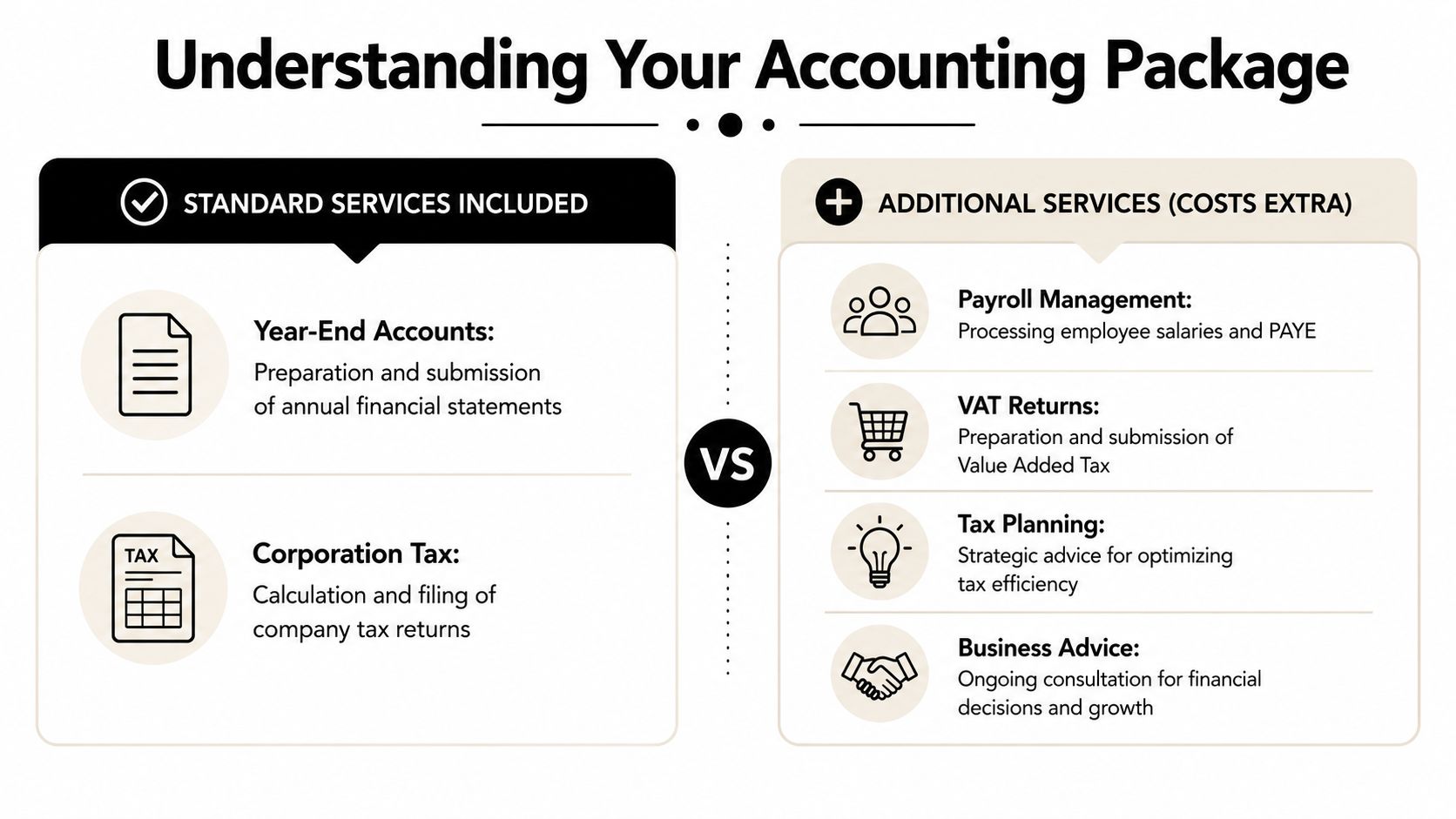
Typical inclusions often look like this:
- Year-end accounts: preparation and filing of the company accounts.
- Corporation tax return: calculation and submission linked to those accounts.
- Director payroll: basic payroll processing for one director.
- Self-assessment support: often for one director-shareholder, but you must confirm this.
- Basic software access: many firms bundle FreeAgent, Xero, or another bookkeeping platform.
- Routine queries: simple email support on day-to-day matters.
That doesn't mean every accountant includes all of the above. It means you should expect a quote to spell out whether they do.
What often sits outside the monthly fee
Here, cheap quotes become expensive.
A contractor might assume VAT is included because the accountant “handles the company accounts”. Another assumes contract reviews or IR35 guidance are standard because the firm markets itself to contractors. Then the extras begin.
Common additional charges include:
- VAT registration and returns: especially where the company has only just crossed into VAT registration or needs scheme advice.
- Bookkeeping cleanup: if records arrive late, incomplete, or poorly categorised.
- Payroll for anyone beyond the director: including employees or more complex payroll changes.
- Tax planning: advice on extraction, pension contributions, or year-end decisions.
- IR35 support: contract reviews, status discussions, and changes in operating model.
- HMRC enquiry support: representation, correspondence handling, or assembling records.
- Amendments and corrections: particularly if records were wrong earlier in the year.
The lowest quote often assumes you will keep perfect records, never change working structure, and never need advice. Most contractors won't fit that pattern for long.
There's also a broader point. Fee models don't capture the cost of compliance risk on their own. Pricing pages often describe fixed, hourly, or value-based billing, but they don't tell you much about the cost of errors, rework, or scope creep. That matters because rising preparation fees in the wider market reflect growing complexity and professional risk, not just time input (why compliance risk matters when judging fees).
How to read the quote properly
When you review a proposal, check these lines first:
- Named deliverables: does it list specific filings, not vague “full support” wording?
- Volume assumptions: does the price assume low transaction volume or limited queries?
- Extra work triggers: does it say what happens if you register for VAT, hire staff, or change contract status?
- Response style: can you ask practical questions during the year, or only at filing points?
For contractors comparing UK and overseas payment structures, Benely on 1099 payments is a useful contrast because it highlights how contractor payment models differ internationally. The exact tax system is different, but it reinforces an important point. Structure drives admin, and admin drives fees.
How IR35 and Your Work Structure Affect Fees
The accounting you need depends first on how you work, not on what an accountant wants to sell you.
A contractor with a limited company outside IR35 has one set of obligations. A contractor working inside IR35 through an umbrella has another. If you change structure mid-year, your fee expectations should change with it.

Limited company outside IR35
Here, ongoing accountant support is usually most relevant.
You're running a company. That means records, payroll, annual accounts, corporation tax, and usually regular decisions about drawings, expenses, and timing. If you're VAT registered, the compliance load increases again. In this setup, a monthly package often makes the most sense because the work is recurring.
Good value here doesn't mean “lowest monthly fee”. It means a fee including the tasks you generate during the year, plus enough support to stop small mistakes turning into bigger ones.
Limited company inside IR35
Contractors can overpay for the wrong setup.
If most or all of your income is caught by inside IR35 rules, the tax efficiency of the limited company narrows, while the admin burden stays. You may still need company filings if the company remains active, but the benefit of paying for a fuller contractor accountancy package may reduce if the structure no longer suits the work.
In practice, this often creates a mismatch. Contractors keep paying for a limited company service designed for outside IR35 trading, even though their contracts no longer justify it.
Umbrella company working
Under an umbrella arrangement, you usually don't need a separate accountant for the contracting income itself.
The umbrella runs PAYE, handles payroll, and processes the employment side of things. Your concern shifts from company accounts and corporation tax to understanding the umbrella margin, payslips, deductions, and whether the provider is compliant. For many contractors working inside IR35, that simplicity is the point.
If your income is fully processed through an umbrella, paying a monthly limited company accountant as though you were actively trading outside IR35 usually isn't good value.
Sole trader and mixed arrangements
Some freelancers and consultants start as sole traders, or they move between sole trader, umbrella, and limited company positions over time. That can create awkward years where more than one tax treatment is in play.
The accounting need is less about one “best” package and more about getting the right support at the points where status changes. The danger is assuming last year's arrangement still fits this year.
The fee question you should ask first
Before comparing fees for accountants, ask:
- What structure am I using right now
- Is that structure likely to change this tax year
- Do I need compliance only, or decision support too
- Am I paying for company complexity I no longer need
If you're unsure how status affects your options, IR35 for contractors is a good place to clarify the underlying rules before you look at pricing.
Typical Accountant Fees for UK Contractors in 2026
A contractor can receive one quote for £95 a month and another for £180 a month, with both firms claiming to be good value. Whether either quote is sensible depends on the structure you are using and how much judgement your accountant needs to apply.
For a UK contractor, "typical fees" only make sense once you separate outside IR35 limited company work from inside IR35 umbrella work. A limited company contractor usually needs recurring compliance, director tax support, and advice on how to extract profits. An umbrella contractor may need little or no ongoing company accounting at all. Paying for the wrong service model is where fees become poor value.
What a typical fee usually covers
For an outside IR35 contractor trading through a limited company, a fixed monthly fee often covers:
- Year-end accounts and corporation tax filing
- Confirmation statement and basic Companies House administration
- Director payroll
- Self Assessment for the director
- Bookkeeping software or basic bookkeeping review
- VAT returns, if registered
- Routine email or phone support
That is the core package many contractors are comparing, even when firms describe it differently.
If your contracts are mostly inside IR35 and paid through an umbrella, those services may be irrelevant or only needed for a dormant company, final accounts, or closing the company down cleanly. In that situation, a low monthly fee for limited company accounting can still be wasted money if the company is no longer actively trading.
Where fees rise
Fees usually increase for reasons that matter in practice, not because a firm has a nicer website.
Expect to pay more if you have:
- Mixed income, such as part umbrella, part limited company, or other freelance earnings
- IR35 changes during the tax year
- VAT complexity, including Flat Rate Scheme reviews or deregistration decisions
- Poor records, late bookkeeping, or unreconciled transactions
- Dividend, salary, and director's loan issues
- Extra advisory work, such as contract reviews, tax planning, or HMRC correspondence
Hourly rates can be misleading. A cheap monthly package that excludes advice, amendments, and year-end clean-up can cost more than a higher fixed fee once problems start appearing.
What "good value" looks like in 2026
For a straightforward limited company contractor with clean records and stable outside IR35 work, a basic fixed monthly package can be good value if it covers all the recurring filings and you can get answers when needed.
For a contractor moving between outside IR35 and inside IR35 roles, good value usually means paying for flexibility and judgement. That might include help deciding whether to keep the company active, close it, run it dormant, or use it only for specific assignments. Those decisions affect tax, admin, and cash flow far more than a small difference in monthly price.
A contractor under an umbrella often needs less ongoing accounting, but still needs clear advice at transition points. Closing VAT registrations, finalising company accounts, handling retained profits, and planning the next step are usually more important than paying for a full-service monthly package all year.
Typical fee ranges contractors often see
In practice, many UK contractors will see pricing along these lines:
- Basic limited company contractor package: often around £90 to £140 per month
- More involved contractor package with VAT and regular advice: often around £140 to £220 per month
- One-off specialist tax or IR35 advice: often priced separately, either as a project fee or hourly
- Umbrella contractor support only: often limited to one-off tax return or transition work, rather than a full monthly package
These are working ranges, not a national rate card. A quote below them is not automatically a bargain, and a quote above them is not automatically overpriced.
If you want a useful benchmark, compare against firms that specialise in this market, such as accountants for limited company contractors, rather than general small business packages that do not reflect IR35 or contractor-specific issues: best accountant for limited company contractors.
Good value is not the lowest monthly fee. It is paying for the level of compliance and judgement your current structure actually needs.
That is the standard to use in 2026. The right fee depends on whether you are operating a live limited company outside IR35, using an umbrella for inside IR35 work, or switching between the two during the same year.
How to Compare and Choose the Right Accountant
You get two quotes on the same day. One is £95 a month. The other is £165. On paper, the cheaper quote wins. In practice, that depends on one question first. Are you running a limited company outside IR35, working inside IR35 through an umbrella, or switching between the two this year?
That choice changes what you should compare.
A contractor with a live limited company usually needs ongoing compliance, timely reminders, year-end work, and someone who can spot tax problems before they become filing penalties or messy corrections. A contractor working through an umbrella may need little more than a self assessment return, expense guidance, or advice on closing down a company cleanly. If a firm charges both people the same monthly fee, one of them is probably overpaying.
The shortlist test
Start by removing firms that talk about “small businesses” in general but say very little about contractors. Contractor accounting has a few predictable pressure points. IR35 status changes. Contracts switch from outside to inside. A dormant company still needs proper handling. VAT may matter one year and not the next. If the firm cannot speak clearly about those situations, keep looking.
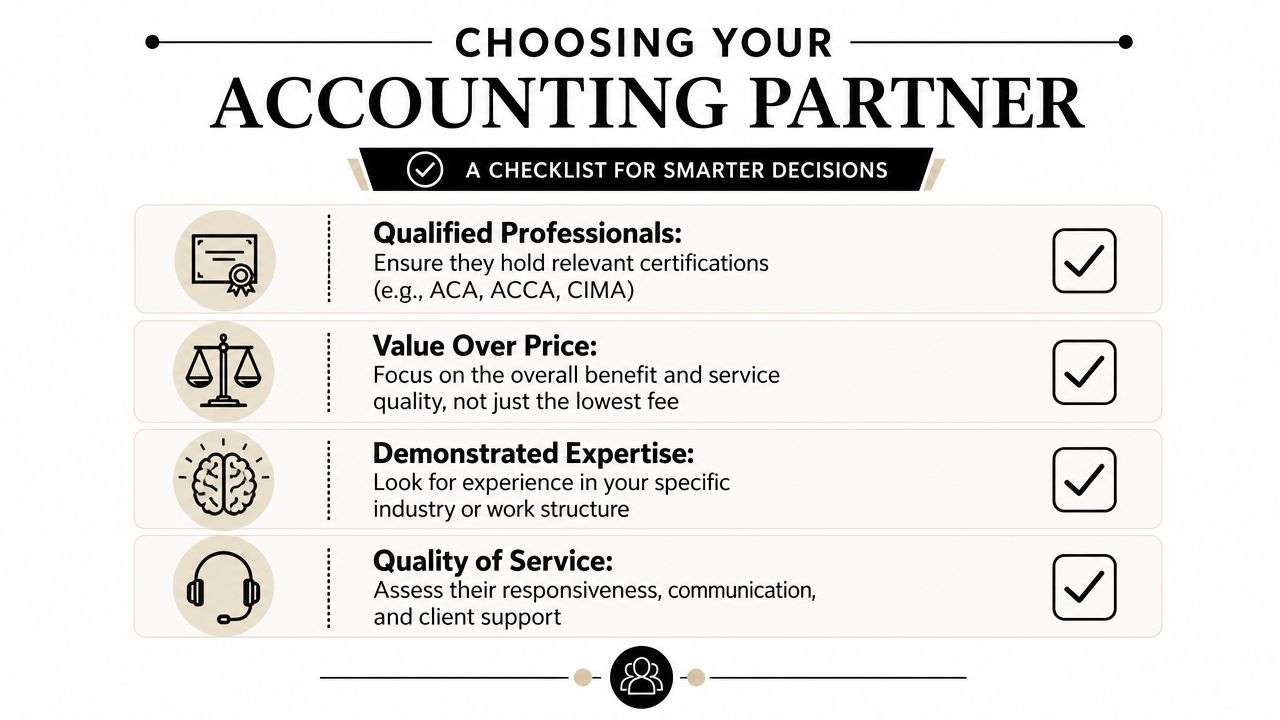
Then use a practical filter:
- Are they properly qualified: look for ACA, ACCA, or CIMA credentials, or clear supervision by someone who is.
- Do they advise contractors: ask how they handle outside IR35 limited companies, inside IR35 umbrella workers, and mid-year structure changes.
- What work is covered each month: bookkeeping, VAT returns, payroll, confirmation statement, annual accounts, corporation tax, self assessment, and support for dividend planning should be spelled out.
- What triggers extra fees: ask about company closure, restoration, CIS issues, tax investigations, IR35 contract reviews, and ad hoc calls.
- How do they answer questions: quick, direct answers matter when you need to decide whether to invoice through your company or accept umbrella payroll for the next contract.
- What software and process do they use: the software matters less than whether records, approvals, and filings happen on time without you chasing them.
A useful extra perspective is hearing how professionals describe the accountant-client relationship in practice. This short video gives a helpful overview of what to look for:
Red flags that should stop the conversation
The first red flag is a quote that looks tidy but hides the actual scope. I regularly see “full service” used for packages that exclude bookkeeping clean-up, payroll changes, amended returns, and any meaningful tax advice. That is how a cheap quote turns expensive.
Other warning signs are straightforward:
- They lead with take-home pay claims: compliant accountants talk about tax treatment, risk, and reporting duties, not inflated net income promises.
- They are vague on IR35: a contractor accountant should explain what changes when a role moves inside IR35, and what does not.
- They push a monthly package for umbrella-only work without justification: many umbrella contractors do not need ongoing company accounts support.
- They cannot explain their extra charges clearly: if every unusual task becomes “we'll see later,” budgeting will be difficult.
- They communicate poorly before you sign: slow replies at sales stage usually mean slower replies when a filing deadline is close.
What good value actually looks like
Good value is a fee that matches your structure and the decisions you need to make.
For an outside IR35 limited company contractor, paying more for an accountant who reviews profit extraction, keeps VAT straight, and deals with year-end properly can save money and reduce risk. For an umbrella contractor, paying for that same level of monthly service often makes no sense. The better option may be a low-cost tax return service or one-off advice when changing structure.
The hardest cases sit in the middle. A contractor spends six months outside IR35 through a company, then moves inside IR35 under an umbrella. That is where the cheapest accountant often falls short. You need clear advice on payroll, dividends, VAT position, possible dormancy, and whether keeping the company open still stacks up. The hourly rate matters less than whether the accountant can handle that change without confusion or missed obligations.
Ask one direct question before you appoint anyone. “If my next contract changes my IR35 position, what work would you do, what would it cost, and what would I need to do differently?”
If the answer is specific, commercial, and easy to follow, you are getting close. If you want a benchmark for that kind of contractor-focused service, compare quotes against firms listed in this guide to the best accountant for limited company contractors.
Conclusion Making the Right Financial Choice
Good decisions on accountant fees start with one honest assessment. What kind of contractor setup are you running?
If you work through a limited company outside IR35, paying for structured, recurring support usually makes sense. If you're inside IR35 and using an umbrella, the right answer may be to avoid separate accountancy costs for that income altogether. If your position changes during the year, the best value often comes from clear advice at the moment of change, not from the cheapest standing fee.
The headline monthly price only tells part of the story. The actual test is whether the quote covers the work your structure creates, whether it reduces compliance risk, and whether the accountant can support you when your circumstances shift.
Transparent scope, contractor-specific experience, and clear communication matter more than a low number on the first page.
If the admin burden of a limited company no longer stacks up for your contracts, especially for inside IR35 work, an umbrella route can be simpler and easier to budget.
If you're weighing up umbrella versus limited company options, Umbrella Company helps contractors compare trusted providers and find a setup that fits their pay, role, and IR35 position.


